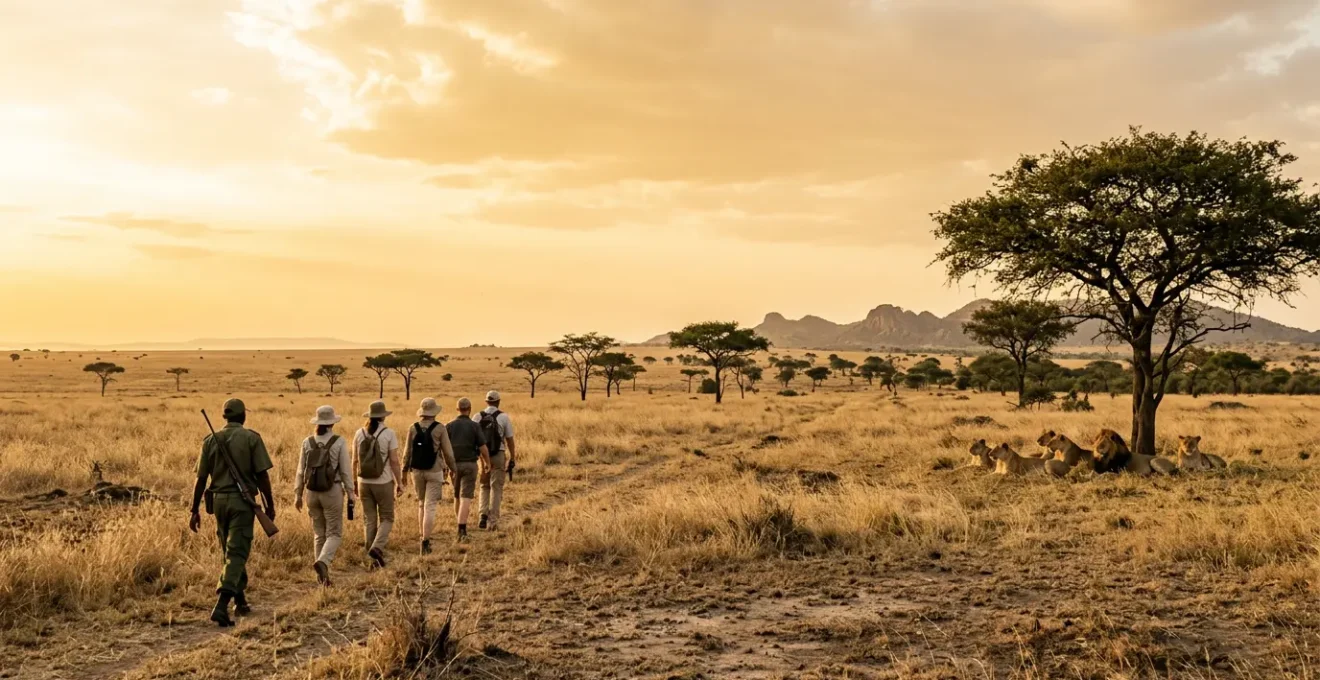
Most think a walking safari is just a slow game drive. They’re wrong. It’s not about spotting animals; it’s a psychological reset. It’s about shedding your modern self and re-engaging the primal senses that tell you whether you are the hunter or the hunted. The goal isn’t to see a lion, but to understand your place in its world.
The engine cuts. The familiar rumble of the Land Rover is replaced by a silence so profound it has weight. You step out, and your boots touch the red African earth. In that moment, you cease to be a spectator. The metal cage is gone. You are no longer looking at a screen or through a window; you are in the frame. The air, once just a temperature, now carries information—the scent of wild sage, the distant alarm call of a francolin, the unsettling stillness that precedes a predator.
Most come to Africa to « see » the Big Five, ticking them off a list from the detached safety of a vehicle. That is observation. A walking safari is something else entirely. It is a primal recalibration. It’s an exercise in humility, a lesson in how to occupy a space you do not own. It’s about understanding that the same senses you use to navigate a city street are useless here. You must awaken older, dormant instincts to survive and truly experience the bush.
This isn’t about chasing thrills, but about respecting them. It’s about understanding the intricate rules of an ancient system where you are no longer at the top of the food chain. This guide will walk you through the sensory shifts, the unwritten laws, and the mental discipline required to move through lion country on your own two feet. We’ll explore why the rules are not just for safety, but for transforming your perception of the wild.
In the following sections, we will deconstruct the experience, from the way you move to the way you think. You will learn the language of the landscape, understand the tools of the trade, and discover how the smallest details reveal the biggest truths about the African bush.
Summary: The visceral reality of a walking safari
- How to Approach a Giraffe on Foot Without Spooking It?
- Why Does the Guide Carry a .458 Rifle and When Is It Used?
- Why Is Wearing Earth Tones Mandatory for Walking Safaris?
- How Does Your Sense of Smell Change After 2 Hours of Walking?
- Why Are Children Under 12/16 Banned from Walking Safaris?
- Single File and Silence: Why Are the Walking Rules So Strict?
- The Mistake That Provokes Buffalo Charges in 90% of Self-Drive Incidents
- Why Is a Walking Safari the Best Way to Learn About Termites and Dung?
How to Approach a Giraffe on Foot Without Spooking It?
Approaching any animal on foot, even a « gentle giant » like a giraffe, is a complex dance of respect and physics. The first rule is distance. We maintain a bubble of at least 100 meters, but this number is meaningless without understanding the variables. The most crucial factor is the wind. You must stay downwind, ensuring your human scent—a smell of unfamiliarity and potential danger—is carried away from their sensitive nostrils. This isn’t just a tip; it’s the fundamental first step in making yourself a non-threat.
Next, we consider our profile. A scattered group of people looks like a pack of predators spreading out for an attack. By walking in a tight, single file, we present the thinnest possible profile, appearing as one single, non-threatening entity. We move with slow, deliberate, and fluid motions. Any sudden gesture, any jerky movement, can shatter the calm. We are aiming to be as boring and predictable as a termite mound.
The final layer is reading the landscape’s language. You don’t just watch the giraffe; you watch its companions. The oxpecker birds on its back are your early warning system. If they fall silent and stare in one direction, you listen. You watch the giraffe’s ears. Are they twitching nervously or swiveling calmly? Is its tail swishing lazily or held stiff with alarm? This is not animal watching; it is a dialogue in body language. Success isn’t getting close; it’s being allowed to share the same space without causing a ripple of fear.
Why Does the Guide Carry a .458 Rifle and When Is It Used?
The rifle is the most misunderstood piece of equipment on a walking safari. It is not a tool for hunting. It is not a symbol of aggression. It is a symbol of absolute responsibility and, in its own way, a symbol of failure. In countries with a long history of walking safaris like Zambia and Zimbabwe, guides are legally required to carry a heavy-caliber rifle, typically a .375 H&H or larger. This comes only after months, sometimes years, of rigorous training and certification in firearm proficiency and ethical conduct.
Its purpose is singular: to be a last resort. The primary safety tools are a guide’s brain, experience, and voice. De-escalation is the law of the land. A situation is managed first by knowledge—not getting into a bad position to begin with. If a confrontation is unavoidable, it’s managed by changing the group’s formation, using calm but firm vocal commands, and as a final step before the ultimate one, a warning shot. The goal is always to defuse, not to destroy.
To fire the weapon at an animal is the last option, a devastating admission that all other skills and experience have failed. It is an outcome that every true guide spends their entire career working to avoid. As the Walking Safari Training Manual states with sobering clarity, the philosophy is one of profound respect for life. As one guide training protocol puts it, « Firing a weapon is the last option, and many guides will tell you that discharging a rifle, even once, can end their guiding career depending on the context. » The weight of the rifle in your hands is a constant physical reminder of the weight of the lives—both human and animal—that are your responsibility.
Why Is Wearing Earth Tones Mandatory for Walking Safaris?
The rule about wearing khaki, beige, or olive green isn’t about fashion; it’s about physics and animal psychology. Most African wildlife, particularly mammals, don’t see color the way we do. They are, however, extremely sensitive to contrast and brightness. In a landscape of muted greens, browns, and grays, a bright white or vibrant pink t-shirt doesn’t just look out of place; it screams « unnatural » and « alien. » It’s a high-contrast beacon that triggers an immediate flight-or-fight response in prey and predator alike. You cease to be part of the landscape and become an intruder.
Certain colors are specifically forbidden for even more precise reasons. Blue and black, for instance, are associated with danger signals in the bush. Studies on animal vision show that these colors can be perceived as threats. They mimic the aggressive coloration of the honey badger or, more annoyingly, the shimmering bodies of biting tsetse flies, which are attracted to dark, moving objects. By wearing earth tones, you are not hiding. You are engaging in a form of visual communication, signaling to the environment that you are a low-threat entity, part of the scenery, not an invader disrupting it.
This choice allows for a deeper immersion. When animals are not nervous about your presence, you witness natural behavior. The goal is to blend in so seamlessly that the bush carries on with its business as if you were not there. It’s the highest compliment a walker can receive. Your clothing is the first step in this process of disappearing.
Your Essential Walking Safari Dress Code
- Wear khaki, beige, olive, or brown clothing exclusively.
- Avoid all blue and black garments, as they are associated with threat signals in the bush.
- Remove any bright or reflective accessories, including watches and shiny jewelry.
- Choose matte fabrics over synthetic materials that can have a sheen.
- Ensure all clothing fits well to minimize the noise of swishing fabric as you walk.
How Does Your Sense of Smell Change After 2 Hours of Walking?
The first hour on foot is a sensory assault. The smell of your own sunscreen, the dust kicked up by your boots, the faint scent of deodorant from the person in front. Your nose is overwhelmed by the familiar and the mundane. But then, something shifts. Around the two-hour mark, after you’ve sweated a bit and the sun has baked the dust into the ground, your senses recalibrate. We call it the ‘scent acuity reset.’
It starts subtly. You begin to distinguish between different types of dust. Then, you catch a new scent on the breeze—a wild, musky odor. It’s the smell of a herd of elephants that passed through an hour ago. A little later, a sharp, pungent tang hits your nostrils; a predator’s territory marker on a bush. You are no longer just smelling ‘the outdoors’; you are reading information. Your nose, a dull instrument in the modern world, becomes a vital tracking tool. The faint, coppery scent of a fresh kill on the wind can become a more reliable way to locate lions than a distant roar.
This is when the primal recalibration truly begins. You start to understand the world as other animals do: through scent. The memory of crushing wild sage under your boot, releasing its sharp, clean aroma, becomes more vivid and lasting than any photograph you could take. You’re not just walking through the landscape; you are inhaling it, processing it, and becoming part of its complex olfactory conversation. This is a level of immersion a vehicle can never offer.
Why Are Children Under 12/16 Banned from Walking Safaris?
The age restriction on walking safaris—typically 12 or 16 depending on the region and operator—is often misunderstood as a simple matter of physical stamina or maturity. It is far more fundamental. The safety and success of a bush walk rely entirely on the group’s ability to function as a single, predictable, and disciplined unit. This is not an environment for individuality; it is an exercise in collective cohesion. When faced with a potentially dangerous animal, the group must instantly and silently obey the guide’s commands, often transmitted through a simple hand signal.
As the Professional Safari Guide Association protocols state, » A walking safari’s safety relies on the group’s ability to act as a single, predictable unit that instantly obeys the guide’s silent commands. Children lack the impulse control and sustained focus required for this. » A sudden shout, a quick, fidgety movement, or a moment of distraction can break the unified facade that keeps the group safe. It’s not about being brave; it’s about having the deep-seated impulse control that often only comes with age and experience.
This principle doesn’t just apply to children. The key requirement is predictable and calm behavior. Any action that fragments the group’s single-entity appearance can be misinterpreted by wildlife. The rule isn’t about discrimination; it’s a stark, pragmatic acknowledgement of human psychology and the non-negotiable demands of moving through a high-stakes environment. The group is a living organism, and its survival depends on every cell working in perfect, silent harmony.
Single File and Silence: Why Are the Walking Rules So Strict?
The two cardinal rules of a walking safari—maintain single file and absolute silence—are not arbitrary drills for discipline. They are sophisticated techniques designed to manipulate the psychology of potential predators. From a lion’s perspective, a scattered group of six humans is six individual, vulnerable targets. It looks like prey. It triggers predatory calculations. However, research into animal behavior has shown that a single-file line of people, moving fluidly, is perceived very differently. It is seen as one large, unified, and unusually shaped organism.
As explained by researchers, this single entity is confusing to a predator. It doesn’t fit into the neat categories of ‘threat’ or ‘food.’ Its size is intimidating, its shape is unfamiliar, and its behavior is unpredictable. By staying in line, we are using the predator’s own perceptual framework against it. Breaking the line is the most dangerous thing a guest can do, as it shatters this illusion and turns the ‘large, weird animal’ back into a collection of small, edible ones. This is why, as guides, we insist that you follow the exact footsteps of the person in front of you.
The rule of silence serves two critical purposes. First, it prevents nervous, high-pitched chatter, which can mimic the sounds of a distressed or injured animal—a dinner bell for any predator in the vicinity. Second, and more importantly, it keeps our own senses sharp. Silence allows you to hear a twig snap 50 yards away. It allows you to hear the guide’s whispered instruction. It allows you to hear your own heart beating, a primal rhythm that connects you directly to the tension and life of the bush. Silence is not an absence of sound; it is the ultimate tool of awareness.
The Mistake That Provokes Buffalo Charges in 90% of Self-Drive Incidents
The Cape buffalo has a reputation, and for good reason. But most incidents, particularly those involving self-drive tourists in vehicles, are not born of aggression but of a fundamental human error: projecting human emotion onto a wild animal. A driver sees a lone buffalo bull, often an old male pushed out of the herd. They interpret his solitude as sadness or loneliness. They inch the car closer, trying to get a better photo, thinking he is a placid creature. This is a catastrophic misreading.
In the words of one safari safety expert, » The real mistake is projecting human emotion onto a wild animal. A lone bull, often old and injured, is hyper-defensive and sees everything as a potential threat. » That old bull is not lonely; he is highly stressed, likely in pain, and has learned through a lifetime of experience that everything is a danger. He sees an approaching vehicle not as a curious tourist, but as another challenge in a life full of them. He is not charging out of malice; he is charging out of a deep-seated, defensive instinct. He is telling you, in the only language he knows, to back off.
On foot, this understanding is magnified a hundredfold. We do not see a « grumpy » buffalo. We see a powerful, unpredictable animal that deserves an enormous amount of space and respect. We read his body language: the way he holds his head, the flick of his ears, the stare that tells you he knows you’re there. The mistake is not in being near a buffalo; the mistake is in forgetting what it is, and treating it like something it’s not. Respecting its nature, not assigning it a human one, is the key to co-existence.
Key Takeaways
- A walking safari is a psychological and sensory recalibration, not just a tour.
- Safety is based on group discipline and manipulating predator perception, not just carrying a rifle.
- Your senses, especially smell and hearing, will become your most important tools for understanding the environment.
Why Is a Walking Safari the Best Way to Learn About Termites and Dung?
Between the heart-pounding moments of tracking a lion or giving a herd of elephants a wide berth, a walking safari unfolds into something else: a micro-safari. It’s in these moments of perceived calm that the true genius of the ecosystem reveals itself. From a vehicle, a termite mound is a dirt pile. On foot, your guide can show you it is the architectural lungs of the savanna, a marvel of natural engineering with a complex ventilation system that regulates temperature and humidity for the colony within.
Animal dung, ignored from a car, becomes the ‘daily newspaper of the bush’. A guide can show you how to read it. The contents reveal what an animal ate. The moisture level tells you how recently it passed—minutes, hours, or days ago. The shape and consistency can even reveal signs of stress or illness. You learn to see the landscape not as a static backdrop, but as a dynamic network of stories and interactions. This intellectual engagement is a crucial part of the experience.
This focus on the small things is not a distraction from the big game; it is the necessary counterbalance. It grounds you. It hones your powers of observation and keeps your mind alert and focused. The deep curiosity sparked by understanding the role of a termite mound serves to calm the nervous system, making you a more stable and reliable member of the group. This grounding makes the subsequent encounter with a predator even more impactful, creating a powerful contrast between quiet wonder and high-stakes alertness. You learn that in the bush, everything is connected, and nothing is insignificant.
Frequently asked questions about Adrenaline on Foot: What It Feels Like to Walk in Lion Country?
Why focus on small details during a dangerous walking safari?
The micro-observations between wildlife encounters serve to calm nerves, deepen appreciation, and maintain the focused awareness essential for safety.
What can animal droppings tell a trained guide?
Dung analysis reveals diet, health status, stress levels, and timing – guides can determine if an animal passed minutes or hours ago.
How do termite mounds contribute to the ecosystem?
Termite mounds act as the ‘architectural lungs’ of the savanna with sophisticated ventilation systems that regulate temperature and humidity.