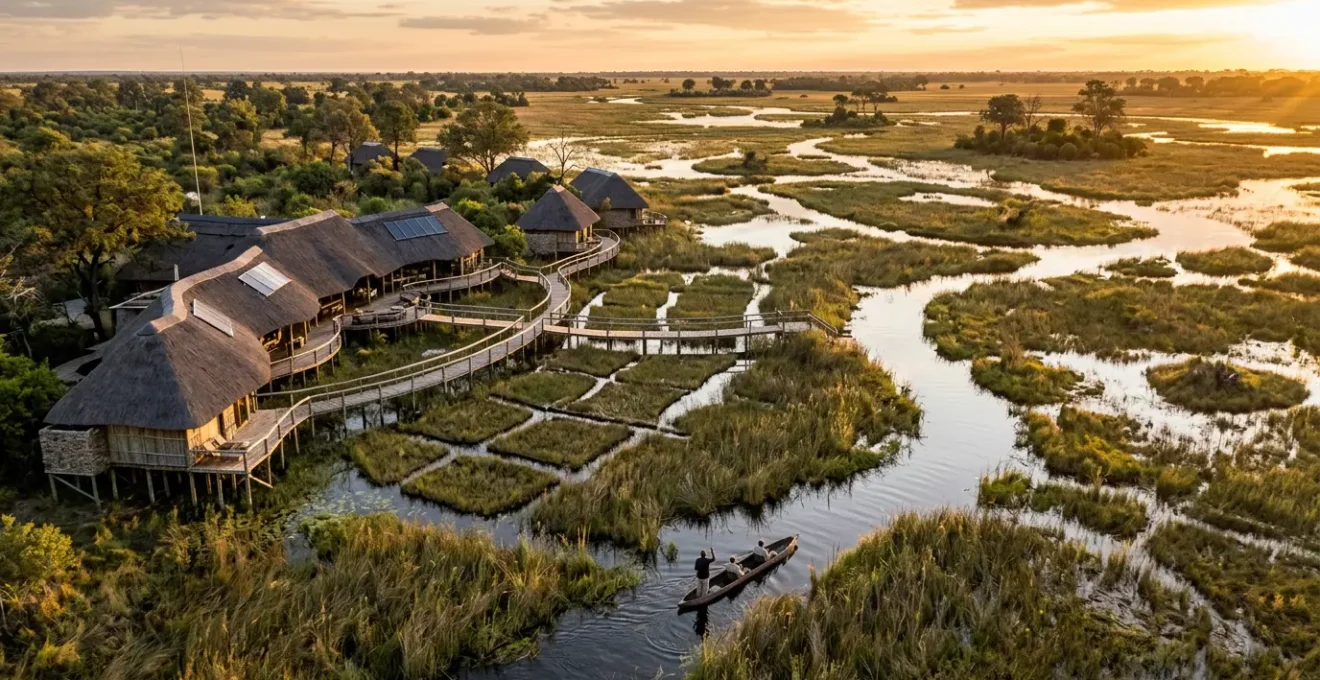
Botswana’s eco-certification is more than a label; it’s a verifiable framework of over 240 standards that a discerning traveler can use for their own audit.
- Verifiable criteria focus on operational integrity in waste, water, and energy management, not just policy.
- Genuine community equity and benefit sharing are key indicators that separate true eco-lodges from superficial ones.
Recommendation: Use the verification mindset and checklist in this guide to move beyond marketing and assess a lodge’s authentic commitment to conservation and community.
For the research-oriented traveler, the desire to support genuine conservation efforts in Botswana is often met with a confusing array of « eco-friendly » claims. The term « eco-lodge » is used so broadly that it risks becoming meaningless, making it difficult to distinguish between authentic sustainable practices and sophisticated greenwashing. Many guides simply advise travelers to look for a certification label, but this passive approach fails to empower the traveler to understand what that label truly represents.
The common assumption is that certification is a simple pass/fail system. However, the reality, particularly in a world-class system like Botswana’s, is far more nuanced. It’s a framework built on hundreds of measurable performance standards. To truly support sustainable tourism, one must look beyond the certificate on the wall and begin to understand the operational integrity it’s meant to guarantee. The real questions are not *if* a lodge is certified, but *how* it meets the specific, rigorous criteria demanded by that certification.
This guide departs from conventional advice. Instead of just accepting the label, we will adopt the mindset of a sustainable tourism auditor. We will dissect the Botswana Ecotourism Certification System to reveal the concrete, verifiable standards that underpin it. This is not about memorizing rules, but about learning how to « read » a lodge’s operations—from its waste disposal chain to its community partnerships—to verify its commitment. This framework will equip you to ask the right questions and identify the tangible proof of sustainability, ensuring your travel investment supports the businesses that are genuinely safeguarding Botswana’s pristine wilderness.
This article provides a verification framework, breaking down the key pillars of the certification system. By understanding how the best lodges handle community ownership, waste, water, and conservation, you can learn to spot true sustainability.
Summary: A Verification Framework for Botswana’s Ecotourism
- How Do Communities Own Lodges and Lease Them to Operators?
- How Is Glass Waste Recycled in Maun into Construction Bricks?
- What Are the Biological Filtration Standards for Lodges in the Wetland?
- Can You Offset Your Safari Flights Directly with Local Reforestation Projects?
- How Do « Kids in the Bush » Programs Create Future Conservationists?
- How Does Keeping Tourist Numbers Low Save the Ecosystem from Collapse?
- Where Does the Waste Water Go in the Middle of the Delta?
- How to Tell if an « Eco-Lodge » Is Truly Sustainable or Just Greenwashing?
How Do Communities Own Lodges and Lease Them to Operators?
A primary verification criterion for any legitimate eco-tourism operation is its relationship with local communities. In Botswana, this is often structured through a system known as Community-Based Natural Resource Management (CBNRM). This isn’t just about hiring local staff; it’s a formal economic model where communities, through established trusts, hold legal rights to the land and its resources. They then lease the tourism rights to professional safari operators, creating a direct revenue stream that is independent of employment.
From an auditor’s perspective, this model’s success hinges on transparent governance and equitable benefit sharing. The goal is for the economic advantages of conservation to outweigh the costs for the community. While tourism’s overall economic impact is significant, with one study showing it represents 10.9% of total employment and over 10.3% of GDP, the effectiveness of CBNRM at the local level requires scrutiny. For a traveler, verifying this means asking how the lodge’s lease agreement is structured and what percentage of revenue is directed to the community trust.
It’s important to approach this with a critical eye. Decades of CBNRM implementation have produced mixed results. Some partnerships are exemplary models of sustainable development, while others have faced challenges with governance and benefit distribution. A truly sustainable operator will be transparent about its community trust agreement, the projects funded by it, and the mechanisms for accountability. This level of community integration is a powerful indicator that a lodge’s presence provides tangible, long-term value that extends beyond its property lines.
How Is Glass Waste Recycled in Maun into Construction Bricks?
In the remote and ecologically sensitive areas of Botswana, waste management presents a colossal logistical challenge. For a lodge to be certified, it must demonstrate a robust system for minimizing and processing its waste, a concept known as operational integrity. Simply transporting waste to a landfill is not a sustainable solution. Instead, leading operators are pioneering circular economy models, turning waste into a resource. One of the most innovative examples of this is found in Maun, the gateway to the Okavango Delta.
Here, a local initiative collects glass waste from safari camps—primarily wine and spirit bottles—and crushes it to be used as an aggregate in the production of high-quality construction bricks. This not only diverts thousands of tons of glass from inadequate landfill sites but also creates a local, sustainable building material. An auditor would verify a lodge’s participation in this program by checking its waste manifests and supply chain records for proof of partnership with the recycling facility.
color variety > environmental context. »/>
This principle of a « waste-to-resource » chain of custody extends beyond glass. The most committed lodges implement comprehensive strategies to tackle all forms of waste. For instance, some safari operators have installed advanced on-site water filtration systems to provide safe, clean drinking water for guests and staff, a measure that can lead to eliminating approximately 9000 plastic bottles annually per camp. These quantifiable impact metrics are precisely the kind of evidence a research-oriented traveler should look for as proof of a genuine commitment.
What Are the Biological Filtration Standards for Lodges in the Wetland?
The Botswana Ecotourism Certification System is not a vague set of guidelines; it is a meticulous, standard-based framework designed for verification. At its core, it is a tool for measurement. This is most evident in its stringent requirements for water management, especially for lodges operating within the pristine Okavango Delta wetland. The system’s credibility comes from its depth, where the certification system evaluates lodges against 240 performance standards covering everything from energy consumption to staff welfare.
For wastewater, lodges cannot simply use standard septic tanks, which risk leaching contaminants into the delicate ecosystem. Instead, high-level certification requires the implementation of above-ground biological filtration systems. These self-contained units use a combination of bacteria, reeds, and sand filters to process « black » and « grey » water until it is clean enough to be safely returned to the environment. An auditor verifies this not by looking at a blueprint, but by inspecting the functioning system, checking water quality test results, and ensuring maintenance logs are up to date. The system’s rigor is recognized globally, as noted by its high ranking among international schemes.
Named among the top 20 sustainable tourism certification schemes in the world by the Tourism and Greenwash Report.
– Tourism and Greenwash Report, Matriarch Africa
This focus on measurable, science-based standards is what gives the certification its authority. It moves sustainability from a marketing concept to an engineering and biological reality. For a traveler, knowing that a lodge meets these specific filtration standards is a far more powerful indicator of its « eco » credentials than any marketing brochure.
Can You Offset Your Safari Flights Directly with Local Reforestation Projects?
The question of carbon offsetting for international flights is a valid concern for any environmentally conscious traveler. However, in the context of Botswana’s ecosystem, the answer is more complex than a simple « yes » or « no. » While various international schemes exist for purchasing carbon credits, the concept of offsetting flights through *local reforestation projects* in Botswana is not a standard or widely available mechanism. From an auditor’s perspective, this is a potential greenwashing red flag.
The ecological priority in Botswana is the preservation of its existing, ancient ecosystems—savannas, wetlands, and grasslands—not large-scale tree planting, which can be ecologically inappropriate in these biomes. The country’s conservation model is predicated on low-density tourism that funds the protection of vast, intact wilderness areas. Therefore, a lodge’s most significant contribution to global carbon balance is through its direct funding of habitat preservation, which keeps massive carbon sinks healthy and functioning. A claim of a local « tree-planting » offset program should be met with skepticism and require verification of its scientific validity and accreditation.
Instead of seeking a direct offset, a more meaningful approach is to verify how a lodge contributes to broader conservation initiatives. These may include funding anti-poaching units, supporting biodiversity research like the National Geographic Okavango Wilderness Project, or contributing to the management of the vast protected land networks. The most impactful investment a lodge can make is in the in-situ conservation that is the hallmark of Botswana’s strategy. This protects far more carbon and biodiversity than a small, unverified tree-planting project ever could.
How Do « Kids in the Bush » Programs Create Future Conservationists?
A truly sustainable tourism model recognizes that its responsibility extends to future generations. The highest-rated eco-lodges in Botswana demonstrate this commitment through community engagement programs that focus on environmental education. These initiatives, often called « Kids in the Bush, » are a critical component of a lodge’s social responsibility portfolio and a powerful long-term conservation strategy. Their goal is to foster a deep appreciation for the environment among local children, who will one day become the custodians of this natural heritage.
These are not just simple field trips. From an auditor’s viewpoint, a legitimate program has a structured curriculum. It involves immersive experiences where children from nearby villages spend time in the safari camps, learning from professional guides about wildlife, ecology, and conservation principles. The aim is to create a positive association with the wilderness and demonstrate that conservation can be a viable and valuable career path. This is a direct investment in building a local constituency for conservation.
Some safari companies have realised that children are the future of conservation in Botswana, and the rest of Africa, and have implemented various children’s programmes to teach the kids the value of conserving the environment.
– Botswana Wildlife Conservation, Botswana.co.za
When assessing a lodge, a traveler can verify the authenticity of such programs by asking about their frequency, the number of children involved, and the long-term engagement strategy. A genuine program is a consistent, ongoing partnership with local schools, not a one-off photo opportunity. It represents a lodge’s understanding that the most enduring legacy is not just protecting the land today, but inspiring the people who will protect it tomorrow.
educational context > environmental setting. »/>
How Does Keeping Tourist Numbers Low Save the Ecosystem from Collapse?
Botswana’s entire conservation philosophy is built on a counter-intuitive economic model: « high-value, low-volume. » This strategy is the single most important factor protecting its wilderness from the pressures of mass tourism. Instead of maximizing the number of visitors, the government and private conservancies strictly limit the number of lodges, vehicles, and guests allowed in any given area. This isn’t just a marketing slogan; it’s an enforced policy with profound ecological benefits.
The foundation of this model is the immense scale of protected land. With a remarkable 37% of its land protected for conservation through a network of national parks, game reserves, and community concessions, Botswana has the space to implement this strategy effectively. By limiting infrastructure and human presence, the ecosystem is allowed to function with minimal disturbance. This prevents habitat fragmentation, reduces stress on wildlife, and preserves the sense of true wilderness that high-end travelers seek. From an audit perspective, this is sustainability at a macro, national-policy level.
Case Study: Low-Density Policy in Practice
The « high-value, low-volume » policy has tangible operational consequences. In both national parks and private concessions, lodges are allocated vast, exclusive-use areas for a very small number of guests. This results in minimal road networks, limiting the impact of safari vehicles on the terrain. Furthermore, it encourages practices like the use of seasonal camps in sensitive areas, which are completely dismantled and removed during the rainy season, allowing the land to fully recover. This approach ensures that the ecological carrying capacity of the land is never exceeded.
For a traveler, this policy translates directly into a higher quality and more exclusive experience—fewer vehicles at a wildlife sighting and an unspoiled landscape. When verifying a lodge’s claims, understanding its location within this policy framework is crucial. A lodge in a private concession with a low guest-to-land ratio is, by design, operating under a more sustainable model than one in a more crowded, less-regulated area. This low-impact approach is the ultimate expression of the country’s commitment to preserving its natural capital.
Where Does the Waste Water Go in the Middle of the Delta?
For any operation in an environment as pure as the Okavango Delta, the management of its complete resource cycle—especially water—is a critical test of its sustainability. The question « where does the waste go? » is not just practical, it is the central question of an environmental audit. The certification system recognizes this by creating a tiered structure that holds different operations to increasingly rigorous standards of environmental performance. This ensures a clear pathway for improvement and a transparent benchmark for assessment.
The system is generally broken down into three levels: Green, Green+, and Ecotourism. While an entry-level « Green » certification requires compliant environmental management systems, the highest « Ecotourism » tier demands that a lodge meets all principles of sustainability, including deep community involvement and proactive nature conservation. For waste and water, this means demonstrating a closed-loop or near-closed-loop system. The ultimate goal is to minimize outputs to an absolute minimum, a standard achieved by only the most elite operators. For example, the fully-certified Chobe Game Lodge has set a benchmark by demonstrating that only 5% of its total waste goes to landfill, a verifiable and world-class impact metric.
This tiered system provides a clear framework for travelers. Instead of a simple yes/no, it allows for a nuanced understanding of a lodge’s commitment. The following table, based on the Botswana Ecotourism Certification System, outlines the different levels of compliance.
| Certification Level | Key Requirements | Focus Areas |
|---|---|---|
| Green | Basic entry level, mandatory criteria met | Environmental management systems established |
| Green+ | Additional requirements, higher performance standards | Enhanced environmental practices and resource efficiency |
| Ecotourism | All ecotourism principles met comprehensively | Community involvement, nature conservation, and environmental interpretation |
When choosing a lodge, asking for its specific certification level provides immediate insight into its operational standards. A lodge at the « Ecotourism » level has provided verifiable proof of its excellence in managing its entire resource and waste chain.
Key Takeaways
- True sustainability is verified through operational integrity, not marketing claims. Focus on waste, water, and energy systems.
- Meaningful community partnership, involving equity and direct revenue sharing, is a non-negotiable sign of a legitimate eco-lodge.
- The best lodges can provide quantifiable impact metrics, such as the percentage of waste recycled or water saved, as proof of their commitment.
How to Tell if an « Eco-Lodge » Is Truly Sustainable or Just Greenwashing?
Ultimately, distinguishing a genuinely sustainable lodge from one engaged in greenwashing comes down to applying a consistent verification framework. The Botswana National Ecotourism Strategy itself provides the guiding principles for this audit. It’s not about looking for a single « eco » feature, but assessing the holistic integration of these principles into the lodge’s entire operation. A truly sustainable lodge doesn’t just « do » eco-friendly things; its very business model is built on a foundation of ecological and social responsibility.
The certification process is designed to be rigorous and ongoing, not a one-time award. As the Botswana Tourism Organisation states, certification is only granted for two-year periods, with committee meetings held at least twice a year to review standards and compliance. This ensures that certified lodges are held accountable and must demonstrate continuous improvement. For the discerning traveler, this means that a current, valid certificate is a strong starting point for trust.
However, the most powerful tool is your own informed curiosity. By using the principles of the national strategy as your guide, you can create a personal audit checklist to assess any lodge, certified or not. This moves you from a passive consumer to an active participant in promoting genuine sustainability. Look for tangible evidence across all key areas, ask specific questions, and don’t be satisfied with vague answers. The checklist below synthesizes these principles into an actionable tool.
Your 5-Point Audit Checklist for Spotting True Sustainability
- Impact Minimization: Ask for specific data. What percentage of your waste is recycled? What is your energy source? Can you show me your water treatment facility?
- Community Benefits: Go beyond employment. How does the lodge’s revenue directly benefit the broader community? Is there a formal trust or lease agreement in place?
- Conservation Re-investment: Inquire about their conservation levy. What specific anti-poaching, research, or habitat restoration projects does it fund?
- Education and Interpretation: Evaluate the quality of the guiding. Do guides offer deep ecological insights, or is it a superficial wildlife-spotting tour? Is there engagement with local communities?
- Quality of Experience: Does the experience feel authentic and respectful of the environment, or commercialized? Is the low-density principle evident in your daily activities?
By applying this auditor’s mindset, you transform your role. You are no longer just a guest; you are a stakeholder in the conservation economy, using your purchasing power to reward integrity and drive the industry toward a more sustainable future.
Apply this auditor’s mindset on your next journey and book with confidence, knowing your travel choices are supporting the genuine conservation of one of the world’s last great wildernesses.