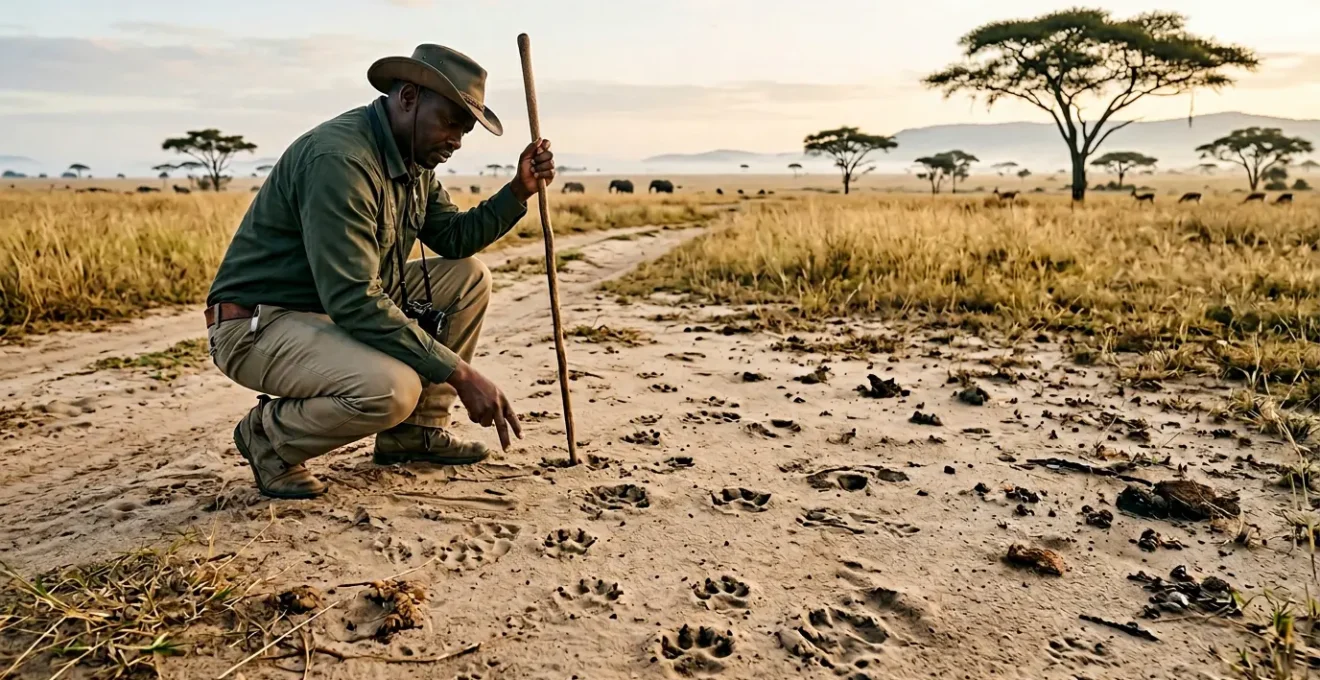
Most safaris feel like watching a film from a car seat, focused only on the big stars. The problem is you miss the entire plot. A walking safari transforms you from a passive viewer into an active reader of the bush’s living newspaper. This guide moves beyond simply spotting animals to teach you the forensic skills to interpret every track, dropping, and broken branch, uncovering the rich, hidden stories of the wild.
The rumble of the 4×4 engine is a familiar sound on safari. You cover vast distances, ticking off sightings of lions, elephants, and leopards. It’s thrilling, yet for the active traveler, a sense of detachment can creep in. You are an observer, separated from the wild by steel and glass. This experience, while popular, is only one chapter of the story. In fact, with industry data revealing a 12% increase in safari search trends in 2024, more people are seeking a deeper connection.
Many believe a walking safari is simply about « getting closer to nature. » While true, this misses the point. It’s not about proximity; it’s about literacy. The true purpose of leaving the vehicle behind is to learn the very language of the landscape. It’s an exercise in what can only be called forensic ecology, where you stop just looking and start seeing, hearing, and feeling the intricate details that tell the story of the last 24 hours.
But what if the real magic of a safari isn’t in the roar of a lion, but in understanding how fresh its track is by the coolness of the sand? This guide is your first lesson. We will trade the wide-angle view of the jeep for the macro-lens of the human senses. You will learn how to decipher the clues left behind, understand the strict rules that keep you safe, and feel the primal thrill of being a part of the landscape, not just a visitor to it.
This article will guide you through the essential skills and sensations of a walking safari. From the discipline of walking in single file to the adrenaline of being on foot in predator country, you will discover how to read the bush like a seasoned guide.
Summary: Decoding the Stories of the Bush on Foot
- Single File and Silence: Why Are the Walking Rules So Strict?
- Impala vs. Springbok Droppings: Can You Tell the Difference?
- How to Tell if an Elephant Passed By 1 Hour or 1 Day Ago by Breaking a Twig?
- What Happens if You Bump into a Buffalo While on Foot?
- How Fit Do You Need to Be for a 4-Hour Morning Bush Walk?
- How to Tell How Fresh a Lion Track Is by Touching the Sand?
- Why Is Wearing Earth Tones Mandatory for Walking Safaris?
- Adrenaline on Foot: What It Feels Like to Walk in Lion Country?
Single File and Silence: Why Are the Walking Rules So Strict?
The first lesson of a walking safari has nothing to do with animals and everything to do with discipline. You will be told to walk in single file, never overtake the guide, and maintain almost complete silence. These aren’t suggestions; they are cardinal rules grounded in decades of experience. The single file formation is crucial for safety and stealth. To an animal, a scattered group of humans looks like a pack of predators fanning out for an attack. A single, unified shape is less threatening and easier for your guide to control. It presents one cohesive silhouette, not multiple, unpredictable targets.
Silence serves a dual purpose. First, it allows your own senses to awaken. You begin to hear the crunch of your own boots, the alarm call of a francolin, or the distant rustle that signals movement. Second, it prevents you from startling wildlife. Your voice carries, and to an animal fine-tuned to survive, an unfamiliar sound means danger. By staying quiet, you increase your chances of observing natural behavior. Running is the absolute worst thing you can do, as it triggers a predator-prey response. As guides, we live by the motto: « Never run—you will only die tired. » Adherence to these rules is why, despite the perceived risk, walking safaris have an impeccable safety record.
Following your guide’s instructions immediately is non-negotiable. When they say stop, you freeze. When they say crouch, you drop. This isn’t a military drill; it’s a finely tuned dance of respect for an environment where we are guests. Every rule is designed to make you a neutral, uninteresting part of the landscape, allowing the wild to unfold around you. This discipline is the foundation upon which every incredible walking safari is built.
Impala vs. Springbok Droppings: Can You Tell the Difference?
In the world of a walking safari, animal dung, or « spoor, » is not waste; it is a page of the living newspaper, rich with information. To an untrained eye, it’s just droppings. To a guide, it’s a detailed report on an animal’s species, diet, stress levels, and recent activities. The first step is identification. For instance, the droppings of an impala, a common prey animal, are distinct. The small pellets are pointed on one end and concave on the other, a result of their digestive process. This is different from the more oval pellets of a springbok.
But the story goes deeper than just identification. The clustering of the pellets tells a behavioral story. If you find a tight cluster of droppings, it means the animal was relaxed, standing in one spot while it relieved itself. If the pellets are scattered over a wide area, it suggests the animal was on the move, likely nervous or fleeing from a predator. You can reconstruct a moment of panic or peace from what’s left behind. This is forensic ecology in its purest form—reading clues to understand past events.
The significance of these small signs extends to the entire ecosystem. As wildlife tracking experts from Shenton Safaris note, the humble dropping is a critical link in the bush’s health.
Dung beetles in nutrient cycling and seed dispersal directly link a small dropping to the health of the entire landscape.
– Wildlife tracking experts, Shenton Safaris Tracking Guide
By learning to read these signs, you begin to see the interconnectedness of everything. That small pile of impala pellets isn’t just a sign of a passing antelope; it’s a potential food source for insects, a fertilizer for the soil, and a seed bank for future trees. It’s a key part of the circular economy of the wild.
How to Tell if an Elephant Passed By 1 Hour or 1 Day Ago by Breaking a Twig?
Elephants are architects of the African bush, and their presence is felt everywhere. With a population estimated to include 228,000 savanna elephants in the KAZA region alone, learning to read their signs is a fundamental skill. A footprint is an obvious clue, but the real art lies in aging that sign to understand when the animal passed. One of the most elegant techniques involves a freshly broken twig from a branch the elephant fed on. The moisture content of the break is a natural clock, a process of sap oxidation.
Your guide will find a branch snapped by an elephant and break it again nearby. By comparing the two breaks, you can time-travel. If the original break is still wet and sticky, with clear sap beading at the surface, the elephant was here minutes ago. You are sharing the same space in almost the same moment. If the surface is tacky to the touch but no longer wet, you’re likely a few hours behind. If the break is dry, darkened, and oxidized, the elephant passed yesterday or even earlier. You are reading a story from the past.
This simple act connects multiple senses. You see the color difference, you feel the tackiness, and you might even smell the fresh scent of the sap. This technique is often cross-referenced with other clues for confirmation. Is the associated footprint still holding sharp edges? Is any nearby dung still warm at its core? By combining these data points, you build a remarkably accurate timeline of the animal’s journey, transforming a simple walk into a detective-like investigation.
What Happens if You Bump into a Buffalo While on Foot?
The Cape buffalo is one of the most respected and potentially dangerous animals in the bush. An unexpected encounter on foot is a moment where your guide’s training is paramount. The first and most critical instruction is to stand perfectly still. Your instinct might scream to run, but this would trigger the buffalo’s chase response. The goal is to project calm confidence and become the most boring object in the landscape. Professional guides are trained in specific de-escalation techniques that rely on animal psychology.
Your guide will likely speak in a calm, deep voice—not to the buffalo, but to you, keeping you grounded. They will stand their ground firmly, but will avoid direct, prolonged eye contact, which can be seen as a challenge. The rifle they carry is an absolute last resort, a tool that is almost never used. Its presence is a testament to the seriousness of the environment, but the guide’s primary tools are their knowledge, voice, and posture. The aim is to signal to the buffalo that you are not a threat and not prey.
As one experienced professional guide from the Ubuntu Travel Group explains, the strategy is about managing the animal’s perception of you.
The goal is to avoid triggering either a prey response by running or a challenger response by staring. Stand still, avert your gaze, and become the most uninteresting object in the landscape.
– Professional Safari Guide, Ubuntu Travel Group Walking Safari Guide
In most cases, after a few tense moments of assessment, the buffalo will lose interest and move on. These encounters are rare, as guides are constantly reading the signs to avoid them. But when they do happen, they are a powerful, humbling reminder that you are on equal ground with these magnificent creatures, relying entirely on wisdom and respect, not dominance.
How Fit Do You Need to Be for a 4-Hour Morning Bush Walk?
The prospect of a four-hour walk can sound daunting, leading many to question their fitness level. However, it’s crucial to understand that a bush walk is not a marathon or a strenuous hike. It’s an interval activity. The pace is slow and deliberate, dictated by the discoveries along the way. You will walk for a bit, then stand to listen, crouch to examine a track, and stop to discuss a plant. The focus is on observation, not mileage. In fact, you may cover surprisingly little ground.
According to safari operators, the typical walk is a gentle affair. A report from industry experts states that a 5-6 mile walk over 2-5 hours is a typical duration. This breaks down to a very manageable pace, far slower than a brisk walk in a city park. The primary physical requirement is not cardiovascular endurance but rather the ability to be on your feet for several hours at a time, often on uneven terrain. Stamina, not speed, is the key. If you are comfortable with a few hours of walking and standing while shopping or visiting a museum, you are likely fit enough for a morning bush walk.
The nature of the activity is best described as a slow-paced exploration. It’s about immersion and sensory engagement. As Safari Consultants, a leading authority on walking safaris, puts it, the physical demand is often misunderstood.
The key is simply being able to be on your feet for the duration, with plenty of stops for rest and observation. The terrain is generally flat, though you may encounter some gentle inclines. The real « workout » is for your senses, not your muscles. It’s an activity designed to be accessible to most people with a reasonable level of mobility who are eager to experience the bush in a more intimate way.
How to Tell How Fresh a Lion Track Is by Touching the Sand?
Finding a lion track—a spoor—in the sand is always a heart-stopping moment. But the real question for a guide is not *what* it is, but *when* it was made. Is the lion hours ahead, or is it just around the next thicket? Aging a track in soft sand is a subtle art that engages multiple senses, including touch. One of the most reliable indicators is the integrity of the track’s walls. A very fresh track, mere minutes old, will have sharp, almost vertical edges where the paw displaced the sand. As time passes, wind and gravity cause the tiny sand granules to slump, softening the definition.
Temperature is another powerful, counter-intuitive clue. On a sunny morning, your guide might place their hand inside the track and then on the surrounding sand. If the sand inside the track is cooler than the sun-baked surface, it’s a very fresh sign. The lion’s paw briefly shielded that patch of sand from the sun, and it hasn’t had time to heat back up. This is a clear signal that you are very close. Moisture can also tell a story; the sand just beneath the surface will have a different moisture level in a fresh track compared to the drier, older sand around it.
By combining these observations—the sharpness of the walls, the temperature difference, the moisture level, and the degree of wind erosion—a skilled tracker can build a precise timeline. This determines whether it’s worth pursuing the track or if the trail has gone cold. It’s this granular level of detail that elevates tracking from a simple hobby to a profound science.
Your Action Plan: Assessing Lion Track Freshness
- Check wall collapse: Look for sharp, vertical edges. A fresh track will be crisp, while older tracks will have slumped, rounded walls from wind erosion.
- Feel the temperature: In the sun, carefully touch the sand inside the track. If it’s noticeably cooler than the surrounding surface, the track is very recent.
- Assess moisture levels: Gently scrape the surface inside the print. A difference in moisture compared to the surrounding sand indicates it was made recently.
- Look for definition: Examine the clarity of the toe pads and claw marks (though lions’ claws are usually retracted). Fine details are lost quickly over time.
- Analyze the pattern: Are the tracks purposeful and in a straight line, suggesting a lion on patrol? Or are they meandering, indicating a relaxed animal? This provides behavioral context.
Why Is Wearing Earth Tones Mandatory for Walking Safaris?
The pre-safari packing list is always firm on one point: bring neutral, earth-toned clothing. This isn’t a fashion statement; it’s a critical element of safety and stealth based on the science of animal vision. While we see the world in a rich tapestry of color, most safari mammals are what we would call red-green colorblind. They see the world in shades of blue, yellow, black, and white. This means that your khaki shirt and beige trousers don’t just « blend in »—they become nearly invisible against the natural backdrop of dry grass and soil.
Conversely, colors like bright blue and, most importantly, white, create a high-contrast silhouette that stands out dramatically in their world. White, in particular, is a universal alarm signal in nature. Think of the white flash of an impala’s tail or the underside of a rabbit’s as it flees—it’s a sign of danger that alerts other animals. Wearing a bright white shirt is like walking through the bush waving a giant flag that screams « unnatural threat. » This is why even a small white logo on a hat can be problematic.
The goal is to avoid creating any high-contrast, unnatural shapes. Dark colors like black or navy blue are also discouraged because they create a stark, solid silhouette that stands out, especially at dawn and dusk. Your clothing choice is a fundamental part of becoming that « uninteresting object » in the landscape. By dressing in the muted palette of the bush—greens, browns, tans, and grays—you are respecting the sensory world of the animals and maximizing your chances of observing them undisturbed. Fascinating Africa’s guide puts it simply: « Try to avoid uniform colours like all white or black, also bright colours such as red, yellow or pink. »
Choosing neutral-coloured clothing that blends with the environment is therefore the first step in disappearing. It’s a simple, effective way to show respect for the wildlife and enhance the quality of your own experience by becoming part of the scenery.
Key Takeaways
- Reading the Bush: A walking safari teaches you to interpret tracks, dung, and broken branches as a « living newspaper » telling the stories of the wild.
- Sensory Literacy: Success on foot depends on engaging all your senses—feeling the temperature of sand, hearing faint sounds, and seeing subtle signs of animal presence.
- Discipline is Safety: Adhering to strict rules like walking in single file and maintaining silence is not about restriction, but about respect and becoming a non-threatening part of the landscape.
Adrenaline on Foot: What It Feels Like to Walk in Lion Country?
To walk in a landscape shared by lions, elephants, and buffalo is to experience a fundamental shift in consciousness. The initial feeling is often a low-grade, humming adrenaline. It’s not fear in the way you might expect—a sharp, panicked emotion. Instead, it’s a heightened state of awareness, a primal alertness that has lain dormant in our modern lives. Suddenly, every one of your senses comes online with an astonishing clarity. You are no longer a passive observer; you are an active participant in the ecosystem.
The rustle of leaves is no longer background noise; it’s a question. The scent on the wind is no longer just air; it’s information. This is what it feels like to shed the buffer of the vehicle and stand on your own two feet, on equal terms with the wilderness. It is a profoundly humbling and grounding experience. The world is reduced to the immediate, the tangible, and the sensory. The concerns of your normal life fade away, replaced by a focus on the here and now.
This unique feeling is perhaps the ultimate reward of a walking safari. It’s a sensation that is hard to describe but instantly recognizable once felt, as this first-hand account perfectly captures:
Walking safaris awaken your seemingly neglected senses into a kind of instinctive alertness. Every movement, sound, smell and touch becomes heightened. Not in a twitchy, scared or adrenaline soaked way. It’s more a feeling of belonging, that you are a part of this wilderness.
This feeling of belonging is the true summit of the experience. The initial adrenaline gives way to a quiet confidence and a deep connection. You have learned a few words of the bush’s language, and you realize you are not an intruder, but a part of a story that is ancient, complex, and beautiful. You are reading the living newspaper, and for a few short hours, you are part of the day’s headlines.
Now that you understand the language of the bush, the next logical step is to experience it for yourself. Inquire with a reputable safari operator about including a guided walking safari in your next adventure to put these skills into practice.