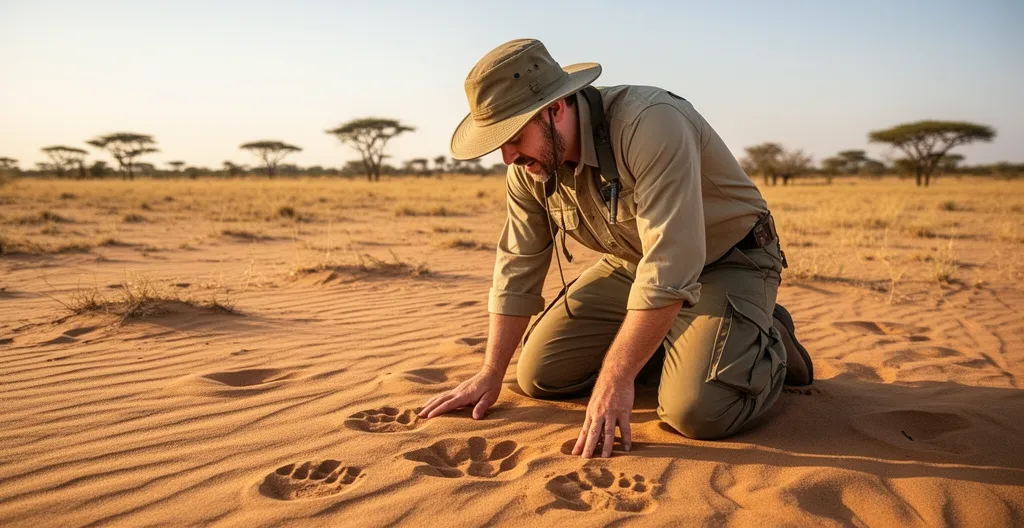
Learning to track is not about memorizing footprints; it’s an intellectual pursuit that transforms a passive safari into an active, deeply engaging story.
- Tracking is a learnable science, formalized by systems like CyberTracker, but rooted in ancient, multi-sensory deduction.
- Distinguishing animals, aging tracks, and interpreting sounds are skills that decode the hidden narrative of the landscape.
- The most immersive experiences are delivered by dedicated tracker-guide teams, a hallmark of top-tier lodges.
Recommendation: When planning your trip to Botswana, seek out lodges that offer dedicated tracking courses or employ a separate tracker-guide team to truly learn the language of the bush.
The Land Rover rounds a bend, and there it is: a magnificent male lion, resting in the shade. It’s a breathtaking moment. But as the cameras click, a deeper question may surface. How did it get here? What was it doing an hour ago? Is it alone? For most, the safari is a series of such spectacular but disconnected snapshots. The story of the animal’s life—the invisible threads connecting it to the landscape—remains unread. This is the gap between seeing and understanding.
Many believe that tracking is an innate, almost magical talent reserved for a select few. The common safari experience reinforces this, where a guide points out a track with a brief explanation, and the vehicle moves on. But what if tracking wasn’t magic, but a language? A complex grammar of signs, sounds, and textures that anyone with the right instruction could learn to decipher. The true art of tracking isn’t just about identifying a footprint; it’s about reading a full narrative written in the sand, on the leaves, and carried on the wind.
This is where the idea of a tracking course in a place like Botswana becomes so powerful. It’s a shift from being a passenger to becoming a student of the wild. This guide is your first lesson. We won’t just list animals; we will explore the foundational principles of tracking as an intellectual pursuit. We will delve into how to get certified, how to distinguish the subtle signs left by predators, and why the most profound safari experiences come from a team that has mastered this ancient and scientific art form. It’s time to learn how to read the story that the bush is constantly writing.
This article will guide you through the core skills and philosophies that define a true tracker. We will explore the structure of formal certifications, decode specific tracks and signs, and understand the deep synergy that makes tracking an essential part of the Botswanan safari experience.
Summary: A Deep Dive into the Art of Tracking
- What Is a CyberTracker Certificate and Can a Tourist Get One?
- Leopard vs. Hyena: How to Tell the Difference in the Sand?
- Is Tracking Pure Science or Is There a Sixth Sense Involved?
- How to Use Bird Calls to Find Hidden Predators?
- How to Follow a Lion Track Without Walking Into an Ambush?
- How to Tell How Fresh a Lion Track Is by Touching the Sand?
- How to Tell if an Elephant Passed By 1 Hour or 1 Day Ago by Breaking a Twig?
- Why Do Top Lodges Have a Separate Tracker and Guide Team?
What Is a CyberTracker Certificate and Can a Tourist Get One?
For those serious about turning a passion for wildlife into a measurable skill, the CyberTracker certification is the global gold standard. It’s not just an informal course; it’s a rigorous, field-based evaluation that quantifies your ability to read the landscape. And the best part? It’s absolutely accessible to a dedicated tourist. You don’t need a background in biology to start; you need curiosity and a willingness to learn the meticulous science of observation.
The certification process is intensely practical. Typically held over several days, an evaluator presents you with a series of « questions » in the field—a faint track in the dust, a chewed-on branch, a subtle scrape on a tree. You assess each sign individually before the group discusses it. Your answers are scored for accuracy, and proficiency is recognized at different levels. It’s a humbling and exhilarating process that quickly moves you beyond the obvious.
The system is designed to build competence progressively. According to the official CyberTracker scoring system, you must achieve a minimum score of 69% for a Level 1 certification. From there, you can progress to Level 2 (80%), Level 3 (90%), and the revered Specialist level, which requires a perfect 100% score on a given evaluation. This structured path provides clear goals and turns the abstract art of tracking into a tangible, recognized expertise. It proves that tracking is a discipline that can be taught, learned, and mastered.
Leopard vs. Hyena: How to Tell the Difference in the Sand?
In the soft sand of the Kalahari, a fresh set of tracks presents a puzzle. Is it the elusive leopard, a master of stealth, or the powerful hyena, an opportunist of the night? For the untrained eye, the prints might seem similar. For the tracker, they speak two entirely different languages. Learning to distinguish them is a foundational lesson in reading the story in the sand. It’s not about a single clue, but a collection of subtle details that, together, paint a clear picture of the animal.
The key differences are found in the animal’s anatomy and movement. A leopard’s retractable claws mean its tracks are neat and rounded, rarely showing claw marks. A hyena’s non-retractable claws are always visible, digging into the sand like cleats. This fundamental difference is your first and most reliable clue. This visual distinction is crucial for any aspiring tracker.
But the story doesn’t end there. A deeper analysis reveals more. The main pad of a leopard’s track has three distinct lobes at the back, whereas a hyena’s is simpler, with only two. This subtle difference in morphology is a definitive sign. The following table breaks down these characteristics, providing a clear reference based on a comparative analysis from safari-goers and guides.
| Feature | Leopard Track | Hyena Track |
|---|---|---|
| Main Pad Shape | Three distinct lobes | Two lobes |
| Claw Marks | Usually absent (retractable) | Always visible |
| Track Symmetry | More symmetrical | More asymmetrical |
| Space Between Pad & Toes | Compact | More spread out |
| Walking Pattern | Direct register (hind in front print) | Irregular placement |
By learning to see these details, you move from simple identification to active deduction. You’re no longer just looking at a print; you’re reconstructing the creature that made it, understanding its physiology and how it moves through its world.
Is Tracking Pure Science or Is There a Sixth Sense Involved?
This is a question that every aspiring tracker eventually asks. Do the legendary trackers of Botswana possess an arcane intuition, a « sixth sense » for the wild? Or is their skill based on a learnable, logical system? The answer, like the bush itself, is complex and beautiful: it’s both. True tracking is a sophisticated fusion of rigorous science and deeply honed intuition.
The scientific foundation is undeniable. As CyberTracker Conservation emphasizes on its official website, the certification process is built on a solid, repeatable methodology. It’s about knowledge of animal behavior, anatomy, and ecology.
The CyberTracker Universal Tracker Certification covers the fundamental principles of tracking as well as the finer details and sophisticated aspects of tracking.
– CyberTracker Conservation, CyberTracker Official Website
However, this science is brought to life by an intuition born from thousands of hours of field experience. This is not a mystical power but a form of high-speed pattern recognition. The tracker’s mind processes thousands of subtle data points—the turn of a leaf, the scent on the breeze, the tension in the air—and arrives at a conclusion that feels instantaneous. It is a « sense » developed through relentless practice, where the conscious and subconscious mind work in perfect harmony. This unique blend of old and new knowledge is perfectly illustrated by the origin of CyberTracker itself.
Case Study: The Genesis of CyberTracker
The system was born when its founder, Louis Liebenberg, sought to « capture » the incredible wealth of information stored in the minds of the Kalahari Bushmen trackers. He recognized their skills were not magic, but a deep, ancestral science passed down through generations. By combining their ancient techniques with modern GPS technology, Liebenberg created a tool that could translate this profound, intuitive knowledge into verifiable scientific data, revolutionizing wildlife management. It was the perfect marriage of the « sixth sense » and pure science.
How to Use Bird Calls to Find Hidden Predators?
A novice tracker walks through the bush looking only at the ground. A master tracker walks with their head up, listening. The ground tells you the past, but the air tells you the present. One of the most powerful tools in a tracker’s sensory kit is the ability to interpret the « bush telegraph »: the alarm calls of birds. A sudden eruption of frantic chirping is not just noise; it’s a bright, flashing arrow pointing directly to a hidden threat.
Birds are the sentinels of the bush. Their survival depends on being aware of predators, and their calls are specific to the type of danger they perceive. Learning this language is a game-changer. It allows you to « see » over ridges and into thickets where your own eyes can’t penetrate. A tracker who understands bird calls has a hundred extra pairs of eyes working for them across the landscape.
Interpreting these calls requires understanding their context and character. Different calls signal different threats. Here are some of the fundamental principles:
- High-pitched, frantic calls often indicate an aerial predator, like an eagle or an owl. The birds are telling each other to look up.
- Persistent, scolding « mobbing » calls are typically directed at a terrestrial predator, like a leopard, snake, or lion. Multiple birds will gather to harass the threat, effectively pinpointing its exact location.
- Key informant species in Southern Africa, like the Grey Go-away-bird (also known as the « Grey Lourie ») and the Fork-tailed Drongo, are particularly reliable. Their calls are loud, distinct, and almost always signify a predator.
- Intensity and duration matter. A brief alarm might be a false start, but a sustained, multi-bird chorus means the threat is real, present, and probably stationary.
By tuning into this symphony of signals, the tracker engages in a truly multi-sensory deduction. You are no longer just following footprints; you are actively participating in the living, breathing communication network of the entire ecosystem.
How to Follow a Lion Track Without Walking Into an Ambush?
The thrill of following a fresh lion track on foot is unparalleled. The heart beats faster with every clear pugmark in the sand. But this excitement must be tempered by a profound sense of respect and a strict methodology. Tracking a large predator is not a reckless pursuit; it is a calculated, deliberate process where safety is the absolute priority. The primary rule is that you never surprise a lion, and you never allow one to surprise you.
This is achieved through a state of total situational awareness. An expert tracker practices what is known as the « one step, ten looks » method. For every step forward focusing on the track, you take ten « looks » around you: scanning the bushes, checking the wind direction, listening for bird alarms, and anticipating where the animal is likely to be resting. You are not just following a line; you are moving through a three-dimensional space filled with potential dangers and clues. It’s an intense mental state, a constant dance between focus and broad awareness.
Patience is as critical as observation. A tracker knows that rushing is the surest way to lose a trail or, worse, walk into a dangerous situation. The process involves frequent stops to reassess, discuss possibilities, and formulate a plan. This methodical approach is the core of safe and successful tracking.
Case Study: Patience on the Trail
On a game drive in the Okavango, guide Dicks and his tracker found fresh lion tracks leading into a difficult, thick area. He gave his guests a choice: move on for an easier sighting or be patient and attempt to track the lions on foot. The guests chose to follow. For 45 minutes, they watched the two men work, thinking their way along the trail, savoring the building anticipation. The tracker would point, the guide would scan ahead, and they would move in a slow, coordinated rhythm. In this case, their patience paid off handsomely when they located the entire pride resting, an experience made all the more rewarding by the skillful and safe pursuit.
This is why professional tracking is never a solo endeavor. It’s a partnership where one person’s micro-focus on the ground is balanced by another’s macro-awareness of the surroundings, ensuring a safe and successful outcome.
How to Tell How Fresh a Lion Track Is by Touching the Sand?
You’ve found it: a perfect lion print. The first question is not « what? » but « when? ». Is this track from last night, or was the lion here just minutes ago? The answer determines your entire strategy. Aging a track is one of the most critical skills a tracker possesses, and it often involves more than just sight. It requires a delicate, tactile investigation of the story told by the sand itself.
A truly fresh track has a life to it. The sand particles, having just been compressed, hold a different temperature and moisture content than the surrounding surface. An expert tracker will gently touch the edge of the track. If it’s very fresh, the compressed sand might feel cooler and slightly damp compared to the dry, sun-warmed sand around it. This is a sign measured in minutes, not hours. The edges of the print will also be incredibly sharp and well-defined, like a crisp photograph.
As time passes, the environment begins to reclaim the track. The sun dries it, the wind softens its edges, and life begins to cross its path. A track that is a few hours old will have lost its temperature differential. Its edges will be slightly blurry, and you might see tiny grains of wind-blown sand or a piece of dry leaf that has fallen into the depression. An ant trail marching straight through the middle of the print is a definitive sign that the track is old. The following checklist is your first lesson in this delicate art.
Action Plan: Reading the Age of a Track
- Check edge definition: Are the ridges of the track sharp and clear (minutes old), or are they softened and blurred by wind (hours old)?
- Feel for temperature: Gently touch inside and outside the track. A noticeable coolness in the compressed sand indicates it is extremely fresh.
- Look for moisture: In the early morning, a very fresh track might still hold a hint of morning dew in its depression, while the surrounding sand has dried.
- Scan for trapped life: Have any insects, like ants, had time to cross the track? An uninterrupted ant trail is a clear sign the track is not recent.
- Observe debris: Check if any wind-blown debris, such as leaves, seeds, or grass, has settled into the track. This takes time.
By combining these observations, a tracker builds a timeline, turning a simple footprint into a precise data point that informs the next move in the thrilling pursuit.
How to Tell if an Elephant Passed By 1 Hour or 1 Day Ago by Breaking a Twig?
While footprints are the most obvious sign, a master tracker reads a much richer vocabulary of clues. For a giant like an elephant, the story is written not just on the ground, but in the vegetation it has disturbed. A broken branch is not just a broken branch; it’s a clock. By examining it, a tracker can determine with remarkable accuracy whether an elephant passed by an hour ago or a day ago.
This technique, often called the « snap test, » is beautifully simple and effective. A freshly broken twig or branch behaves very differently from an old one. The key lies in its moisture content. When you find a branch that has been snapped by a passing elephant, you perform your own test. Bend the broken end. If it makes a sharp, audible « crack, » the break is fresh, full of sap and life. If it crumbles or tears silently, the wood has had time to dry out, meaning the break is much older.
The visual and tactile clues are just as important. A fresh break will be light in color, almost white or pale green, and may even bleed a little sticky sap. An old break will be discolored, having oxidized to a darker brown or grey. This simple, multi-sensory examination provides an instant and reliable timeline. This skill is especially vital in a country like Botswana, which is a critical stronghold for Africa’s elephants. Recent aerial counts confirm the presence of around 228,000 savanna elephants in the KAZA region, making these skills essential for guides and conservationists.
- The Snap Test: A fresh break cracks audibly; an old break is silent and crumbles.
- Sap Bleed: Wet or sticky sap means the break is minutes old. Crystallized sap means hours.
- Color Examination: A light, bright color at the break point is fresh. A dark, discolored break is old.
- Associated Signs: Always combine this test with other signs, especially dung. If the dung is still steaming inside when broken open, the elephant is very, very close.
This is the grammar of the bush in action—a simple, observable fact (a broken twig) is turned into a detailed piece of intelligence that guides the tracker’s next move.
Key Takeaways
- True tracking is a learnable, scientific discipline, not an innate magical ability, with formal certifications available to all.
- Expert tracking is a multi-sensory art, relying on auditory clues like bird alarms and tactile information, not just visual footprints.
- The most profound and safe safari experiences are delivered by a dedicated tracker-guide team, where specialized roles create a synergistic effect.
Why Do Top Lodges Have a Separate Tracker and Guide Team?
On many safaris, a single person fulfills the roles of both driver and guide. They are often incredibly knowledgeable and skilled. However, the most renowned and high-end lodges in Botswana operate on a different model: the tracker-and-guide team. This isn’t a luxury for its own sake; it’s a fundamental commitment to providing a deeper, safer, and more successful safari experience. The two roles, while complementary, are fundamentally different in their focus and execution.
The distinction between the two is a matter of perspective and direction. An expert from African Safari Magazine puts it perfectly, highlighting the different fields of focus that each role commands, which shows why luxury and high-end safari lodges are more likely to have dedicated trackers.
The tracker’s focus is micro, downward, and backward-looking (interpreting the historical story on the ground). The guide’s focus is macro, outward, and forward-looking (guest safety, vehicle positioning, interpreting current animal behavior, and wider ecology).
– African Safari Magazine, What is a Tracker on Safari?
This division of labor creates a powerful synergy. While the tracker, often perched on a seat at the front of the vehicle, is completely absorbed in the intricate story written in the sand, the guide is free to focus on the bigger picture. The guide can scan the horizon for movement, listen for alarm calls, interpret the behavior of animals they encounter, and, most importantly, engage with the guests, sharing the ecological context and ensuring their safety and comfort. It’s a system that allows for simultaneous deep focus and broad awareness.
The Londolozi Partnership Model
South Africa’s Londolozi Game Reserve is legendary for perfecting this partnership. They estimate that their guiding and tracking teams possess a staggering 350 years of combined wisdom. This isn’t just a job; it’s a deep, almost telepathic bond forged over years of working together in the bush. This partnership allows them to deliver unparalleled wildlife encounters, tracking the most elusive animals and creating a narrative journey for their guests that is simply impossible for a single guide to replicate.
When you choose a lodge with a dedicated tracker and guide, you are investing in a more profound connection to the wild. You are not just being shown things; you are being invited into the process of discovery itself.
Your journey into the world of tracking has just begun. The next step is not just to book a flight to Botswana, but to change your mindset. Start looking for the stories in your own local park. Ask « why » and « when, » not just « what. » When you do travel, seek out experiences that prioritize this deep learning, choosing lodges with dedicated teams or enrolling in a course. Transform your next safari from a passive holiday into an active, intellectual, and unforgettable adventure in decoding the language of the wild.