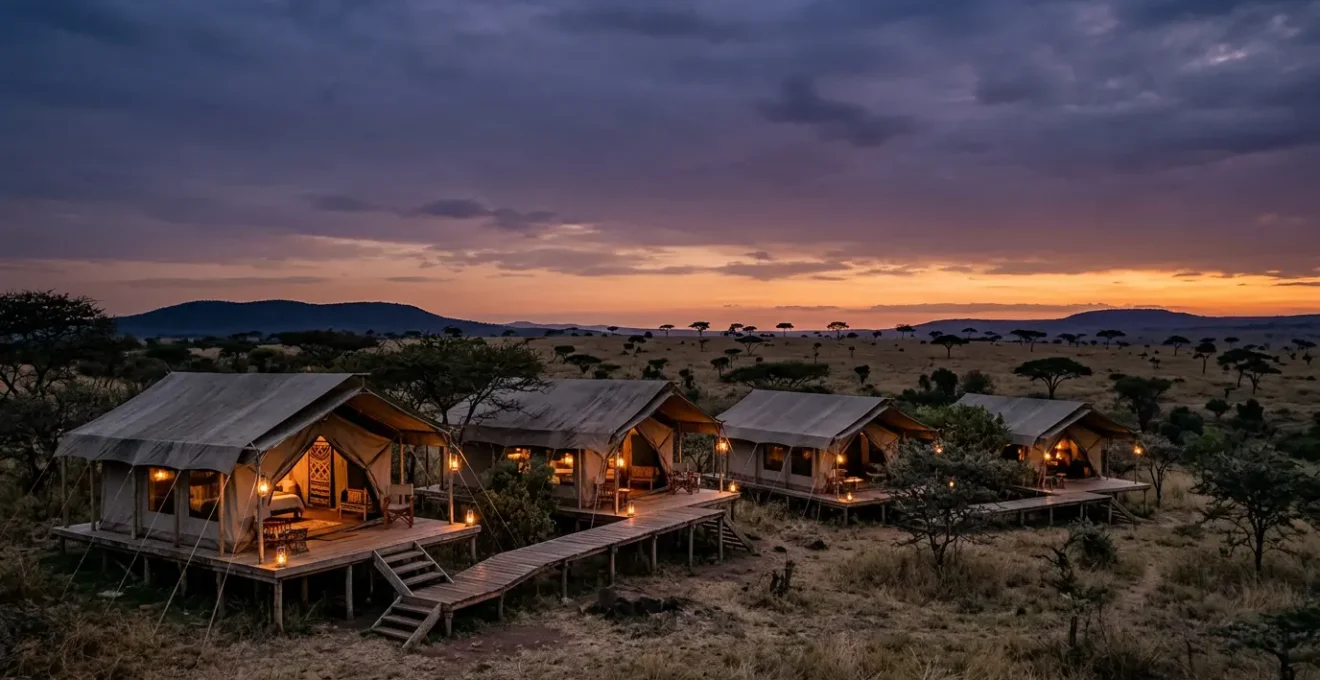
The high price of a luxury tented camp isn’t a premium for ‘roughing it’; it’s an investment in sophisticated, removable architecture engineered to outperform traditional buildings.
- This architectural approach delivers superior comfort in extreme climates through passive engineering rather than brute-force air conditioning.
- The cost reflects a minimal-impact philosophy, where the entire structure is designed to be removed without a trace, preserving the pristine environment.
Recommendation: Evaluate luxury camps based on their design philosophy and environmental integration, not just the cost per night, to understand their true value.
The question often arises for the discerning traveler: why would one pay a premium, sometimes significantly more than for a five-star hotel suite, to sleep under canvas? The perception of a « tent » instinctively calls to mind notions of basic living, a compromise on comfort for the sake of proximity to nature. Common justifications point to remote logistics, all-inclusive service, and exclusivity, but these explanations miss the fundamental point.
As a hospitality architect, I propose a different perspective. The cost isn’t for a lesser structure; it’s for a more intelligent one. The luxury tented camp represents a pinnacle of design and engineering, a form of non-permanent architecture meticulously crafted to offer profound comfort and sensory immersion while maintaining a symbiotic relationship with its delicate surroundings. It’s not about choosing canvas over concrete; it’s about choosing sophisticated, adaptable engineering over a static, imposing footprint. The premium is not for the materials, but for the masterful intelligence with which they are deployed.
This guide deconstructs the architectural and experiential elements that define the value of a high-end tented camp. We will explore the engineering that keeps you comfortable, the design that ensures your safety, the ethos that protects the environment, and the financial transparency that underpins the entire experience. By the end, you will understand that the canvas wall is not a barrier to luxury but the very fabric of it.
Summary: Deconstructing the Value of Luxury Tented Architecture
- How Do Luxury Tents Stay Cool in Summer Without Air Conditioning?
- Outdoor Showers vs. Copper Bathtubs: What to Expect in a Tented Bathroom?
- How Safe Are You Sleeping in a Tent When Elephants Walk Through Camp?
- Communal Dining vs. Private Tables: What Is the Norm in Luxury Camps?
- Why Are Some Ultra-Luxury Camps Designed to Be Removed Without a Trace?
- Does High-End Luxury Inherently Conflict with Eco-Tourism Principles?
- Does Being on the Riverfront Lower the Room Temperature naturally?
- All-Inclusive vs. Full Board: What Hidden Costs Should You Expect in Lodges?
How Do Luxury Tents Stay Cool in Summer Without Air Conditioning?
The absence of traditional air conditioning in many luxury camps is not a cost-saving measure, but a testament to superior architectural intelligence. It signals a commitment to engineered comfort through passive design, a system that works with the environment rather than fighting against it. The primary tool is the tent structure itself. High-end canvas is often a multi-layered system, featuring a taut outer flysheet that reflects solar radiation, an insulating air gap, and a breathable inner canvas. This design allows hot air to escape upwards and out through ventilated ridges while preventing the sun’s heat from penetrating the living space. At Camp Sarika by Amangiri, for example, the design must perform in an environment where temperatures can fluctuate dramatically; one advanced three-layered membrane system withstands a 20 to 105 degrees Fahrenheit temperature range.
Furthermore, the entire tent is oriented and designed for maximum airflow. Large, netted windows and doors are positioned to capture prevailing breezes, creating constant cross-ventilation. The tent is often raised on a wooden deck, allowing cooling air to circulate underneath the floor, further reducing the ambient temperature. In extremely hot locations like Botswana’s Kalahari Desert, innovative solutions emerge. Jack’s Camp features a bespoke over-bed cooling system, a silent and energy-efficient device that directs a gentle flow of cool air over guests as they sleep, ensuring a comfortable rest even after a day in the desert heat. This is the essence of luxury engineering: solving a problem with elegance and ingenuity, not brute force.
Outdoor Showers vs. Copper Bathtubs: What to Expect in a Tented Bathroom?
The bathroom in a luxury tented camp is a sanctuary designed for sensory immersion. Forget cramped, purely functional spaces; these are expansive suites that intentionally blur the line between indoors and out. The presence of an outdoor shower or a freestanding copper bathtub is a deliberate architectural statement, designed to connect you with the surrounding wilderness in a moment of private indulgence. The experience of showering under the stars or soaking in a warm bath while listening to the distant call of a lion is an unparalleled luxury that a sealed, tiled hotel bathroom simply cannot offer.
From an architectural standpoint, these features represent significant engineering challenges. Providing copious hot water on demand, ensuring perfect water pressure, and guaranteeing absolute privacy in a remote, wild location requires sophisticated plumbing, discreet screening, and thoughtful site planning. The choice of materials is also intentional. As luxury travel experts at Ker & Downey note, « The hand-hammered copper tubs are custom-made, » reflecting a dedication to bespoke craftsmanship and materials that age beautifully within the natural environment. These are not standard fixtures; they are heavyweight, high-cost art pieces that must be transported and installed with incredible care.
This design philosophy transforms a daily ritual into a memorable highlight of the safari experience. It reassures the guest that comfort is not being sacrificed, but redefined. The ultimate luxury here is not just the high-end fixture itself, but the unique and profound experience that its specific placement and design make possible. It’s a bathroom that doesn’t just serve a function, but creates a memory.
How Safe Are You Sleeping in a Tent When Elephants Walk Through Camp?
The idea of sleeping with only a layer of canvas separating you from Africa’s largest land animals can be unsettling. However, safety in a luxury tented camp is a deeply integrated aspect of its design, founded on an intimate understanding of wildlife behavior, not on impenetrable walls. The core principle is low-density, high-awareness design. These camps are intentionally small and spread out, creating a low-impact human presence that doesn’t disrupt ancient wildlife corridors. Elephants and other animals are not breaking into a compound; they are simply walking through their home, and the camp is designed to respectfully accommodate that.
The statistical scarcity of humans is a key safety feature. At a property like Marataba Safari Lodge, the low-density model means there is approximately one guest bed for every 1,000 acres, ensuring that wildlife encounters are natural and uncrowded. This spatial luxury is the first layer of security. The second, and most crucial, is human expertise. Camps employ guides and staff, often from local communities, who possess generations of knowledge about animal behavior. They understand the signs, sounds, and rhythms of the bush. Guests are escorted to their tents after dark, and comprehensive briefings ensure everyone knows how to coexist safely and respectfully with their wild neighbors.
This approach is exemplified by the Natural Selection Coexistence Model. By managing vast private reserves with a maximum of 12 suites per camp, they create a ‘light-touch’ tourism environment. The canvas walls of your tent allow you to hear the sounds of the bush—a branch snapping, a hippo’s call—connecting you to the environment in a way a concrete wall never could. This is not a vulnerability; it is a feature of the immersive experience, made possible by a profound, expertly managed system of coexistence.
Communal Dining vs. Private Tables: What Is the Norm in Luxury Camps?
Dining in a luxury camp is rarely just about the food; it’s a form of social architecture. While five-star hotels often emphasize private, intimate dining, many tented camps foster a communal atmosphere, and this is by design. The tradition of communal dining stems from the very essence of safari: a shared adventure. Gathering around a long table with other guests and guides at the end of the day provides a natural forum to share stories, compare wildlife sightings, and learn from the collective experience. It transforms a meal into a vibrant, engaging event.
This doesn’t mean privacy is unavailable. Flexibility is paramount, and a request for a private table for a romantic dinner or a special occasion is almost always accommodated with pleasure. However, the default is often a shared experience, particularly in the iconic outdoor « boma. » A boma is a traditional reed or wood-enclosed space, open to the stars, where guests dine around a crackling fire. It’s a carefully curated setting designed to create a sense of community and connection to both the culture and the wilderness. The experience is often cited as a trip highlight, as one guest at MalaMala Camp shared: « We often hear from guests about the memorable experience of dining in the reed-enclosed boma, beneath the night sky… It is moments like these that capture the meaning of a true safari. »
From an architectural standpoint, creating these multiple dining venues—the main lodge, the boma, and potential private « bush dinner » spots out on the savanna—requires more space, more staff, and more logistical planning than a single hotel restaurant. It’s a commitment to offering a variety of experiences that cater to the guest’s mood, ensuring the social environment feels as bespoke and luxurious as the physical one.
Why Are Some Ultra-Luxury Camps Designed to Be Removed Without a Trace?
The concept of a « mobile » or « seasonal » camp represents the zenith of luxury eco-tourism and the principle of non-permanent architecture. The ability to completely dismantle and move a camp, leaving no permanent scar on the landscape, is arguably a greater feat of design and a more profound statement of luxury than building a permanent structure. It is the ultimate act of respect for a pristine environment. This philosophy dictates that our enjoyment of a place should not come at the cost of its integrity.
From an engineering perspective, this is immensely complex. Every component, from the raised wooden floorboards to the plumbing for en-suite bathrooms and the framework for the canvas walls, must be modular, durable, and transportable. The entire camp is a sophisticated kit of parts, designed for assembly and disassembly without heavy machinery. As experts at Africa Overland Tours explain, « These camps are assembled to remain in a single location for months at a time and will move locations two or three times a year, » typically following seasonal wildlife migrations. This ensures guests are always in the heart of the action, a level of responsiveness a fixed hotel cannot match.
This approach has a higher operational cost than a permanent lodge. It requires a dedicated team for the painstaking process of deconstruction, transportation, and reconstruction. It also necessitates a lighter touch in every aspect, from solar-powered energy systems to self-contained waste management. The resulting minimal-impact footprint is not a compromise but the very definition of its luxury. It offers guests the exclusive privilege of experiencing a wild place in its purest form, with the knowledge that when they leave, the wilderness will reclaim the space as if they were never there.
Does High-End Luxury Inherently Conflict with Eco-Tourism Principles?
A common concern for the conscientious traveler is whether the opulence of a high-end camp can truly align with the ethos of eco-tourism. The surprising answer, from an architectural and economic design perspective, is that high-end luxury can be the most powerful engine for conservation. The model is simple: low volume, high yield. By creating an exceptionally luxurious experience, camps can command a premium rate from a small number of guests. This revenue is then used to protect vast tracts of wilderness, creating a symbiotic financial ecosystem.
As Kate Hughes, a partner in a collection of lodges, stated frankly in National Geographic, « We created our lodges to be as luxurious as possible so we could charge a premium rate and raise as much money as we could » for conservation. This isn’t greenwashing; it’s a pragmatic and highly effective business model for preservation. The alternative—mass-market tourism—would require far more visitors to generate the same revenue, leading to greater environmental strain, more infrastructure, and more human-wildlife conflict. The luxury model ensures that the land can be supported by the fewest number of people, preserving its wild character.
This symbiosis is proven by operators like Natural Selection, who codify their commitment by ensuring that 1.5% of every booking is donated to conservation projects. The pinnacle of this model is found in places like Lepogo Lodges in South Africa, a case study in how luxury can be entirely selfless. The lodge operates as a 100% non-profit. Guests enjoy exquisite tented villas with plunge pools and every conceivable amenity, but all profits beyond operating costs are plowed directly into protecting and rewilding the 50,000-hectare reserve. Here, the high price tag is a direct, transparent contribution to environmental preservation. It proves that far from being in conflict, high-end luxury can be eco-tourism’s most vital and effective partner.
Does Being on the Riverfront Lower the Room Temperature naturally?
Yes, and it’s a prime example of site-specific architectural design. Locating a camp along a river is not merely for the scenic views and wildlife access; it is a strategic decision that leverages the natural environment to enhance guest comfort. Architects and camp designers use the river as a natural, large-scale air conditioning system. A riparian microclimate is often several degrees cooler than the surrounding savanna. This is due to two main factors: evaporative cooling from the water’s surface and the denser, healthier vegetation along the banks which provides more shade and transpires moisture into the air.
Placing tented suites to capture the gentle breezes coming off the water is a fundamental principle of passive cooling in these locations. This constant, subtle airflow, combined with the tent’s own ventilation design, creates a far more pleasant and natural-feeling coolness than the dry, recycled air of a mechanical AC unit. Of course, the primary draw for a riverfront location is the theater of wildlife it provides. Water is life, and especially during the dry season, rivers become magnets for animals. It is a fact that the Chobe Riverfront sees peak wildlife concentration as animals flock to the only reliable water source. The architectural brilliance lies in leveraging a single natural feature—the river—to solve two problems: delivering both thermal comfort and world-class game viewing directly to the guest’s doorstep.
This dual benefit, however, comes at a premium. The following table, based on insights from luxury travel planners, outlines why these prime locations command a higher price.
| Aspect | Riverfront Camps | Inland Camps |
|---|---|---|
| Wildlife Viewing | Constant activity, especially dawn/dusk | Requires game drives |
| Natural Cooling | Riparian microclimate, evaporative cooling | Depends on elevation/shade |
| Ambiance | Water sounds, bird activity | Savanna silence, distant calls |
| Premium Cost | 20-30% higher on average | Standard luxury rates |
Key takeaways
- Luxury tented camps are sophisticated, engineered systems designed for comfort in extreme environments, not simply fabric shelters.
- The high cost often reflects a deep commitment to ecological responsibility, including minimal-impact construction and direct funding for conservation.
- The core value of tented architecture is sensory immersion—safely connecting you to the sights and sounds of the wilderness in a way a concrete building cannot.
All-Inclusive vs. Full Board: What Hidden Costs Should You Expect in Lodges?
The pricing structure of a luxury tented camp is another element of its « all-in » design philosophy. The typically high, all-inclusive rate is engineered to remove financial friction and decision fatigue from the guest experience. It is not just about bundling costs; it’s about creating an environment where the answer to any reasonable request is « yes, » without the guest ever having to consider the price. This fosters a sense of total immersion and relaxation. When your game drive runs late because you’re tracking a leopard, you don’t worry about the kitchen closing; when you decide you’d like a gin and tonic while watching the sunset, you don’t need to find your wallet.
While the term « all-inclusive » sounds comprehensive, it’s crucial to understand what it typically covers—and what it might not. Generally, it includes all meals, all local-brand drinks (soft and alcoholic), and standard activities like two daily game drives. What distinguishes it from « full board » is the inclusion of drinks and activities. However, « all » doesn’t always mean « everything. » Top-shelf imported spirits, cellar wines, and special activities like hot-air ballooning or helicopter tours are often extra. It’s essential to clarify these details before booking. The nightly rate for this level of service reflects the operational complexity; in East Africa, for example, true luxury safari rates vary between $775 to $4,495 per night.
Your Pre-Booking Financial Clarity Checklist
- List all included activities: Confirm if it’s just game drives or if walking safaris, night drives, or boat trips are also standard.
- Define « inclusive drinks »: Ask for a list of included spirits, wines, and beers. Are premium brands and cellar wines extra?
- Itemize laundry service: Is it included daily, and are there any restrictions on items or quantity?
- Check park and conservation fees: Are these daily fees included in the headline rate or added to the final bill?
- Clarify tipping policy: Enquire about the recommended tipping guide and whether tips can be added to the final bill or must be paid in cash.
Armed with this architectural and financial understanding, you can now evaluate luxury camps not by a simple price tag, but by the depth of the experience they are engineered to provide. It is a choice to invest in intelligent design, ecological harmony, and an unforgettable immersion in the wild.
Frequently Asked Questions about Canvas vs. Concrete: Why Are Tented Camps More Expensive Than Hotels?
What’s typically excluded from safari packages?
International flights, regional bush flights, visas, tips, and certain premium activities such as hot-air ballooning or gorilla trekking are often excluded and should be budgeted separately.
Why is Botswana more expensive than other destinations?
Botswana operates a low-impact tourism model that limits lodge numbers and visitor density, particularly in the Okavango Delta. Higher prices are used to protect ecosystems rather than maximize volume.
How many nights should I budget for?
For most people, 5 to 7 nights of safari time is ideal, with total trip budgets at luxury level often ranging from $18,000 to $35,000+ per person for 7-10 nights.