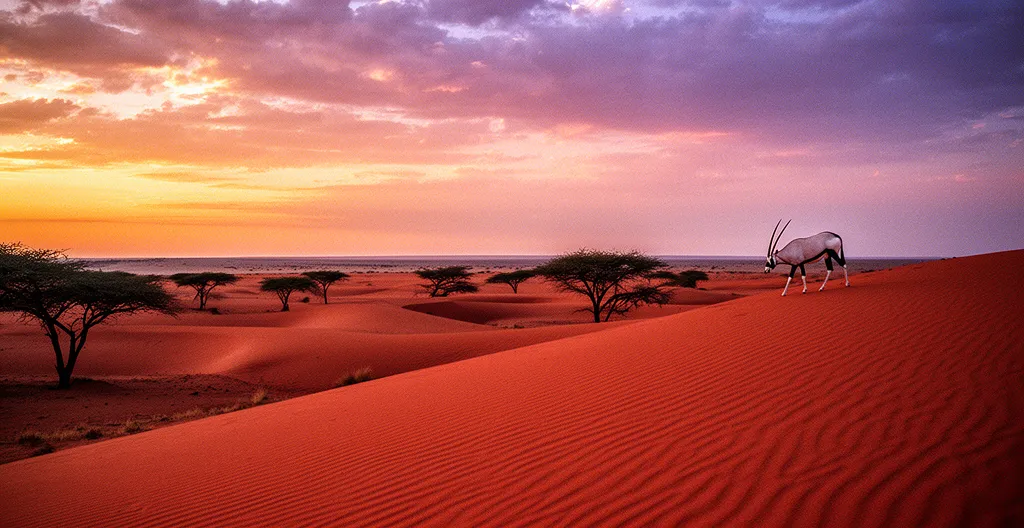
The decision between the Central Kalahari and Kgalagadi is not about which has ‘better’ wildlife, but about choosing your style of desert engagement.
- The Central Kalahari Game Reserve (CKGR) offers a deep, challenging wilderness immersion where sightings are earned through tracking and patience.
- The Kgalagadi Transfrontier Park (KTP) provides a more accessible, structured experience with highly reliable predator viewing along its fossil riverbeds.
Recommendation: Choose CKGR for ultimate solitude and an ecological challenge; choose KTP for classic predator action and more straightforward logistics.
For the traveler who has witnessed the thundering herds of the Serengeti and navigated the lush waterways of the Okavango Delta, the allure of « orange Africa » presents a new frontier. The vast, seemingly empty expanses of the Kalahari Desert call with a promise of profound silence and uniquely adapted wildlife. Yet, this single name hides two vastly different experiences: the Central Kalahari Game Reserve (CKGR) and the Kgalagadi Transfrontier Park (KTP). The common advice often circles around cost or basic animal checklists, but this misses the fundamental point. For the seasoned Africa hand, the choice is not merely logistical.
The real question is about the nature of your desired encounter with one of the world’s most extreme environments. Are you seeking a structured safari where predator sightings are the main goal, or do you crave a deeper, more challenging immersion into a truly wild ecosystem? The key to deciding isn’t in comparing which animals you might see, but in understanding the underlying ecological rhythms and logistical realities that define each park. This guide moves beyond the surface-level debate, offering an expert’s perspective on the character, challenges, and rewards of each destination.
We will delve into the seasonal dynamics that turn Deception Valley into a predator haven, the science behind how Kalahari lions survive without water, and the practicalities of packing and vehicle choice for this demanding terrain. By understanding the ‘why’ behind each park’s unique identity, you can make a choice that aligns not just with your itinerary, but with your very philosophy of travel.
To help you navigate this decision, this article breaks down the key aspects that differentiate these two magnificent desert realms, from wildlife behavior to the essential gear you’ll need to thrive there.
Summary: A Tale of Two Deserts
- Why Is Deception Valley the Best Place to See Predators in Summer?
- How to Pack for Freezing Nights and Scorching Days in the Kalahari?
- How Do Kalahari Lions Survive for Months Without Drinking Surface Water?
- Are Black-Maned Lions a Separate Subspecies or Just an Adaptation?
- Why Is the Kalahari One of the Best Dark Sky Reserves in the World?
- Why Combining the Delta and Kalahari Creates the Perfect 10-Day Trip?
- High-Lift Jack vs. Air Jack: Which Is Safer for Solo Travelers in Sand?
- How to Choose Between a Hilux and a Land Cruiser for Deep Sand Driving?
Why Is Deception Valley the Best Place to See Predators in Summer?
While conventional safari wisdom often favors the dry season, the Central Kalahari, and particularly Deception Valley, operates on a completely different ecological rhythm. The summer months (roughly December to April) trigger the ‘green season,’ a period of dramatic transformation. The arrival of rains carpets the fossil river valleys with nutritious grasses, attracting vast herds of springbok, gemsbok, and wildebeest. This concentration of prey is the magnet for the region’s top predators.
For lions, cheetahs, and hyenas, this is a time of plenty. The abundance of game means less energy is expended on the hunt, and the lush vegetation provides ample cover for ambushes. It is this pulse of life that defines the CKGR experience. Indeed, research from Deception Valley Lodge indicates that large herds concentrate from January to March, creating a thriving environment for predators. This is not the static, waterhole-based viewing of the dry season; it is a dynamic landscape of pursuit and survival played out against a backdrop of vibrant green and dramatic summer thunderstorms.
Case Study: Wildlife Photography Success in the Summer Kalahari
Photographer Paolo Sartori’s experience during the green season (February-April) highlights the unique opportunities of this period. He documented rare predator behaviors, including jackals hunting springbok fawns. While overall animal density might seem lower than in parks like Kruger, the photographic rewards were exceptional. The stark contrast of predator coats against the green grass and the dramatic texture of rain-dampened fur created powerful, unique images, proving the summer’s immense value for serious wildlife photography.
The green season offers a vision of the Kalahari that defies stereotypes. It’s a time of birth, abundance, and intense predatory action, making Deception Valley a prime destination for those who wish to witness the desert’s peak ecological rhythm in full force.
How to Pack for Freezing Nights and Scorching Days in the Kalahari?
The Kalahari’s climate is one of brutal extremes, a reality that every traveler must prepare for. The dry, clear air that provides such stunning night skies also allows for dramatic temperature swings. It is a place where you can experience frost on your tent in the morning and seek shade from blistering heat by midday. In fact, official park records show temperature ranges from a bone-chilling -11°C (12°F) to a staggering 45°C (113°F). Packing for this is not about choosing warm or cold clothes; it’s about mastering the art of layering.
The cornerstone of any Kalahari packing list is high-quality merino wool. This natural fiber is unparalleled in its ability to regulate body temperature, wick moisture, and resist odor over multiple days. A system of lightweight and mid-weight merino layers is far more effective than a single bulky jacket. A thin 150gsm (grams per square meter) t-shirt can be worn during the heat of the day, a 200gsm long-sleeve added as the sun sets, and a 250gsm base layer kept for the freezing nights. This is complemented by a windproof outer shell and an insulated jacket (down or synthetic) for evenings around the campfire.
As the image above illustrates, a successful setup is about having the right materials ready. Beyond clothing, a wide-brimmed hat, high-SPF sunscreen, and quality sunglasses are non-negotiable for sun protection. A thermal flask for keeping water cool during the day and a warm beanie for the night are small items that make a huge difference in comfort and safety. This layering philosophy allows you to adapt instantly to the desert’s changing moods, ensuring you remain comfortable and focused on the experience, not the temperature.
The following table provides a practical guide to selecting the right merino wool weight for different conditions you will encounter. Mastering this system is key to comfort in the desert.
| Temperature Range | Merino Weight (gsm) | Use Case |
|---|---|---|
| 30°C+ (Hot days) | 150gsm | Lightweight base layer, fast-drying |
| 20-30°C (Warm) | 170gsm | Versatile all-day wear |
| 0-20°C (Cool) | 200gsm | Evening/morning layer |
| Below 0°C (Freezing) | 250gsm | Night-time base layer |
How Do Kalahari Lions Survive for Months Without Drinking Surface Water?
The image of a lion drinking from a waterhole is iconic, yet in the arid heart of the Kalahari, this is a rare sight for much of the year. The survival of these large predators in a region with scarce surface water is a masterclass in physiological and behavioral adaptation. It shatters our understanding of their needs and highlights the intricate web of life in the desert. The primary answer lies not in finding water, but in extracting it from their food.
Kalahari lions derive the vast majority of their moisture from the body fluids of their prey. Animals like gemsbok (oryx), springbok, and even porcupines are themselves superbly adapted to the arid environment. For instance, desert-adapted antelopes like gemsbok can obtain all the water they need from the vegetation they consume, concentrating this precious fluid in their bodies. When a lion makes a kill, it is effectively acquiring a mobile canteen.
The process is remarkably efficient and strategic. As experts have observed, the lions’ feeding behavior is key to maximizing hydration. This insight from the Central Kalahari Wildlife Guide explains the strategy:
Lions strategically consume moisture-rich organs like the stomach and intestines first
– Wildlife behavior observation, Central Kalahari Wildlife Guide
By consuming the blood (which is about 80% water) and the internal organs of their prey before the muscle meat, they ingest the most liquid-rich parts immediately. This is supplemented by seeking out and eating tsamma melons and other moisture-filled plants when available. This incredible example of desert-adapted physiology allows an apex predator to thrive in an environment that would seem impossible, offering a profound insight into the resilience of nature.
Are Black-Maned Lions a Separate Subspecies or Just an Adaptation?
The legendary black-maned lions of the Kalahari are one of the region’s most iconic and sought-after sightings. Their magnificent dark manes, contrasting starkly with the pale desert landscape, have fueled speculation for centuries, with many wondering if they represent a unique, separate subspecies. The Kgalagadi, in particular, is famous for these impressive males. However, modern science has provided a clear, and perhaps more fascinating, answer: it’s not about subspecies, but about individual fitness and environment.
The color of a lion’s mane is not a fixed genetic marker like the stripes of a zebra. Instead, it is a dynamic trait influenced by a combination of factors, primarily age, climate, and hormones. Specifically, scientific research confirms that higher testosterone directly linked to darker manes is a key driver. A darker, fuller mane is an honest signal to other lions—both rivals and potential mates—of the male’s strength, health, and fighting ability. Healthier, better-fed lions in their prime tend to have higher testosterone levels, which promotes the growth of darker, more impressive manes.
Authoritative sources confirm this conclusion, dispelling the subspecies myth entirely. The Institute for Environmental Research states it plainly:
No, lions with dark manes are not considered a separate subspecies. They are simply lions (Panthera leo) with variations in their coat color due to genetic factors
– The Institute for Environmental Research, What is a black lion? – IERE
Case Study: Cape Lion Genetic Analysis
The historical Cape lion, once thought to be a distinct subspecies known for its extensive black mane, was the subject of a revealing genetic study in 2023. Analysis of museum specimens found that they were not genetically distinct from other Southern African lion populations. The study confirmed that their famous black manes were simply a variation also found in living populations, influenced by climate and individual condition, rather than a unique subspecies marker. This reinforces that the black mane is an indicator of condition, not lineage.
So, when you see a magnificent black-maned lion in the Kgalagadi, you are not seeing a different type of lion. You are witnessing a prime example of a successful, dominant male at the peak of his power—a testament to his ability to thrive in the harsh Kalahari.
Why Is the Kalahari One of the Best Dark Sky Reserves in the World?
A journey into the Kalahari is a journey away from the modern world, and nowhere is this more apparent than after the sun sets. The desert’s immense scale, its profound lack of human settlement, and its dry, clear atmosphere combine to create one of the most pristine night skies left on Earth. The experience of standing in the absolute silence of the desert, under a canopy of stars so bright they seem almost within reach, is as profound as any wildlife sighting.
The Kalahari’s credentials as a world-class stargazing destination are built on several key factors. The near-zero light pollution is the most critical. Hundreds of kilometers from the nearest city, the sky is untainted by artificial glow, allowing the faint light of distant galaxies to shine through. The arid climate means very low humidity and minimal cloud cover for much of the year, resulting in exceptional atmospheric clarity. This combination makes the Kalahari an astrophotographer’s dream, a place where the Milky Way is not a faint smudge but a brilliant, textured river of light stretching from horizon to horizon.
This celestial spectacle is more than just a beautiful view; it fundamentally changes the nocturnal safari experience. During a full moon, the landscape can be so brightly illuminated by reflected moonlight that you can see wildlife moving through the pans without the need for artificial spotlights. It’s a magical, non-intrusive way to observe the desert’s night-time inhabitants. This incredible darkness connects you to a primal sense of wonder, making the Kalahari a destination for those who want to explore not just the earth, but the cosmos as well.
Why Combining the Delta and Kalahari Creates the Perfect 10-Day Trip?
For the traveler looking to comprehend the full spectrum of Botswana’s ecosystems, there is no better combination than the Okavango Delta and the Kalahari Desert. It is a journey of ultimate contrasts, a transition from an world defined by water to one shaped by its absence. This pairing transforms a great safari into an extraordinary one, offering a holistic education in African ecology within a single, manageable 10-day trip.
The experience is a study in sensory opposition. In the Delta, your world is green and blue, and your soundtrack is the splash of a mokoro paddle, the call of a fish eagle, and the chorus of reed frogs. Wildlife viewing is often at water-level, intimate and close. Just a short flight away in the Kalahari, the palette shifts to ochre and gold. The soundscape becomes one of profound silence, broken only by the wind or the distant, guttural roar of a lion. Here, the focus shifts to tracking and scanning vast horizons. This contrast elevates both experiences, making the lushness of the Delta feel even more miraculous and the starkness of the desert even more soulful.
This combination is also logistically brilliant, as it allows you to experience the peak season for both environments. The best time for the Delta is the dry winter (May-October) when floodwaters are high and animals concentrate. Conversely, the Kalahari’s prime time is the green summer season (December-April) when the wildlife spectacle is at its peak. By planning a trip that bridges these seasons, or by simply accepting the unique rewards of each park’s « off-season, » you create a perfectly balanced itinerary. A journey from Maun, the hub for both regions, makes the transition seamless.
The following table, based on expert analysis, encapsulates the fundamental differences that make this combination so compelling. Sourcing this information required a deep dive into comparative analyses of Botswana’s prime safari areas.
| Aspect | Okavango Delta | Kalahari Desert |
|---|---|---|
| Landscape | Lush wetlands, water channels | Arid savanna, red sand dunes |
| Wildlife Viewing | Water-based, mokoro level | Tracking-focused, horizon scanning |
| Soundscape | Birds, frogs, water sounds | Profound silence, distant roars |
| Best Season | May-October (flood season) | December-April (green season) |
| Photography | Reflections, close encounters | Wide vistas, dramatic skies |
High-Lift Jack vs. Air Jack: Which Is Safer for Solo Travelers in Sand?
In the deep sands of the Kalahari, getting stuck is not a matter of ‘if’ but ‘when’. For the solo traveler or small group, the choice of recovery equipment is one of the most critical safety decisions you will make. The debate often centers on two tools: the traditional high-lift jack and the modern air jack (or exhaust jack). While the high-lift jack is a versatile and iconic piece of overlanding kit, in the specific context of soft sand recovery, the air jack is unequivocally the safer option, especially for those with less experience.
The high-lift jack, often called a ‘widow-maker,’ is a powerful tool that demands respect and expertise. It operates with a narrow base and a high center of gravity, making it notoriously unstable on soft or uneven ground like sand. Without a large, solid base plate, it is prone to slipping or kicking out, which can cause catastrophic vehicle damage or serious personal injury. The mental load of operating a high-lift jack under the stress of being stuck alone in a remote area cannot be overstated.
The air jack, by contrast, is designed for these exact conditions. It uses a large inflatable bag with a wide footprint, which sits securely on top of the sand rather than digging into it. It provides a stable, low-stress lift, using the vehicle’s own exhaust or a compressor for inflation. Its operation is forgiving and intuitive, dramatically reducing the risk of user error and injury. While it lacks the versatility of a high-lift jack for other tasks like winching or clamping, its specialized excellence in soft-ground lifting makes it the superior choice for desert self-recovery.
| Factor | High-Lift Jack | Air Jack |
|---|---|---|
| Stability in Sand | Low – requires base plate | High – wide surface area |
| User Injury Risk | High – ‘widow-maker’ reputation | Low – stable operation |
| Versatility | High – multiple uses | Low – lifting only |
| Mental Load | High stress/anxiety | Low – forgiving operation |
| Required Skill | Expert level | Beginner friendly |
Action Plan: Multi-Layer Emergency Recovery
- Communication First: Always carry a satellite communication device (like an InReach or Sat Phone) as your primary safety net before even starting the engine.
- Tire Redundancy: Pack at least two full-size spare tires and a comprehensive tire repair kit to ensure self-sufficiency against multiple punctures.
- Jack-Free Techniques: Learn and practice track-building with sandbags or traction mats, a method that can often free a vehicle without needing any type of jack.
- Hydration Margin: Carry a minimum of 5 liters of water per person, per day, plus an additional emergency reserve of 20 liters.
- Fuel Security: Maintain adequate fuel reserves at all times. Fuel stations are extremely limited, so plan your consumption meticulously and use long-range tanks or jerry cans.
Key Takeaways
- The CKGR experience is defined by its ‘ecological rhythm,’ with the summer green season offering peak predator action, while KTP offers more consistent viewing year-round along its riverbeds.
- Survival in the Kalahari requires mastering layering with merino wool to handle temperature swings from over 45°C to below freezing.
- The choice between a Hilux and Land Cruiser depends on balancing the Cruiser’s legendary reliability and load capacity against the Hilux’s comfort and fuel economy.
How to Choose Between a Hilux and a Land Cruiser for Deep Sand Driving?
The choice of vehicle is central to any Kalahari self-drive expedition. The two undisputed champions of the African bush, the Toyota Hilux and the Toyota Land Cruiser (specifically the 70-series), are both exceptionally capable. The decision isn’t about which is « better, » but which is better aligned with your trip’s specific demands, budget, and personal risk tolerance. Both can handle the Kalahari’s deep sand and corrugated tracks, but they offer different balances of reliability, comfort, and cost.
The Land Cruiser 70-Series is the gold standard for rugged simplicity and reliability. Its design has been proven over decades in the harshest conditions on Earth. It boasts a higher load capacity, crucial for carrying extra fuel, water, and two spare tires, and its simpler mechanics often make for easier bush repairs. This legendary durability, however, comes at a premium, with higher rental costs and poorer fuel economy. It is the choice for those who prioritize ultimate dependability and load-carrying ability above all else.
The Toyota Hilux offers a more modern and comfortable driving experience. Its superior fuel economy is a significant advantage on long transit days, and its smoother on-road handling makes the journey to and from the parks more pleasant. While a highly capable 4×4, its lower load capacity requires more careful packing and weight management. It’s a fantastic choice for those on a slightly tighter budget who value comfort and efficiency, while still being more than capable of tackling the desert’s challenges when properly equipped and driven with skill.
Case Study: Vehicle Performance in Central Kalahari Conditions
The experience of rental company Tawana Self Drive shows that both vehicles are effective in the Kalahari’s mixed terrain. The key is not the vehicle itself, but its preparation and the driver’s skill. They note that the Land Cruiser’s legendary reliability is a major asset for bush repairs, while the Hilux’s comfort and fuel economy are significant benefits. Crucially, they emphasize that navigating deep sand sections, like the notorious 40km approach to Piper Pan, requires proper tire deflation (around 1.2-1.4 bar), momentum management, and full recovery gear, regardless of which Toyota you choose.
With the right preparation and a clear understanding of what each park offers, your journey into orange Africa will be a safe, rewarding, and unforgettable expedition into one of the planet’s last true wildernesses.
Frequently Asked Questions about the Kalahari Experience
What makes the Kalahari ideal for stargazing?
The Kalahari’s remote location, minimal light pollution, clear dry air, and vast open landscapes create perfect conditions for astronomical observation.
What is the ‘500 rule’ for astrophotography?
To avoid star trails in your photos, divide 500 by your lens’s focal length to get the maximum shutter speed in seconds. For a 24mm wide-angle lens, the calculation would be 500 / 24, which equals a maximum exposure of about 20 seconds.
Can you spot wildlife during full moon nights?
Yes, absolutely. When the moon is full, the landscape is so brightly illuminated that you can often observe wildlife moving across the pans and open areas without using any artificial spotlights, offering a truly magical and non-intrusive viewing experience.