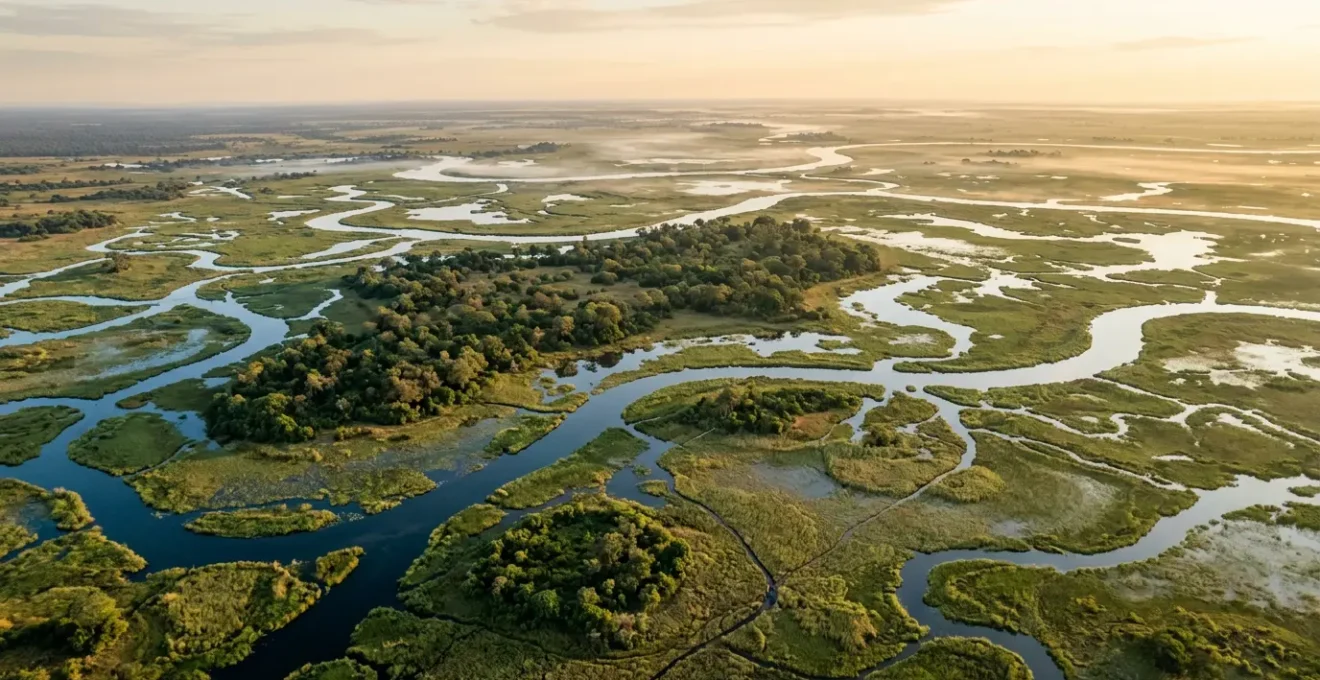
Choosing the right Okavango Delta region is less about the area and more about understanding the operational rules that define your entire safari experience.
- Private concessions (like those on Chief’s Island) offer unparalleled exclusivity—night drives, off-roading, and no crowds—in exchange for a higher cost.
- Water-based areas focus on a « micro-safari » experience via mokoro, prioritizing scenery and small details over high big game density.
Recommendation: Match the region to your primary goal: safari purity and big game (Chief’s Island) or immersive water wilderness (the Panhandle), and use provisional bookings to secure your choice.
The Okavango Delta presents a paradox of choice. As a first-time visitor, you’re faced with a mosaic of options—Chief’s Island, the Panhandle, Moremi, private concessions—all promising the safari of a lifetime. The vast price differences and conflicting advice can be paralyzing. Many guides will tell you that private concessions are exclusive and expensive while national parks are affordable and busy. This is true, but it’s a surface-level explanation that doesn’t help you make a confident decision.
But what if the key to choosing wasn’t about comparing lists of animals or camp photos? What if the most critical factor is understanding the operational reality on the ground? The rules governing a specific area—from vehicle limits to whether your guide can drive off-road—have a more profound impact on your experience than almost anything else. This isn’t just about picking a location; it’s about matching the region’s fundamental logistics to your personal definition of a perfect safari.
This guide moves beyond the ‘what’ to explain the ‘why’. We will decode the core differences in safari operations across the Delta, analyze the real value of conservation levies, and clarify the logistical imperatives like flight transfers. By the end, you will have a clear framework not just for choosing between Chief’s Island and the Panhandle, but for designing the Okavango journey that is unequivocally right for you.
To help you navigate these critical decisions, this article breaks down the essential factors that define an Okavango safari. The following sections provide clear, specialist answers to the most pressing questions first-time visitors face.
Summary: A Specialist’s Guide to Choosing Your Okavango Safari
- Why Private Concessions in the Delta Allow Night Drives but National Parks Don’t?
- Is Moremi Game Reserve Worth the Crowds Compared to Private Areas?
- Maun to the Delta: Is a Light Aircraft Transfer Mandatory?
- Do You Really Need Malaria Pills for the Okavango Delta in Winter?
- Why a Mokoro Trip Is Not About Viewing Big Game but Small Details?
- Is the Conservation Levy in Private Concessions Worth the Extra $100/Day?
- Why Are Hippos Called the « Architects of the Okavango Channels »?
- Provisional Bookings: How to Hold Safari Space While You Decide?
Why Private Concessions in the Delta Allow Night Drives but National Parks Don’t?
The ability to go on a night drive is one of the most significant distinctions between a private concession safari (common on Chief’s Island) and a stay in a national park like Moremi Game Reserve. The reason isn’t about wildlife; it’s about operational reality and land management. National Parks are state-owned lands with strict regulations designed to protect the environment and manage public access. This includes set gate times, meaning all vehicles must return to camp by sunset. Night drives are simply not permitted.
Private concessions, however, are vast tracts of land leased to single safari operators. This grants them the authority to set their own rules. With far fewer guests and vehicles, they can manage activities sustainably. They allow night drives using red-filtered spotlights, which minimize disturbance to wildlife, opening up a completely new world. This is when nocturnal predators like leopards, hyenas, servals, and genets are most active. This difference in regulation is fundamental to the safari experience you are paying for.
The following table, based on an analysis of operational rules, clarifies the key differences that stem directly from this public vs. private management model.
| Aspect | Private Concessions | National Parks |
|---|---|---|
| Vehicle Limits at Sightings | Maximum 3 vehicles | 5-10+ vehicles possible |
| Night Drives | Permitted with red-filter spotlights | Not permitted (park closes at sunset) |
| Off-Road Driving | Allowed for better sightings | Strictly prohibited |
| Walking Safaris | Available with trained guides | Limited or not available |
| Guest Density | 6-12 rooms per camp typical | Multiple lodges plus self-drive visitors |
This operational freedom is what creates the feeling of safari purity in a private concession. When your guide can drive off-road to get a better angle on a lion pride or track a leopard through the bush after dark, you are having an experience that is logistically impossible within the boundaries of a national park.
As you can see, the red light allows for intimate viewing without blinding the animal. This single activity—the night drive—fundamentally changes the value proposition, transforming the safari from a daytime activity into a 24-hour potential for discovery.
Is Moremi Game Reserve Worth the Crowds Compared to Private Areas?
Moremi Game Reserve is a spectacular wildlife area, often lauded for its high density of predators and diverse habitats. However, its status as a public national park means it faces a challenge that private concessions do not: crowds. The question of whether it’s « worth it » depends entirely on your tolerance for sharing sightings and your budget. In Moremi, there are no limits on the number of vehicles at a sighting. A leopard in a tree can quickly attract a convergence of safari vehicles from multiple lodges as well as self-drive tourists.
In contrast, private concessions enforce a strict protocol, typically allowing a maximum of three vehicles at any one time. This difference is not trivial. It changes the entire dynamic of a sighting from a public spectacle to an intimate encounter. According to research from African safari operators, it’s common for a single popular sighting in a national park to draw 5-10 vehicles, whereas private concessions guarantee an exclusive experience. This exclusivity is a primary component of the higher price tag.
For a first-time visitor, Moremi can be an excellent and more affordable introduction to the Delta’s wonders. The wildlife is undeniably superb. However, if your vision of a safari involves quiet moments alone with nature and unobstructed photographic opportunities, the extra cost for a private concession delivers on that promise. It’s a clear trade-off: volume of sightings versus quality of sightings.
Case Study: The Khwai Community Concession Model
The Khwai Community Area, which borders Moremi, offers a compelling hybrid model. As a community-owned concession, it operates under private concession rules, allowing night drives and limiting vehicle numbers. However, its proximity to Moremi ensures it shares the same high wildlife density. Visitors here report the best of both worlds: having exclusive sightings of leopards hunting at night with only one or two other vehicles, an experience that would be impossible just a few kilometers away inside the national park boundary.
Ultimately, Moremi is worth it if your budget is the primary driver and you are prepared for a more communal safari experience. If solitude and exclusivity are your non-negotiables, the investment in a private concession is justified.
Maun to the Delta: Is a Light Aircraft Transfer Mandatory?
For most of the Okavango Delta, particularly the premier wildlife areas like Chief’s Island, a light aircraft transfer is not a luxury—it is a logistical imperative. The Delta is a vast, seasonally flooded inland wetland with very few roads. During the high-water season (roughly June to August), many areas become a patchwork of islands completely surrounded by water, making land travel impossible. This is the fundamental reason for the prevalence of fly-in safaris.
According to operational data from African Bush Camps, an estimated 70% of the Okavango Delta is inaccessible by land, meaning the camps located deep within the wilderness require mandatory fly-in access. While some camps on the periphery of the Delta can be reached by a 4×4 vehicle, this often involves long, bumpy, and time-consuming journeys. A transfer that takes 30 minutes by air could take over six hours by road, consuming an entire day of your valuable safari time.
The flight itself is an integral part of the experience, offering breathtaking aerial views of the winding channels and scattered islands—your first game drive from the air. The choice between flying and driving is a calculation of time, cost, and access, as this comparison shows.
| Aspect | Light Aircraft (30 min) | Road Transfer (5-6 hours) |
|---|---|---|
| Cost | $200-400 per flight | $50-100 per vehicle |
| Time Lost | 30 minutes | Full day of travel |
| Safari Activities Same Day | Yes – afternoon game drive possible | No – arrival too late |
| Luggage Limit | 15-20kg soft bags only | No restrictions |
| Experience Value | Aerial safari views included | Extended game drive possible |
The strict luggage limitations on these flights are a critical planning point. To ensure a smooth transfer, packing correctly is essential. Here are the key guidelines:
- Use only soft-sided duffel bags, as hard suitcases cannot be loaded into the small aircraft holds.
- Adhere to the strict 15-20kg limit, which includes all hand luggage.
- Pack light, layerable clothing in neutral colours.
- Plan to use the lodge’s laundry services, which are often included, to reduce the amount you need to pack.
- Keep sensitive camera equipment in a padded carry-on bag.
Do You Really Need Malaria Pills for the Okavango Delta in Winter?
This is one of the most common medical questions for visitors to the Okavango, and the answer requires nuance. Officially, the Okavango Delta is a malarial region, and most travel doctors will recommend prophylaxis as a precaution. However, the actual risk of transmission varies dramatically with the seasons. Your decision should be an informed one, made in consultation with your doctor, weighing the low risk against the potential side effects of the medication.
During the dry winter months (May to August), the risk of malaria is exceptionally low. The reason is simple entomology: mosquitoes struggle to breed and survive in the cold, dry conditions. Seasonal data from Okavango camps confirms that pre-dawn temperatures can drop to 7°C (45°F), a level at which mosquito activity virtually ceases. In contrast, the hot and humid build-up to the rainy season (October-November) sees temperatures soar and mosquito populations increase, raising the transmission risk.
Many travelers find that the side effects of common antimalarials—such as vivid dreams from Malarone or increased sun sensitivity from Doxycycline—are more of a nuisance than the mosquitos themselves during winter. For this reason, many seasoned African travelers and local residents opt against medication in the winter, relying instead on a robust multi-layered prevention strategy. This includes using a good quality insect repellent with at least 30% DEET, wearing long sleeves and trousers at dawn and dusk (peak mosquito hours), and sleeping under the mosquito nets provided by all reputable lodges.
While the risk is never zero, a pragmatic approach based on the season is wise. For a winter safari, diligent physical prevention offers excellent protection with no side effects. For a summer safari, the addition of chemoprophylaxis becomes a much more important consideration.
Why a Mokoro Trip Is Not About Viewing Big Game but Small Details?
A mokoro trip—a glide through the Delta’s channels in a traditional dugout canoe—is an iconic Okavango experience. However, a common misconception is that it’s a water-based version of a game drive. Setting this expectation leads to disappointment. A mokoro trip is not about chasing big game; it is a micro-safari, a chance to slow down and immerse yourself in the intricate details of the ecosystem. It’s about trading the macro for the micro.
From the low, water-level vantage point, the world changes. Your focus shifts from the horizon to what’s right in front of you: the iridescent flash of a malachite kingfisher, a tiny painted reed frog clinging to a papyrus stalk, or the geometric perfection of a water lily. The silence, broken only by the gentle splash of the poler’s « ngashi » (pole), allows you to hear the Delta’s subtle soundtrack—the calls of birds, the buzzing of insects, and the rustle of the reeds.
This shift in perspective is what makes the experience so profound. You are no longer a spectator in a vehicle; you are a participant in the quiet flow of the Delta’s lifeblood. The polers, many from local Bayei or Hambukushu communities, grew up in these waterways and possess an incredible knowledge of its smaller inhabitants.
In a mokoro, you’re low in the water. The world feels larger. It’s not about getting anywhere fast. It’s about noticing—the way water lilies close at night, how frogs call just before dusk, the soft exhale of a hippo after sunset. These are the things guests remember.
– A Mokoro Guide, as told to Weewa Wild Adventures
Case Study: The Scientific Value of Silence
During a three-week bird census crossing the Delta by mokoro, researchers documented behaviour that is impossible to observe from a noisy motorboat or vehicle. The expedition’s complete silence allowed them to count over 400 bird species, including shy cranes and eagles that would typically flee. By becoming part of the scenery rather than intruders, the team could study natural interactions, proving that the quiet intimacy of a mokoro provides a scientifically valuable, and not just aesthetically pleasing, perspective.
Is the Conservation Levy in Private Concessions Worth the Extra $100/Day?
When looking at the cost of a private concession safari, the conservation levy, which can be up to $100 per person per day, often stands out. It’s easy to see it as just another charge, but understanding its purpose reveals its crucial role in the entire safari ecosystem. This levy is not a tourism tax; it’s a direct investment in the long-term survival of the wilderness you are there to enjoy. The « experience-per-dollar » here is measured in sustainability.
These funds are the lifeblood of the conservation model that makes private concessions so successful. They are funneled directly into essential on-the-ground operations that the government alone cannot fully support. This includes funding anti-poaching units that patrol vast areas, managing wildlife research projects (like rhino monitoring and reintroduction), and supporting community development initiatives in surrounding villages. This creates a virtuous cycle: tourism funds conservation, which protects the pristine environment, which in turn attracts tourism.
Without this revenue stream, the land’s economic value would plummet. The most likely alternative for these areas would be a conversion to cattle farming, a practice that is often detrimental to wildlife through habitat loss and conflict. In essence, the conservation levy is what keeps the wilderness wild. It is the price of ensuring that the elephants, lions, and leopards you see are protected and have a future.
Case Study: The African Bush Camps Foundation Impact
A tangible example is the work of the African Bush Camps Foundation. Every guest staying at their properties contributes USD $85 per night via a Community & Conservation Levy. This money directly supports anti-poaching patrols across 250,000 acres of wilderness, funds critical wildlife corridor research including the rhino reintroduction project on Chief’s Island, and finances education and healthcare projects for local communities. This demonstrates a clear and accountable link between your visit and the direct, positive impact on both wildlife and people.
So, is the levy worth it? If you value the very existence of the pristine, exclusive, and wildlife-rich environment that a private concession offers, then the answer is an unequivocal yes. You are not just a visitor; you are an active participant in its preservation.
Why Are Hippos Called the « Architects of the Okavango Channels »?
While elephants are often seen as the landscape engineers of the bush, in the Okavango Delta, that title belongs to the hippopotamus. Hippos are the true architects of the Delta’s intricate network of channels. Their immense size and repetitive behaviour are the primary forces that carve and maintain the waterways that are the very essence of this unique ecosystem. Without hippos, the Delta as we know it would not exist.
The process is straightforward but powerful. Every night, hippos leave the safety of the deeper pools to graze on the floodplains, often traveling several kilometers. They are creatures of habit, following the exact same paths night after night. The sheer pressure exerted by their two-ton bodies moving along these routes—these « hippo highways »—tramples the dense papyrus and reeds, compacting the sediment underneath. Over time, these paths become deeper and wider, forming permanent channels.
These hippo-created channels then act as the main arteries for water flow throughout the 15,000 square kilometer delta. When you glide through the reeds on a mokoro, you are, in most cases, following a path forged by generations of hippos. They are the original civil engineers of the Okavango, ensuring that water reaches new areas, replenishes floodplains, and sustains the entire ecosystem.
Case Study: Following the Hippo Highways
Expedition teams navigating the Delta by mokoro rely entirely on this hippo infrastructure. Guides explain how during expeditions, they deliberately follow the hippo trails in shallower areas, as these paths inevitably lead to deeper, navigable channels. Researchers have observed that as the annual floodwaters arrive from Angola, it is these hippo highways that dictate the new patterns of water flow, effectively designing the landscape for the coming season. Their constant movement keeps the channels open, preventing them from being choked by vegetation.
Recognizing the hippo’s role transforms your perception of them. They are not just large, water-loving mammals; they are the tireless, essential force that shapes and maintains the very structure of the Okavango Delta.
Key Takeaways
- The primary difference between safari areas is operational: private concessions allow exclusive activities like night drives and off-roading that are forbidden in national parks.
- A mokoro trip is a « micro-safari » for appreciating the small details and quiet beauty of the channels, not for chasing big game.
- Flying into the Delta is often a logistical necessity dictated by your camp’s remote location, not a luxury choice.
Provisional Bookings: How to Hold Safari Space While You Decide?
Now that you understand the key differences between the Delta’s regions, the final challenge is securing a spot. The best Okavango camps are small and intimate, often with only 4 to 12 rooms. This exclusivity means they get booked up very far in advance. In fact, booking data from luxury safari operators reveals that premier camps are often full 12-18 months in advance for the peak season (June-September). This is where the provisional booking, or « pro-hold, » becomes your most valuable strategic tool.
A provisional booking is a temporary, no-obligation hold that a tour operator can place on your behalf. It reserves your space at a camp for a set period, typically 7 to 14 days, without any financial commitment. This gives you a crucial window to make final decisions, coordinate international flights, and confirm other parts of your itinerary without the risk of losing your preferred accommodation. It effectively takes the pressure off, allowing for thoughtful planning instead of rushed decisions.
Using this system strategically is key to crafting the perfect trip. You can even hold space at a couple of different camps or for slightly different dates while you weigh your final options. Once you are ready, you simply instruct your operator to convert the hold to a confirmed booking by paying the deposit. If you decide against it, the hold is released automatically on its expiry date with no penalty. It is the industry’s indispensable tool for navigating the high demand for limited space.
Your Action Plan: The Strategic Provisional Booking Process
- Request provisional holds from 2-3 operators for different itinerary options simultaneously to compare.
- Confirm the exact release date (typically 7-14 days) and mark it in your calendar immediately.
- Use the hold period to finalize international flights and compare the total costs of your options.
- Ask if multiple camps from the same collection (e.g., all Wilderness Safaris camps) offer complimentary transfers when booked together.
- Convert to a confirmed booking by paying the deposit at least 48 hours before the release date to avoid losing your space.
To apply these strategies effectively, the next logical step is to engage with a destination specialist who can navigate the booking process, secure these holds on your behalf, and ensure your final choice perfectly aligns with your safari goals.
Frequently Asked Questions About The Okavango Delta
What is the actual malaria risk during winter months (June-August)?
During the dry winter months, mosquito populations drop to near-zero levels due to cooler temperatures (7°C at dawn) and lack of standing water, making transmission risk exceptionally low though not completely zero.
What are the main side effects of common antimalarials?
Malarone can cause vivid dreams and stomach upset, while doxycycline increases sun sensitivity – particularly problematic on safari. Many travelers experience these side effects more acutely than any mosquito encounters in winter.
What non-pharmaceutical prevention methods work best?
A multi-layered approach using high-DEET repellent (30%+), wearing long sleeves/pants at dawn and dusk, sleeping under treated mosquito nets, and choosing accommodation with screened windows provides excellent protection without medication side effects.