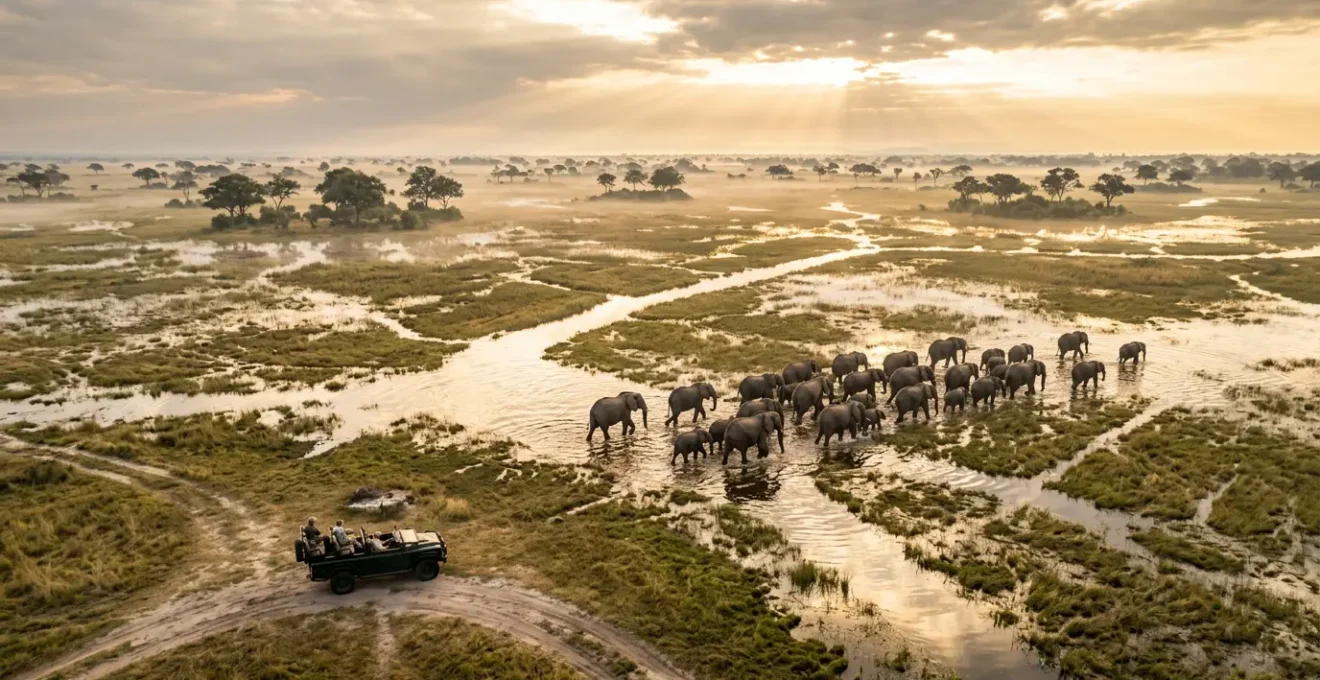
The transition to electric safari vehicles is more than an environmental upgrade; it represents a fundamental reprogramming of the wildlife viewing experience, creating a superior platform for observation and photography.
- EVs are powered by self-sufficient solar grids, creating a true operational symbiosis between the camp and its environment.
- The absence of engine vibration and noise not only allows for closer, less intrusive animal encounters but also unlocks a new level of sensory immersion and photographic stability.
Recommendation: For the tech-savvy traveler, the key is to look beyond « electric » as a label and seek out operators who have mastered the entire EV ecosystem—from charging infrastructure to guide training.
The quintessential safari experience is often defined by the deep, guttural rumble of a diesel Land Cruiser. It’s a sound synonymous with adventure, yet it’s also a constant audio intrusion. For decades, we’ve accepted that this engine noise is the price of admission to the wild. The conventional wisdom is to simply cut the engine at a sighting. But what if the entire approach—the very act of moving through the landscape—could be fundamentally different? The arrival of electric vehicles (EVs) on the safari scene is often heralded for one primary benefit: silence. This is presented as the key to getting closer to wildlife.
But this view is remarkably one-dimensional. The silence is not the end goal; it is merely the gateway. For the discerning traveler, photographer, and technology enthusiast, the electric revolution is about a complete paradigm shift. It’s about expanding the sensory bandwidth of the safari, replacing the engine’s roar with the subtle soundscape of the bush. It’s about the engineering reality of instantaneous torque on challenging terrain and the creation of a perfectly stable photographic platform. This isn’t just about swapping a combustion engine for a battery; it’s about a ground-up redesign of the mobile-hide concept.
This article will deconstruct the electric safari ecosystem from an engineering-first perspective. We will explore how these vehicles are charged in total isolation, how their performance characteristics create new opportunities, why they alter animal behavior, and what this all means for the future of ethical and immersive wildlife observation. We will move past the marketing-friendly « silent safari » and into the technical specifics that make this technology a true game-changer.
This in-depth exploration will guide you through the technical and practical realities of the electric safari revolution. The table of contents below outlines our journey from the remote power grid to the camera lens.
Table of Contents: A Deep Dive into the Electric Safari Ecosystem
- How Do Camps Charge Electric Jeeps in the Middle of the Bush?
- Why Are Electric Vehicles a Game Changer for Audio-Birding?
- Can an Electric Safari Vehicle Last a Full Day Drive on Deep Sand?
- Do Animals React Differently When a Vehicle Has No Engine Noise?
- Is It Better to Buy New EVs or Retrofit Old Land Cruisers?
- How Close Can You Legally Get to an Elephant in Chobe?
- Can You Use a Hairdryer in a 100% Solar Powered Camp?
- Which Camera Lens Is Essential for Big Five Viewing in the Okavango?
How Do Camps Charge Electric Jeeps in the Middle of the Bush?
The most pressing logistical question for any EV operation is « where do you plug it in? » In the heart of the African bush, hundreds of kilometers from the nearest national grid, the answer lies in creating a completely self-sufficient energy ecosystem. This is where the concept of operational symbiosis comes into play. Modern safari camps are becoming high-tech, off-grid power stations, with the safari vehicles as a core component of their energy strategy.
The backbone of this system is a vast solar array. These are not just a few panels on a roof; they are substantial solar farms engineered to power the entire lodge and its fleet. For instance, the groundbreaking infrastructure at a camp like Cheetah Plains showcases the scale required; its solar setup includes over a thousand panels. This installation is so robust that advanced reports show Cheetah Plains’ solar infrastructure generates an average of 550MWh per annum, offsetting enormous amounts of CO2. At pioneering camps like Natural Habitat Adventures’ base in the Okavango Delta, vehicles return from a game drive and plug directly into a dedicated solar-powered charging station, replenishing their batteries with 100% renewable energy.
The daily energy budget is meticulously calculated. A vehicle doesn’t need a « full-to-empty » charge every day. As Peter Dros, a leader in the luxury safari space, explains, the charging strategy is based on actual usage.
The charging of vehicles is based on distance travelled. One fully-charged battery normally lasts about 70 – 90 kilometers. A game drive is normally around 25-30 kilometers.
– Peter Dros, Head of Sales and Marketing at Cheetah Plains
This means a typical morning or evening drive uses only a fraction of the battery’s capacity. The vehicle is then topped up during the day’s long midday break, powered entirely by the sun. This creates a closed-loop system where the energy for motion is harvested directly from the environment the vehicle explores, representing the pinnacle of sustainable-tech tourism.
Why Are Electric Vehicles a Game Changer for Audio-Birding?
For the general safari-goer, silence is a pleasant bonus. For the serious birder, it’s a quantum leap in capability. Birding is an acoustic sport as much as a visual one; identifying a species often starts with hearing a faint, distant call. A diesel engine, even at idle, produces a constant, low-frequency rumble that masks the very sounds birders travel across the world to hear. It effectively shrinks the audible world to a small radius around the vehicle.
An EV, by contrast, is acoustically transparent. When stationary, its vibrational signature is zero. This expands the listener’s sensory bandwidth, allowing them to detect the subtle rustle of a green-capped eremomela in a nearby bush or the high-pitched call of a raptor miles away. You are no longer a noisy observer passing through the environment; you are an integrated, silent part of it. This allows for the identification of shy, rare, and cryptic species that would be completely missed from a traditional vehicle.
The technical efficiency of the electric powertrain is the enabler of this experience. A standard internal combustion engine is notoriously inefficient, wasting most of its energy as heat and noise. Electric motors are the opposite, converting almost all stored energy directly into motion. This inherent efficiency is what produces the profound silence that audio-birders can leverage. It’s a direct link between superior engineering and a richer, more detailed connection to the natural world.
Can an Electric Safari Vehicle Last a Full Day Drive on Deep Sand?
A common concern for any prospective EV safari is range anxiety, compounded by the demanding African terrain. The image of being stranded by a dead battery among a pride of lions is a powerful deterrent. However, this fear is largely based on a misunderstanding of modern battery capacity and the superior physics of electric powertrains in challenging conditions like deep sand.
Firstly, the range of a modern, professionally converted safari EV is more than sufficient for even the longest game drives. A vehicle equipped with a robust battery pack can comfortably achieve a range that far exceeds the typical 50-60 kilometers covered in a full day of morning and afternoon drives. The key is the powertrain’s efficiency in converting energy to motion.
Secondly, and more counter-intuitively, electric motors are superior to diesel engines in low-traction environments. The defining challenge of driving on deep sand is maintaining consistent momentum without spinning the wheels. Diesel engines deliver power in rough, uneven pulses. Electric motors, on the other hand, provide instantaneous and infinitely variable torque. A skilled guide can apply precisely the right amount of power to each wheel, allowing the vehicle to « float » over the sand with minimal disturbance. This superior energy-to-torque conversion is a fundamental engineering advantage.
Case Study: The Nuance of EV Weight in Mud
While EVs excel in sand, their performance in deep mud introduces a critical trade-off. The heavy battery systems, while providing a low center of gravity, can cause the vehicle to sink more readily than a lighter diesel counterpart in saturated black-cotton soil. While modern EVs and high-quality retrofits handle mud exceptionally well, logistics for recovery are more complex due to the sheer weight. In scenarios of continuous, deep-mud operations, some operators find that the range reliability and lighter weight of traditional diesel 4WDs still present a pragmatic advantage.
This demonstrates that while EV technology is a massive leap forward, its application requires a deep understanding of the specific environmental context. It’s not a magic bullet, but a specialized tool that, in most safari conditions, outperforms its predecessor while offering zero emissions and silence as a bonus.
Do Animals React Differently When a Vehicle Has No Engine Noise?
This is the central question of the silent safari promise. The answer is an emphatic yes, but the reasons are more complex than simply the absence of noise. Wildlife does not perceive a diesel vehicle as a single entity. They perceive a multi-sensory assault: the loud, unpredictable sound of the engine starting and stopping, the smell of exhaust fumes, and the ground-level vibrations transmitted through the soil. This combination triggers a flight-or-fight response, as it signals an unnatural, large, and potentially predatory presence.
An electric vehicle fundamentally alters this interaction. By moving almost silently and with a dramatically lower vibrational signature, it doesn’t trigger the same innate alarm bells. It is perceived less as a threat and more as a benign, neutral part of the landscape. This is especially true for more sensitive or skittish species, but even large, confident animals like elephants react differently.
As we came to a stop near an elephant, the animal wasn’t spooked – thanks to the silence of electric safari vehicles
– Discover Africa, The Rise of Silent Safaris article
The result is not just about getting physically closer. It’s about observing more natural behavior. Animals continue their routines—grazing, playing, interacting—as if the vehicle isn’t there. For a photographer or a wildlife enthusiast, this is the ultimate goal: to witness authentic moments, not moments tainted by the stress of our own presence. The silence of the EV allows the safari-goer to become a ghost, a passive observer rather than an active intruder. The experience shifts from « looking at » animals to « being with » them.
Is It Better to Buy New EVs or Retrofit Old Land Cruisers?
As the benefits of electric safaris become undeniable, operators face a crucial strategic and financial decision: invest in brand-new, purpose-built electric safari vehicles, or convert their existing, trusted fleet of diesel Land Cruisers? From a purely futuristic standpoint, a new vehicle seems ideal. However, the on-the-ground reality in Africa makes retrofitting a technologically, economically, and sustainably superior choice in many cases.
The primary driver is economics. A new, specialized EV from a manufacturer like Rivian can cost well over $100,000, and that’s before factoring in high import duties on complete vehicles in many African countries. In contrast, leading conversion kits from companies like Opibus (now Roam) make it possible to electrify a classic Land Cruiser. According to reports, it can cost around US$37,000 to convert a vehicle. This is a massive capital expenditure saving, especially when scaling across an entire fleet.
The following is a breakdown of the key factors involved, based on a detailed economic comparison of the two approaches.
| Factor | New EV | Retrofit |
|---|---|---|
| Initial Cost | $100,000+ | $37,000-$60,000 |
| Import Duties | High on complete vehicles | Lower on conversion kits |
| Local Support | Limited in remote Africa | Existing Land Cruiser expertise |
| Sustainability | New manufacturing footprint | Reuses existing assets |
Beyond cost, retrofitting leverages a critical asset: decades of local mechanical expertise with the Toyota Land Cruiser. The chassis, suspension, and body are legendary for their durability and simplicity. Every bush mechanic knows them inside and out. By only swapping the powertrain, operators retain this ecosystem of support, which is vital for maintenance in remote locations. It also aligns with circular economy principles by giving a second, zero-emission life to an existing, perfectly functional asset, which is a powerful sustainability story.
Therefore, while new EVs are sleek and impressive, the pragmatic and often more sustainable path for the African safari industry is the electrification of its proven workhorses. It’s a solution born of the bush, for the bush.
How Close Can You Legally Get to an Elephant in Chobe?
The quiet approach of an electric vehicle can be deceptive. Because animals react less, it’s tempting for an inexperienced guide to push the boundaries and get closer than is safe or ethical. This is where technology must be paired with an even greater level of discipline and training. The absence of an engine’s roar as a yardstick means guides must rely more heavily on visual cues and a deep understanding of animal behavior.
In national parks like Chobe in Botswana, regulations are in place to protect both wildlife and tourists, regardless of vehicle type. A general rule is to maintain a minimum distance of 50 meters from elephants. However, this is a baseline, not a target. The real art of guiding is reading the animal’s state. An elephant’s body language—a flap of the ears, a turn of the head, a subtle stiffening of the posture—provides clear signals of comfort or stress. A silent EV allows these signals to be observed without the corrupting influence of engine noise, but it also places a greater responsibility on the guide to interpret them correctly.
Furthermore, many conservancies impose their own strict rules to prevent overwhelming animals. For instance, it’s common practice to enforce a maximum of three vehicles at any sighting. The quiet nature of EVs doesn’t give a pass on this rule; in fact, it makes adherence even more critical to maintain the quality of the sighting. The goal is not to use silence to crowd an animal, but to use it to observe from a respectful distance without causing a disturbance.
Your Action Plan: The Silent Approach Protocol
- Respect Regulations: Strictly maintain the minimum 50-meter distance as per park regulations as a starting point.
- Read the Animal: Prioritize observing the elephant’s body language for stress signals, as traditional engine habituation cues are absent.
- Use Visual Gauges: Rely on visual positioning and rangefinders rather than engine noise to judge a safe and respectful distance.
- Limit Vehicle Numbers: Adhere to the « maximum 3 vehicles per sighting » rule to prevent overwhelming wildlife with your silent presence.
- Account for Surprise: Consider maintaining a slightly greater distance with EVs, as the lack of auditory warning can startle an animal if approached too quickly.
Ultimately, the privilege of a silent approach comes with the heightened responsibility of ethical conduct. The technology is a tool, but the guide’s expertise and respect for the wildlife remain the most important elements of the encounter.
Can You Use a Hairdryer in a 100% Solar Powered Camp?
This seemingly trivial question cuts to the core of energy discipline in an off-grid environment. The answer is almost universally no, and it provides a powerful lesson in the physics of power consumption. A camp’s solar grid, even one as robust as Cheetah Plains’ 330kWp installation, operates on a strict energy budget. It’s designed to power essential services and, crucially, recharge the multi-ton safari vehicles. Every watt is accounted for.
The problem with a hairdryer isn’t just that it uses electricity; it’s the *way* it uses it. Hairdryers, along with other appliances that generate heat (like electric kettles or irons), are « high-draw » or « resistive load » devices. They demand a massive, instantaneous surge of power, often 1,800 to 2,000 watts. This single appliance can momentarily consume more power than all the LED lights, refrigerators, and charging laptops in the entire camp combined.
In a domestic setting connected to a national grid, this surge is unnoticeable. In a closed-loop solar system, it’s a critical drain on the batteries, directly competing with the energy needed for the next day’s game drives. Using a high-draw appliance for just 10 minutes could consume the equivalent power needed to drive a safari vehicle for several kilometers. Therefore, camps strictly prohibit them to protect the integrity of the entire system. It’s a matter of prioritizing power for the core mission: exploration and wildlife viewing. This is a non-negotiable aspect of the technological contract of staying at a truly remote, solar-powered lodge.
Key Takeaways
- The electric safari ecosystem is a closed-loop system where vehicles are powered by dedicated, off-grid solar farms, creating true operational sustainability.
- Silence is just the beginning; the primary benefits for enthusiasts are the expanded sensory bandwidth for hearing wildlife and the superior stability of the EV as a photographic platform.
- Retrofitting existing Land Cruisers is often the more pragmatic, economical, and sustainable choice for operators compared to purchasing new EVs, leveraging local expertise and a circular economy model.
Which Camera Lens Is Essential for Big Five Viewing in the Okavango?
For the photographer, the safari vehicle is more than transport; it’s a mobile hide and a camera platform. The shift to electric vehicles represents the single greatest hardware upgrade to this platform in a generation. The choice of lens remains critical, but the EV’s characteristics allow you to use that lens in new and more effective ways.
A versatile zoom lens like a 100-400mm or a 200-600mm remains the gold standard for its flexibility. It allows you to capture wide, environmental portraits and also zoom in for tight details on a leopard’s eye or a lion’s scar. However, the EV enhances its utility. Because silent approaches often result in closer encounters, you may find yourself using the wider end of the zoom more frequently than you would in a diesel vehicle.
The most significant advantage, however, is the creation of a perfect platform stability. The constant, subtle vibration of an idling diesel engine forces photographers to use faster shutter speeds to avoid motion blur, which in turn requires a higher ISO in low light, degrading image quality. As Go2Africa’s experts note, this is a major technical frustration.
Wildlife photographers will also love the total absence of shuddering start-ups and jerky gear changes that are synonymous with diesel-powered 4×4 safari vehicles.
– Go2Africa, The Future of Luxury African Safaris
With an EV, the platform is rock-solid. This allows a photographer to confidently shoot at slower shutter speeds (e.g., 1/125s instead of 1/500s) during the golden hours of dawn and dusk, using a lower ISO for cleaner, sharper images. Heavy, cumbersome beanbags become less necessary, and capturing smooth, stable video footage becomes dramatically easier. You can even add an external microphone to your camera setup to capture the high-fidelity ambient sounds that the EV allows you to hear, adding another layer to your storytelling.
To experience this technological leap firsthand, the next logical step is to seek out camps and operators who have invested in a fully integrated electric safari ecosystem, ensuring your next adventure is at the forefront of wildlife viewing technology.