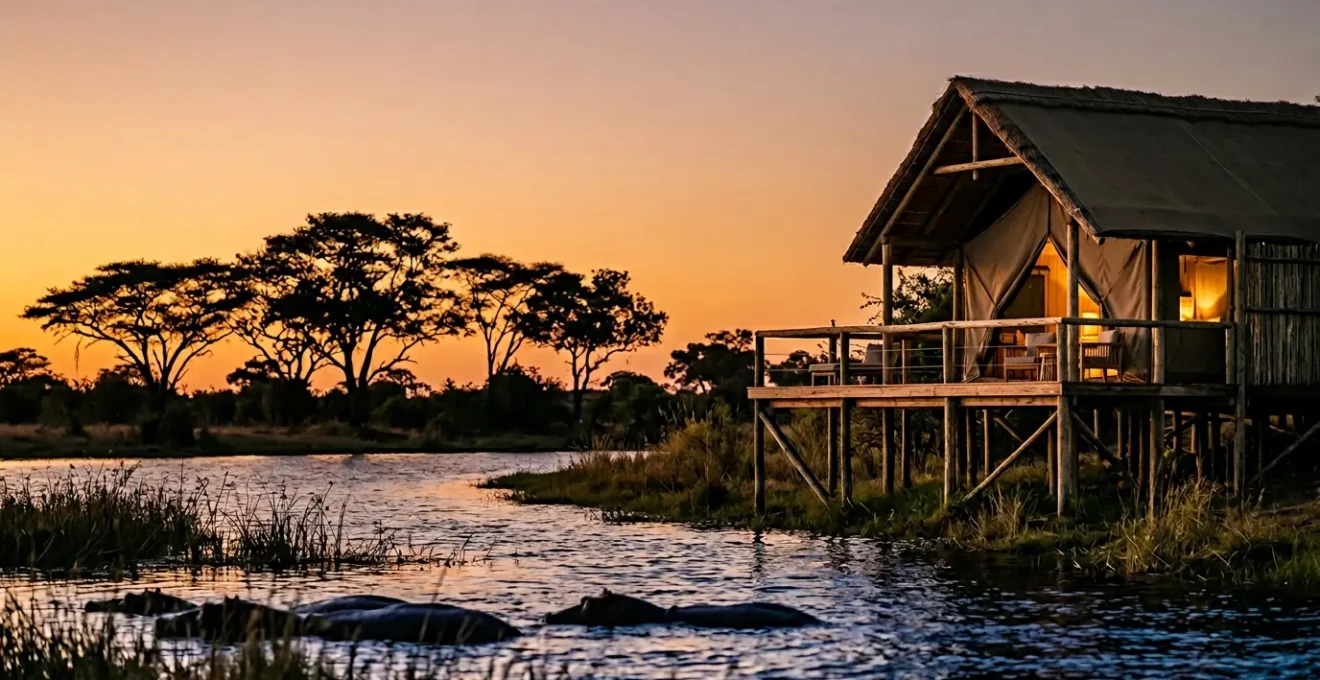
A riverfront suite isn’t about embracing risk; it’s about experiencing engineered safety that fundamentally enhances your connection to the wild.
- Architectural intelligence, using elevation and strategic orientation, provides a secure and private buffer from wildlife without sacrificing the view.
- Understanding and respecting animal behavior, from hippo vocalizations to herd movements, is the foundation of a modern lodge’s safety protocols and design.
Recommendation: When choosing your safari, look for a lodge that showcases its seamless integration with the environment; this is the truest indicator of a safe, authentic, and unforgettable experience.
The allure of a riverfront safari suite is undeniable: an uninterrupted tableau of Africa’s wilderness unfolding from your private deck. Yet, for many thoughtful travelers, this dream is tinged with a specific anxiety. The very proximity to the water that promises spectacular elephant sightings also means sharing the neighborhood with one of the continent’s most formidable animals: the hippopotamus. The question is a valid one: how can you truly relax when a creature known for its power and territorial nature is just a stone’s throw away?
The common assumption is that safety is a matter of barriers—thicker walls, higher fences, and a general sense of being fortified against the wild. But this misses the profound elegance of modern safari lodge design. The secret to safety and serenity in these incredible locations isn’t about separation; it’s about intelligent integration. As a lodge designer, my primary role is to balance the thrill of proximity with the absolute necessity of security, using architecture and a deep understanding of the ecosystem as my primary tools.
This guide moves beyond the simplistic reassurances. We will explore how thoughtful design transforms potential concerns into sources of wonder. We will demystify the sounds you’ll hear, explain the principles of passive safety that keep you secure, and reframe the mighty hippo not as a threat to be feared, but as a key architect of the very landscape you’ve come to admire. The ultimate luxury, you’ll find, is not being isolated from nature, but being a safe and respectful guest within it.
This article provides a detailed look into the design and safety considerations that make riverfront suites a premier safari choice. We’ll cover everything from the acoustics of the wild to the structural integrity of your suite during flood season.
Summary: A Designer’s Perspective on Riverfront Living
- Can You Sleep Through the Sound of Hippos Grazing Next to Your Room?
- How Do Lodges Ensure Privacy in Suites with Open Walls Facing the River?
- Does Being on the Riverfront Lower the Room Temperature naturally?
- What Animals Can You Expect to See from Your Riverfront Deck?
- Are Riverfront Suites Safe During the High Flood Season?
- How Do Luxury Tents Stay Cool in Summer Without Air Conditioning?
- Why Are Hippos Called the « Architects of the Okavango Channels »?
- Motorboat Safari: How Is It Different from a Mokoro or Game Drive?
Can You Sleep Through the Sound of Hippos Grazing Next to Your Room?
The nighttime soundscape of the African bush is an immersive symphony, and hippos are its bass section. A primary concern for guests is whether this natural soundtrack will be disruptive. The deep, resonant honks and grunts are indeed powerful; hippo vocalizations can reach 115 decibels, comparable to a loud rock concert. However, these sounds are rarely a constant barrage. They are part of a rhythmic, ambient backdrop that most guests find deeply soothing rather than alarming.
The key is understanding what you’re hearing. Far from being a sign of imminent danger, these sounds are the language of the river. Disentangling the different vocalizations transforms potential anxiety into a fascinating listening experience. It’s the difference between hearing a meaningless noise and listening to a conversation. Well-designed lodges often provide information to help guests interpret this nightly performance.
To help you become an expert listener from your deck, here is a simple guide to hippo communication:
- Deep grunts and honks: These are often territorial displays between males, establishing dominance over a stretch of the river.
- Soft breathing sounds: When hippos are resting in the water at night, their rhythmic breathing creates a gentle, almost meditative ambient noise.
- Roars and growls: More intense and less common, these sounds usually signal aggressive interactions or fights with rivals, typically happening further out in the main channels.
- Wheezing and chuffing: This is general « chatter » within the pod, a form of social communication that is constant but rarely loud.
Ultimately, sleeping through hippo sounds is a matter of acclimatization and perspective. What might seem loud on the first night often becomes a comforting, integral part of the safari experience by the second, a powerful reminder that you are truly in the wild.
How Do Lodges Ensure Privacy in Suites with Open Walls Facing the River?
The concept of a suite with « open walls » or vast expanses of mesh and glass facing a river can seem counterintuitive to privacy. The solution lies not in high walls, but in strategic orientation and natural screening. Lodge designers meticulously study the site, considering sightlines from the river, neighboring suites, and common areas. Each suite is angled precisely to maximize its private view while blocking views into it.
This architectural foresight is complemented by the landscape itself. Existing trees, termite mounds, and natural variations in terrain are used as organic screens. Where nature doesn’t provide, indigenous, water-wise vegetation is planted to create a living barrier that enhances the habitat rather than detracting from it. The goal is to create a feeling of complete seclusion, where your only observers are the passing elephants and birds.
The effectiveness of this approach is remarkable. At pioneering lodges like the Sandibe Okavango Safari Lodge, the design is so integrated into the environment that it becomes almost invisible to wildlife. As noted in an architectural review, the success is demonstrated by the fact that animals « continue to use the site with such disregard for the buildings that they might not see them at all. » This is the pinnacle of private, immersive design: you can see the wild, but it remains undisturbed by, and largely unaware of, your presence. This creates a one-way mirror effect, where the wilderness is your theatre, but you are not on stage.
Does Being on the Riverfront Lower the Room Temperature naturally?
Yes, a riverfront location is a key element of a lodge’s passive cooling strategy, offering a significant advantage in a climate where daytime temperatures can soar. For context, summer temperatures in parts of Southern Africa can reach 40°C (104°F). The proximity to a large body of water helps mitigate this heat in several ways.
Firstly, the process of evaporation from the river’s surface has a natural cooling effect on the immediate air. Breezes coming off the water are consistently cooler than those blowing across the dry inland savanna. Lodges are designed to capture and channel these breezes. Features like floor-to-ceiling mesh screens, strategically placed louvred windows, and open-plan layouts encourage cross-ventilation, allowing the cool air to flow through the suite and push warmer air out.
Secondly, the design of the suite itself works in concert with the riverside location. Deep, shaded verandas and overhanging thatched roofs prevent the harsh midday sun from directly hitting the main living areas, keeping the interior cool. The use of natural materials like wood, thatch, and canvas, which have a lower thermal mass than concrete or brick, means the structure doesn’t absorb and retain heat throughout the day. This approach to passive cooling is not only energy-efficient but also central to the ethos of sustainable tourism, where lodges are seen as having a profound « environmental responsibility. » It’s about creating comfort through intelligent design, not just by turning on an air conditioner.
What Animals Can You Expect to See from Your Riverfront Deck?
A riverfront deck is not just a place to relax; it is a private, front-row seat to one of the greatest shows on Earth. The river is the lifeblood of the ecosystem, drawing a constant procession of wildlife throughout the day and night. Unlike a game drive, which offers a snapshot in time, your deck provides a 24-hour viewing platform, revealing the changing rhythms of the bush. The experience is one of patient observation, where the world comes to you.
The cast of characters is diverse and ever-changing. You can expect to see large breeding herds of elephants coming to drink and play, their social dynamics on full display. Buffalo approach the water’s edge more cautiously, ever-watchful of the crocodiles that patrol the banks. The birdlife is extraordinary, from the flash of a malachite kingfisher to the majestic silhouette of a fish eagle. And of course, there are the hippos, who spend up to 16 hours a day submerged to stay cool, their heads dotting the water’s surface.
The spectacle continues after dark. As hippos leave the water to graze, often audibly munching on grasses near your suite, the nocturnal world awakens. You might spot the shy genet or a wide-eyed bushbaby on your deck railings. The wildlife viewing from your suite follows a predictable, yet always thrilling, schedule:
- Dawn (5:00-7:00): Hippos returning to the safety of the water as the bush awakens with a chorus of birdsong.
- Morning (7:00-11:00): Elephants arriving for their morning drink and bath, often with young calves in tow.
- Midday (11:00-15:00): A quieter time for land animals, but perfect for watching hippos and crocodiles in the water.
- Late Afternoon (15:00-18:00): The « golden hour » brings herds of buffalo, zebra, and various antelope species to the river’s edge.
- Dusk (18:00-20:00): The moment hippos begin to emerge from the water to start their nightly foraging.
- Night (20:00-5:00): The domain of nocturnal creatures, with sounds of grazing hippos and the potential for a leopard to come for a silent drink.
Are Riverfront Suites Safe During the High Flood Season?
The idea of seasonal floods can be alarming, conjuring images of rising water levels. However, in ecosystems like the Okavango Delta, the annual flood is not a destructive event but a life-giving pulse that the entire landscape—and the safari lodges within it—is designed to embrace. The high flood season, which often peaks during the dry winter months from the Okavango Delta’s flood season from May to September, transforms the environment into a breathtaking water wonderland.
Lodge safety during this period is guaranteed by a simple but effective architectural principle: engineered elevation. Riverfront suites are not built at ground level. They are constructed on sturdy wooden or steel stilts, raising the entire structure well above the highest recorded flood lines. This stilted design has a dual benefit. Primarily, it ensures the suite remains completely safe, dry, and secure, regardless of the water level below. The engineering is precise, based on decades of hydrological data.
Secondly, it creates a magical experience for the guest. As the floodwaters rise, the lodge appears to « hover magically over the water. » The connection to the aquatic environment becomes absolute. Instead of walking on paths, you move along elevated wooden walkways that connect the suites, with the gentle lapping of water beneath you. During this time, activities adapt; mokoro (dugout canoe) and motorboat excursions often depart directly from the main lodge deck, turning the entire camp into a seamless gateway to the flooded plains. This design doesn’t just withstand the flood; it celebrates it, turning a potential hazard into the very essence of the safari experience.
How Do Luxury Tents Stay Cool in Summer Without Air Conditioning?
While some lodges feature solid-walled suites, many premier riverfront accommodations are luxury tents. Staying cool inside a tent in the African sun without relying on power-hungry air conditioning is a masterclass in passive design. The solution involves a multi-layered approach that works with natural elements to maintain a comfortable internal temperature.
The first and most critical element is the double-skin construction. A luxury safari tent is not a single layer of canvas. It consists of an inner tent, which is your living space, and an outer « flysheet » stretched over the top, with a significant air gap in between. This outer layer absorbs the direct solar radiation, while the air gap acts as an insulator, preventing that heat from transferring to the interior. This is the same principle used in a thermos flask.
Ventilation is the second key. Large, floor-to-ceiling mesh panels (often behind canvas flaps you can roll up) allow for maximum airflow. Because a riverfront location benefits from cooler breezes, these panels are positioned to capture that airflow, creating constant cross-ventilation. Furthermore, many tents feature ventilation flaps near the apex of the roof. As hot air naturally rises, it escapes through these top vents, drawing cooler air in from the lower windows and creating a continuous, natural convection cycle. This is especially important as the « sunshine reflecting off water surfaces means additional cooling considerations are needed. » The design must manage both direct sun from above and reflected heat from below.
Your Passive Cooling Checklist: What to Look For
- Structural Design: Is the tent a double-skin design with a separate outer flysheet? Look for the visible air gap between the two layers.
- Ventilation Points: Are there large, screened « windows » on at least two opposing walls to allow for cross-breeze?
- Roof Vents: Check for small, protected vents at the highest point of the tent’s roof to let hot air escape.
- Shading: Is the tent situated under a larger shade structure or mature trees? Does it have a deep, shaded veranda?
- Material & Color: Is the outer canvas a light, heat-reflecting color (like beige or off-white) rather than a dark, heat-absorbing one?
Key Takeaways
- Safety in riverfront suites comes from smart design (elevation, orientation), not just fences or walls.
- Understanding the river’s ecosystem, including hippo behavior and sounds, is integral to the lodge’s design and enhances your experience.
- The proximity to water offers unique benefits, from natural cooling to unparalleled, 24/7 wildlife viewing opportunities directly from your deck.
Why Are Hippos Called the « Architects of the Okavango Channels »?
Viewing hippos from the safe elevation of your suite allows for a profound shift in perspective: you begin to see them not as individual threats, but as a powerful, collective force of nature. In ecosystems like the Okavango Delta, hippos are a keystone species, meaning their activities fundamentally shape and maintain the environment for countless other animals. Their title, « Architects of the Okavango, » is not a metaphor; it is a literal description of their ecological role.
The vast, intricate network of channels and waterways that makes the Delta navigable is not a static feature. It is actively created and maintained by hippos. Every night, these massive animals—weighing up to 1,500 kg—leave the main rivers to graze on floodplain grasses, often traveling several kilometers. In doing so, they forge deep, wide paths through the dense papyrus and reeds. These « hippo highways » become new channels for water to flow through. Without this constant activity, many of the smaller channels would quickly become overgrown and blocked.
This ecological engineering has a cascading effect. As noted by conservation researchers, « the maze of channels in the flooded Okavango Delta is created by hippos as they move from water to dry land. » These same channels are then used by other large animals, such as elephants, who help keep them open and free of obstructions. The channels also create diverse habitats for smaller creatures, from reed frogs to water birds, and provide deeper pools where fish can survive during drier periods. Even their dung is a vital source of nutrients (silica) that feeds the entire aquatic food web.
By choosing a riverfront suite, you are not just observing hippos; you are witnessing a fundamental, ecosystem-shaping process in real-time. This understanding transforms the hippo from a simple checklist sighting into a deeply respected, integral part of the landscape’s magic.
Motorboat Safari: How Is It Different from a Mokoro or Game Drive?
Your riverfront suite is the perfect base for exploring the wilderness, but the way you explore it dramatically changes your perspective. While a traditional game drive covers terrestrial habitats, water-based safaris offer a completely different experience. The two primary modes are the silent, intimate mokoro and the faster, more powerful motorboat. Understanding their differences is key to planning a comprehensive safari itinerary.
A motorboat safari allows you to cover large distances on the main, deep-water channels and open lagoons. It offers a water-level perspective on big game. This is the best way to safely navigate hippo and crocodile-dense waters, observing pod dynamics up close. It also provides excellent opportunities to photograph birds in flight and see elephants swimming. While motorboats cannot access the Delta’s narrowest, shallowest channels, they are uniquely able to « hop onto small islands for walking safaris, » offering a multi-faceted exploration. The hum of the engine is a constant, but it allows for rapid repositioning to get the best angle on the action.
The mokoro, a traditional dugout canoe poled by an expert guide, is the polar opposite. It is an experience of near-total silence and intimacy. You glide slowly through the shallow, narrow channels that hippos create, channels inaccessible to motorboats. This brings you eye-to-eye with the smaller wonders of the Delta: painted reed frogs, delicate waterlilies, and shy water birds. It’s a meditative journey that connects you to the subtle details of the ecosystem. The following table provides a clear comparison:
| Aspect | Game Drive | Motorboat Safari | Mokoro |
|---|---|---|---|
| Speed | Variable (0-40 km/h) | Moderate (10-30 km/h) | Slow (2-5 km/h) |
| Coverage | Wide terrestrial areas | Main channels & lagoons | Narrow, shallow channels |
| Noise Level | Engine rumble | Motor hum with water | Near silence |
| Viewing Angle | Elevated, wide-angle | Water level, panoramic | Low, intimate |
| Wildlife Access | Woodlands, grasslands | Aquatic species, hippos | Reed frogs, water birds |
| Photography | Stable for telephoto | Good for action shots | Best for reflections |
As this comparative analysis of safari activities shows, each mode offers a unique and complementary view of the Okavango. A great itinerary includes all three, giving you a complete picture of this complex and beautiful world from land, fast-flowing river, and quiet channel.
To truly experience the Okavango’s magic, the next step is to choose the safari activities that align with your interests, transforming your spectacular room view into an interactive adventure.