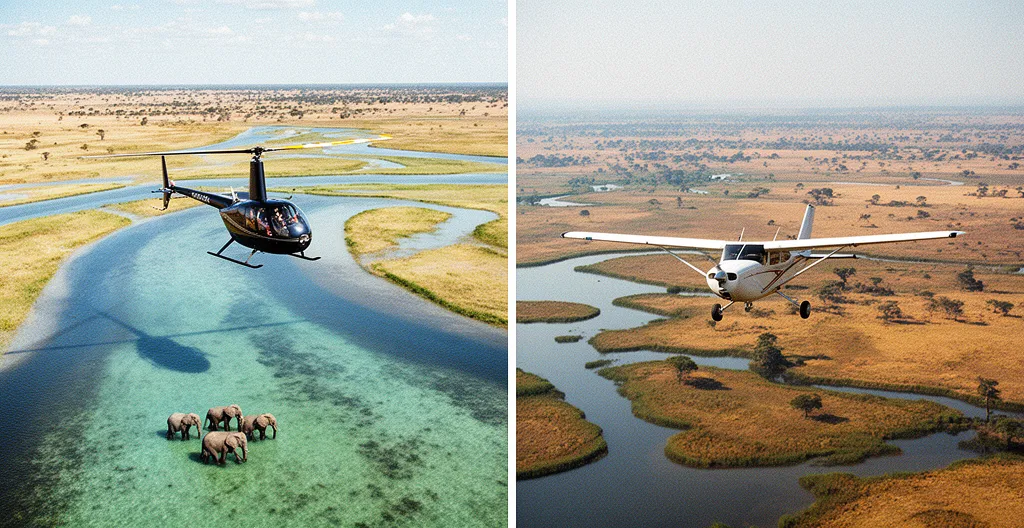
The choice between a helicopter or a fixed-wing plane is not about which is ‘better,’ but which is the right tool for your specific photographic mission.
- Helicopters offer unparalleled control for detailed, low-altitude shots of individual animals and textures, making them ideal for professional-grade portfolio work.
- Fixed-wing aircraft provide a cost-effective way to capture the grand scale and abstract patterns of the Delta, perfect for landscape and geographical context.
Recommendation: Define your primary shot—intimate wildlife portrait or vast landscape pattern—before you book. This single decision will determine your ideal aerial platform.
The promise of an aerial view over the Okavango Delta is what draws so many photographers to this corner of Botswana. It’s the vision of that one perfect frame: a lone elephant crossing a shimmering floodplain, vast herds of buffalo carving paths through the reeds, or the abstract, painterly patterns of the waterways from above. The common wisdom simply pits the low-flying helicopter against the high-altitude, cost-effective plane. But for a photographer, this is a gross oversimplification. The decision is far more nuanced, a strategic choice that directly impacts the creative potential of your flight.
This isn’t just a tour; it’s a photographic mission. Success depends on understanding how each aerial platform behaves, the quality of light at different times of day, and what you can realistically capture from your seat. Thinking about the aircraft as an extension of your camera, rather than just a mode of transport, is the key. It’s about matching the machine’s unique capabilities—its altitude, speed, and maneuverability—to your specific compositional intent. Do you want the tack-sharp texture of a crocodile’s skin, or the epic, sprawling geometry of the entire ecosystem?
This guide moves beyond the basics. We’ll analyze the choice from the perspective of an aerial tour coordinator who has flown countless photographers over the Delta. We will explore the critical advantages of a doors-off flight, the distinct visual signature of morning versus evening light, and the tangible differences in what you can see and shoot from 200 feet versus 500 feet. We’ll even cover the practicalities of booking, the real value of a longer flight, and how to get the shot even through a scratchy airplane window. This is your pre-flight briefing for capturing the Okavango Delta in a way that truly does justice to its magnificence.
To help you navigate these critical decisions, this article breaks down every aspect of choosing and executing the perfect photographic flight over the Delta. The following sections provide a detailed comparison to ensure your investment in time and money results in the images you’ve envisioned.
Summary: Your Guide to Aerial Photography in the Okavango
- Why Is a Doors-Off Helicopter Flight Essential for Pro Photographers?
- Morning Mist or Golden Sunset: When Is the Delta Most Photogenic from the Air?
- How Low Can You Fly and What Animals Can You Actually See?
- Can You Book a Scenic Flight Last Minute from Your Camp?
- Is a 45-Minute Flight Worth Double the Price of a 30-Minute One?
- How to Shoot Through Scratchy Airplane Windows Without Reflections?
- How to Capture the Mirror Effect on the Floodplains at Sunset?
- Is Flying Over the Delta a Scarier or Safer Experience Than Driving?
Why Is a Doors-Off Helicopter Flight Essential for Pro Photographers?
For a photographer whose goal is to produce gallery-quality images, a doors-off helicopter flight isn’t a luxury; it’s a fundamental requirement. The primary advantage is the complete elimination of physical barriers. Shooting through even the cleanest plexiglass window introduces distortion, glare, and reflections, compromising image sharpness and color fidelity. With the doors removed, you have an unobstructed, crystal-clear line of sight to your subject, allowing for the use of polarizing filters to manage reflections off the water below.
Beyond the clarity, the helicopter offers unparalleled perspective control. Unlike a fixed-wing plane that must maintain forward momentum, a helicopter can slow down, hover, and make precise lateral movements. This ability is crucial. A knowledgeable pilot can position you for perfect lateral shots of animals, showcasing their profile and behavior, rather than just a top-down view. You can direct the pilot to hold a position while you bracket exposures or wait for a specific animal interaction to unfold. This collaborative dynamic turns the flight into a true creative partnership.
Finally, a doors-off experience simplifies your gear and workflow. The vibrations in a helicopter are significant, so minimizing gear changes is essential. Most professionals find a single, versatile zoom lens is all that’s needed. Key considerations for a successful shoot include:
- Shutter Speed: A minimum of 1/1000s is non-negotiable to counteract the helicopter’s vibration and freeze the motion of wildlife.
- Lens Choice: A telephoto range under 200mm often yields the most impactful compositions from typical hovering altitudes.
- Gear Simplicity: Limit yourself to one primary zoom lens and perhaps a phone for wide-angle shots to reduce cognitive load and avoid fumbling with equipment in an open-air environment.
This level of control and clarity is simply unattainable in any other type of aircraft, making it the definitive choice for professionals on a specific photographic mission.
Morning Mist or Golden Sunset: When Is the Delta Most Photogenic from the Air?
The time of day you choose to fly will define the entire mood and visual signature of your photographs. In the Okavango, scenic flights are almost exclusively scheduled for the first and last hours of daylight, and for good reason. Midday sun is harsh, flat, and bleaches the subtle colors of the landscape, while wildlife is typically inactive. Therefore, the real choice is between the ethereal quality of early morning and the dramatic tones of late afternoon.
As a general rule, scenic flights are scheduled for the early morning and late afternoon, as these are the best times for both light quality and wildlife activity. Each period offers a distinct photographic opportunity. An early morning flight, especially during the cooler months, often means flying over low-lying mist clinging to the waterways. This creates moody, atmospheric shots with a soft, diffused light that can feel incredibly painterly. It’s the best time to capture herds of lechwe or elephants moving towards water sources as the day begins.
Conversely, the late afternoon offers the classic « golden hour. » The low-angled sun creates long, dramatic shadows that sculpt the landscape and reveal its texture. This is the time for high-contrast, richly saturated images. The warm, golden light is particularly flattering on animal coats, and it’s when predators like lions and wild dogs may begin their evening hunts. The choice between morning and afternoon ultimately comes down to your artistic goal.
This table breaks down the key differences to help you align the timing with your compositional intent.
| Time | Light Quality | Wildlife Activity | Best Aircraft Type |
|---|---|---|---|
| Early Morning | Low mist, ethereal moody shots | Herds moving to water sources | Helicopter (can descend into mist) |
| Late Afternoon | Long dramatic shadows, golden light | Predators starting hunts | Fixed-wing (higher altitude for vast landscapes) |
How Low Can You Fly and What Animals Can You Actually See?
A common question from photographers is about altitude: how close can you get? The answer is the single biggest differentiator between a helicopter and a fixed-wing aircraft and directly impacts the type of photos you can capture. The choice of aerial platform dictates your proximity to the wildlife and the level of detail you can resolve.
Fixed-wing aircraft, like the popular Cessna 206, are bound by stricter regulations. For the safety of both passengers and wildlife, the plane flies at approximately 500 feet above ground level. From this height, you get a magnificent sense of the Delta’s grand scale. You can see the intricate network of channels, vast islands, and the sheer number of animals in large herds. It’s the perfect perspective for capturing the abstract patterns of the landscape and the epic scale of migrations. However, individual animals will appear small, and capturing behavioral details is challenging.
This is where the helicopter excels. With the ability to fly as low as 150-200 feet, it transforms the experience from landscape photography to intimate wildlife photography. At this altitude, you are no longer just observing a herd; you are close enough to see the texture of an elephant’s skin, the powerful jaws of a hippo, or the social dynamics of a family group. This proximity allows for powerful, detailed portraits that are impossible from a plane.
The following illustration and table clearly show the difference in perspective and what to expect from each aircraft.
As the visual demonstrates, the choice is not about one being better, but about aligning the aircraft’s altitude capability with your photographic goals.
| Aircraft Type | Typical Altitude | Best For Spotting | Detail Level |
|---|---|---|---|
| Helicopter | 150-200 feet | Individual animals, behaviors, textures | Can see crocodile skin texture, elephant matriarch guiding young |
| Fixed-Wing | 500+ feet | Herds, migration patterns, delta layout | Large buffalo herds, vast lechwe migrations, overall geography |
Can You Book a Scenic Flight Last Minute from Your Camp?
The romantic idea of spontaneously deciding to take a scenic flight upon arrival at your Okavango camp is, for the most part, a myth. While it’s not entirely impossible, securing a last-minute booking—especially for a sought-after doors-off helicopter—is extremely difficult, particularly during the peak season from June to September.
The primary reason is simple supply and demand. There are a limited number of aircraft and experienced pilots available to service the entire Delta. These flights are often booked solid 6 to 12 months in advance by international travelers planning their safaris. Tour operators block out slots for their clients, leaving very little inventory for on-the-spot requests. Furthermore, logistics play a huge role. Aircraft are based in Maun and need to be positioned, which requires advance scheduling and coordination.
If you arrive with your heart set on a flight, your first point of contact should always be your camp manager. They have direct lines to the charter companies and are aware of any potential cancellations or ’empty leg’ flights—flights repositioning an aircraft from one camp to another. These can sometimes be secured at a reduced rate, but they offer zero flexibility on timing and location. Generally, if you are flexible enough to consider a fixed-wing plane, your chances of finding a last-minute seat improve, as they operate more frequent transfer routes between camps that can sometimes accommodate a scenic detour. However, for a dedicated photographic helicopter flight in peak season, relying on last-minute availability is a strategy that is almost certain to lead to disappointment.
Is a 45-Minute Flight Worth Double the Price of a 30-Minute One?
When looking at the price list for helicopter flights, the jump from a 30-minute to a 45- or 60-minute tour can seem steep. Based on current estimates, rates start at $325 for 30 minutes, $490 for 45 minutes and $640 for 60 minutes per person. It’s easy to question if that extra 15 or 30 minutes justifies the significant increase in cost. For a casual tourist wanting a quick « taster » experience, the 30-minute flight might suffice. For a serious photographer, however, the longer flight offers exponentially more value.
The critical factor to understand is « prime viewing time. » A significant portion of any flight is spent on ascent, descent, and positioning the aircraft. In a 30-minute flight, you may only get 15-20 minutes of actual, quality time over prime wildlife areas. This is barely enough time to get oriented, let alone compose a variety of compelling shots. You might get one or two good opportunities before it’s time to head back.
A 45- or 60-minute flight completely changes the dynamic. It allows the pilot to take you deeper into the Delta’s core, away from the more frequently flown routes near Maun. This opens up opportunities to find more unique wildlife sightings in pristine, untouched landscapes. Most importantly, it gives you time to think and compose. You can ask the pilot to circle a subject multiple times, experiment with different angles and focal lengths, and truly work a scene rather than just snatching a single shot. For a photographer, this extra time is the difference between a happy snap and a portfolio-worthy image.
This analysis breaks down the real value you get from each duration.
| Duration | Total Time | Prime Viewing Time | Best For |
|---|---|---|---|
| 30 minutes | 30 min | 15-20 min (after ascent/positioning) | Quick taster, tick-box experience |
| 45-60 minutes | 45-60 min | 30-45 min | Deep immersion, multiple photo opportunities, reaching delta core |
How to Shoot Through Scratchy Airplane Windows Without Reflections?
While a helicopter offers the ultimate photographic experience, a fixed-wing flight is a fantastic and more accessible way to see the Delta’s grandeur. However, it comes with a challenge: shooting through plexiglass windows that are often scratched and prone to reflections. With the right techniques, you can mitigate these issues and still come away with stunning images.
The number one enemy is internal reflection. Your own reflection, the brightly colored shirts of other passengers, and light bouncing around the cabin will appear as ghosts on your images. The solution is to create a « dark tunnel » between your lens and the window. The most effective tool for this is a flexible rubber lens hood or a dedicated « lens skirt, » which suctions to the window. In a pinch, you can drape a dark jacket or scarf over yourself and your camera, pressing it against the window to block out stray light.
The second challenge is focusing on the distant landscape instead of the scratches on the window itself. To do this, position your lens as close to the glass as possible. Using a wider aperture (like f/4) will help to reduce the depth of field, making the scratches so out of focus that they effectively disappear. Finally, you must use a very fast shutter speed (1/1000s or faster) to compensate for the engine’s vibration and the plane’s movement. As a final reassuring note, Mosu Safari Tours highlights a key feature of these planes: « Everyone gets a window seat…and your view is not obstructed as the wings are above the windows. »
Your Action Plan: Nailing the Shot from a Fixed-Wing
- Create a dark tunnel using a lens skirt or black jacket pressed against the window to kill reflections.
- Set shutter speed to a minimum of 1/1000s to freeze motion and negate vibrations from the aircraft.
- Use a wider aperture like f/4 or f/5.6 to blur out surface scratches on the window by reducing depth of field.
- Switch to single-point autofocus to ensure your camera is precisely targeting the distant landscape, not the glass.
- Position the lens as close as physically possible to the window to minimize distortion and the angle of reflections.
How to Capture the Mirror Effect on the Floodplains at Sunset?
One of the most sought-after and spectacular shots in the Okavango Delta is the « mirror effect. » This occurs when the calm, shallow waters of the floodplains perfectly reflect the sky, creating a stunning symmetrical image, often featuring a lone elephant or a silhouetted tree as a focal point. Capturing this requires a specific combination of conditions, timing, and technique.
This effect is most pronounced during the last hour before sunset. The sun must be at a very low angle to the horizon, which creates the perfect conditions for the water’s surface to act like a mirror. A completely calm, windless day is essential, as even a slight breeze will create ripples and break the reflection. Your pilot will be looking for sheltered lagoons and floodplains where the water is still.
From a technical standpoint, a helicopter provides a significant advantage for this shot. The pilot can hover and adjust altitude to find the precise low angle where the reflection is strongest and the composition is most balanced. You can direct them to move left or right to perfectly position a subject within the frame. To maximize the effect on camera, follow this recipe:
- Use a Polarizing Filter: This is crucial. A polarizer will cut through any residual surface glare, dramatically enhancing the reflection and saturating the colors of the sky.
- Balance Your Horizon: For a perfect symmetrical shot, position the horizon line directly in the center of your frame.
- Find a Focal Point: A composition with only water and sky can feel empty. Look for a strong subject—a single tree, a giraffe drinking, or an elephant wading—to anchor the image and provide a sense of scale.
This shot is the pinnacle of aerial Delta photography, a perfect marriage of natural conditions and photographic skill.
Key Takeaways
- Define your mission: Choose a helicopter for detailed, close-up wildlife work and a fixed-wing for grand, abstract landscapes.
- Time is light: Fly in the morning for moody, ethereal mist and in the afternoon for dramatic, golden-hour shadows.
- Invest in time: For serious photography, a 45- or 60-minute flight provides exponentially more value and creative opportunity than a 30-minute one.
Is Flying Over the Delta a Scarier or Safer Experience Than Driving?
For some travelers, the idea of flying in a small aircraft can be more intimidating than the thought of encountering wildlife on the ground. It’s natural to wonder about the safety of these flights. However, when you compare the objective risks, flying over the Delta is statistically and anecdotally a far safer experience than driving through its remote and unpredictable terrain.
The aviation industry in Northern Botswana is one of the most experienced and regulated in Africa. As the Safari Bookings Expert Panel notes in their safety assessment, « Northern Botswana has one of the most experienced fleet of planes, pilots and mechanics in Africa: they’ve been flying people around the Delta for decades. » This extensive operational experience means that aircraft are subject to stringent and regular maintenance checks, and pilots possess an intimate knowledge of the weather patterns and landscape. Flights are simply cancelled if conditions are deemed unsafe.
Driving, on the other hand, introduces a host of variables. Roads can become flooded and impassable without warning, leaving vehicles stranded for days. The risk of unpredictable wildlife encounters, such as a defensive elephant charge or a hidden hippo on a flooded track, is ever-present. Navigational errors are easy to make in a landscape with few landmarks. In the air, you are removed from all these ground-level risks, guided by an expert with reliable radio communication.
The following table provides a clear risk comparison.
| Risk Type | Flying | Driving |
|---|---|---|
| Weather | Flights cancelled if unsafe | Must continue regardless |
| Wildlife | No animal encounters | Elephant charges, hidden hippos |
| Mechanical | Stringent maintenance checks | Risk of getting stuck for days |
| Navigation | Experienced pilots, radio communication | Easy to get lost, flooding roads |
Ultimately, choosing the right aerial platform is the final, crucial step in your photographic planning. By aligning your budget, creative vision, and understanding of each aircraft’s capabilities, you set yourself up for a successful mission that will yield the breathtaking images that first inspired your journey to the Okavango Delta.