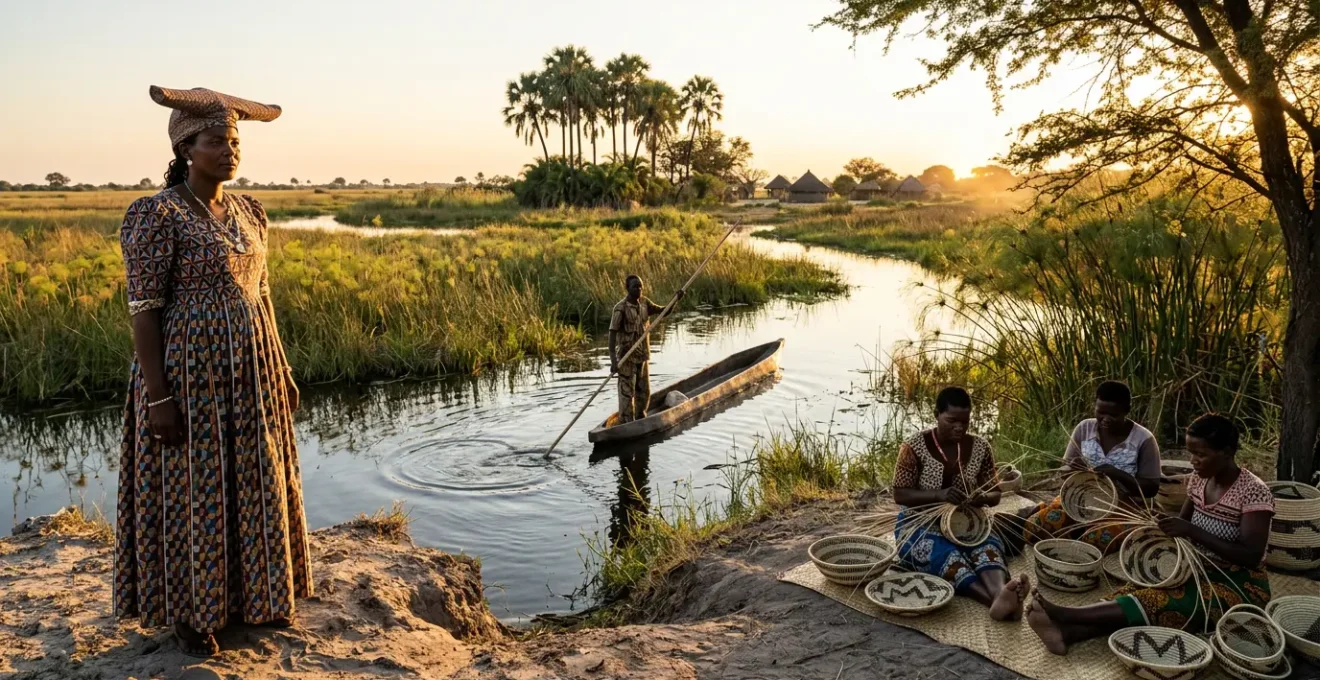
The true richness of the Okavango Delta lies not just in its wildlife, but in its complex mosaic of human cultures, each with a unique « cultural DNA » waiting to be understood.
- Identity is expressed through « living history, » like the Herero’s Victorian dress, a powerful symbol of defiance and cultural pride.
- The environment and its people are symbiotic, as seen in the Bayei’s mastery of the waterways with the mokoro, a technology they introduced.
- Spiritual traditions, like the Hambukushu’s revered role as « rainmakers, » remain a core part of cultural governance and connection to the land.
Recommendation: Approach your journey as a cultural apprentice, seeking to understand the ‘why’ behind each tradition, sound, and story you encounter.
For many travelers, the Okavango Delta is a landscape defined by its iconic wildlife. Yet, to focus only on the fauna is to miss the deeper, more intricate story of the region: its people. A common point of confusion for visitors is the rich ethnic diversity. While the San are often the most recognized group, they are but one thread in a vibrant tapestry that includes the Herero, Bayei, Hambukushu, and others. Most guides offer surface-level distinctions, leaving you with a checklist of names rather than a genuine understanding of their identities.
The standard narrative often frames these cultures around what a tourist might see—a colorful dress, a dugout canoe. But what if the key to truly appreciating the Delta was not just observing these markers, but decoding their origins? This guide moves beyond the safari checklist to explore the cultural DNA of the Okavango’s non-San peoples. We will investigate the history, traditions, and beliefs that make each group distinct, transforming your perspective from that of a simple observer to a respectful and informed traveler.
This article provides a structured look into the unique identity markers of several key groups. By exploring the stories behind their traditions, the nuances of their languages, and their relationship with the land, you will gain a richer appreciation for the human element that makes the Okavango truly exceptional.
Summary: A Journey into the Cultural Heart of the Okavango
- Why Do Herero Women Wear Victorian Dresses and Horn-Shaped Hats?
- How Did the Bayei Tribe Introduce the Mokoro to the Delta?
- Why Are the Hambukushu Known as the Rainmakers of the Okavango?
- How Does Geography Shape the Lifestyle of the Kalanga vs. the Tswana?
- Setswana is National, but Who Speaks Shekgalagari?
- Why a Mokoro Trip Is Not About Viewing Big Game but Small Details?
- Xhosa vs. Khoisan Clicks: What Is the Difference for a Listener?
- Why Is a Guide Mandatory to Visit the Rock Art at Tsodilo Hills?
Why Do Herero Women Wear Victorian Dresses and Horn-Shaped Hats?
The striking image of a Herero woman in her full regalia is one of Botswana’s most enduring cultural symbols. The outfit consists of a voluminous, floor-length dress made from many meters of fabric, multiple petticoats, and a distinctive horizontal horn-shaped headdress, the otjikaiva. At first glance, the Victorian silhouette seems a colonial imposition. It was indeed introduced by German missionaries in the 19th century. However, the Herero people transformed this attire into a powerful symbol of identity and resistance. After surviving the brutal German-Herero genocide of the early 20th century, wearing the dress of the oppressor became an act of defiance and remembrance.
The otjikaiva headdress is equally significant, crafted to resemble the horns of a cow. Cattle are central to Herero culture, representing wealth, status, and a sacred link to their ancestors. By incorporating this symbol into their daily wear, Herero women carry their cultural heritage with them. This is not a costume for tourists; it is a profound statement of « living history. » The immense pride and effort invested are reflected in the fact that, the cost of a complete Herero outfit can be equivalent to several cows. This fusion of history and symbolism creates an identity marker that is uniquely Herero.
Case Study: Intergenerational Cultural Continuity
The award-winning documentary « Herero » traces the journey of Veundja, an American-born daughter of a Herero man, as she travels to Namibia for the first time. She attends the annual genocide commemoration, wearing the traditional dress. As she moves through ancestral sites and partakes in ceremonies, the film beautifully captures the intimate, intergenerational passage of culture. The dress becomes a physical link connecting her to a past she has never known and securing its place in the future, proving its role as a vessel for lived experience, not just a historical artifact.
This remarkable cultural adaptation was highlighted by filmmaker Kate Schoenbach, whose work on the subject earned a Lowell Thomas Award. Her documentary was aptly described as a look at « The Africans who wear Victorian petticoats – a poetic look at Herero women’s dress as cultural resistance. »
How Did the Bayei Tribe Introduce the Mokoro to the Delta?
The mokoro, or traditional dugout canoe, is synonymous with the Okavango Delta. Navigating the serpentine waterways in one is a quintessential Delta experience. While many local groups use them today, it was the Bayei people who brought this essential technology to the region. Originally from Central Africa, the Bayei migrated south and settled in the Delta, bringing with them unparalleled river skills. Their identity is intrinsically linked to water; their name is thought to mean « the masters of the river. »
This symbiotic relationship is perfectly embodied in the mokoro. Introduced to the area by the BaYei people centuries ago, these canoes were traditionally carved from the straight, large trunk of a single sausage tree (Kigelia africana) or Jackalberry tree (Diospyros mespiliformis). The poler stands at the stern, propelling the craft with a long pole called an nkashi, traditionally made from the mogonono tree (Terminalia sericea). This method of transport is perfectly suited to the shallow, vegetation-choked channels of the Delta, allowing for silent, unobtrusive movement through the ecosystem. The mokoro is not just a boat; it is a cultural artifact representing the Bayei’s profound understanding and adaptation to their wetland environment.
As the mokoro became central to the burgeoning tourism industry, the demand put immense pressure on the slow-growing trees used for their construction. To preserve this vital part of their culture and the ecosystem, a shift began towards using modern materials. Today, many mekoro (plural of mokoro) used for safaris are made from fiberglass. While they lack the romance of a hand-carved wooden vessel, they ensure the tradition can continue sustainably, protecting both the trees and the Bayei’s way of life.
Why Are the Hambukushu Known as the Rainmakers of the Okavango?
The Hambukushu people, also known as the Mbukushu, have a deeply spiritual connection to the Okavango’s lifeblood: water. They are widely revered as the « Rainmakers of the Delta, » a reputation rooted in their complex belief system and the perceived spiritual powers of their chiefs, known as Fumu. Historically, other tribes would pay tribute to the Hambukushu leadership in exchange for rituals to bring rain, a testament to their esteemed position in the region’s spiritual hierarchy. This role gave them significant influence, often transcending political or military power.
Their history is also one of migration and resilience. Originally from the north, many Hambukushu fled conflict in Angola. Historical records show that in 1967, 3,300 refugees from the Hambukushu tribe crossed into Botswana, settling along the Okavango Panhandle. This movement further solidified their presence and cultural influence in the northern part of the Delta. Their spiritual authority is not just a historical footnote; it continues to inform their relationship with the natural world and their governance of resources.
The Dikongoro: Spiritual Beliefs and Water Governance
A 2013 study by scholar Manfred O. Hinz explored the ethno-philosophical foundation of customary water law in the Kavango region. He interviewed 78 Hambukushu elders about their belief in Dikongoro, powerful river spirits. This research revealed that traditional laws governing water use are not based on modern legal codes but on a deep respect for these spirits. The belief that Dikongoro inhabit and protect the river ensures that the community manages its most precious resource with reverence and a sense of collective, spiritual responsibility, a practice far more powerful than any written regulation.
For the Hambukushu, the river and the rain are not mere meteorological phenomena. They are elements governed by spiritual forces, and their chiefs are the crucial intermediaries between the human and the divine. This belief system is the very foundation of their identity as the rainmakers of the Okavango.
How Does Geography Shape the Lifestyle of the Kalanga vs. the Tswana?
The Tswana are the dominant ethnic group in Botswana, a fact reflected in the country’s name and national language, Setswana. Demographic data shows that the Tswana people make up almost 80% of Botswana’s total population. Historically a pastoralist and agriculturalist society from the drier eastern parts of the country and South Africa, their social and political structure is centered around the kgotla. This is a traditional assembly or court, usually held under a large tree, where community matters are discussed openly and decisions are made by consensus under the guidance of a chief (kgosi). This democratic and centralized system allowed the Tswana to establish broad political control, which was formalized across the nation after independence in 1966.
In contrast, the Kalanga people, who historically occupied parts of northeastern Botswana and western Zimbabwe, have a different story shaped by their geography and history. As one of the earliest Bantu-speaking groups in Southern Africa, their society was traditionally more decentralized, organized around smaller, hereditary chiefdoms. While they also practice agriculture and cattle herding, their historical proximity to the ancient trade routes and kingdoms like Mapungubwe and Great Zimbabwe influenced their material culture and social organization.
The following table, based on information from anthropological reports, highlights the key differences in traditional governance shaped by these distinct histories.
| Governance Aspect | Tswana System | Other Delta Peoples |
|---|---|---|
| Political Structure | Kgotla (traditional court) | Hereditary headmen |
| Decision Making | Open discussion encouraged | Extended family councils |
| Historical Control | Since late 1700s in Delta | Traditional inhabitants |
| Integration | Universally adopted post-1966 | Adapted to kgotla system |
As the Tswana-led state expanded, the kgotla system was implemented nationwide, and other groups like the Kalanga and the peoples of the Delta adapted to this structure. However, the underlying differences in their geographical origins and historical social frameworks remain a key part of their distinct cultural identities.
Setswana is National, but Who Speaks Shekgalagari?
Language is one of the most vital components of cultural DNA. In Botswana, Setswana is the national language, used in government, media, and schools. This creates a unifying force, but it also puts immense pressure on the country’s many minority languages. The Okavango Delta and the surrounding Kalahari are home to an incredible diversity of tongues, from the Khoisan languages of the San with their famous clicks, to various Bantu languages spoken by groups like the Herero (Otjiherero), Bayei (Shiyeyi), and Hambukushu (Thimbukushu).
Shekgalagari is the language of the Bakgalagadi people, who are among the oldest Bantu-speaking inhabitants of the Kalahari region. As a Sotho-Tswana language, it is related to Setswana but distinct enough to have its own identity. Its speakers are often found in the arid lands bordering the Delta, and their language reflects a deep knowledge of that specific environment. However, like many other indigenous languages, it faces the risk of being overshadowed by the dominant national language. As the 101 Last Tribes Research Team notes in their « Okavango Delta Peoples of Botswana Report, » the Okavango Delta Peoples face a number of challenges to preserving their traditional lifeways, languages, and cultural traditions.
The struggle to maintain linguistic diversity is a global one, but it is particularly poignant in a place as culturally rich as the Delta. When a language is lost, it’s not just words that disappear, but entire libraries of ecological knowledge, oral histories, and unique ways of seeing the world. Efforts to document these languages and encourage their use among younger generations are crucial for preserving the full cultural spectrum of Botswana. For a traveler, showing interest in a few words of a local language beyond Setswana—even a simple greeting—is a powerful gesture of respect.
Why a Mokoro Trip Is Not About Viewing Big Game but Small Details?
A game drive in an open 4×4 vehicle is about covering ground to find the « Big Five. » It’s an experience of scale and spectacle. A mokoro trip, by contrast, is an exercise in intimacy and subtlety. While the Okavango is famously home to elephants, rhinos, and endangered wild dogs, the true magic of the mokoro is not in spotting these large animals from the water. Instead, it is about shifting your perspective and tuning your senses to the miniature world of the Delta’s waterways.
Gliding silently at water level, your world shrinks to the reeds, the water lilies, and the surface of the channel itself. The roar of an engine is replaced by the gentle splash of the nkashi pole and the symphony of the bush. As one safari operator aptly describes the experience: « Silently gliding up the delta in a mokoro, eye-level with the tiny, jewel-coloured reed frogs. The Okavango Delta’s waterways give a unique perspective on the landscape. » Your guide, a master of this small world, will point out things you would never see from a vehicle: a painted reed frog clinging to a papyrus stem, the intricate web of a fishing spider, or the iridescent flash of a malachite kingfisher diving for its prey.
This is a safari in slow motion. It invites you to notice the way sunlight filters through the papyrus, to track the path of a water strider, and to understand the ecosystem from the ground up. It’s a meditative experience that connects you to the environment in a more profound way than simply ticking off a list of large mammals. You are not just observing the Delta; you are moving through its veins, becoming part of its gentle, rhythmic pulse.
Key Takeaways
- Cultural identity is a dynamic blend of history, resistance, and adaptation, not a static collection of traditions.
- The environment and its people are inextricably linked; tools like the mokoro and beliefs like rainmaking are expressions of this bond.
- Respectful travel involves looking beyond the surface to understand the ‘why’ behind cultural practices, from dress to language.
Xhosa vs. Khoisan Clicks: What Is the Difference for a Listener?
The « click » sounds found in several Southern African languages are fascinating to the foreign ear, but they are not all the same. The primary distinction lies between the clicks of the Khoisan language family and those found in Bantu languages like Xhosa or Zulu. The San people, the original inhabitants of the region, have languages that are part of the Khoisan family. Archaeological evidence indicates that the San have lived in this area for thousands of years, and their languages are characterized by an astonishingly diverse and complex array of click consonants.
For a listener, the difference is one of complexity and integration. In a Khoisan language like Juǀʼhoan, clicks are a fundamental part of the phonology, with numerous types produced using different parts of the tongue against the teeth, alveolar ridge, or palate. They serve as primary consonants, and their variety can be bewildering. In contrast, Bantu languages like Xhosa acquired their clicks through prolonged contact with Khoisan speakers. Consequently, they typically use a smaller subset of these sounds. The most common are the dental click (c), the lateral click (x), and the alveolar click (q). For an English speaker, the dental click sounds like the ‘tsk-tsk’ of disapproval, while the lateral click is the sound one might use to call a horse.
The « sonic signature » is different. Khoisan clicks can feel more varied and central to the flow of speech, while in Xhosa, they are distinct consonants integrated into a Bantu language structure. Understanding this difference is key to appreciating the linguistic history of the region—one of ancient, indigenous languages and the powerful story of their influence on later arrivals.
Your Checklist for Respectful Linguistic Inquiry
- Listen First: Before asking questions, simply listen to the cadence and sounds of the local language being spoken around you.
- Learn the Right Names: Ask your guide for the proper names of the local people and their language (e.g., Hambukushu, not « Mbukushu Bushmen »).
- Master a Greeting: Learning to say « hello » and « thank you » in a local language (Shiyeyi, Thimbukushu) is a small effort that shows immense respect.
- Ask About Meaning, Not just Sound: Instead of just asking « How do you make that click sound? », ask about the meaning of a word that contains it.
- Acknowledge Complexity: Understand that you are only hearing a fraction of the linguistic story. Show humility and a genuine desire to learn.
Why Is a Guide Mandatory to Visit the Rock Art at Tsodilo Hills?
The Tsodilo Hills, a UNESCO World Heritage site, rise dramatically from the flat expanse of the Kalahari Desert. It is an outdoor art gallery of immense scale; archaeological surveys document that Tsodilo is adorned with over 4,000 rock paintings. Some of these intricate depictions of animals, humans, and geometric patterns are estimated to be thousands of years old. For this reason alone—to protect this fragile, irreplaceable historical archive from damage and vandalism—having a guide would be a sensible precaution. However, the mandatory guide rule at Tsodilo goes much deeper than simple preservation.
For the local Hambukushu and San peoples, Tsodilo is not a museum. It is a sacred place, the abode of ancestral spirits. The hills are often called the « Mountains of the Gods. » A guide, who is typically from the local community, is therefore not just a tour operator but a cultural custodian and an intermediary. They are there to ensure visitors behave with the proper respect required in a place of worship. They will show you where you can and cannot walk, which sites are open to visitors, and which are reserved for private, spiritual purposes. Their role is to interpret the art not just historically, but also culturally and spiritually.
This spiritual significance is woven into the oral traditions of the local people. The 101 Last Tribes research team captured one such story from the Hambukushu:
Hambukushu have a legend that their Supreme God, Nyembe created the first people of their tribe and let them down on a rope from Heaven to the Tsodilo Hills. They authenticate their story by saying that they can show the actual footprints of the first men and animals on the rocks.
– 101 Last Tribes Research Team, Mbukushu People Documentation
This belief transforms the site from a collection of ancient paintings into a living, sacred landscape. The guide is mandatory because you are not just visiting a historical site; you are a guest in their church.
By understanding the cultural DNA behind the traditions, tools, and beliefs of the Herero, Bayei, Hambukushu, and other peoples, you transform your journey through the Okavango from a passive viewing into an active, meaningful exchange. To truly honor the richness of the Delta, approach every encounter with curiosity and respect, seeing not just what people do, but seeking to understand who they are.