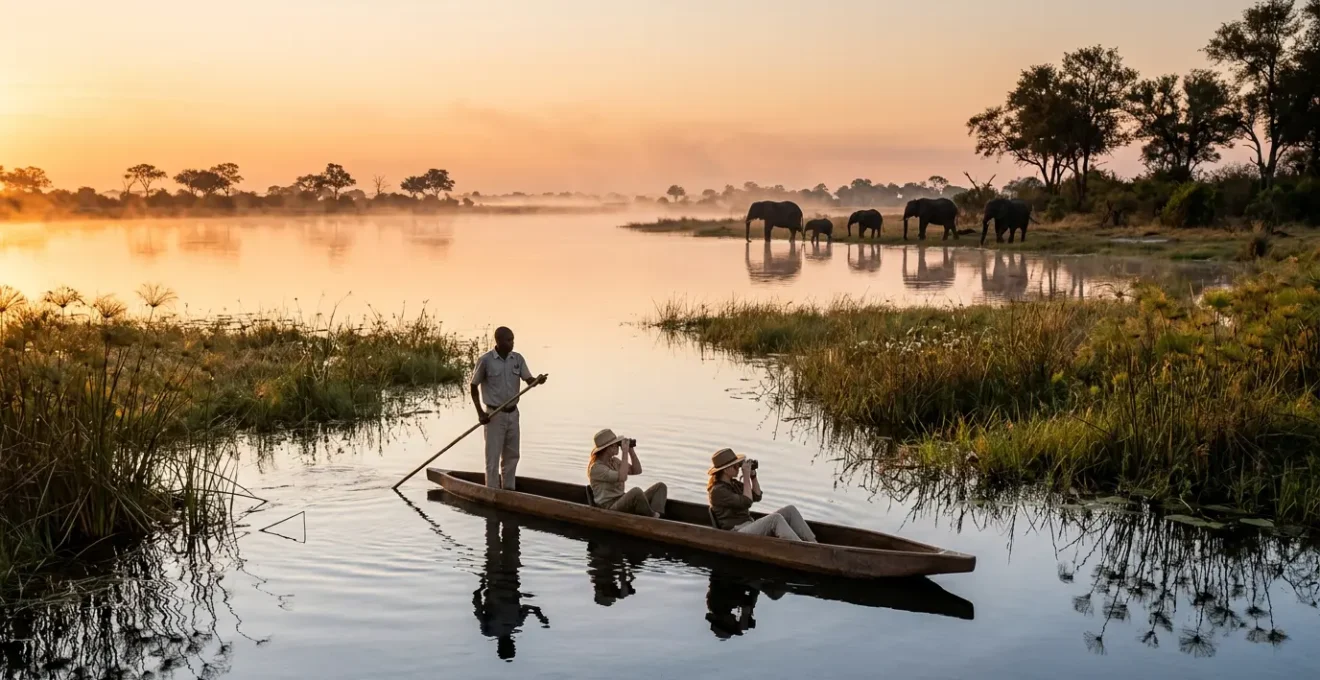
Botswana’s high safari price isn’t a barrier to entry; it’s the core mechanism of a revolutionary conservation model that prioritizes ecological health over tourist numbers.
- Fewer tourists mean less stress on wildlife, leading to more natural animal behaviors and profoundly authentic encounters.
- High revenue is directly reinvested into a « Conservation Value Chain, » funding everything from anti-poaching patrols to community development projects.
Recommendation: Shift your perspective from ‘cost’ to ‘investment’. Choosing Botswana means actively participating in the preservation of one of the world’s last great wildernesses.
For the eco-conscious traveler weary of the convoys of jeeps that can mark a safari in East Africa, Botswana presents a compelling paradox. The price tag is undeniably higher, a fact that often leads to the simple conclusion that it’s a destination reserved for luxury seekers. This perception, however, misses the profound strategic thinking behind the nation’s celebrated « High Value, Low Volume » tourism policy. The higher cost isn’t about gilded taps or champagne breakfasts; it’s the very fuel of a sophisticated economic engine designed for radical conservation.
While many destinations grapple with the impacts of over-tourism, Botswana made a deliberate choice decades ago. It chose to limit human footprint to preserve the integrity of its ecosystems. But if the real purpose isn’t exclusivity for its own sake, what does this policy truly mean for your experience on the ground? It fundamentally redefines the relationship between the visitor, the wildlife, and the land itself. It transforms the safari from a passive viewing activity into an active investment in a living, breathing conservation success story.
This article deconstructs the mechanics of this pioneering model. We will explore how limiting tourist numbers creates a cascade of positive effects, from the psychological well-being of the animals to the economic empowerment of local communities. By understanding where your investment goes, you’ll see why a Botswana safari is not just a trip, but a partnership in preservation.
To fully grasp this unique approach, this guide breaks down the key components of Botswana’s conservation-led tourism model, revealing how it shapes every aspect of your journey.
Contents: How Botswana Redefined the Safari
- Why Animals in Botswana Are Less Stressed Than in the Serengeti?
- Self-Drive Freedom vs. Guided Expertise: Which Reveals the True Botswana?
- How to Photograph Wildlife Without Disturbing the « Essence » of the Bush?
- Green Season vs. Dry Season: Which Offers the True Spirit of the Delta?
- Why a Digital Detox in the Okavango Recharges Your Brain Faster?
- How Does Keeping Tourist Numbers Low Save the Ecosystem from Collapse?
- How Do « Kids in the Bush » Programs Create Future Conservationists?
- Where Does Your $1000/Night Actually Go in the Conservation Chain?
Why Animals in Botswana Are Less Stressed Than in the Serengeti?
The first and most immediate impact of Botswana’s low-density policy is on the wildlife itself. In high-traffic parks, animals are often habituated to a constant parade of vehicles, which can alter their natural behaviors. The sound and presence of numerous engines can cause chronic stress, disrupt hunting patterns, and make wildlife more skittish. Botswana’s model directly counters this by engineering tranquility. The entire philosophy is built on respecting the ecological carrying capacity of the land, ensuring the human presence remains a minor, well-managed factor rather than a dominant force.
This is achieved through a strict concession system. Private reserves and Wildlife Management Areas have firm rules on tourist presence. According to wilderness management data, Botswana’s private concessions have strict limitations on bed numbers and vehicle density, often allowing only a handful of vehicles from a single lodge in a vast area. The result is a profound de-commodification of the wildlife experience. Instead of a competitive rush to a sighting, you get long, uninterrupted moments, observing animals that are genuinely at ease in their environment. This is not just a more pleasant experience; it’s a more authentic one.
A seasoned safari traveler on Natural Habitat Adventures perfectly captures this distinction: « With heavily regulated concessions, it’s you and the wilderness. Only a few other vehicles are allowed in a particular region at one time, giving you and your safari group lots of uninterrupted time with Africa’s incredible wildlife. » You are no longer just a spectator; you are a quiet guest in their world, witnessing behaviors that only emerge in the absence of pressure. This creates an atmosphere of intimacy and respect that is simply unattainable in more crowded environments.
Self-Drive Freedom vs. Guided Expertise: Which Reveals the True Botswana?
While self-driving offers a sense of adventure, Botswana’s « High Value » model intrinsically elevates the role of the expert guide, transforming them from a simple driver into a master interpreter of the bush. In the vast, unfenced private concessions that define the Botswana experience, a guide’s knowledge is not a luxury—it’s the key that unlocks the wilderness’s deepest secrets. They are trained ecologists, trackers, and storytellers who possess generational knowledge of animal territories, behaviors, and the subtle language of the landscape.
This expertise translates into tangible benefits that a self-driver cannot access. Guides in private concessions have permission to go off-road for significant sightings, allowing them to track a leopard through the bush or get a better angle on a lion kill without disturbing the scene. They conduct night drives, opening up the world of nocturnal hunters and rare creatures that are invisible during the day. Their tracking skills are often the difference between a fleeting glimpse of a distant shape and an intimate encounter with elusive species like wild dogs or honey badgers.
This deep knowledge creates what can be called « experience integrity. » It’s not just about seeing an animal, but understanding its context. As Natural Habitat Adventures notes, the goal is to provide an « unmatched ability to interpret everything you witness. » A guide can read the alarm calls of birds to locate a predator, identify tracks in the sand to tell a story of the previous night’s events, and position the vehicle with a photographer’s eye for the best light. This level of insight elevates a safari from a checklist of sightings to a rich, educational immersion.
How to Photograph Wildlife Without Disturbing the « Essence » of the Bush?
For a wildlife photographer, Botswana’s low-volume model is a game-changer. The greatest challenge in wildlife photography is not just technical skill, but access and time. In crowded parks, photographers often face a frustrating reality: a great sighting is immediately swarmed by other vehicles, jostling for position, kicking up dust, and stressing the animal, which may quickly retreat. The window for capturing a truly natural, behavioral shot is often measured in seconds. Botswana’s policy systematically eliminates this problem, creating a photographer’s paradise by design.
The core advantage is the gift of time and space. Because private concessions limit vehicles to very few per area, you can spend extended, unhurried periods at a sighting. This allows you to wait for the perfect light, for a specific behavior to unfold, or simply to observe without the pressure of having to « move on » for the next vehicle. You can watch a cheetah stalk its prey for an hour, or sit with a pride of lions as they interact during the golden light of sunset, all without another vehicle in your frame. This is the essence of ethical wildlife photography: patience and observation over pursuit.
This « unhurried approach, » as Go2Africa specialists describe it, allows photographers to capture the « essence » of the bush. Instead of just a portrait of an animal, you can tell a story. You have the freedom to experiment with composition, to capture the environment, and to document natural interactions. Guides, aware of photographers’ needs, will position the vehicle for optimal light and background, and will turn off the engine to minimize vibration and noise. This collaborative and respectful environment ensures that the resulting images are not only beautiful but are also a true reflection of an undisturbed moment in the wild.
Green Season vs. Dry Season: Which Offers the True Spirit of the Delta?
The « best » time to visit Botswana is a common question, but the « High Value, Low Volume » model encourages a more nuanced perspective. Instead of a single peak season, Botswana offers distinct experiences throughout the year, each with its own unique spirit and appeal. The choice between the Dry Season (roughly May-Oct) and the Green Season (Nov-Apr) is not about « good vs. bad, » but about what kind of safari you wish to experience. The low tourist density ensures that even in the most popular months, you never feel crowded.
The Dry Season is the classic safari period. As inland water sources dry up, wildlife congregates in massive numbers along the permanent rivers and the incoming floodwaters of the Okavango Delta. This concentration makes for spectacular and relatively easy game viewing. It’s the prime time for water activities like mokoro (dugout canoe) excursions as the floodplains are at their fullest. The vegetation is sparse, making it easier to spot animals from a distance.
The Green Season, however, holds a different kind of magic. The landscape transforms into a lush, green paradise with dramatic afternoon thunderstorms. This is the calving season for many antelope species, which in turn attracts predators. It’s a time of birth and renewal, and a haven for birdwatchers as migratory species arrive in their thousands. While wildlife can be harder to spot in the dense foliage, the sightings are often more rewarding. Furthermore, this season offers the significant benefits of lower prices and even fewer visitors, providing the ultimate sense of solitude. The following table breaks down these seasonal trade-offs.
This detailed seasonal comparison, based on data from safari experts, helps travelers choose the experience that best suits their priorities. A comprehensive analysis from Wilderness Destinations provides a deeper look into these nuances.
| Season | Water Levels | Wildlife Experience | Unique Benefits | Photography |
|---|---|---|---|---|
| Green Season (Nov-Apr) | Falling/Low | Calving season, migrant birds arrive | Lower prices, green landscapes, fewer tourists | Dramatic cloudy skies, vibrant colors |
| Dry Season (May-Oct) | Highest (flood arrives) | Best wildlife viewing, animals concentrate at water | Water activities at peak, classic safari conditions | Clear skies, dusty atmospheric shots |
| Shoulder (Apr-May, Oct-Nov) | Transitional | Good wildlife viewing | Moderate prices, best of both seasons | Mixed conditions, diverse opportunities |
Why a Digital Detox in the Okavango Recharges Your Brain Faster?
In our hyper-connected world, the concept of a « digital detox » has become a travel cliché. In Botswana, however, it’s not a marketing gimmick; it’s an unavoidable and deeply therapeutic reality. The remoteness of the camps in the Okavango Delta and other wilderness areas means that Wi-Fi is often non-existent or strictly limited to a small common area. This forced disconnection is a key, albeit unintentional, benefit of the low-volume, high-value model, plunging you into a state of full sensory immersion that recharges the mind in a way a typical vacation cannot.
Without the constant distraction of notifications and screens, your senses awaken. You begin to notice the intricate details of the world around you: the way the light filters through the mopane leaves, the scent of wild sage after a rain shower, the vastness of the star-filled sky. The soundtrack of your life shifts from digital pings to the natural symphony of the bush.
The sounds are stimulating, being in a canvas tent with absolutely no noise but that of lions grunting, baboons calling, hippo grazing, zebra honking…
– Safari traveler, Natural Habitat Adventures Review
This isn’t just about relaxation; it’s about cognitive restoration. The « Attention Restoration Theory » suggests that exposure to natural environments allows the brain to recover from the mental fatigue of directed attention. The complex, fractal patterns of nature engage our « soft fascination, » restoring our capacity for focus and creativity. The experience becomes less about capturing content for social media and more about being present in the moment. Travelers often report this as the most transformative aspect of their trip—a profound mental reset that lasts long after they return home.
Case Study: The Transformative Power of Wilderness Immersion
In an AFAR magazine feature, a traveler described the profound effect of encountering wildlife without a digital intermediary. The experience was not merely relaxing but « existentially transformative. » The article notes that the disorientation of meeting truly wild animals, creatures that « fill our books and screens from infancy, » creates a powerful recalibration of one’s perspective. By stripping away the digital layer, the safari becomes a direct, visceral connection to the wild, fostering a deeper appreciation for the raw, untamed world.
How Does Keeping Tourist Numbers Low Save the Ecosystem from Collapse?
Botswana’s low-volume policy is, at its core, a pragmatic strategy for long-term ecological survival. It is a direct acknowledgment that mass tourism, however well-intentioned, inevitably leads to environmental degradation through soil erosion, pollution, habitat fragmentation, and stress on wildlife. By treating its wilderness as a precious, finite resource, Botswana has turned the laws of supply and demand into a powerful conservation tool. The « high value » component is not an end in itself; it is the means to fund the protection of a vast and pristine wilderness.
The scale of this commitment is immense. An incredible 39% of Botswana’s land is protected in some form, with 17% designated as National Parks and a further 22% as Wildlife Management Areas. This vast network of protected land acts as a buffer against development and provides contiguous habitats for wide-ranging species like elephants and wild dogs. However, protecting such a large area is astronomically expensive. The revenue generated from a small number of high-paying tourists is the primary funding source for the management of these lands, including the crucial costs of anti-poaching patrols, wildlife monitoring, and scientific research.
This model creates a virtuous cycle. High safari fees fund conservation; effective conservation maintains a pristine ecosystem; a pristine ecosystem attracts tourists willing to pay a premium for an authentic experience. This economic interdependence makes the wilderness a valuable asset to the national economy, providing a powerful incentive for the government to maintain its strong protectionist policies. It proves that tourism can be more than an extractive industry; it can be an active partner in ecological repair. As one analysis noted, this model has led to concrete results like rising lion populations in areas where cattle farms were relocated using tourism revenue.
How Do « Kids in the Bush » Programs Create Future Conservationists?
A conservation model that excludes local communities is doomed to fail. Botswana’s « High Value, Low Volume » strategy understands this implicitly, integrating community benefit deep into its structure. The goal is to ensure that the people who live alongside wildlife see it not as a threat or a competitor for resources, but as a valuable asset that improves their lives. This is achieved through direct employment, community trusts, and targeted development projects funded by tourism revenue.
The economic impact is significant. In the tourism-heavy regions of the country, it’s reported that up to 45% of northern Botswana’s population is employed in tourism. This goes beyond jobs as guides or lodge staff; it creates a whole ecosystem of related employment, from local food suppliers to artisans. Furthermore, a portion of the high concession fees paid by safari operators goes directly to Community Trusts, which then fund local projects like schools, clinics, and clean water initiatives. This creates a clear, tangible link between the presence of a luxury safari camp and the well-being of the surrounding villages.
Perhaps most importantly, this model helps mitigate human-wildlife conflict by turning the tourism industry into a problem-solver. By demonstrating direct benefits, it fosters local buy-in for conservation and creates a generation of future guardians of the wilderness.
Case Study: The Elephant Express
In the village of Seronga, children faced a perilous walk to school through active elephant corridors, leading to dangerous encounters. Recognizing this critical issue, safari operator Natural Selection helped sponsor a bus service, « The Elephant Express, » to provide safe transportation. This initiative, funded by tourism dollars, did more than just protect children; it transformed the local perception of elephants. Instead of being seen solely as a danger, the elephants became the indirect reason for a vital community service, powerfully illustrating the positive impact of a thriving, conservation-focused tourism industry.
Key Takeaways
- Botswana’s model is a deliberate economic strategy, not just a luxury preference. High costs are a tool for conservation.
- The policy directly improves animal welfare and provides a more authentic, less-crowded visitor experience.
- Revenue is systematically channeled into conservation, anti-poaching, and community projects, making every visitor an investor.
Where Does Your $1000/Night Actually Go in the Conservation Chain?
The high price of a Botswana safari can be abstract until you trace the journey of that investment through the « Conservation Value Chain. » Unlike a standard vacation where costs cover accommodation and services, a significant portion of your expenditure in Botswana is strategically allocated to preserve the very wilderness you’ve come to experience. It’s a transparent system where your spending becomes a direct force for good, funding a multi-layered conservation and community support network. The model is intentionally designed as « high-cost, low-impact » to ensure sustainability.
A large slice of the cost goes towards high concession fees. These are lease payments that lodges make to the government and local community trusts for the exclusive right to operate in a specific area. This single mechanism ensures that revenue flows directly to both national conservation budgets and local village development funds, even before the first guest arrives. Another major component is the investment in people. Safari operators are major employers in remote regions, providing stable jobs with comprehensive benefits that often include housing, healthcare, and educational support for staff and their families.
The remaining funds are plowed back into the operational integrity of the conservation effort. This includes everything from funding anti-poaching units that protect rhinos and elephants to supporting scientific research on wildlife populations. It also covers the cost of building and maintaining truly sustainable infrastructure—camps that are designed to be disassembled without leaving a trace. Understanding this breakdown demystifies the cost and reframes it as a powerful, targeted investment.
Your Safari Bill’s Journey: A Conservation Audit
- Concession Fees: A significant portion goes to government and community trusts for exclusive land use, directly funding park management and local projects.
- Local Employment & Empowerment: Your stay supports fair-wage jobs, training, and benefits for local staff, creating a skilled conservation workforce.
- Anti-Poaching & Monitoring: Funds are allocated to on-the-ground patrols, aerial surveillance, and wildlife monitoring to protect endangered species.
- Sustainable Infrastructure: Investment covers low-impact, often removable, camp structures that preserve the pristine environment.
- Community & Conflict Mitigation: Support flows to local schools, clinics, and programs that reduce human-wildlife conflict, like the « Elephant Express » bus.
Choosing a Botswana safari is, therefore, a conscious decision to support a holistic and sustainable vision for the future of Africa’s wilderness. It’s an affirmation that the world’s most precious natural spaces are worth more than just a quick visit; they are worth a deep and meaningful investment.