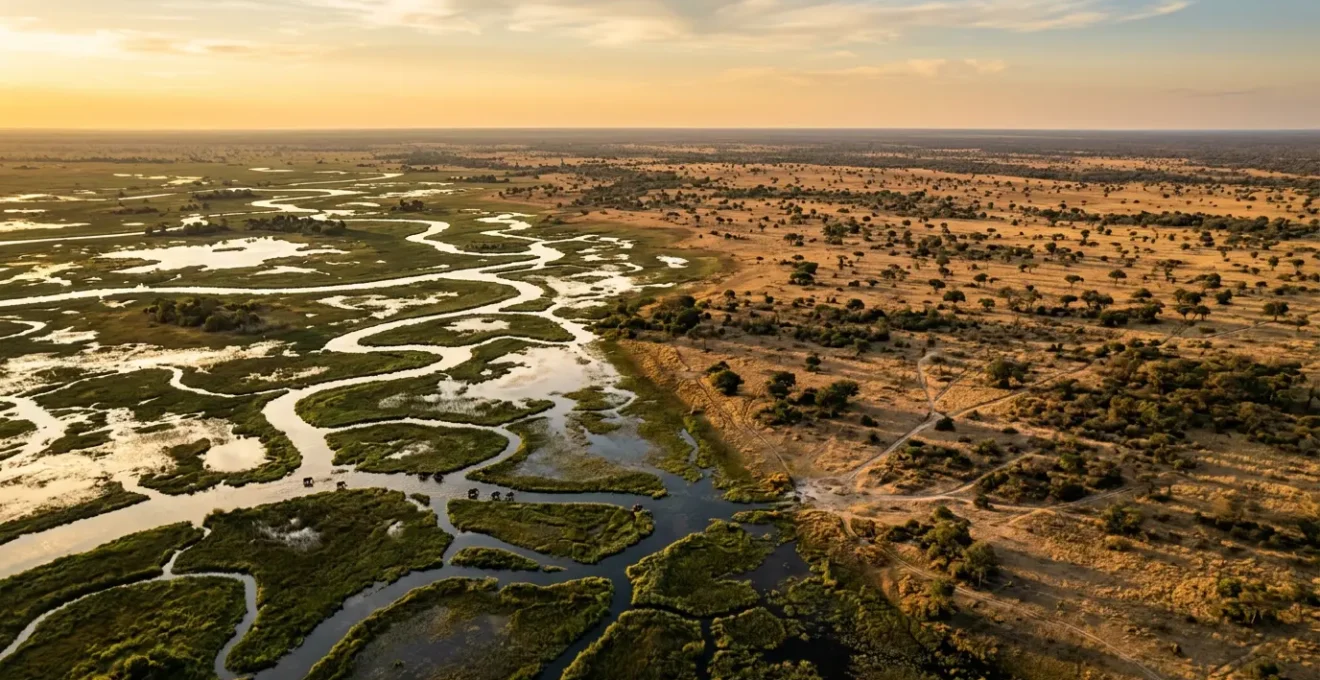
Botswana’s safari regions are not just different places; they are interconnected systems driven by a powerful, delayed hydrological pulse from Angola.
- The Okavango Delta and Linyanti Swamps thrive on annual floods, creating a vast water-world months after distant rains fall.
- The Kalahari operates in reverse, blooming during local summer rains and becoming a predator hotspot while the Delta is still building up its water.
Recommendation: Plan your itinerary to align with these opposing natural rhythms for the ultimate ‘wet heart, dry heart’ safari experience.
When planning a journey to Botswana, travelers are often faced with a dizzying array of choices. The question of whether to visit the Okavango Delta or the Linyanti Swamps is a common starting point. On the surface, both are premier wildlife destinations, celebrated for their immense herds of elephants and thriving predator populations. Standard advice often boils the decision down to subtle differences in activities—more water-based excursions in one, slightly different game drive dynamics in the other. But this perspective misses the profound ecological narrative that defines these landscapes.
The truth is, the Linyanti is fundamentally an extension of the Okavango system, a northern spillway that shares its lifeblood. To truly understand Botswana’s variety, one must look beyond this internal comparison and pit the entire wet, northern ecosystem against its great ecological counterpoint: the arid Central Kalahari. These are not merely separate locations but two halves of a single, magnificent natural engine. The key to unlocking a truly exceptional safari lies not just in choosing a place, but in understanding the deep, interconnected systems of water and life that pulse in opposite rhythms across the country.
This guide moves beyond surface-level comparisons to deconstruct the very mechanics of Botswana’s wilderness. We will explore the « hydrological pulse » that begins with rain in Angola and culminates in the Delta’s flood six months later. We will examine how this single phenomenon dictates everything from vegetation and animal behavior to the contrasting safari experiences in the nation’s wet heart and its dry heart. By understanding this grand system, you can design an itinerary that is not just a trip, but a journey through the very soul of Southern Africa’s ecology.
To navigate this ecological exploration, we will dissect the key components that differentiate Botswana’s prime wilderness areas. This article provides a clear framework for understanding how these environments function, enabling you to make informed decisions for your trip.
Summary: Deconstructing Botswana’s Great Ecological Engine
- Why Combining the Delta and Kalahari Creates the Perfect 10-Day Trip?
- How Does Rain in Angola Flood the Okavango 6 Months Later?
- Mopane Worms and Trees: Why Is This Vegetation Crucial for Ecosystem Health?
- How Is Climate Change Altering the Flood Patterns of the Delta?
- Why Are There No Fences Between Botswana and Its Neighbors?
- Why Private Concessions in the Delta Allow Night Drives but National Parks Don’t?
- Why Is Deception Valley the Best Place to See Predators in Summer?
- North to South or South to North: How to Flow Your Botswana Itinerary?
Why Combining the Delta and Kalahari Creates the Perfect 10-Day Trip?
A journey that combines the Okavango Delta and the Central Kalahari is more than a trip; it’s a study in contrasts, a dialogue between two of Africa’s most iconic and opposing ecosystems. This combination allows a traveler to experience the full spectrum of Botswana’s natural identity. You move from a world defined by water, channels, and lush floodplains to one shaped by sand, ancient riverbeds, and resilient desert life. This duality offers a profound insight into the adaptability of wildlife and the powerful forces that shape a continent. As travel experts note, it is a truly holistic experience.
In their « Art of Safari Travel Guide, » leading experts articulate this unique synergy perfectly:
The Okavango Delta and Central Kalahari offer a journey through Botswana’s two ‘hearts’: the wet heart and the dry heart, pulsing at opposite times of the year.
– Travel Experts, Art of Safari Travel Guide
The concept of « pulsing at opposite times » is the key. The Delta’s peak water levels and the best game viewing occur in the dry winter months (June-September), long after the rains have ceased. Conversely, the Kalahari comes alive during the green summer season (December-March), when local thundershowers fill ephemeral pans and trigger a cascade of life. Planning a 10-day trip that straddles these two biomes means you are not just seeing different places, but witnessing two distinct, time-shifted ecological peaks. You can experience the abundance of the flooded Delta and then travel to the Kalahari to see its dramatic summer transformation, a spectacle of new grass, newborn animals, and the predators that follow them.
This journey provides an unparalleled educational and sensory experience. You witness how elephants, lions, and birds adapt their behaviors to completely different environments, from navigating waterways to surviving in arid landscapes. It’s a living lesson in ecological counterpoint, offering a far richer and more complete picture of Botswana than visiting either ecosystem alone could ever provide.
How Does Rain in Angola Flood the Okavango 6 Months Later?
The Okavango Delta’s existence is a geographical paradox: a massive inland wetland that floods not during its own rainy season, but months later, during the driest part of the year. This phenomenon, the hydrological pulse, is the engine that drives the entire ecosystem. The process begins over 1,000 kilometers away in the highlands of Angola, where heavy summer rains from October to April feed the Cuito and Cubango rivers. These rivers converge to form the Okavango River, which then flows southeast across Namibia’s Caprivi Strip and into Botswana.
This journey is remarkably slow. The water does not rush but meanders across a vast, near-flat landscape. It takes approximately one month for the flood pulse to travel the first 1,000 km, but up to six months for it to seep across the final 250 km of the Delta’s alluvial fan. This temporal disconnect is what makes the Okavango so unique. The peak of the flood arrives in the heart of the Delta between June and August, transforming the dry, dusty plains into a labyrinth of channels, lagoons, and islands. An immense volume of around 11 cubic kilometers of water spreads over a vast area, covering between 6,000 and 15,000 square kilometers annually.
Each drop of this water is precious, having completed an epic journey to bring life to the desert. The slow, patient percolation allows the water to be filtered by sand and papyrus, resulting in the crystal-clear channels the Delta is famous for. This is the lifeblood that sustains the entire food web, from the smallest insects to the largest elephant herds.
As this image suggests, the journey of each water droplet is a microcosm of the Delta’s larger story. It is a system built on patience and immense scale. Understanding this six-month delay is crucial for any traveler; it explains why the best time for water-based activities and concentrated wildlife viewing is during Botswana’s cool, dry winter, when the gift from the Angolan highlands finally arrives.
Mopane Worms and Trees: Why Is This Vegetation Crucial for Ecosystem Health?
While the dramatic water systems and large mammals often steal the spotlight, the health of the Okavango ecosystem is built upon its foundational vegetation, with the Mopane tree (Colophospermum mopane) playing a particularly vital role. Mopane woodlands dominate large areas of northern Botswana, forming a critical habitat and food source that supports an incredible diversity of life. These hardy, resilient trees are central to the region’s nutrient cycling and overall ecological stability.
The Mopane tree is a cornerstone species. Its butterfly-shaped leaves are a primary food source for elephants, especially during the dry season when other grazing is scarce. The tree also hosts the famously protein-rich Mopane worm, the caterpillar of the Gonimbrasia belina moth. These caterpillars are a crucial food source for a vast array of birds and other animals, and they are also a traditional and highly nutritious food for local communities. The presence of Mopane woodlands directly contributes to the astonishing biodiversity of the region, which, according to biodiversity surveys, includes over 1,300 species of flowering plants and 122 species of mammals. This rich flora provides the base for a complex and resilient food web.
Case Study: Mopane Woodlands as a Keystone Habitat
An analysis of the Okavango’s biodiversity reveals the direct impact of Mopane woodlands. The ecosystem supports 444 bird species, including globally threatened ones. Mopane woodlands are essential, providing crucial nesting sites for cavity-nesters like hornbills and rollers. Furthermore, these woodlands are a cornerstone of the diet for the region’s massive elephant population, which is the largest in Africa. In Botswana, where the elephant population reaches an estimated 130,000, the Mopane provides a reliable and essential food resource that sustains these mega-herbivores through the driest months, preventing overgrazing of more delicate floodplain grasses.
From the microscopic fungi in its soil to the giant elephants that feed on its leaves, the Mopane ecosystem is a perfect example of interconnectedness. The tree provides food and shelter, the Mopane worms convert plant matter into animal protein, and the herbivores that browse its leaves help shape the landscape. Without this robust and widespread vegetation, the Delta could not support the sheer volume and variety of wildlife for which it is renowned.
How Is Climate Change Altering the Flood Patterns of the Delta?
The Okavango Delta’s existence is a delicate balancing act, entirely dependent on the consistent hydrological pulse from the Angolan highlands. This makes it exceptionally vulnerable to the impacts of climate change, which threaten to disrupt the very foundation of this UNESCO World Heritage Site. The primary threat is not necessarily a change in local rainfall in Botswana, but a shift in the precipitation patterns far upstream in the Angolan catchment area.
Scientific projections paint a concerning picture. As global temperatures rise, the patterns of rainfall that have reliably fed the Okavango River for millennia are becoming less predictable. A reduction in annual rainfall in Angola or an increase in temperature and subsequent evaporation rates could have a catastrophic domino effect. A reduced flow in the Cuito and Cubango rivers would mean a weaker, smaller, or less reliable annual flood in the Delta. This would shrink the extent of the seasonal floodplains, directly impacting the entire food web that depends on them.
This threat is not merely theoretical; it is a documented concern among conservation bodies working in the region. As Conservation International Botswana highlights in a stark warning:
The Okavango catchment is projected to experience decreasing annual rainfall as well as increasing temperatures as a result of global warming, likely resulting in reductions in the extent of floodplains.
– Conservation International Botswana, via Wikipedia – Okavango Delta
The consequences of a diminished flood are profound. It would mean less grazing for herbivores, altered fish breeding cycles, and a concentration of wildlife in smaller areas, leading to increased competition and stress. The entire mosaic of habitats—permanent swamps, seasonal floodplains, and dry islands—would be altered, potentially forever. This makes the conservation efforts in the Angolan highlands just as critical as those within Botswana itself. The future of the Delta is inextricably linked to the health of a river system that spans three countries, highlighting the need for transboundary water management and global action on climate change.
Why Are There No Fences Between Botswana and Its Neighbors?
Botswana’s conservation philosophy is built on a grand vision: that wildlife should be allowed to roam freely across vast, unfenced landscapes as it has for millennia. This forward-thinking policy stands in stark contrast to the fenced-in reserves common in many other parts of Africa. The absence of fences, particularly along its northern borders with Namibia, Zambia, and Zimbabwe, is not an oversight but a deliberate strategy to maintain the integrity of one of the planet’s last great terrestrial wildlife migrations. This approach recognizes that ecosystems do not adhere to political boundaries.
This philosophy is most powerfully embodied by the Kavango-Zambezi Transfrontier Conservation Area (KAZA), a monumental conservation initiative. KAZA is the cornerstone of Botswana’s unfenced strategy, a testament to international cooperation for the sake of biodiversity.
Case Study: The Kavango-Zambezi Transfrontier Conservation Area (KAZA)
The Okavango Delta is a central component of KAZA, which is the world’s largest transfrontier conservation area. Spanning five countries (Angola, Botswana, Namibia, Zambia, and Zimbabwe), it covers an area of approximately 520,000 square kilometers. This vast, interconnected landscape allows for the free movement of wildlife across international borders, which is essential for maintaining genetic diversity and allowing animals to access seasonal resources. Critically, this unfenced wilderness supports Africa’s largest single population of elephants, enabling them to follow ancient migratory routes between the Delta’s water and the woodlands of neighboring countries.
Within Botswana itself, the management of this unfenced landscape is a mosaic of different protection levels. The core of the Delta is protected as the Moremi Game Reserve, but this is only part of the story. The surrounding areas are managed through a system of community trusts and private concessions that act as a crucial buffer zone. As UNESCO explains, this creates a layered approach to conservation.
About 40% of the property is protected within the Moremi Game Reserve, and the remainder is composed of 18 Wildlife Management Areas managed by community trusts or private tourism concession-holders.
– UNESCO World Heritage Centre, Okavango Delta World Heritage Site
This unfenced, multi-layered approach ensures that wildlife has the space it needs to thrive. It allows animals to respond naturally to seasonal changes, moving from the dry Kalahari sands to the Okavango’s life-giving waters. For a traveler, this means witnessing an ecosystem that functions with a scale and authenticity that is increasingly rare in the modern world.
Why Private Concessions in the Delta Allow Night Drives but National Parks Don’t?
A key difference that shapes the safari experience in the Okavango Delta lies in the distinction between National Parks, like the Moremi Game Reserve, and the vast private concessions that surround them. While both are committed to conservation, they operate under different regulations, which directly impacts the activities available to visitors. The primary reason for these differences is a management philosophy that balances public access with exclusive, low-impact tourism.
National Parks in Botswana are public lands, managed by the government’s Department of Wildlife and National Parks. To protect the ecosystem and ensure a fair experience for all visitors, they enforce strict rules: vehicles must stay on designated tracks, park gates close at sunset, and walking safaris are generally not permitted. This model is designed for high-volume, self-drive tourism as well as mobile safari operators.
Private concessions, on the other hand, are large tracts of land leased by safari companies from the government or local communities. With only a few small lodges operating in each vast area, the number of visitors is inherently limited. This low-density model allows for greater flexibility. The current tourism infrastructure includes around 60 camps and lodges spread across these exclusive-use areas. Because they are managing a very low number of vehicles, concession operators are permitted to conduct activities that would be unsustainable in a busy national park. This includes selective off-road driving to get closer to significant sightings and, most notably, night drives. After sunset, a whole new world of nocturnal species like leopards, hyenas, genets, and bushbabies becomes active, an experience entirely missed by visitors who must return to camp before dark in the national parks.
Checklist: Key Distinctions for Your Safari Choice
- Off-road driving: Permitted selectively in private concessions for exceptional sightings; strictly forbidden in national parks.
- Night drives: A key activity in concessions to see nocturnal animals; not allowed in national parks where gates close at sunset.
- Walking safaris: Widely available with armed guides in private concessions; highly restricted or unavailable in national parks.
- Vehicle density: Strictly limited in concessions, ensuring an exclusive and uncrowded experience; can be higher in popular areas of national parks.
- Activity schedules: Flexible in concession lodges to follow wildlife patterns; more rigid in national parks due to opening and closing times.
Choosing between a concession and a national park, therefore, comes down to your priorities. For travelers seeking flexibility, exclusivity, and a wider range of activities including the chance to see nocturnal animals, a private concession is the superior choice. For those on a self-drive adventure or a mobile safari, the Moremi Game Reserve offers a spectacular and more accessible wilderness experience.
Why Is Deception Valley the Best Place to See Predators in Summer?
While the Okavango Delta reigns supreme during the dry winter, the Central Kalahari, and particularly the famed Deception Valley, undergoes a spectacular transformation during the green summer season (typically November to March). This period turns the conventional wisdom of safari planning on its head. The arid, seemingly barren landscape erupts in life, creating one of the best predator-viewing experiences in all of Africa. This seasonal shift is the perfect « ecological counterpoint » to the Delta’s hydrological pulse.
The mechanism is simple and powerful. The summer thundershowers, though often brief and localized, are enough to fill the ancient pans and riverbeds with temporary water. This moisture, combined with the heat, triggers the germination of vast carpets of nutritious green grasses. This sudden abundance of food and water acts as a magnet for huge herds of desert-adapted herbivores, primarily springbok and gemsbok (oryx). Crucially, this is the time they choose to give birth, flooding the plains with vulnerable young. This convergence of thousands of prey animals creates a veritable banquet for the Kalahari’s predators.
Case Study: The Green Season Predator Hotspot
During the green season, Deception Valley becomes a theater of predator-prey interaction. The open plains, now lush with grass, offer little cover for the newborn springbok and oryx, making them easy targets. This creates ideal hunting conditions for the Kalahari’s famed black-maned lions, as well as for cheetahs, who thrive in the open spaces that allow them to utilize their incredible speed. The density of prey is so high that predators are exceptionally active and successful, providing visitors with unparalleled opportunities to witness dramatic hunts and the full circle of life in this seemingly harsh environment.
This summer phenomenon makes the Kalahari an essential component of a well-rounded Botswana itinerary, especially for those traveling between January and March. While other regions may be wet and wildlife more dispersed, the Kalahari is at its absolute peak. It offers a raw, powerful, and dramatic safari experience focused on the dynamic interplay between life-giving rain, vast herds of prey, and the magnificent predators they attract. It is the dry heart of Botswana, beating its loudest when the rains fall.
Key Takeaways
- The Okavango Delta’s flood is driven by rain in Angola, arriving with a 6-month delay during Botswana’s dry season.
- The Central Kalahari’s ecosystem peaks in the opposite season, activated by local summer rains that attract vast herds and predators.
- Understanding this « ecological counterpoint » is the key to planning a trip that experiences both of Botswana’s « hearts » at their most vibrant.
North to South or South to North: How to Flow Your Botswana Itinerary?
Once you’ve embraced the concept of Botswana’s « two hearts, » the final piece of the puzzle is determining the optimal flow for your journey. Should you start in the watery north and move to the arid south, or vice-versa? The answer depends entirely on the season of your travel and the narrative you wish to experience. Each direction offers a distinct crescendo, aligning with the country’s opposing ecological pulses.
There is no single « correct » direction; the ideal flow is one that maximizes the wildlife spectacles of the season. A south-to-north itinerary during the green season (summer) allows you to begin with the dramatic predator action in the Kalahari before moving to the lush, green, and water-filled Delta. A north-to-south flow in the dry season (winter) starts you in the heart of the action in the flooded Delta, amidst massive elephant concentrations, before transitioning to the stark, beautiful solitude of the dry Kalahari, where you can find desert-specialist species.
This table breaks down the strategic advantages of each directional flow based on the time of year, helping you align your journey with the natural rhythm of the landscape.
| Flow Direction | Best Season | Key Advantages | Wildlife Experience |
|---|---|---|---|
| South to North | Green Season | Building intensity from Kalahari to Delta | Start with desert predators, end with water-based wildlife |
| North to South | Dry Season | From peak water levels to desert solitude | Start with elephant concentrations, end with desert specialists |
Ultimately, designing your itinerary’s flow is about storytelling. Do you want your journey to build from the subtle beauty of the desert to the overwhelming abundance of the flood? Or do you prefer to immerse yourself in the peak of the Delta’s water world before seeking the quiet and specialized life of the arid south? By aligning your direction of travel with the seasonal pulses, you transform a simple trip into a cohesive and deeply resonant ecological narrative. Your safari becomes a deliberate progression through the contrasting, yet interconnected, systems that make Botswana one of the most remarkable wilderness areas on Earth.
To truly experience Botswana’s ecological marvel, your next step is to map your journey against these seasonal pulses, ensuring you witness both the wet and dry hearts at their most vibrant. Evaluate your travel dates and choose the itinerary flow that aligns your adventure with the rhythm of the wild.