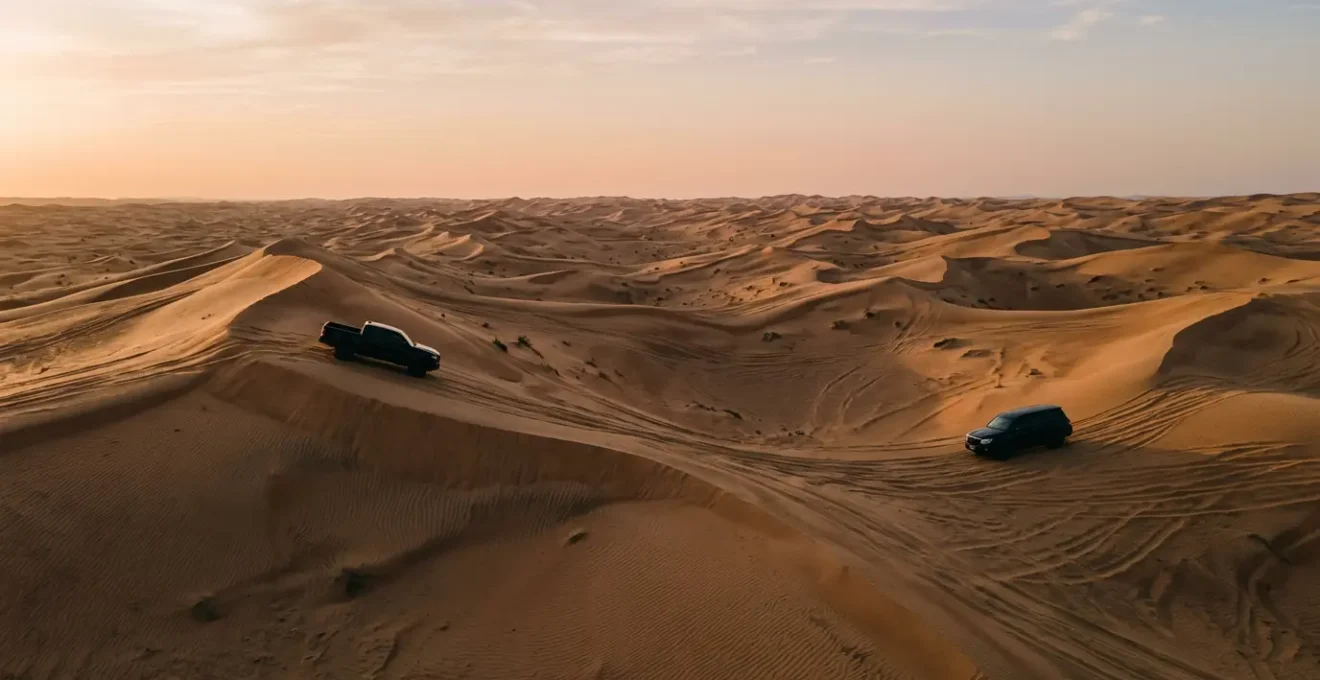
For a solo driver in deep sand, the right choice is not about raw capability but about managing solo-recovery risk.
- The Land Cruiser’s superior power is offset by its significant weight, making a bogged situation a critical liability for a single person to recover from.
- The Hilux, while less powerful, presents a strategic advantage with its lower weight and cost, which translates to a more manageable risk profile for self-recovery.
Recommendation: Base your decision on the vehicle whose potential failure modes you are most prepared to handle by yourself, not on its on-paper superiority.
The engine cuts out. The only sound is the faint hiss of sand settling around tires that have dug themselves into the soft, unforgiving floor of the Moremi Game Reserve. You are alone. This is the scenario that keeps every adventurous self-driver awake at night. The debate between the Toyota Hilux and the legendary Land Cruiser is often the central topic around the campfire, usually framed as a simple question of which is « better. » Forum wisdom and rental agencies will often point to the Land Cruiser as the undisputed king of the bush.
This advice, however, often overlooks the most critical variable in your expedition: you are solo. The conventional logic of « more power, more capability » can become a dangerous trap when you are your own and only recovery team. The real-world physics of vehicle recovery, fuel logistics across vast, roadless tracks like the Magwikwe Sand Ridge, and the fine print of a Botswana rental contract all point to a more nuanced truth. The choice isn’t about which vehicle is more capable; it’s about which vehicle’s specific failure modes you are better equipped to survive.
This technical-minded guide moves beyond the spec-sheet comparisons. We will analyze the practical implications of each vehicle’s design from an expedition mechanic’s perspective. We’ll examine why a heavier vehicle can be a greater liability, how to calculate your true operational range in low-gear sand conditions, and what your insurance *really* covers when you’re miles from anywhere. The goal is to equip you to make a decision based on a rigorous analysis of risk management and solo recovery viability, ensuring your adventure is memorable for the right reasons.
This article provides a comprehensive breakdown of the critical factors to consider, from vehicle recovery systems to the logistical realities of a mobile safari. The following sections will guide you through the technical considerations necessary for a safe and successful solo expedition.
Summary: Hilux vs. Land Cruiser for Solo Sand Driving
- High-Lift Jack vs. Air Jack: Which Is Safer for Solo Travelers in Sand?
- Why Deflating Tires to 1.5 Bar Is Crucial for Crossing the Magwikwe Sand Ridge?
- Hard Shell vs. Soft Shell: Which Roof Tent Survives the Kalahari Winds?
- How to Calculate Fuel Range When Driving in Low Gear for 6 Hours?
- What Does « Standard Excess » Really Cover in a Rental Contract for Botswana?
- How Deep Can a Land Cruiser Go Before the Engine Floods?
- How Does a Mobile Camp Move Location Without You Lifting a Finger?
- Why Choose a Mobile Safari Over a Permanent Lodge for Authenticity?
High-Lift Jack vs. Air Jack: Which Is Safer for Solo Travelers in Sand?
When you’re bogged to the axles in sand, your choice of jack is not a matter of convenience but of survival. The classic high-lift jack, often seen as the emblem of a serious off-roader, is a poor and often dangerous choice for a solo traveler in sand. Its small base plate offers no stability on soft ground, making it prone to slipping or sinking, potentially causing catastrophic damage to the vehicle or, worse, the operator. Furthermore, most standard rental vehicles, whether a Hilux or Land Cruiser, lack the reinforced steel bumpers or rock sliders that provide a safe jacking point for this type of equipment.
The far superior option for sand recovery is the air jack (or exhaust jack). It uses a large inflatable bag that provides a wide, stable footprint on sand, lifting the vehicle safely and evenly. It can be placed under the center of the chassis to lift two wheels at once, allowing you to fill the ruts with sand or position recovery boards. Its operation is simple and requires far less physical exertion, a critical factor when you are already fatigued. However, before any jacking attempt, the primary action is always to dig. Reducing the amount of sand piled up in front of the tires and under the chassis is paramount.
Case Study: Recovery Force Measurements on Sand-Bogged Vehicles
A real-world test on Stockton Beach measured recovery forces for a sand-bogged Defender 90 weighing 1610kg. The vehicle required a snatched force equivalent to 80% of its mass to pull it from the sand trap. This demonstrates the immense forces involved, which are magnified with a heavier vehicle like a Land Cruiser. Crucially, after five minutes of simply digging sand away from the vehicle, the recovery force reduced to just 36% of its mass, demonstrating how preparation dramatically reduces recovery risks and the strain on your equipment.
Ultimately, the goal is to avoid needing the jack at all. This means having the right non-jacking recovery gear. The choice between Hilux and Land Cruiser is less important than having a recovery system appropriate for your vehicle’s weight and the conditions. A lighter Hilux puts less strain on all recovery components.
Action Plan: Selecting Your Vehicle-Specific Recovery System
- Assess vehicle weight: A fully loaded Hilux (approx. 2.5 tons) is compatible with most standard air jack systems rated to 3 tons. Ensure the jack’s capacity exceeds your vehicle’s Gross Vehicle Mass (GVM).
- Check jacking points: Confirm your rental vehicle’s available jacking points. Standard vehicles are incompatible with high-lift jacks, making an air jack or the vehicle’s original bottle jack (on a solid base) the only viable options.
- Assemble core gear: Ensure you have appropriately sized shackles and a kinetic rope or strap rated for your vehicle’s weight. Add high-quality recovery boards like Maxtrax, as they are often the most effective first line of defense.
- Understand vehicle electronics: For sand driving, especially on dunes, it’s critical to turn Electronic Stability Control (ESC) OFF. Many 4x4s do this automatically in specific off-road modes. Failing to do so can cause the system to cut power halfway up a dune, leading to a bog.
- Practice at home: Practice setting up your recovery gear, including the jack and recovery boards, in a controlled environment before embarking on a solo trip. Familiarity is a key safety component.
Why Deflating Tires to 1.5 Bar Is Crucial for Crossing the Magwikwe Sand Ridge?
Tire pressure is the single most important variable in sand driving. Failing to deflate your tires is not a minor mistake; it is a guarantee of getting stuck. The conventional wisdom of dropping pressure to 1.5 bar (or around 22 PSI) is not arbitrary; it’s based on the fundamental physics of flotation. A fully inflated tire has a small contact patch and acts like a knife, cutting into the sand and digging itself into a hole. A deflated tire dramatically elongates its footprint, increasing the surface area in contact with the sand.
This transformation from a « knife » to a « ski » allows the vehicle to float on top of the sand rather than digging through it. The Magwikwe Sand Ridge in Botswana is a notorious stretch of deep, soft sand that is impassable without proper tire deflation. The difference in performance is not subtle; it is absolute. When considering a Hilux versus a Land Cruiser, this principle applies equally, but the systemic load of the heavier Land Cruiser makes proper deflation even more critical. The extra weight requires a larger footprint to achieve the same level of flotation, meaning there is less margin for error.
This is where the visual evidence becomes undeniable. The sidewall of the tire bulges significantly, and the length of the tire touching the sand can more than double. This is the mechanism that allows a multi-ton vehicle to glide over terrain that would trap a person on foot.
As you can see, the deformation creates a much larger contact patch. This is why you must carry a reliable tire pressure gauge and a portable air compressor. You will need to deflate for sand sections and re-inflate for harder gravel roads or tarmac to avoid damaging the tires. Driving at high speed on a deflated tire can cause it to overheat and fail catastrophically. The choice of vehicle is secondary to the disciplined application of this principle.
Hard Shell vs. Soft Shell: Which Roof Tent Survives the Kalahari Winds?
Your roof top tent is your sanctuary in the bush, and its design has a significant impact on safety, comfort, and even vehicle performance. The choice between a hard shell and a soft shell tent is particularly relevant in the open landscapes of the Kalahari, which are prone to strong, persistent winds. A hard shell tent, typically a clamshell or pop-up design, offers superior aerodynamic performance both when driving and when deployed. Its rigid structure is inherently more resistant to flapping and noise in high winds, providing a more secure and restful night’s sleep.
Conversely, a soft shell tent, which folds out and is supported by a frame and fabric walls, acts like a large sail in the wind. While manufacturers have improved their designs, strong gusts can still cause significant noise and stress on the fabric and poles. For a solo traveler, the speed of deployment is another critical safety factor. A hard shell tent can often be set up or packed away in under a minute, a significant advantage at dusk when predators are active or when trying to outrun an approaching storm. A soft shell requires more time to unfold, secure covers, and tension poles.
When selecting your rental, the type of tent should be a key consideration. The vehicle it’s mounted on, whether a Hilux or a Land Cruiser, is less important than the quality and type of shelter it provides. A well-rested driver is a safe driver. Always position your vehicle so the narrowest profile of the tent faces the prevailing wind to minimize its impact. In extreme winds, having a plan to quickly pack down and sleep in the vehicle is a necessary emergency precaution.
How to Calculate Fuel Range When Driving in Low Gear for 6 Hours?
Underestimating fuel consumption is one of the most common and dangerous mistakes made by self-drivers in Botswana. The official fuel economy figures for a Hilux or Land Cruiser are irrelevant in the real world of deep sand and low-range 4×4 driving. For a six-hour stretch in low gear, as is common in areas like Savuti, you must calculate your fuel needs based on consumption per hour, not per 100 kilometers. The engine is working consistently hard at high RPMs while the vehicle covers very little ground.
Real-world data is sobering. While a diesel 4×4 might average 13 L/100km on a highway, sand driving can easily double that. Field data from experienced travelers shows that sand driving can increase fuel consumption to 22 liters per 100km or more. When operating in low range, it’s more practical to think in liters per hour. A V8 Land Cruiser, for example, can consume over 20 liters of fuel for every hour it spends churning through thick sand. This drastically reduces its operational range compared to the more frugal 4-cylinder diesel in a Hilux.
Before your trip, you must meticulously plan your route, identify all available fuel stops (which are few and far between), and calculate your needs with a significant safety margin. Carrying at least two 20L jerry cans is not optional; it is mandatory. Your calculation should always be based on the worst-case scenario: fully loaded, low-range driving in soft sand.
| Vehicle Model | Engine Type | L/hour in Sand (Low Range) | Typical Range with 80L Tank |
|---|---|---|---|
| Hilux 2.8 GD-6 | 2.8L Turbo Diesel | 12-15 L/hr | 5-6 hours |
| Land Cruiser 79 V8 | 4.5L V8 Diesel | 18-22 L/hr | 3.5-4.5 hours |
| Land Cruiser 200 | 4.5L V8 Twin Turbo | 20-25 L/hr | 3-4 hours |
This table clearly illustrates the « thirst » of the larger Land Cruiser engines, which directly impacts your logistical planning. A Hilux often provides a greater safety margin in terms of range, a critical advantage for a solo traveler far from the nearest pump. Always err on the side of carrying too much fuel.
What Does « Standard Excess » Really Cover in a Rental Contract for Botswana?
The term « standard excess » in a 4×4 rental contract for Botswana is dangerously misleading. It creates a false sense of security, as it typically covers only a narrow range of collision scenarios and excludes almost all common off-road incidents. For a solo driver, understanding these exclusions is as critical as checking the oil. Standard policies almost universally exclude underbody damage from rocks or grounding out in sand, as well as damage to tires and windscreens. These are the most frequent types of damage encountered during a self-drive safari.
Even more alarmingly, most policies contain a negligence clause that can be interpreted broadly. A single-vehicle rollover, a common occurrence in soft sand for inexperienced drivers, is often classified as negligence. In this case, the renter becomes liable for the *full value* of the vehicle, which can exceed $50,000 USD. The « excess » becomes irrelevant. It is imperative to purchase the « super cover » or zero-excess insurance option, and even then, to read the fine print for specific exclusions like water damage from a failed river crossing.
The choice between a Hilux and a Land Cruiser also has financial implications here. An analysis of rental agreements in the region shows that the vehicle’s market value directly affects the insurance calculations. Because the Hilux is typically priced lower than a Land Cruiser, the potential liability and excess amounts can be correspondingly lower, as noted in a review of the used rental market and its impact on insurance valuations. Furthermore, ensure your contract explicitly includes cross-border coverage for Botswana if you are renting from a neighboring country like South Africa or Namibia, as this often requires separate paperwork and fees.
How Deep Can a Land Cruiser Go Before the Engine Floods?
A vehicle’s wading depth is a hard limit, not a target. While manufacturer specifications indicate the Land Cruiser 300 Series has a 700mm wading depth, this figure is measured in ideal, static conditions. In a real-world river crossing with a flowing current and an uneven riverbed, the practical safe depth is significantly less. The most critical factor is keeping water out of the engine’s air intake. Once water enters the engine—a condition known as hydrolock—the incompressible nature of water will cause catastrophic internal damage, instantly turning your vehicle into a multi-ton paperweight.
The key to any water crossing is to create and maintain a « bow wave ». This is achieved by entering the water at a steady walking pace (around 5-7 km/h) and maintaining that momentum. The wave of water pushed by the front of the vehicle effectively lowers the water level around the engine bay, helping to protect the air intake and critical electronics. If you go too fast, you risk flooding the engine over the bonnet; too slow, and you may lose the bow wave and stall. A snorkel is a vital modification that raises the air intake to roof level, providing a massive safety margin. It should be considered a non-negotiable feature for any serious water crossings.
Both the Hilux and Land Cruiser have similar factory wading depths, but a solo driver must always be conservative. Walk the crossing first to check the depth and identify obstacles. If you have any doubt, do not attempt it. After every water crossing, it’s essential to perform safety checks:
- Immediately check the air filter for any signs of moisture or water ingress.
- Inspect all fluids (engine oil, transmission, differentials) for a milky appearance, which indicates water emulsification.
- Listen for unusual noises from bearings or squealing from wet belts.
- Gently test the brakes to dry the pads and rotors, as their effectiveness will be severely reduced when wet.
How Does a Mobile Camp Move Location Without You Lifting a Finger?
The magic of a fully-serviced mobile safari lies in its seamless logistics, which are a world away from the reality of a self-drive trip. A mobile camp appears to « move » because there is a dedicated back-of-house operation working tirelessly behind the scenes. While you are out on a morning game drive, a separate team of staff with a dedicated logistics vehicle breaks down the entire camp—tents, kitchen, showers, and all. They then drive ahead to the next designated private campsite and set everything up again before your arrival in the afternoon.
This support vehicle is the unsung hero of the operation. As noted in safari logistics analyses, professional operators often favor the rugged, utilitarian models of the Land Cruiser (like the 70 series) for this task. Their robust construction and often superior off-road features, like standard locking rear differentials and hill descent control, are essential for moving heavy camp equipment across the most challenging and remote tracks while the guests enjoy a more comfortable ride in a separate game viewer.
For the solo self-driver, this contrast is stark. You are the driver, guide, mechanic, and camp staff all in one. Every piece of equipment you bring must be set up and broken down by you, every day. This reality should influence your vehicle choice. The simplicity and lighter weight of a Hilux can translate to less work, less fuel used, and a less complex system to manage on your own. The « luxury » of the mobile camp is the presence of a support team; your « luxury » is the independence and simplicity of your setup.
Key Takeaways
- Focus on solo recovery viability, not just raw power. A lighter stuck vehicle (Hilux) is easier for one person to recover than a heavy one (Land Cruiser).
- Tire pressure isn’t a suggestion; it’s a fundamental principle of sand flotation. Deflating to 1.5 bar is mandatory for soft sand.
- Fuel consumption in low-range sand can be 50-70% higher than on the highway. Calculate your range based on worst-case hourly consumption, not kilometers.
Why Choose a Mobile Safari Over a Permanent Lodge for Authenticity?
The decision to undertake a solo mobile safari in a vehicle like a Hilux or Land Cruiser, rather than staying in permanent lodges, is a choice of philosophy. It’s about trading comfort for authenticity and predictability for adventure. A permanent lodge offers luxury, security, and the expertise of professional guides. A mobile safari, particularly a self-drive one, forces an intimate connection with the environment. You are not just observing the wilderness; you are an active participant in it, subject to its rhythms, its challenges, and its raw beauty.
Your vehicle becomes an extension of this philosophy. While the Land Cruiser is often associated with the comfort and capability required for high-end safaris, the humble Hilux embodies the spirit of a durable, self-reliant workhorse. It may not have the V8 power or the advanced multi-terrain systems, but it is exceptionally capable and, crucially, a simpler and lighter system to manage alone. The performance difference, while measurable, is often less dramatic than perceived.
In a technical off-road test, a Land Cruiser clocked a time of 21.63 seconds through a challenging course, while the Hilux was close behind, achieving a time of 23.40 seconds. The Land Cruiser’s shorter wheelbase provided some advantage in tight sections, but the Hilux proved its immense capability.
– Carscoops, Land Cruiser Vs. Hilux Off-Road Test Results
This data confirms that a well-driven Hilux is more than a match for most challenges. The choice, therefore, circles back to risk and personal style. The Land Cruiser offers more operational headroom, but when things go wrong, the consequences are more severe due to its weight and complexity. The Hilux demands more from the driver but offers a system that is fundamentally easier to manage and recover when you are the only one there to do it. Choosing the vehicle is choosing your adventure: do you want the one with the highest performance ceiling, or the one with the most manageable risk floor?
The final decision rests on an honest assessment of your skills, your risk tolerance, and the type of journey you want to experience. To ensure your vehicle is perfectly matched to your expedition plan, the next logical step is to conduct a detailed assessment of your specific route and logistical needs.
Frequently Asked Questions on Hilux vs. Land Cruiser for Sand Driving
Does standard excess cover underbody damage from sand driving?
No, underbody damage is typically excluded from standard excess coverage, requiring separate coverage or accepting full liability.
What happens if I roll the vehicle in sand?
Single vehicle rollovers are often classified as ‘negligence’ making you 100% liable for the full vehicle value, even with standard excess.
Is cross-border coverage automatic?
No, crossing from South Africa to Botswana requires specific paperwork and additional fees or insurance becomes invalid.