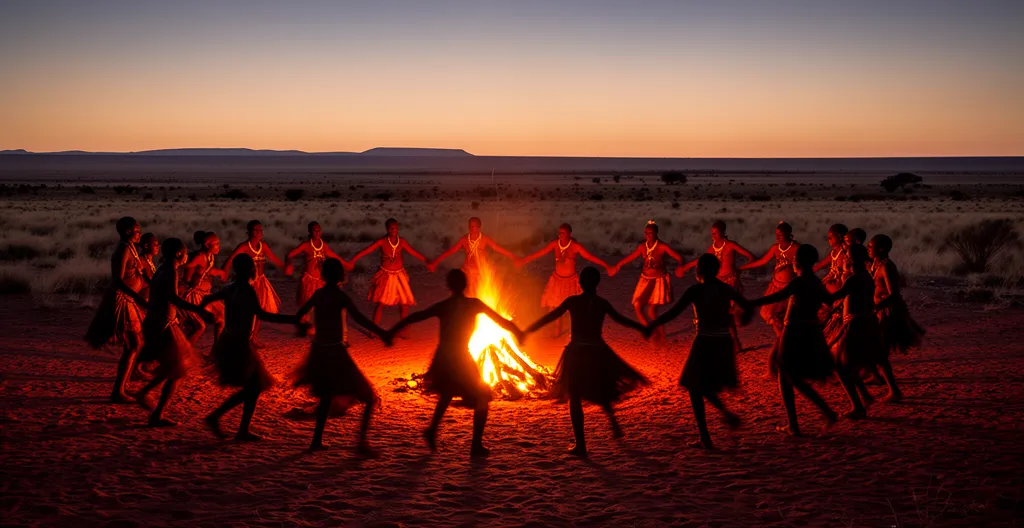
The key to an authentic San cultural experience isn’t finding an « untouched » community, but learning to decipher the cultural codes of a modern people navigating their heritage.
- Authenticity lies in understanding the *why* behind a practice (like a trance dance), not just watching the spectacle.
- Ethical engagement is an active process that requires asking tour operators specific, difficult questions about revenue and respect.
Recommendation: Shift your mindset from a passive tourist to a respectful student, and seek experiences where the San people themselves control the narrative and the economic benefits.
The desire to connect with the First People of Southern Africa, the San, often stems from a deep respect for their ancient heritage. Yet, this desire is shadowed by a significant fear: participating in a « human zoo. » The conscious traveler is haunted by the image of a staged, hollow performance that commodifies culture and dishonors its practitioners. Many guides offer checklists of « authentic » experiences, often focusing on learning survival skills or watching traditional dances, but these can easily be part of the very tourist trap you hope to avoid.
The conventional approach of seeking a « pure » or « untouched » experience is a flawed premise. The San are a contemporary people, deeply engaged with the modern world, its challenges, and its opportunities. The true path to a respectful encounter does not lie in a futile search for an imagined past. It lies in developing the ability to understand the living context of their culture today.
But what if the distinction between « real » and « staged » is more nuanced than we think? What if some staged elements are a form of cultural gatekeeping—a conscious decision by the community to share accessible parts of their heritage while protecting what is sacred? This guide proposes a different approach: instead of just looking, we must learn to see. It is a shift from being a consumer of culture to becoming a respectful student of a living anthropology, one capable of deciphering the profound meanings behind the practices.
This article will provide you with an anthropological framework to understand the deeper layers of San culture. We will explore the spiritual purpose of the healing dance, the practical genius of desert survival, the nuances of their unique language, and the symbolism of their ancient art. Most importantly, we will equip you with the critical tools to vet your travel choices and ensure your visit is one of genuine, mutual respect.
Summary: How to Experience Authentic San Culture Without Falling into Tourist Traps
- Why the San Healing Dance Is Still Performed at Night in the Kalahari?
- How to Find Water in the Desert Using Only Nature’s Cues?
- Xhosa vs. Khoisan Clicks: What Is the Difference for a Listener?
- The 3 Questions to Ask Your Tour Operator Before Booking a Cultural Village Tour
- Tsodilo Hills Art: How to Distinguish San Paintings from Bantu Art?
- How to Interpret the « Whale » Painting in the Middle of the Desert?
- How Does Your Animal Totem Influence Who You Can Marry or Eat?
- Hunter-Gatherer Lifestyle: What Is Real and What Is Staged for Tourists?
Why the San Healing Dance Is Still Performed at Night in the Kalahari?
The San healing dance, or trance dance, is perhaps the most iconic and misunderstood of their cultural practices. For the casual observer, it is a captivating spectacle of rhythmic clapping, singing, and intense dancing around a fire. For the San, however, it is the very core of their spiritual and community life. It is not a performance for an audience; it is a vital technology for healing, social cohesion, and accessing the spirit world. Performed at night because the darkness aids the journey inward, it is a practice that remains deeply embedded in community life. Research suggests these dances are not a relic of the past; they are held with a frequency that underscores their current importance, with some communities holding them up to four times a month on average.
The central purpose is to activate n/om, a spiritual energy or life force that resides in the healers. Through the exhausting dance, hyperventilation, and auditory driving of the polyrhythmic songs, a healer’s n/om is « heated » until they enter a trance state, known as !kia. In this altered state of consciousness, they are believed to be able to pull sickness from individuals, travel to the spirit world, and negotiate with the spirits of the dead. The violent trembling and shaking seen in healers are not just dramatic flair; they are the physical manifestation of this intense spiritual energy boiling within them. This process is a sophisticated manipulation of the body and mind, a form of living shamanic cosmology that connects the physical and spiritual realms.
Understanding this context transforms the traveler’s perspective. You are not witnessing a « show. » You are witnessing a powerful, and often draining, community ritual. A respectful presence means recognizing the vulnerability and power of the moment, keeping a discreet distance, and appreciating the deep trust the community extends by allowing outsiders to be present. The dance is not about entertainment; it is about survival—spiritual, physical, and communal.
How to Find Water in the Desert Using Only Nature’s Cues?
Beyond the spiritual realm, San heritage is a masterclass in environmental literacy. The ability to find water in the arid Kalahari is not magic; it is the result of a profound, multi-generational knowledge system based on observing subtle cues in the landscape, flora, and fauna. This deep ecological wisdom demonstrates a connection to the land that is both practical and philosophical. For the San, the desert is not an empty wasteland but a library of information, if you know how to read it. Learning about these techniques offers a window into a worldview where human and nature are inextricably linked.
This is not just about digging a hole. It involves a complex understanding of animal behavior and botany. Certain plants, for example, act as indicators of subterranean water tables. The most famous of these is the Tsamma melon (Citrullus caffer), a bitter wild fruit that can hold a significant amount of water and is a crucial source of hydration for both people and animals during the dry season.
As the image powerfully illustrates, this knowledge is tangible and life-sustaining. But the techniques are far more varied and subtle. They include:
- Following animal trails: Animals have an innate ability to find water. Converging game trails, particularly those used at dawn or dusk, often lead to hidden sources.
- Observing bird flight: The flight patterns of certain bird species can signal the direction of water, as they typically fly towards it in the morning and away from it in the evening.
- Reading the terrain: Digging in the outer bends of dry riverbeds is a common technique, as this is where the last vestiges of moisture are likely to be trapped beneath the sand.
- Watching other diggers: Animals like baboons and porcupines are skilled at locating and digging for tubers and roots that have high water content.
This knowledge is a testament to a life of acute observation. When a guide demonstrates these skills, they are sharing a piece of an immense intellectual and cultural legacy. The authenticity lies not in you successfully finding water, but in your appreciation for the intricate science behind the search.
Xhosa vs. Khoisan Clicks: What Is the Difference for a Listener?
The click consonants are the most famous feature of Khoisan languages, making them phonetically unique on a global scale. However, not all clicks heard in Southern Africa are the same. The languages of the Nguni people, such as Xhosa and Zulu, also famously incorporate clicks. For a traveler, understanding the distinction is a key step in appreciating the region’s complex linguistic history. The primary difference lies in their origin and function: for the San, clicks are a foundational, integral part of their language’s structure. For Xhosa, they are a borrowed feature, adopted through centuries of contact and intermarriage with Khoisan communities.
This historical difference has a direct impact on what a listener hears. In a Khoisan language like Ju|’hoan, clicks are incredibly frequent and varied. They are the ‘percussion’ of the language, forming the core of many words. A change in the type of click can completely change a word’s meaning. In Xhosa, clicks are used more as an ‘accent’ on certain words, many of which are themselves loanwords from Khoisan. They are less frequent and the inventory is smaller. The following comparison helps clarify the key distinctions.
This table breaks down the fundamental differences in how click consonants are used in Khoisan languages versus the Xhosa language, offering a clear guide for the discerning listener, as detailed in an analysis of San cultural practices.
| Feature | Khoisan Languages | Xhosa Language |
|---|---|---|
| Origin of clicks | Foundational part of phonemic inventory | Borrowed feature from contact with Khoisan |
| Frequency in speech | Core ‘percussion’ integral to rhythm | Used as ‘accent’ on certain words |
| Complexity | Change in click type changes word meaning | Less semantic variation |
| Number of click types | Up to 5 different clicks | 3 borrowed clicks (c, q, x) |
Recognizing this is more than a linguistic fun fact. It is an acknowledgment of a deep history of cultural exchange and influence. When you hear clicks in Xhosa, you are hearing a living echo of Khoisan heritage preserved within another culture, a testament to the profound and lasting legacy of the San people across Southern Africa.
The 3 Questions to Ask Your Tour Operator Before Booking a Cultural Village Tour
This is where the ethically-conscious traveler must become an active investigator. The glossy brochures and well-meaning websites of tour operators rarely reveal the full picture of their relationship with the communities they feature. The difference between an exploitative « human zoo » and a genuine, community-led enterprise often lies in the details of ownership, respect, and revenue sharing. To move beyond vague promises of « ethical tourism, » you must be prepared to ask specific, and sometimes uncomfortable, questions. Your willingness to ask is a powerful statement that you value the community’s agency as much as the experience itself.
An operator committed to genuine partnership will welcome these questions and have transparent answers. Hesitation, deflection, or generic responses are significant red flags. Before you book any « cultural village » tour, you have a responsibility to perform your own due diligence. The following questions are designed to cut through the marketing language and get to the heart of the matter: the distribution of power and profit.
Your Ethical Audit Checklist: Questions for Tour Operators
- What is the exact ownership structure and revenue distribution model? Don’t accept « a portion of proceeds go to the community. » Ask for specifics. What percentage goes directly to the participating individuals? What percentage goes to a community-managed trust? Who are the signatories on that trust’s bank account?
- What are the community’s established policies on photography and visitor engagement? The existence of clear, community-defined rules (e.g., « ask permission before photographing an individual, » « do not enter homes uninvited ») is a strong indicator of a healthy, respectful dialogue between the operator and the community. It shows the San are agents defining the terms of the encounter, not passive subjects.
- How does the experience address modern life and challenges, beyond just ancestral skills? A truly respectful tour acknowledges the San as a contemporary people. Does the operator facilitate conversations about current issues like land rights, access to education, or economic integration? Or do they exclusively present a romanticized, « primitive » version of San life? The former indicates a partnership; the latter suggests a performance.
Positive models do exist, where tourism serves as a tool for cultural preservation and economic self-determination.
Case Study: The Dqae Qare San Lodge Model
The Dqae Qare San Lodge in Botswana represents a powerful example of community-based tourism. In this model, the local San community owns and operates the lodge themselves. This crucial element of ownership ensures that they are not merely employees or subjects of the tourist gaze. Guests engage directly with community members who lead bush walks, demonstrate tracking skills, and share stories on their own terms. The revenue generated directly supports the community, providing a sustainable economic base that empowers them to preserve their culture while navigating the modern world. This model proves that ethical tourism is not only possible but is a powerful force for good when communities are in control.
Tsodilo Hills Art: How to Distinguish San Paintings from Bantu Art?
The Tsodilo Hills, a UNESCO World Heritage site in Botswana, are often called the « Louvre of the Desert. » The rock faces hold one of the highest concentrations of rock art in the world, with over 4,500 paintings. This sacred landscape contains a layered history, with art from both San and later Bantu-speaking peoples. For the untrained eye, the panels can be a confusing jumble of figures. However, learning to distinguish between the two traditions unlocks a deeper understanding of the different worldviews, purposes, and artistic techniques that have shaped this land over millennia.
The differences are not merely stylistic; they reflect fundamentally different reasons for creating the art. San art is predominantly shamanistic. The paintings are not simple depictions of daily life; they are records of trance experiences, portals to the spirit world, and visual manifestations of spiritual power. The animals, especially the powerful eland, are imbued with n/om, and their depiction is part of a ritual process. Bantu art, by contrast, is often more didactic or illustrative. It frequently depicts domestic animals like cattle (which the San did not traditionally keep), figures with shields and spears, and scenes that may relate to historical events, territorial claims, or initiation rites.
The visual and material differences are stark once you know what to look for. The following table, based on common rock art analysis and information such as that provided by specialist safari guides, provides a clear framework for differentiation.
| Characteristic | San Rock Art | Bantu Rock Art |
|---|---|---|
| Style | Fine-line, often polychrome (multiple colors), shaded | Thicker lines, often monochromatic (single color, typically white or red) |
| Subjects | Wild animals (especially Eland), shamanic figures (therianthropes), trance scenes | Domestic animals (cattle), human figures with weapons, geometric patterns |
| Purpose | Shamanistic, portal to spirit world, harnessing spiritual power | Didactic, historical record, territorial marking, initiation |
| Pigments | Complex mix: ochre, blood, egg white, plant extracts | Simpler pigments: kaolin clay, charcoal, often mixed with animal fat |
By learning to see these differences, the traveler moves from passive viewing to active interpretation. Each panel becomes a text, revealing insights into the spiritual cosmology of the San or the social history of the Bantu farmers. You are no longer just looking at old paintings; you are reading the cultural history of the Kalahari written on stone.
How to Interpret the « Whale » Painting in the Middle of the Desert?
Among the thousands of paintings at Tsodilo Hills, one set of images is particularly baffling: a whale and a penguin, rendered in the distinctive red ochre of the San, hundreds of kilometers from the nearest ocean. This seemingly impossible depiction is a profound lesson in San cosmology and a critical check on our own literal-minded interpretations. To ask « how did they see a whale? » is to ask the wrong question. The correct question, from an anthropological perspective, is « what does the whale represent in a shamanistic worldview? » The painting is almost certainly not a literal record of a coastal visit.
Instead, it is widely believed to be a metaphor for a deep spiritual experience. San rock art is not a field guide of local fauna; it is a map of the spirit world. The trance journey undertaken by a shaman is often described in aquatic terms—a dive into the depths of another reality. The rock face itself is seen as a veil or membrane between the physical world and the spirit world. In this context, the whale, a master of the deep, becomes a powerful symbol.
It represents a potent spirit animal encountered on a shaman’s journey into the « underwater » realm of the trance state. Alternatively, it could be a depiction of a « rain animal. » In San belief, rain takes the form of an animal that a shaman must capture in the spirit world and lead across the land to make it rain. A whale, as a massive water-holding creature, would be an exceptionally powerful rain animal. The painting, therefore, isn’t about marine biology; it’s about spiritual power, altered states of consciousness, and the shaman’s role in mediating between worlds to ensure the community’s survival.
How Does Your Animal Totem Influence Who You Can Marry or Eat?
The San, a diverse group of peoples numbering approximately 100,000 across Southern Africa, have complex social structures that govern their communities. One of the most fundamental of these is the kinship system, which is deeply intertwined with their spiritual beliefs about the natural world. This system dictates not only social relationships but also core aspects of life such as marriage rules and dietary restrictions. It is a framework that binds the community together and reinforces their connection to the environment, where animals are not just food sources but also spiritual relatives and symbols of identity.
At the heart of this system is often a form of totemism. An individual or a family group may have a special relationship with a particular animal, which is considered a kind of ancestor or spiritual guardian. This totem animal is treated with great respect. This relationship is not merely symbolic; it has very real social consequences. For example, it is often taboo for a person to eat their totem animal, as it would be akin to cannibalism. This practice also functions as a sophisticated, if unintentional, conservation method by creating a patchwork of hunting restrictions across different family groups.
The term San people, derived from sonqua in the Khoikhoi language, was used by the Khoikhoi people to denote the hunter-gathering communities who did not speak Khoi languages and means ‘those without cattle’.
– Study.com Educational Resources, San People | History, Cultural Practices & Language
Furthermore, these kinship and totem rules often dictate marriage eligibility through a system of exogamy. This means individuals are required to marry outside of their own immediate family or clan group. In some cases, this can be linked to totems, where individuals with the same primary totem animal may be considered « family » and thus ineligible for marriage. This practice is crucial for building alliances between different bands and for maintaining genetic diversity within a small-scale society. Understanding this social fabric reveals that a « hunter-gatherer lifestyle » is not a chaotic free-for-all, but a highly ordered society with intricate rules that ensure its long-term health and stability.
Key Takeaways
- Authenticity is not about finding a « primitive » past but about understanding a modern people’s relationship with their heritage.
- Ethical tourism is an active responsibility that requires travelers to critically investigate tour operators’ practices and revenue models.
- Many San cultural expressions (art, dance) are rooted in a deep shamanic cosmology and should be interpreted symbolically, not literally.
Hunter-Gatherer Lifestyle: What Is Real and What Is Staged for Tourists?
This is the ultimate question for the conscious traveler. After understanding the depth of San culture, how do we reconcile it with the reality of a tourist demonstration? The first step is to discard the binary of « real » versus « fake. » It is more productive to think in terms of « context. » No San person today lives a full-time, isolated Paleolithic existence. They live in villages, wear modern clothes, use cell phones, and send their children to school. The idea of a « pure » hunter-gatherer is a romantic fiction.
Therefore, a demonstration of traditional skills is, by its very nature, a form of performance. But this does not automatically render it inauthentic or disrespectful. The authenticity lies in the knowledge being shared, the context in which it is presented, and the agency of the people sharing it. A San elder teaching a younger community member how to make a bow in front of tourists is profoundly authentic—it is a moment of cultural transmission. A guide who puts on traditional skins for a demonstration, then changes back into jeans, is not being « fake. » They are engaging in cultural gatekeeping, consciously choosing what to share and how, separating their daily life from the cultural heritage they are entrusted to preserve.
An authentic experience acknowledges this modern context. It does not try to hide it. It embraces it. The most meaningful encounters are those where the demonstration of making fire with sticks is followed by a conversation about the challenges of getting a generator for the village water pump. This is the reality of 21st-century San life. To seek only the former and ignore the latter is the true act of disrespect. The following points can help you identify a truly valuable experience:
- The narrative is controlled by the San: They are the ones explaining, teaching, and answering questions, not a non-San guide translating from a script.
- The financial benefit is direct and transparent: The community owns the enterprise, or a clear, equitable partnership is in place.
- Modern reality is included: The experience doesn’t shy away from discussing contemporary life, including its challenges and successes.
- It feels like a workshop, not a zoo: The atmosphere is one of teaching and mutual respect, where questions are encouraged, and the dignity of the individuals is paramount.
Your journey to understand San culture, therefore, becomes an active process. It requires you to be more than a spectator. It asks you to be a student, an investigator, and a respectful guest. By shifting your approach, you can move beyond the fear of the tourist trap and participate in a meaningful exchange that honors the oldest living culture on Earth.
Frequently Asked Questions About the Tsodilo Whale Painting
What is the shamanic journey hypothesis for the whale painting?
The ‘whale’ and fish represent a shaman’s spirit journey through the ‘underwater’ realm of the spirit world, a common metaphor for the trance state experienced during healing dances.
Could it represent a rain-making ritual?
In San cosmology, certain creatures are ‘rain animals.’ A shaman would capture one in the spirit world and lead it across the land to make it rain. The whale could be a powerful water-holding rain animal.
Is there a possibility of ancestral memory?
The painting could represent ancestral memory passed down from times when climatic conditions were different, or from coastal San groups who migrated inland carrying ocean stories.