Booking a safari is an act of trust, and the single most critical factor is your guide’s caliber, which goes far beyond simple certifications.
- True qualification lies in judgment-based skills (like BQA Level 3) for handling unscripted wilderness, not just knowledge-based identification.
- A guide’s value is measured by their ability to weave narratives that connect you to the ecosystem, turning sightings into stories.
Recommendation: Demand transparency on a guide’s training level, storytelling philosophy, and the operator’s ownership structure before you commit a single dollar.
The success of a safari—the difference between a series of drive-by animal sightings and a profound, life-altering immersion into the wilderness—hinges on a single variable: the quality of your guide. For the meticulous planner, this is the most crucial decision. Yet, the industry is awash with vague advice to « read reviews » or « check for experience. » This approach is inadequate. It treats the selection of a guide like choosing a hotel, focusing on amenities rather than the core competence that will define every moment of your journey.
Most travelers look for a friendly face who can name the animals. An expert traveler, however, understands they are not hiring an encyclopedia. They are entrusting their safety, their investment, and their one chance at a transformative experience to a wilderness interpreter. This person must be a biologist, a historian, a master storyteller, and a risk manager, all in one. The standard qualifications listed on a website are merely the entry ticket; they are not a guarantee of excellence. True competence is found in the nuances of their training, their communication philosophy, and the ethical structure of the company they represent.
This guide provides an insider’s framework for deconstructing a guide’s qualifications. We will move beyond the surface-level checks and give you the critical questions to ask. We’ll dissect the meaning behind certification levels, differentiate a mere « pointer » from a true narrative weaver, and explore the non-negotiable importance of guide authority and the economic impact of your booking. This is how you stop hoping for a great guide and start ensuring you get one.
This article will provide you with a detailed framework for evaluating every critical aspect of a safari guide’s competence. The following sections will equip you with the knowledge to make an informed, expert-level decision.
Summary: How to Check Your Safari Guide’s Qualifications Before Booking
- What Is the Difference Between a BQA Level 2 and Level 3 Guide?
- Why a Good Storyteller Is More Valuable Than a Guide Who Just Points?
- Why You Must Obey Your Guide Instantly When Walking in the Bush?
- How Much Should You Tip Your Guide per Day in Botswana?
- Do You Need a Specialist Birding Guide or Can a Generalist Do It?
- How to Tell How Fresh a Lion Track Is by Touching the Sand?
- How to Check if a Safari Company Is Truly 100% Citizen Owned?
- Why Booking with a Citizen-Owned Operator Changes the Impact of Your Dollar?
What Is the Difference Between a BQA Level 2 and Level 3 Guide?
On the surface, guide qualifications can look like an alphabet soup of acronyms. However, understanding the hierarchy is the first step in separating the competent from the truly exceptional. In Botswana, the BQA (Botswana Qualifications Authority) framework provides a clear distinction, one that represents a fundamental shift from knowledge to judgment. A BQA Level 2 qualification certifies a guide who has mastered the ‘what’ of the safari experience. They are experts in species identification, local ecology, and conducting safe, controlled game drives. This is a solid, knowledge-based foundation.
A BQA Level 3 guide, however, operates on a different plane. This is a judgment-based qualification, focused on the ‘why’ and ‘what if.’ These guides are certified to lead walking safaris and handle complex, unscripted encounters with potentially dangerous game on foot. Their training goes beyond identification to include advanced animal behavior interpretation, risk assessment, and high-stakes decision-making under pressure. They are not just knowledgeable; they are proven leaders in the wilderness.
The distinction is best illustrated in practice. In a surprise elephant encounter, a Level 2 guide is trained to retreat to the vehicle. A Level 3 guide, by contrast, possesses the skills to read the elephant’s subtle body language, assess wind direction, and use advanced situational awareness to decide whether to stand their ground calmly or orchestrate a controlled withdrawal, turning a moment of potential danger into a profound educational experience. Demanding to know your guide’s BQA level—or its equivalent in other countries—is your first and most important filter for excellence.
This table breaks down the core differences, helping you understand the significant gap in responsibility and skill between the two levels.
| Aspect | BQA Level 2 Guide | BQA Level 3 Guide |
|---|---|---|
| Core Focus | Masters the ‘what’ – species identification | Masters the ‘why’ and ‘what if’ – behavioral interpretation |
| Responsibility Threshold | Vehicle-based safaris in controlled settings | Complex scenarios including on-foot encounters |
| Skills Level | Knowledge-based expertise | Judgment-based qualification |
| Typical Activities | Game drives, basic wildlife viewing | Walking safaris, advanced risk management |
| Experience Value | Can offer excellent localized expertise | Handles unscripted wilderness situations |
Why a Good Storyteller Is More Valuable Than a Guide Who Just Points?
A guide who simply points and identifies— »Look, an impala. Look, a giraffe »—provides you with a checklist, not an experience. They show you the canvas but never reveal the painting. A truly great guide is a narrative weaver, someone who transforms a simple sighting into a story that connects you to the intricate web of life unfolding around you. They don’t just show you a lilac-breasted roller; they explain the fierce territorial disputes behind its vibrant colors. They don’t just point to a lion; they interpret the subtle flick of its tail as a sign of imminent conflict with its rival brother.
This ability to build a narrative is not a « soft skill »; it is a core competency that separates a guide from a driver. It’s the difference between observing nature and understanding it. As Bushwise Field Guide Training notes when describing its advanced courses, the goal is to produce guides who create unforgettable experiences. According to their description of the IFGA Professional Safari Guide Course, this globally recognisable certification highlights guides who excel in soft skills such as communication, presence, and storytelling.
This emotional connection is the hallmark of a world-class safari. The memories that endure are not of the animals you ticked off a list, but of the stories that gave them context and meaning. A great storyteller makes you a participant in the drama of the bush, not just a spectator. Before booking, you have every right to vet this critical skill.
Your Action Plan: Vetting a Guide’s Storytelling Skills
- Ask the safari operator for your prospective guide’s personal bio, specifically requesting details on their guiding philosophy.
- Request links to any blogs, articles, or social media posts where the guide shares wildlife stories or observations.
- Inquire about a few specific, memorable moments the guide has created for past guests that go beyond a simple sighting.
- Ask if the guide has completed any advanced training in communication, interpretation, or holds an IFGA certification, which specifically evaluates storytelling.
- Check guest reviews for mentions of « storytelling, » « making the bush come alive, » or « connecting the dots, » not just « knowledgeable. »
Why You Must Obey Your Guide Instantly When Walking in the Bush?
When you step out of the safari vehicle and walk into the bush, you enter into a sensory contract with your guide. You are agreeing to subordinate your own senses—which are woefully inadequate in this environment—to their highly trained and finely tuned awareness. Your guide is constantly processing a stream of data you are completely oblivious to: the faint alarm call of a distant baboon troop, the subtle change in wind direction carrying a predator’s scent, the way the sand is scuffed, indicating a running herd of impalas just moments ago. Your safety does not depend on what you can see; it depends entirely on what your guide can sense.
Therefore, an instruction from your guide—whether it’s « stop, » « get down, » or « move behind me »—is not a suggestion. It is a command based on a rapid threat assessment you are not equipped to make. Hesitation, questioning, or pausing to take a photo is not just disrespectful; it is a profound breach of this contract and the single greatest risk factor on a walking safari. The guide’s word is law because their perception is your only real-time defense mechanism in an environment where humans are not the apex predator.
Case Study: The Sensory Contract in Action
The ability to interpret invisible dangers is a guide’s most critical skill. According to a report on advanced tracking techniques, these are not classroom skills but learned over thousands of hours. In one documented case from an analysis of guide sensory skills, a guide on foot detected the presence of a leopard purely through a subtle shift in the wind and the agitated alarm calls of nearby birds. He interpreted these signals ten minutes before the cat became visible to the guests, immediately directing his group to safety behind a large termite mound. By the time the leopard appeared, the potential for a dangerous surprise encounter had already been neutralized. The guests were never in danger precisely because they obeyed a command that, at the moment it was given, made no sense to them.
This is why you must demand a guide with the authority and confidence to command respect, and you must be prepared to offer your absolute, instantaneous obedience in return. It is the fundamental principle of safety when walking in big game country.
How Much Should You Tip Your Guide per Day in Botswana?
Tipping is a direct expression of gratitude for the skill, effort, and dedication your guide has invested in your experience. In Botswana, while never mandatory, it is a deeply ingrained and expected part of the safari culture, forming a significant portion of a guide’s income. Budgeting for it is not an afterthought; it is an essential part of responsible travel planning. The industry standard provides a clear benchmark for showing your appreciation appropriately.
For your safari guide, the accepted range is between US$15 and US$20 per person, per day. This is a guideline, and exceptional service that profoundly enhanced your trip certainly warrants a more generous tip. This amount should be given directly to your guide at the very end of your stay at a particular lodge or camp. It should not be given after each activity. Presenting it in a sealed envelope, perhaps with a short, personal note of thanks, is the customary and most respectful method.
It’s also crucial to remember the wider team who makes your safari possible. A separate tip should be allocated for the general staff—including chefs, housekeepers, and maintenance crew. For this, an amount of US$10 to US$20 per person, per day is recommended. This is typically placed in a communal tip box at the main lodge. If you have a dedicated tracker or a mokoro poler, they should be tipped separately and directly, at a rate similar to the main guide (US$15 per person per day). A detailed guide on tipping etiquette in Botswana confirms these ranges are standard practice.
While the amounts are important, the gesture itself is a powerful acknowledgment of the professional expertise and long hours that contribute to a seamless and magical safari experience. If, in the rare case of poor service, you feel a reduced tip is warranted, this decision should always be accompanied by private, constructive feedback to the camp manager.
Do You Need a Specialist Birding Guide or Can a Generalist Do It?
The answer to this question depends entirely on your ambition as a birder. For most travelers, any passionate generalist guide will not only suffice but will excel. A good guide’s enthusiasm for all aspects of the ecosystem is infectious, and they will delight in pointing out the vibrant plumage of a Woodland Kingfisher or the impressive nest of a Sociable Weaver. If your goal is to appreciate the beautiful and obvious birds you encounter, a generalist is perfect.
However, if your birding intensity is higher, your guide requirements must escalate accordingly. If you are a Serious Lister, arriving with a target of seeing 100+ species, you need to ensure your operator assigns you a generalist guide known for their strong birding passion. These guides often pursue birding as a personal hobby and can identify most species by sight and many by call alone. They will understand your mission and actively help you achieve your goal.
For the most dedicated avian enthusiasts—the LBJ Hunters in pursuit of ‘little brown jobs’ and rare, cryptic endemics—a generalist will not do. You require a dedicated specialist birding guide. These experts possess an encyclopedic knowledge of calls, habitats, and the subtle behaviors that distinguish near-identical species. They live and breathe birding and are the only ones who can realistically help you find that elusive Pel’s Fishing Owl or a specific cisticola. You must request and pay for this specialization upfront.
This table helps define which type of guide you need based on your personal birding goals.
| Birder Type | Typical Goals | Guide Recommendation |
|---|---|---|
| Casual Ticker | Identify colorful, obvious birds | Any passionate generalist guide |
| Serious Lister | 100+ species target per trip | Generalist with birding specialization |
| LBJ Hunter | Rare endemics, ‘little brown jobs’ | Dedicated specialist birding guide |
If you fall into the ‘Serious Lister’ category, you can vet a generalist guide’s birding passion by asking your operator a few key questions:
- Who is your most passionate birder among the general guides?
- Does the guide own their own high-quality binoculars (e.g., Swarovski, Leica) and a library of field guides?
- Can they identify a significant portion of local birds by their calls?
- Have they completed any specialized birding courses or an SKS (Specialist Knowledge and Skills) Birding certification?
How to Tell How Fresh a Lion Track Is by Touching the Sand?
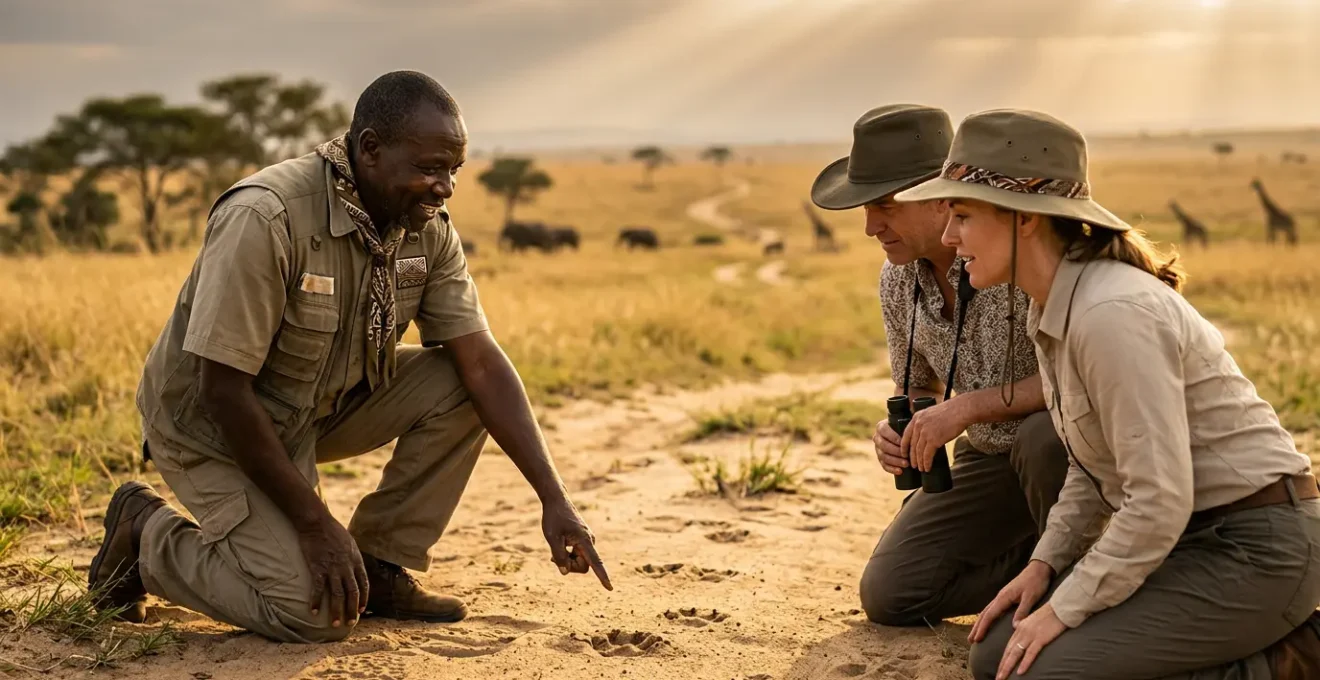
The question itself is a romantic simplification of a complex analytical process. A master tracker doesn’t just touch the sand; they conduct a multi-sensory forensic investigation. Determining the age of a track is an art form that synthesizes dozens of environmental variables, a skill honed over a lifetime of observation, not learned from a textbook. While a guide might demonstrate a single aspect, like touching the sand, it’s the combination of signs that tells the real story.
The sharpness of the track’s edges is a primary indicator. A very fresh track in soft sand will have crisp, clearly defined ridges. As time passes, wind and gravity begin to soften these edges, causing them to crumble slightly. A tracker will also feel for moisture. By digging a finger into the soil just beside the print, they can feel if the underlying sand is cooler or damper than the sun-baked surface. If so, the track is likely very recent, made before the sun had a chance to dry it out. According to safari experts, the best time to find fresh tracks is early in the morning, before the ground has been disturbed by wind or other animals, and before the sun evaporates these crucial moisture clues.
But these are just two data points. A true expert integrates far more.
Case Study: Multi-Sensory Track Analysis
In one instance, expert trackers identified a young male lion track as being only a few hours old. They noted the four toes were nicely rounded with three distinct lobes, and nearby, the tracks of a lioness showed the characteristic pointy leading edges. But to assess the time, their analysis went deeper. They observed the almost total lack of any wind-blown debris (like tiny leaves or seeds) within the depression of the track. They also noted the absence of any insect activity, like ants, which would have had time to explore the disturbance if it were older. By combining track sharpness, subsurface moisture, debris accumulation, and insect activity, they built a comprehensive picture that allowed them to confidently declare the tracks were from that morning, making a successful follow-up highly probable.
So, while you may see your guide touch the sand, know that you are witnessing one small part of a sophisticated mental calculation. It is a profound demonstration of the deep, almost intuitive, connection a great guide has with their environment.
How to Check if a Safari Company Is Truly 100% Citizen Owned?
In the context of Botswana and much of Africa, « citizen-owned » is a powerful term that signifies a direct link between your tourism dollars and the local economy. However, the term can sometimes be used cosmetically. A meticulous planner must look beyond marketing claims and perform due diligence to ensure a company is not just citizen-owned on paper but is genuinely citizen-empowered in practice. This requires a level of verification that goes beyond a simple question.
True ownership means local citizens hold the equity, sit in leadership positions, and have ultimate operational control. It means profits are reinvested locally, staff are developed into management roles, and the company has a long-term, multi-generational stake in the conservation of its environment. This stands in stark contrast to « fronted » companies, where a local citizen may hold shares as a token requirement, but all strategic decisions and financial control reside with a foreign parent company. Verifying this distinction is a critical ethical check.
Case Study: Citizen Empowerment vs. Nominal Ownership
A truly citizen-empowered safari company in Botswana showcases its commitment through action, not just paperwork. One such operator demonstrates this by having 85% of its management positions filled by local citizens. Furthermore, it runs a dedicated guide training program that has successfully promoted 12 local staff members to senior guide and management positions over the past five years. They also have transparent profit-sharing agreements with the communities surrounding their concessions. This model contrasts sharply with nominally citizen-owned companies where locals may hold shares, but all significant operational and financial decisions are made from overseas offices, with profits being repatriated abroad.
To verify the true status of a safari company, you can take several concrete steps:
- In Botswana, ask for evidence of registration with CIPA (Companies and Intellectual Property Authority) and membership in HATAB (Hospitality and Tourism Association of Botswana).
- Directly request to see official business registration documents that clearly show the ownership structure and list of directors.
- Inquire about the nationality of the general manager, camp managers, and head guides. A high percentage of citizens in leadership is a strong positive indicator.
- Ask about staff tenure and internal promotion policies. Citizen-empowered companies typically invest in their staff, leading to longer employee retention and clear career paths.
- Be alert for red flags, such as a complex ownership structure involving offshore parent companies or a local « front person » who seems to have no real operational authority.
Key Takeaways
- A guide’s real value is in judgment-based qualifications (like BQA Level 3 or equivalent) and interpretive storytelling, not just pointing out animals.
- Instant obedience to a guide in the bush is non-negotiable; you are trusting their highly trained senses to mitigate invisible risks.
- Your booking choice has a direct economic and conservation impact; verifying and prioritizing 100% citizen-owned and empowered operators multiplies the benefit of your tourism dollars.
Why Booking with a Citizen-Owned Operator Changes the Impact of Your Dollar?
Choosing a 100% citizen-owned and empowered safari operator is not merely a feel-good decision; it is a strategic economic and conservation choice that fundamentally alters the impact of your travel investment. When you book with a foreign-owned company, a significant portion of your expenditure—often the majority—is repatriated to another country. The money leaves the local ecosystem. When you book with a genuine citizen-owned operator, your dollar stays, multiplies, and becomes a powerful force for community development and environmental stewardship.
This is known as the economic multiplier effect. The salary paid to a local guide is used to buy produce from a local farmer, who in turn pays school fees at the local school, whose teacher then buys supplies from a local artisan. Research into the safari industry’s local impact shows that money spent with locally-owned safari companies circulates within the community multiple times, creating a ripple effect of prosperity. This creates what is known as economic dignity, providing stable, high-quality employment that empowers communities and reduces dependency on external aid.
Beyond the economics, there is a deeper, more profound conservation benefit. As one industry report on sustainability eloquently states, the connection to the land is personal and permanent.
Citizen owners have a vested, multi-generational interest in preserving the environment that is their livelihood. It’s not just a business asset; it’s their children’s inheritance.
– Safari Industry Conservation Report, Botswana Tourism Sustainability Study 2024
This long-term perspective ensures that conservation is not just a marketing slogan but an existential necessity. The health of the wildlife and the wilderness is directly tied to the health of their family and community for generations to come. By choosing a citizen-owned operator, you are aligning your investment with those who have the most profound and enduring stake in protecting the very ecosystem you have traveled so far to experience.
Your role as a meticulous planner extends beyond your own itinerary. By demanding excellence in guide qualifications and committing to citizen-empowered operators, you don’t just book a trip—you become a stakeholder in the sustainable future of the wild places you visit. Start asking these critical questions today.