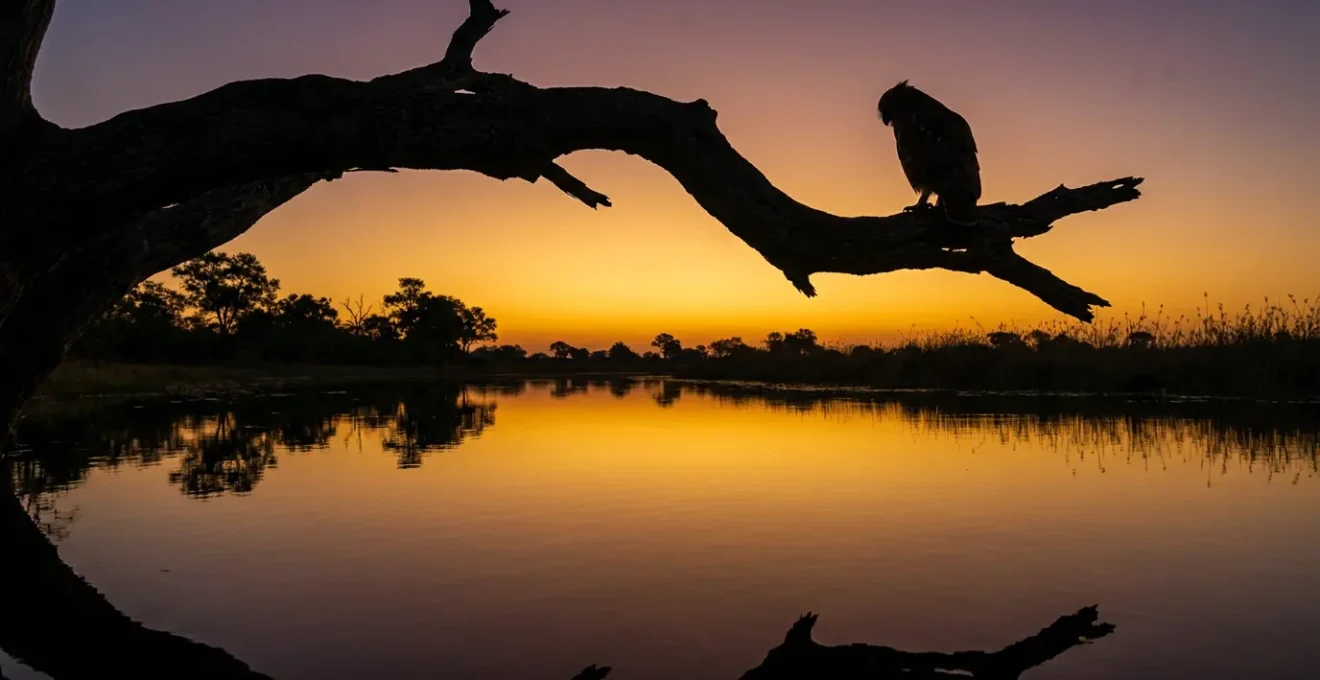
Spotting the Pel’s Fishing Owl is not about luck; it’s about systematically decoding the river’s ecological signals.
- Track key indicator species like Carmine Bee-eaters and Malachite Kingfishers to identify prime hunting territories.
- Master acoustic triangulation—listening for what isn’t there (oxpecker alarms) is as crucial as hearing the owl’s call.
Recommendation: Shift your mindset from passively searching for the owl to actively reading the entire riverine ecosystem as a map that leads directly to it.
For the dedicated birder, the Okavango Delta holds a singular, almost mythical prize: the Pel’s Fishing Owl. Many arrive with this ghost of the river at the top of their checklist, armed with the usual advice—look in the large, overhanging trees at dusk and dawn. They listen for the deep, booming call. While this is a starting point, it’s often not enough. This approach relies on chance, on stumbling upon an owl in a vast, intricate waterway system.
The common mistake is to search for the bird in isolation. True success, the kind that feels earned and repeatable, comes from a profound shift in perspective. It requires you to stop looking *for* the owl and start reading the ecosystem *around* it. The secret isn’t just about knowing which trees they prefer; it’s about understanding why they choose a specific branch on a specific bend in the river at a specific time of year. It’s a process of ecological deduction.
This guide moves beyond the basics. We will not just tell you where to look; we will teach you how to see. We will explore the ecological indicators that signal a healthy hunting ground, the advanced acoustic techniques that turn the delta’s soundscape into a live map, and the specific gear and methods that give you a definitive edge. By the end, you will understand that finding a Pel’s Fishing Owl is the final step in a fascinating puzzle you solve by interpreting the language of the delta itself.
To master this challenge, we’ve broken down the key strategies and environmental clues into a clear, actionable guide. The following sections will equip you with the expert knowledge needed to transform your search from a game of chance into a science of observation.
Summary: A Twitcher’s Strategic Map to the Pel’s Fishing Owl
- When Do the Carmine Bee-eaters Return to Breed in Kalizo?
- How to Photograph Birds in Flight from a Moving Boat?
- Why 10x Magnification Is Too Shaky for Birding on a Mokoro?
- Wattled Crane or Grey Crowned Crane: Which One Is Critically Endangered?
- Why Are Oxpeckers the Best Warning System for Herbivores?
- How to Spot Malachite Kingfishers Hiding in the Papyrus?
- Why Are Electric Vehicles a Game Changer for Audio-Birding?
- How to Photograph the Mirror Reflections of the Delta Without Glare?
When Do the Carmine Bee-eaters Return to Breed in Kalizo?
The arrival of the Southern Carmine Bee-eaters is one of the most spectacular avian events in the region, but for the savvy PFO hunter, it’s more than a beautiful sight—it’s a calendar entry. These birds are a critical ecological indicator. Their breeding season is precisely timed with the annual flood recession of the Zambezi and Chobe river systems. This is your first major clue.
Experts know that the Southern Carmine Bee-eaters arrive to breed between August and November, a period that coincides with dropping water levels. As the water recedes, fish become concentrated in the main channels and in shrinking pools, creating a bountiful, easily accessible buffet. This is the exact condition the Pel’s Fishing Owl awaits. The arrival of the Carmines doesn’t just signal that it’s a good time for insect-eating birds; it signals that the entire aquatic food chain is entering a period of peak accessibility. This is when the owls’ hunting becomes most active and predictable.
Therefore, your search for the owl should intensify in perfect sync with the life cycle of the bee-eater. Observing the vibrant, noisy Carmine colonies by day tells you it’s time to begin your quiet, patient search for the silent hunter by night. You are using one species to set your watch for another.
Action Plan: Using Ecological Indicators to Pinpoint PFO Season
- Monitor water level drops from late August as the flood recession actively concentrates fish.
- Look for exposed, overhanging branches on riverbanks that were previously submerged; these are new, prime perches.
- Track the arrival of Carmine Bee-eaters as the definitive signal that the prime PFO hunting season is beginning.
- Switch your observation strategy from diurnal, vibrant colony observations to nocturnal, silent searches in the main channels.
- Focus efforts on the main, deep channels where fish become trapped and concentrated during this water recession.
How to Photograph Birds in Flight from a Moving Boat?
Spotting the Pel’s is one challenge; capturing a world-class photograph of it from the unstable platform of a boat is another entirely. The low-light conditions and movement of both the bird and the boat conspire against you. The single most important technical setting to master is your shutter speed. To freeze the motion of a large bird and counteract the boat’s drift and bob, you must be aggressive.
As a rule of thumb for any bird-in-flight photography from water, professional wildlife photographers recommend you maintain shutter speeds of at least 1/1000 second or faster. This may require you to increase your ISO, but a sharp image with some grain is always superior to a blurry, unusable one. For a PFO, which often perches before swooping, you can use a technique called the ‘Anticipatory Zone’. This involves pre-focusing on a likely patch of water below a promising perch, giving you a head start when the action happens.
This technique is about preparation and stability. Bracing your lens or using a monopod pressed against the boat floor can dramatically reduce shake, allowing you to be ready for that split-second moment when the owl makes its move.
environmental context > emotion. »/>
As this photographer demonstrates, stability is paramount. By creating a solid base with a monopod and pre-focusing on a high-probability hunting spot, you shift the odds in your favor. You are no longer just reacting; you are anticipating the shot. This proactive approach is what separates a lucky snapshot from a truly great wildlife photograph.
Why 10x Magnification Is Too Shaky for Birding on a Mokoro?
When gliding silently through the papyrus-lined channels of the Okavango on a mokoro, every subtle movement is magnified. This is a paradise for close-up encounters, but it presents a significant challenge for your optics. Many birders assume more magnification is always better, reaching for 10x or even 12x binoculars. On an unstable platform like a mokoro, this is a critical mistake. The primary reason is image stability.
While 10x binoculars bring you ‘closer’ to the bird, they also magnify your own handshake—and the gentle sway of the mokoro—by a factor of ten. An 8x binocular offers a much more stable view, allowing your brain to process the image without struggling against constant jitter. Furthermore, 8x binoculars typically offer a wider field of view, which is essential for initially locating a camouflaged bird in a complex backdrop of branches and leaves. You can’t examine the details of a bird you can’t find in the first place.
| Feature | 8x Magnification | 10x Magnification |
|---|---|---|
| Field of View | Wider – easier to locate camouflaged birds | Narrower – harder to find birds in branches |
| Image Stability | More stable on moving platform | 25% more shake magnification |
| Initial Detection | Superior for scanning | Better for known location detail |
| Weight | Generally lighter | Slightly heavier |
| Depth of Field | Wider – maintains focus longer | Narrower – requires more adjustments |
The choice between 8x and 10x isn’t just about technical specifications; it’s about matching your tool to the specific environment of the delta’s narrow waterways.
Field Study: The 8x Advantage in the Delta
During an intensive bird atlasing survey in the Okavango Delta, the Olympus 8×42 PRO binoculars proved ideal for mokoro-based observation. The wider field of view from 8x magnification was crucial for picking up movement and initially detecting birds in dense foliage. The stability advantage became apparent when observing from the unstable mokoro platform, where the 8x magnification provided sufficient detail while maintaining a steadier image than comparable 10x models tested.
Wattled Crane or Grey Crowned Crane: Which One Is Critically Endangered?
Understanding the conservation status of the delta’s iconic birds adds a layer of depth and responsibility to your birding. When you see the elegant Wattled and Grey Crowned Cranes, it’s important to know their distinct situations. While both face threats, their status on the IUCN Red List is different. The Wattled Crane is listed as Vulnerable, but it is the magnificent Grey Crowned Crane that is officially classified as Endangered.
As the International Union for Conservation of Nature, the world’s leading authority on species’ conservation status, states:
The Grey Crowned Crane is Endangered while the Wattled Crane is Vulnerable on the IUCN Red List.
– IUCN Red List, International Union for Conservation of Nature
For the Pel’s Fishing Owl seeker, this information is more than trivia; it’s a key to understanding habitat zonation. Cranes, particularly the Wattled Crane, are specialists of the open floodplains. They forage in shallow, open wetlands where visibility is high. This is the *wrong* habitat for a Pel’s Fishing Owl. The PFO is a specialist of the deep-channel, riverine forests with their dense canopy and large, overhanging trees. By identifying a prime crane habitat, you have successfully identified an area where you should *not* be focusing your search for the owl. You are using the cranes’ presence to map the delta and eliminate unproductive territory.
ecological zones > atmospheric perspective. »/>
The delta is not one uniform environment. Recognizing the transition from the open floodplains favored by cranes to the dense riverine forests required by owls is a high-level birding skill. It allows you to focus your energy and time far more effectively, concentrating only on the habitats with the highest probability of success.
Why Are Oxpeckers the Best Warning System for Herbivores?
Oxpeckers are famously known as the sentinels of the bush, raising a chattering alarm at the slightest hint of danger, primarily for the benefit of their herbivore hosts. For a birder, this alarm is a useful sign of a nearby predator, like a leopard or lion. But for the advanced PFO enthusiast, it is the conspicuous absence of this alarm that is the most valuable signal of all. This is the heart of a technique known as acoustic triangulation.
The Pel’s Fishing Owl is vulnerable to predation from ground-based carnivores, especially leopards. It will therefore establish its primary perches and territories in stretches of river that are less frequented by these threats. An area with a high density of buffalo and giraffe will also have a high density of oxpeckers, and thus a constant, sensitive alarm system. A stretch of riverbank where you consistently *don’t* hear oxpecker alarms can indicate a ‘safe zone’ for an owl, a place it feels secure enough to hunt from regularly.
Case Study: Acoustic Triangulation in Practice
The Pel’s Fishing Owl serves as an indicator species for healthy river ecosystems. Successful location involves acoustic triangulation: listening for oxpecker alarms (indicating ground predators), Fish Eagle calls (aerial competitor territories to avoid), and the splash of surfacing fish (prey availability). The absence of oxpecker alarms on a riverbank stretch often indicates a ‘safe’ territory where a PFO might establish a permanent perch, free from mammalian threats like leopards.
This method requires you to listen to the entire soundscape and interpret it as a collection of data points. Your search becomes an exercise in listening for patterns and anomalies. By layering these acoustic signals, you can build a highly accurate map of potential PFO territories.
- PFO Call: The target sound, a deep ‘hooo-hmmm’.
- Fish Eagle Call: A competitor’s territory to avoid or search the periphery of.
- Oxpecker Alarm: Indicates a high-risk zone for the owl. Its absence is a positive sign.
- Fish Splashes: Direct evidence of available prey.
How to Spot Malachite Kingfishers Hiding in the Papyrus?
With a confirmed population of only approximately 100 pairs of Pel’s Fishing Owls inhabit the entire Okavango Delta, finding one requires moving from a macro to a micro strategy. The vastness of the delta can be overwhelming. The key is to find another, more common indicator species that shares the PFO’s love for healthy fish populations: the dazzling Malachite Kingfisher.
These tiny, jewel-like birds are much easier to spot. They hunt small fish and tadpoles along the fringes of papyrus beds, which serve as crucial fish nurseries. Where you find a healthy population of Malachite Kingfishers, you have found a healthy fish nursery. And where there is an abundance of small fish, there will be an abundance of the larger fish that a Pel’s Fishing Owl preys upon. The kingfisher acts as a living marker for a well-stocked pantry.
This leads to a highly effective two-step visual technique known as the ‘flash and shadow’ method. You are not scanning the giant trees for an owl; you are scanning the bright, sunlit papyrus for the electric-blue flash of a kingfisher.
Micro-Habitat Targeting at Xigera Camp
At Xigera Camp in the Okavango Delta, successful PFO sightings relied on micro-habitat targeting. Guides first located Malachite Kingfishers in papyrus fringes, indicating healthy fish nurseries. They then scanned adjacent large Jackalberry and Sausage Trees for the owl. The ‘flash and shadow’ method proved effective: spotting the jewel-like flash of kingfishers, then switching focus to search for the PFO’s negative space silhouette in nearby tree shadows.
This strategy is beautifully efficient. It uses a high-visibility target (the kingfisher) to pinpoint a low-visibility one (the owl). You train your eyes to catch the movement and color at the water’s edge, and once confirmed, you shift your gaze up into the shadows of the nearest giant riverine trees like Jackalberrys and Sausage Trees. You are letting the delta’s smallest hunter lead you to its largest.
Why Are Electric Vehicles a Game Changer for Audio-Birding?
The call of a Pel’s Fishing Owl is one of the most evocative sounds of the African night. It’s also a powerful tool for locating them. The deep, low-frequency boom is designed to travel vast distances through dense vegetation. As a matter of fact, it’s known that the song of the male Pel’s fishing owl is a deep, sonorous, horn-like boom that can be heard from up to 3 km away. The challenge has always been hearing it over the rumble of a diesel engine.
This is where the advent of electric safari vehicles (EVs) has completely revolutionized nocturnal birding, particularly for species located by sound. An EV can move through the landscape in near-total silence and, more importantly, can stop and become a perfect mobile acoustic hide. The absence of engine vibration and noise allows you to hear the subtle, distant sounds that were previously masked. You can now effectively practice the « Stop, Listen, Advance » technique.
This method transforms a passive game drive into an active acoustic survey. The silence of the EV is not just a lack of noise; it’s the presence of an opportunity to gather data from the soundscape—the distant call of an owl, the chorus of bell frogs indicating healthy water, or the splash of a large fish that betrays a hunting ground.
environmental context > symbolic representation. »/>
By leveraging this technology, you are no longer just an observer; you are a listener. This systematic approach allows you to cover large areas with your ears, stopping to triangulate a call or investigate a promising sound, dramatically increasing your chances of pinpointing a nocturnal hunter like the PFO.
- Drive 500 meters in complete EV silence.
- Stop the vehicle completely for 5-10 minutes of intense listening.
- Listen for the PFO’s low-frequency ‘hooo-hmmm’ call and other ecosystem sounds.
- Note the direction and estimated distance of any calls.
- Advance to the next listening post and repeat the process to triangulate the source.
Key Takeaways
- Success hinges on decoding ecological signals, not just searching randomly.
- Mastering your equipment for specific conditions (8x binoculars on a mokoro, high shutter speed on a boat) is non-negotiable.
- Acoustic birding, amplified by silent EVs, is the most effective technique for locating this nocturnal hunter.
How to Photograph the Mirror Reflections of the Delta Without Glare?
On a calm Okavango morning, the water’s surface becomes a perfect mirror, a flawless sheet of glass reflecting the sky and riverine forest. For a photographer, this is a breathtaking canvas, but it’s also a powerful detection tool. The challenge is managing the glare to see both the reflection and what lies beneath the surface. The essential tool for this is a circular polarizing filter.
A polarizer works like a pair of high-end sunglasses for your lens, cutting through the reflective glare on the water’s surface. By rotating the filter, you can either enhance the reflection for a perfect mirror shot or dial it back to reveal the world beneath the water. This is crucial because, as the « Dual Target » technique shows, the reflection itself can help you find the owl. Your eyes can scan the real branch and its mirrored image simultaneously, effectively doubling your search area. But the true expert takes it a step further.
After spotting the owl, you can adjust the polarizer to look *through* the water beneath its perch. This can reveal the presence of large fish holding in the current, confirming exactly *why* the owl has chosen that specific spot. It’s a moment of pure ecological insight, where you see not just the predator, but its intended prey. This understanding is what separates a good sighting from an unforgettable one, powered by the incredible strength of the owl. With a massive wingspan of 1.5 meters, Pel’s Fishing Owls can lift fish up to 1.5kg, so the prey they target is often large and visible just below the surface.
The Dual Target Composition Technique
At Xugana Island Lodge, a photographer successfully captured a Pel’s Fishing Owl by using the water’s mirror reflection as a detection tool. The perfect glassy conditions at dawn allowed scanning both the tree branch and its reflection simultaneously, effectively doubling the visual search area. Using a circular polarizer to look through the surface revealed not just the owl, but also large fish holding in the current beneath its perch – explaining the owl’s choice of hunting location.
By applying this mindset—reading the water, understanding the prey, and using your tools to see the complete picture—you elevate your photography from simply capturing a subject to telling its entire ecological story.