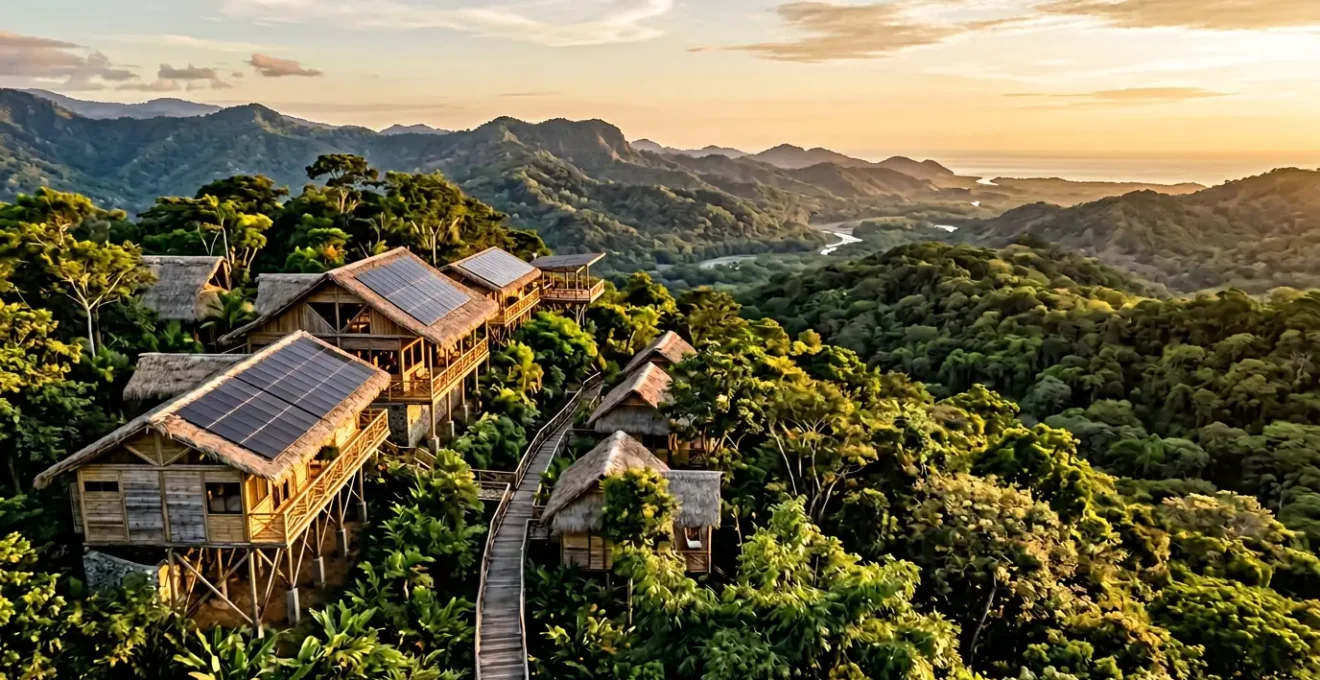
Genuine eco-lodges are defined not by visible solar panels, but by the verifiable integrity of their hidden operational systems.
- Energy sovereignty is tested by grid capacity (the ‘hairdryer test’), not just panel count.
- Water and waste cycles must be closed-loop systems, not just off-site disposal.
- Community benefit is measured by ownership and management roles, not just entry-level jobs.
Recommendation: Demand operational transparency; if a lodge cannot explain its core systems, it is a marketing façade, not an eco-lodge.
The term « eco-lodge » is ubiquitous, a comforting label for the environmentally conscious traveler. Yet, beneath the surface of recycled wood and promises of nature conservation, a pervasive issue lurks: greenwashing. Many establishments leverage the « eco » prefix as a marketing tool, promoting superficial actions like ditching plastic straws or installing a few solar panels for show. These gestures, while not inherently negative, often mask unsustainable core operations that continue to deplete resources and offer minimal community benefit.
For the traveler who acts as a strict auditor of their own footprint, these surface-level claims are insufficient. The common advice to « look for certifications » or « ask if they recycle » barely scratches the surface. This approach fails to interrogate the fundamental systems that define an operation’s true impact. The critical question is not *if* a lodge performs an eco-friendly action, but *how* deeply that principle is integrated into its entire operational DNA.
The shift in mindset required is from a passive tourist to an active auditor. The real proof of sustainability is not in what you can see, but in the integrity of the systems you cannot: the energy grid’s true capacity, the destination of wastewater, the structure of community partnerships, and the source of every item on your plate. This guide is not a checklist of amenities; it is an auditor’s framework for interrogating these hidden systems. It provides the hard questions designed to pierce the marketing veneer and reveal whether a lodge is a genuine partner in conservation or merely an eco-façade.
This article provides a systematic approach to verifying a lodge’s claims. By examining the critical, often invisible, infrastructure and policies, you can move beyond marketing and perform a true sustainability audit. The following sections offer the specific questions and indicators you need to look for.
Summary: An Auditor’s Framework for Vetting Eco-Lodges
- Can You Use a Hairdryer in a 100% Solar Powered Camp?
- Where Does the Waste Water Go in the Middle of the Delta?
- How Do Lodges Provide Safe Drinking Water Without Plastic Bottles?
- What Percentage of Staff Are Local vs. Expat in Eco-Lodges?
- Does High-End Luxury Inherently Conflict with Eco-Tourism Principles?
- How Do Lodges Receive Food Supplies Without Plastic Packaging?
- How Do Communities Own Lodges and Lease Them to Operators?
- How Does Botswana’s Eco-Tourism Certification System Grade Lodges?
Can You Use a Hairdryer in a 100% Solar Powered Camp?
The claim of being « 100% solar powered » is a common greenwashing tactic. While solar panels are a visible sign of green intent, they reveal nothing about a lodge’s actual energy sovereignty. The critical components are the ones you cannot see: battery storage capacity and inverter ratings. A few panels might power lobby lights, but running an entire lodge, especially through the night and cloudy days, requires a massive investment in infrastructure. In fact, hotels can save 30-50% of energy expenses with solar, but achieving full off-grid status requires an industrial-scale installation, not a token array.
This brings us to the « hairdryer test, » a simple but powerful diagnostic question. A high-wattage appliance like a hairdryer places a significant, sudden demand on an electrical system. A truly solar-powered lodge with a robust battery and inverter system will have a clear policy on its use. They might restrict it to certain hours or have specific outlets that can handle the load. A vague « yes, of course » is a major red flag, suggesting a hidden diesel generator is picking up the slack. This single question cuts through marketing to reveal the true limitations and systems integrity of their energy grid.
A genuine eco-lodge is proud of its energy system and transparent about its management. They should be able to tell you their battery capacity in kWh and explain their strategy for energy conservation, such as the exclusive use of LED lighting and the absence of power-hungry amenities like in-room air conditioning. An evasive answer to a technical question is an answer in itself.
Your Energy Audit Action Plan
- Ask for specific battery capacity in kWh; genuine solar lodges typically need 10-30 kWh minimum battery storage to operate through the night.
- Request to see the inverter specifications; the inverter rating in kW determines what appliances can actually run simultaneously.
- Inquire about backup power sources; truly sustainable lodges will admit to having minimal or no diesel backup, not hide it.
- Test the ‘hairdryer question’; if they say yes without explaining power management strategies, be suspicious.
- Look for LED lighting throughout; this indicates a serious commitment to energy efficiency.
Where Does the Waste Water Go in the Middle of the Delta?
In a remote, ecologically sensitive area like an undeveloped delta or rainforest, there is no municipal sewer system. The question of wastewater is therefore not a matter of convenience, but of ecological survival. The discharge of untreated « greywater » (from showers and sinks) and « blackwater » (from toilets) can contaminate groundwater, harm wildlife, and introduce devastating nutrients and pathogens into a pristine ecosystem. A lodge claiming eco-credentials cannot simply pipe its waste « away. » There is no « away. »
The only responsible solution is a closed-loop system that treats 100% of wastewater on-site to a standard where it can be safely returned to the environment. The gold standard for this is a constructed wetland. This is a biologically engineered system that mimics nature’s own filtration process. Wastewater is channeled through a series of gravel and sand beds planted with native wetland vegetation. The roots of these plants, along with microorganisms in the substrate, break down pollutants and purify the water naturally, without the need for harsh chemicals.
This is a complex, often expensive system to build and maintain, representing a profound commitment to environmental stewardship. A lodge that has invested in such a system will be able to explain it in detail and will often be proud to show it to you. An inability to answer the simple question « Where does the water go? » is an immediate disqualification.
As the visual demonstrates, these systems are a living part of the landscape. They transform a liability—waste—into a resource, often creating a micro-habitat for birds and insects. This is the essence of systems integrity: solving a problem in a way that enhances, rather than degrades, the local environment. Any lodge that cannot provide a clear, verifiable answer on its wastewater management is, by definition, polluting.
How Do Lodges Provide Safe Drinking Water Without Plastic Bottles?
Eliminating single-use plastic water bottles is now a baseline expectation for any eco-lodge, but it is merely the first step in a much larger system of resource sovereignty. The real challenge is not just removing plastic, but guaranteeing a safe, reliable, and sustainable source of drinking water in a remote location. Simply offering a pitcher of filtered tap water is not enough; an auditor needs to know the source of that water and the exact process used to purify it.
Lodges typically draw from three sources: boreholes (groundwater), rainwater harvesting, or surface water (rivers or lakes). Each has its own contamination risks, from agricultural runoff to natural mineral content. A legitimate eco-lodge must employ a multi-stage purification process that goes far beyond a simple sediment filter. This should involve advanced technologies like reverse osmosis (RO), which removes microscopic contaminants, or UV sterilization, which kills bacteria and viruses without chemicals. An operation that has invested in such a system will be able to walk you through it step-by-step.
Furthermore, operational transparency is key. You have the right to ask for their water quality test results. As outlined by guidelines for identifying greenwashing, asking pointed questions about the purification process is a critical verification step. A responsible lodge should conduct regular testing and have the data available. If they use RO, ask them how they manage the brine byproduct—a concentrated saline solution that can harm the environment if not disposed of properly. The answers to these questions reveal whether they are managing a professional water treatment system or simply running tap water through a cheap filter and hoping for the best.
What Percentage of Staff Are Local vs. Expat in Eco-Lodges?
The social component of sustainability is often the easiest to greenwash. Many lodges boast of « hiring locally, » but this can be a hollow claim if local community members are only employed in low-wage, low-skill positions like housekeeping or groundskeeping, while all management and high-paying guide roles are reserved for expatriates. This model creates dependency, not empowerment, and is a form of social exploitation masked as benevolence.
A true eco-lodge measures its community contribution not by the number of locals it employs, but by the level of responsibility and ownership they hold. The critical audit point is the ratio of local to expat staff in management positions. Is the camp manager from the local village? Are the head guides community members who have been trained and promoted? This is the difference between a business that simply uses a community as a labor pool and one that actively invests in its human capital. A truly sustainable operation will have clear, documented career progression paths for local employees and can share specific success stories of staff who have advanced to senior roles.
Authentic cultural experiences are led by people who own their narrative. When a local guide, deeply connected to the land and its stories, leads an excursion, the experience is profoundly different from one led by a foreigner with a memorized script. Look for who holds the knowledge and the authority. If local staff are empowered to be the primary interface with guests—as guides, hosts, and managers—it’s a strong indicator of a genuine commitment to benefit-sharing over simple employment.
Does High-End Luxury Inherently Conflict with Eco-Tourism Principles?
There is a common assumption that luxury and sustainability are mutually exclusive. This is rooted in the image of traditional, resource-intensive luxury: private plunge pools, 24/7 air conditioning, and menus featuring imported delicacies. This model is indeed fundamentally at odds with eco-tourism. However, a new paradigm of experiential eco-luxury demonstrates that high price points, when structured correctly, can be a powerful engine for conservation, not a detriment to it.
The key is understanding where the money goes. In this model, « luxury » is defined not by material excess but by exclusive access to pristine nature, expert guidance, and profound silence and space. The premium rates paid by guests do not fund imported champagne; they directly finance the conservation of the very ecosystem they are visiting. This creates a virtuous cycle: the better the conservation, the more pristine the experience, which in turn justifies the premium that funds the conservation.
Case Study: The Botswana Model
Botswana’s high-end eco-lodges demonstrate how luxury pricing enables substantial conservation investments. As highlighted in an analysis of Africa’s top eco-lodges, Mombo Camp in the Okavango Delta operates on 100% solar power with complete wastewater treatment systems, while funding the Botswana Rhino Reintroduction Project since 2001. The camp’s premium rates support both endangered species programs and genetic research on lion populations. This model proves that higher prices can directly fund conservation initiatives that budget operations cannot afford.
The distinction between these two forms of luxury is critical for any auditor. The table below provides a clear framework for differentiating between consumptive and conservative luxury models.
| Luxury Type | Typical Features | Resource Impact | Conservation Value |
|---|---|---|---|
| Traditional Resource-Intensive | Private plunge pools, 24/7 air conditioning, imported foods | High water usage, high energy consumption, large carbon footprint | Minimal – focuses on guest comfort only |
| Experiential Eco-Luxury | Private guided walks, cultural immersion, pristine silence, dark sky viewing | Low resource use, renewable energy, local sourcing | High – funds habitat protection, community development, wildlife monitoring |
How Do Lodges Receive Food Supplies Without Plastic Packaging?
A remote lodge’s supply chain is its lifeline, but it is also a primary source of waste, particularly plastic. A lodge that serves food on ceramic plates but receives all its ingredients wrapped in plastic is not practicing sustainability; it is outsourcing its waste problem. A comprehensive « food-print » assessment must examine the entire lifecycle of food, from its origin to the disposal of its waste.
The first metric is food miles. What percentage of ingredients are sourced from within a small radius (e.g., 50km) of the lodge? Hyper-local sourcing not only supports the local economy but drastically reduces the carbon footprint and packaging associated with long-distance transport. A truly integrated lodge will have formal partnerships with local farmers and may even have its own on-site permaculture garden, greenhouse, or food forest to achieve maximum self-sufficiency.
The second critical area is packaging. Ask specifically about the systems in place to eliminate it. Do suppliers deliver produce in reusable crates? Are oils, grains, and spices purchased in bulk and stored in permanent, reusable containers in the kitchen? Are they using traditional, biodegradable materials for wrapping? Finally, investigate the end of the line: how is organic kitchen waste processed? The ideal solution is on-site composting or a biodigester, which turns food scraps into valuable fertilizer for their gardens, thus closing the loop on the nutrient cycle.
How Do Communities Own Lodges and Lease Them to Operators?
The most advanced model of social sustainability moves beyond employment to genuine ownership. In some of the most successful eco-tourism regions, the land on which a lodge sits is not owned by the operator, but by the local community itself. The community, often organized as a legal trust or conservancy, leases the land to a professional lodge operator under a strict, legally binding agreement.
This structure fundamentally changes the power dynamic. The community is no longer a passive recipient of jobs or charity, but the landlord and a key partner in the business. These lease agreements are powerful tools for enforcing conservation and community benefit. They typically include clauses that mandate a specific percentage of revenue be paid directly to the community trust, require extensive environmental impact assessments, and stipulate that the lodge must be fully removable at the end of the lease, leaving no permanent trace.
Case Study: Community Conservancy Models in Africa
In Botswana, many safari lodges operate on private concessions leased directly from local communities. According to a review of Botswana’s eco-aware camps, these legal arrangements ensure local people are directly involved in and benefit from camp operations. Revenue-sharing agreements are built into the lease structures, and the communities retain full ownership of the land, receiving direct financial payments from the tourism operations conducted there.
As an auditor, you must demand financial transparency regarding this relationship. Ask for the specific percentage of revenue that goes to the community. Inquire about the governance structure of the community trust—are community members truly represented on the board? Ask to see tangible projects—schools, clinics, water wells—that have been funded by the lodge revenue. A legitimate partnership will be transparent and proud to share this information; an exploitative one will be vague and evasive.
Key Takeaways
- True sustainability is proven by the integrity of hidden systems (energy, water, waste), not by visible marketing gestures.
- Adopt an auditor’s mindset: ask specific, technical questions and demand verifiable data, not just promises.
- The most sustainable models turn problems into solutions, such as converting wastewater into a thriving wetland or using luxury pricing to fund conservation directly.
How Does Botswana’s Eco-Tourism Certification System Grade Lodges?
The advice to « look for an eco-certification » is dangerously simplistic. The market is flooded with hundreds of labels, many of which are little more than pay-to-play schemes with lax standards and no independent verification. A meaningless logo is a potent greenwashing tool, providing a false sense of security. An auditor’s job is not to find a label, but to audit the label itself.
A robust certification system serves as a reliable, third-party audit. The Botswana Ecotourism Certification System is an excellent example of what to look for. It is not a simple pass/fail system but is tiered, allowing lodges to demonstrate a progression of commitment. It is holistic, evaluating operations against approximately 240 performance standards covering environmental management, community benefit, and conservation contributions. Most importantly, certification is not a one-time event; it requires ongoing compliance and is subject to verification, ensuring standards are maintained.
In Practice: Botswana’s Three-Tier System
Lodges like Chobe Game Lodge have achieved the system’s highest ‘Ecotourism’ rating through concrete, measurable actions. These include operating 100% electric safari vehicles and achieving a 95% waste diversion rate from landfills. This demonstrates that the certification is earned through significant operational investment, not just by filling out a form or paying a fee.
You can apply the principles of a strong certification system to evaluate any label you encounter, anywhere in the world. The following table provides a clear set of red flags to watch out for and green flags that indicate a credible, trustworthy certification.
To distinguish a credible certification from a marketing ploy, one must analyze the process behind the label. According to an investigative guide on eco-labels, the presence of independent, third-party audits is the most critical green flag.
| Certification Aspect | 🚩 Red Flags | ✅ Green Flags |
|---|---|---|
| Audit Process | Self-assessment only, no site visits | Independent third-party audits, unannounced inspections |
| Transparency | Vague criteria, no public standards | Detailed criteria publicly available online |
| Grading System | Simple pass/fail, no levels | Tiered system showing progression levels |
| Cost Structure | Pay-to-play with guaranteed certification | Fee covers assessment only, certification earned on merit |
| Validity Period | Lifetime certification, no renewal | Time-limited requiring regular re-assessment |
| Scope | Single aspect focus (e.g., energy only) | Holistic assessment of environment, community, and operations |
Your choice of where to stay is one of the most powerful tools you have. By refusing to accept surface-level claims and adopting the rigorous mindset of an auditor, you actively drive the industry toward genuine accountability. Use this framework to demand operational transparency, reward true sustainability, and ensure your travel investments contribute to the conservation of the places you love, not their decline.