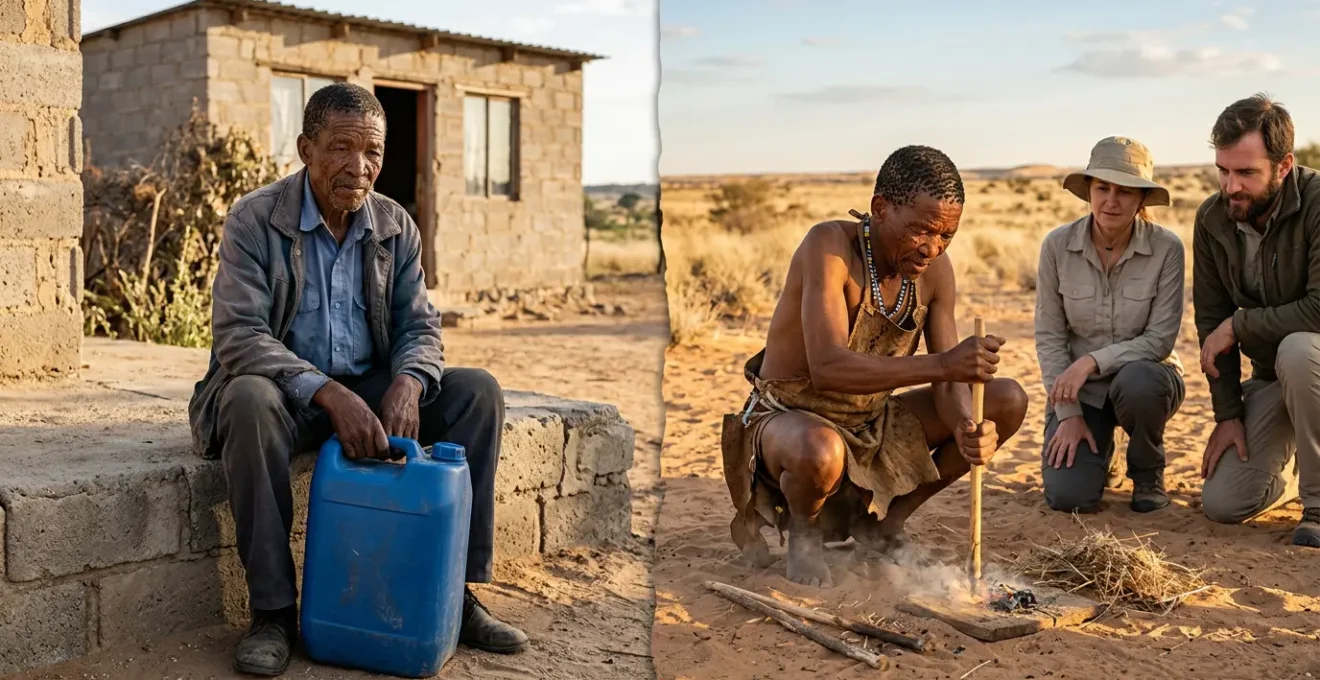
Contrary to the romantic image of an unchanged ancient culture, the San « hunter-gatherer » experiences for tourists are often carefully staged performances—and understanding this is the key to a truly meaningful encounter.
- Cultural demonstrations like fire-making or healing dances are not just for show; they are a vital modern strategy for economic survival and passing traditions to the next generation.
- The « authenticity » of your visit lies not in witnessing a perfectly preserved past, but in appreciating the complex reality of a people navigating the space between ancestral knowledge and contemporary challenges.
Recommendation: Approach your visit not as a spectator at a « human safari, » but as a student of anthropology, learning to read the context and meaning behind every interaction.
The promise of visiting one of the world’s last hunter-gatherer societies, the San people of the Kalahari, evokes powerful imagery: timeless traditions, unparalleled survival skills, and a connection to the earth long lost to the modern world. Many travelers seek this « authentic » encounter, a genuine glimpse into a life lived in harmony with nature. This desire is often met with tour packages offering walks with Bushmen, tracking demonstrations, and mesmerizing fireside dances. But for the discerning, skeptical traveler, a nagging question arises: in an era of global tourism, what is real and what is staged?
The common narrative often simplifies or romanticizes San life, presenting it as a static, living museum. We are shown the ‘how’—how to find water in a desert, how to track an antelope, how to make fire with sticks. But this focus on bushcraft often obscures a more complex and poignant reality. It sidesteps the difficult questions about land rights, the impact of conservation laws, and the socio-economic pressures that have profoundly reshaped San society. The truth is, many San communities no longer live a purely subsistence lifestyle, having been displaced from their ancestral lands.
But what if the key to an authentic experience isn’t to find an « unspoiled » culture, but to understand the very nature of the performance itself? This guide takes an anthropological approach, moving beyond the surface of the tourist demonstration. We will deconstruct the staged elements not to dismiss them as fake, but to reveal the deeper purpose they serve. By understanding *why* these traditions are performed for visitors, we can begin to appreciate the resilience, adaptability, and modern-day reality of the San people. This is not a guide to finding a fantasy, but a roadmap to understanding a living, evolving culture in all its complexity.
This article explores the nuanced reality behind the common perceptions of San culture. We will delve into their social structures, their relationship with the natural world, and how they navigate the challenges of the 21st century, providing you with the context needed for a respectful and insightful journey.
Summary: Hunter-Gatherer Lifestyle: What Is Real and What Is Staged for Tourists?
- How Do San Women Identify Edible Tubers in the Dry Sand?
- How Does the San Egalitarian Society Work Without Chiefs?
- Why Is Making Fire with Sticks More Than Just a Survival Skill for the San?
- Which Bush Plants Do the San Use to Treat Snake Bites?
- How Are the Bushmen Adapting to Modern Conservation Laws?
- Why the San Healing Dance Is Still Performed at Night in the Kalahari?
- Why Is the Fireplace the Center of Tswana Dining Culture?
- Why Is a Guide Mandatory to Visit the Rock Art at Tsodilo Hills?
How Do San Women Identify Edible Tubers in the Dry Sand?
One of the most astonishing skills demonstrated on a bush walk is the ability of San women to locate edible roots and tubers buried deep beneath the seemingly uniform Kalahari sand. This is not a matter of luck, but of a profound and sophisticated botanical knowledge system passed down through generations. For a traveler, it can look like magic; for the San, it is a science encoded in the landscape.
The process begins with reading subtle cues on the surface that are invisible to the untrained eye. A San woman can identify a specific plant by the faintest trace of a dried, withered vine, a slight variation in soil color, or a tiny crack in the earth. Each sign tells a story about what lies beneath—the species of the tuber, its likely depth, and whether it is ripe for harvesting. This is a mental library of the land, where thousands of details about plant life cycles, seasonal availability, and ecological relationships are stored and accessed.
The tool for this task is the simple but effective digging stick. Once a potential spot is identified, the woman uses the stick with practiced precision, not digging randomly but following the path of the root system downward. It is a physically demanding task that requires both strength and an intimate understanding of plant morphology. The contribution of women as primary gatherers has always been the bedrock of San subsistence, historically providing the majority of the community’s regular caloric intake.
While a tourist demonstration might last only a few minutes and result in finding a pre-selected tuber, it represents a deep well of generational ecological knowledge. It’s a living link to a time when this skill meant the difference between a full belly and hunger, and its continued practice, even in a modified context, is a testament to its enduring cultural importance.
How Does the San Egalitarian Society Work Without Chiefs?
One of the most radical and often misunderstood aspects of traditional San society is its profound egalitarianism. In a world defined by hierarchies, the San developed complex social mechanisms to ensure that no single individual, whether a great hunter or a charismatic speaker, could accumulate power or authority over others. They operate not through chiefs and top-down commands, but through consensus, cooperation, and a fierce commitment to equality.
The system works through what anthropologists call « demand sharing »—a principle where resources, especially meat from a large kill, are not gifted but are expected to be shared among the entire group. This prevents the successful hunter from using his provision of food as a means to gain social status or indebt others. In fact, the culture actively works to deflate ego and prevent arrogance. A famous anthropological account captures this ethos perfectly through the words of a Ju/’hoansi hunter, who explained the practice of « insulting the meat »:
When a young man kills much meat, he comes to think of himself as a chief or a big man, and he thinks of the rest of us as his servants or inferiors.
– Ju/’hoansi hunter, in The Dobe Ju/’hoansi by Richard Lee
This quote reveals a conscious social strategy. By downplaying the hunter’s achievement, the group reinforces its core value: the individual serves the community, not the other way around. This principle is visualized in the very structure of their camps and gatherings, which are often circular, with no seat of honor or position of prominence.
As the image above illustrates, the sharing of resources is a communal act that reinforces social bonds and parity. While modern life has introduced new pressures, including wage labor and private property, this deep-rooted ethos of egalitarianism continues to influence San social relations. For the traveler, understanding this concept is crucial: the humility and lack of overt leadership you may observe is not passivity, but the active, successful practice of a sophisticated social system.
Why Is Making Fire with Sticks More Than Just a Survival Skill for the San?
The demonstration of making fire with two sticks is a quintessential part of any San cultural experience. Watching the patient, rhythmic rotation of a hardwood drill in a softwood hearth, culminating in a glowing ember that is gently coaxed into flame, feels like witnessing an ancient, primal skill. For the San, however, the meaning of this act has evolved. Today, it is less about daily survival and more about cultural survival.
In the past, the ability to make fire was fundamental to life in the bush—for warmth, protection from predators, cooking, and social gathering. Today, most San communities have access to lighters and matches. The continued performance of fire-making is a conscious act of what can be called a « cultural preservation economy. » It is a way to both keep ancestral knowledge alive and participate in the modern cash economy brought by tourism. It’s a performance, yes, but one with profound purpose.
This complex relationship between past practice and present necessity was articulated by a San elder. When asked about the shift from living in the bush to performing for tourists, his response was not one of simple nostalgia but of pragmatic realism and cultural foresight. He acknowledged the hardships of the old ways while underscoring the new purpose these demonstrations serve:
Living in the bush is hard. The children were almost always hungry. Life is better now. [This is] a way for us to pass-on our culture without it being lost forever.
– San elder
This perspective transforms the traveler’s understanding. The fire-making demonstration is not a mere reenactment. It is a living classroom where elders transmit techniques to younger generations, a source of income that provides for their families, and a powerful symbol of identity in a world that has largely stripped them of their traditional means of subsistence. It is an act of symbolic significance, embodying resilience and adaptation. The fire being kindled is not just for warmth; it is to keep the flame of San culture from being extinguished.
Which Bush Plants Do the San Use to Treat Snake Bites?
The San’s knowledge of the natural world extends far beyond finding food and water; it encompasses a vast and complex indigenous pharmacopoeia. Their understanding of medicinal plants, developed over millennia of trial, error, and observation, is one of the most sophisticated systems of traditional medicine on the planet. When a tourist asks about a dramatic ailment like a snake bite, the answer reveals just the tip of this iceberg of ethnobotanical expertise.
While specific remedies are often closely guarded knowledge, certain plants are known to be used. For a venomous bite, the approach is often multi-faceted. A healer might use one plant as a poultice applied directly to the wound to draw out venom and reduce swelling, while another plant might be prepared as an infusion for the victim to drink, intended to counteract the venom’s systemic effects. This dual approach shows a sophisticated understanding of treating both the localized and internal symptoms. The San make use of a vast array of plant species for both food and medicine, showcasing an incredible biodiversity knowledge.
The preparation of these remedies is a precise art, often involving crushing specific parts of the plant—the root, bark, or leaves—and sometimes mixing them with other ingredients. The weathered hands of a San healer, meticulously preparing these ancient medicines, tell a story of a lifetime of learning and practice.
The image powerfully conveys the tactile and experiential nature of this knowledge. It is not written in books but is held in the hands and minds of the elders. This living pharmacy of the Kalahari is under threat from land loss and a shift away from traditional lifestyles. Every plant identified and every remedy remembered is an act of cultural resistance. For the traveler, inquiring about these practices should be done with immense respect, recognizing that you are being granted a brief look into a sacred and endangered library of knowledge.
How Are the Bushmen Adapting to Modern Conservation Laws?
The romantic image of the hunter-gatherer living in pristine wilderness clashes sharply with the modern reality of conservation politics. For the San, the creation of national parks and game reserves on their ancestral lands has often meant displacement, the loss of their traditional subsistence lifestyle, and a profound struggle for their rights. This conflict is a critical, if often invisible, part of the context for any « cultural tourism » experience.
The core of the conflict lies in a clash of worldviews. Western conservation models have historically prioritized the protection of wildlife and ecosystems by creating « fortress conservation » areas, which often entails removing human inhabitants. For the San, who have co-existed with and shaped these ecosystems for millennia, this separation of humans from nature is a foreign concept. The prohibition of hunting, a central pillar of their culture and diet, represents a direct threat to their survival and identity. This tension has led to a state of subsistence duality, where communities are caught between their traditional ways and restrictive modern laws.
This struggle is starkly illustrated by the legal battles fought by the San in Botswana, particularly concerning their right to live and hunt in the Central Kalahari Game Reserve (CKGR).
Case Study: The Central Kalahari Game Reserve Legal Battle
In a landmark 2006 case, the Botswana High Court ruled that the government’s eviction of San residents from the Central Kalahari Game Reserve was unlawful and unconstitutional. The ruling should have allowed them to return to their ancestral homes and resume their traditional lifestyles. However, the enforcement of this victory has been fraught with challenges. As an analysis of the post-judgment situation shows, the government has been extremely reluctant to issue hunting licenses, effectively cutting off their primary means of subsistence. This led a judge in the case to issue a dire warning that the government’s actions were « tantamount to condemning the remaining residents of the Central Kalahari Game Reserve to death by starvation. » While some San have returned to the reserve, many remain in government resettlement camps, disconnected from their land and culture. A nationwide hunting ban in 2014 further entrenched these restrictions, creating a system that disproportionately affects San subsistence hunters.
This context is vital for the ethical traveler. The « Bushman walk » you experience may be taking place on the periphery of a reserve they can no longer freely access. The hunting demonstration uses a bow they may be legally forbidden to use for actual subsistence. Understanding this struggle adds a layer of profound meaning and urgency to the cultural performances you witness; they are not just echoes of a distant past, but acts of identity in a contentious present.
Why the San Healing Dance Is Still Performed at Night in the Kalahari?
The healing dance, also known as the trance dance, is perhaps the most spiritually significant ritual in San culture. It is a powerful, all-night ceremony where the entire community gathers to confront illness, resolve social tensions, and connect with the spirit world. While tourists may be shown a shortened version, the authentic practice continues to be a cornerstone of San spiritual life.
In a genuine healing ceremony, the women sit around a central fire, clapping complex rhythms and singing specific songs known as « n/um. » The men dance in a circle around them, their leg rattles providing a percussive counterpoint. As the hours pass, the intense, repetitive sound and movement help the healers enter a powerful trance state known as !kia. In this state, they are believed to be able to draw out the « sickness » from afflicted individuals and argue with the spirits of the dead. It is a deeply communal and spiritually charged event, lasting until dawn.
The version performed for tourists is, by necessity, a very different experience. It is a demonstration, not a ceremony. A participant in one such cultural tour noted the formal introduction by a guide and the explicit framing of the event as a showcase of « traditional San Bushmen culture and lifestyle. » These performances are much shorter, and while they use the same basic elements of song and dance, they rarely involve the healers achieving a genuine state of !kia. Certain sacred elements are intentionally withheld. This is not a deception, but a form of cultural protection, preserving the sanctity of the true ritual while still sharing a part of their heritage.
The motivation, as with other demonstrations, is a blend of cultural pride and economic need. It allows the San to « earn some extra money » and serves as a public classroom where elders can « help the younger tribe members to learn from the elders how their way of life used to be. » For the traveler, knowing the difference is key to a respectful experience.
Actionable Checklist: Spotting the Difference in a Healing Dance
- Duration: Is the dance a 30-60 minute demonstration, or is it an all-night ceremony lasting until dawn? Authentic rituals are endurance events.
- Participants: Does it involve a select group of « performers, » or is the entire community present and participating with specific, integrated roles?
- Trance State (!Kia): Is the stated goal to demonstrate the dance form, or do healers actively work to enter a deep, authentic trance state for a specific healing purpose?
- Purpose: Is the event for the entertainment and education of visitors, or is it addressing a genuine health issue or spiritual concern within the community?
- Sacred Elements: Acknowledge that you are likely seeing a public-facing version. The most sacred songs and ritual aspects are typically reserved for private, community-only ceremonies.
Why Is the Fireplace the Center of Tswana Dining Culture?
To fully grasp the nomadic nature of the San and their relationship with fire, it’s incredibly helpful to contrast it with that of their settled neighbors, like the Tswana people. While both cultures value fire as a social center, its meaning and structure are fundamentally different. For the Tswana, a predominantly pastoralist and agricultural society, the fireplace or *lapa* is a permanent, architectural heart of the homestead. For the San, fire has traditionally been a temporary anchor in a life of movement.
As a historically semi-nomadic people, the San moved seasonally within their territories, following the availability of water, game, and edible plants. A research document on their lifestyle confirms that « The San were traditionally semi-nomadic, moving seasonally within certain defined areas. » Consequently, their campfires were temporary installations, built with whatever wood was available and abandoned when the group moved on. The social organization around this fire was, like their society, egalitarian—a circle with no fixed or hierarchical seating.
The Tswana fireplace, in contrast, is a symbol of permanence and family identity. It is a constructed feature, often built with stones or bricks, that serves as the social and culinary hub of a multi-generational household. Seating arrangements can be hierarchical, reflecting age and gender roles. The following table, based on information from sources like a comparative analysis of regional cultures, highlights these key distinctions:
| Aspect | San Nomadic Fire | Tswana Lapa Fireplace |
|---|---|---|
| Structure | Temporary, portable | Permanent architectural feature |
| Materials | Gathered wood, no construction | Built with stones/bricks |
| Mobility | Abandoned when moving | Fixed location, generational use |
| Social organization | Egalitarian circle, no fixed positions | Hierarchical seating arrangements |
| Cultural meaning | Survival tool, temporary gathering | Family identity, ancestral connection |
This comparison illuminates the San worldview. Their fire is not a monument to anchor them to a single spot, but a portable tool for survival and a temporary focal point for a community on the move. Understanding this contrast helps the traveler appreciate the philosophy of mobility that underpins so much of traditional San culture, even as they now face a more sedentary existence.
Key Takeaways
- Cultural performances are not « inauthentic » fakes but a complex, modern strategy for economic survival and the transmission of traditions.
- True San egalitarianism is not a passive state but an active social practice, maintained through sophisticated mechanisms like « insulting the meat » to prevent hierarchy.
- The most authentic travel experience comes from understanding the context of conflict, land rights, and adaptation that shapes the modern San reality, not from seeking a romanticized past.
Why Is a Guide Mandatory to Visit the Rock Art at Tsodilo Hills?
For any traveler visiting the Tsodilo Hills, a UNESCO World Heritage site known as the « Louvre of the Desert, » one rule is absolute: you must be accompanied by a local guide. To some, this might seem like a simple tourist regulation, but for the San and Hambukushu communities who hold these hills sacred, the guide’s role is far more significant. They are not just tour leaders; they are cultural gatekeepers, interpreters, and protectors of a sacred landscape.
Tsodilo contains one of the highest concentrations of rock art in the world, with over 4,500 paintings. This art is not a random collection of images but a layered, living text with deep ancestral roots, representing millennia of human history and spiritual practice. The mandatory guide system serves a dual purpose: first, economic, providing essential employment for local communities; and second, and more importantly, cultural. The guides provide the authorized interpretation of the art, sharing the stories and meanings that are appropriate for outsiders to hear while protecting the more sacred or esoteric knowledge.
The guide acts as a bridge between two worlds: the visitor’s curiosity and the community’s sacred heritage. They can explain the difference between a shamanistic trance scene and a depiction of a great hunt. They can point out the subtle superposition of paintings, where generations have added their stories to the same rock canvas. Without this interpretation, the visitor would see only images; with the guide, they begin to see a narrative. The guide ensures that visitors tread respectfully, both physically and spiritually, in a place that is believed to be the resting place of spirits.
This system acknowledges that Tsodilo is a place of contested heritage, with different stakeholders (like UNESCO and the local communities) having different perspectives on its value and meaning. The guide system is a practical compromise that helps balance conservation, tourism, and the preservation of intangible cultural heritage. Therefore, hiring a guide is not an inconvenience; it is the first and most fundamental step in engaging with Tsodilo Hills respectfully and meaningfully. It is an acknowledgment that you are a guest in a place of immense spiritual power.
The ultimate goal for a thoughtful traveler is to move beyond mere observation. By understanding the context behind the demonstrations, the social structures that prize equality, and the modern struggles for land and identity, you transform your visit from a passive sightseeing trip into an active, respectful engagement with a living, resilient, and profoundly complex culture.
Frequently Asked Questions About Hunter-Gatherer Lifestyle: What Is Real and What Is Staged for Tourists?
Why can’t visitors explore Tsodilo Hills rock art independently?
The rock art represents complex, layered ‘texts’ with millennia of overlapping paintings requiring cultural interpretation. As described by sources familiar with the site’s management, guides serve as cultural gatekeepers who can explain the spiritual significance while protecting sacred meanings that shouldn’t be shared with outsiders.
What is the difference between UNESCO’s narrative and San oral traditions?
According to UNESCO’s framework, the focus is often on universal heritage value and physical conservation. In contrast, San traditions view the hills as the resting place of spirits with specific, ongoing ritual significance. These interpretations sometimes conflict but also complement each other in the effort to preserve the site for future generations.
How does guide employment benefit local communities?
Guide positions provide crucial economic opportunities for the San and Hambukushu communities who hold the sites sacred. However, the distribution of tourism revenue and the control over how their stories are presented remains a contested issue between community trusts, private operators, and government bodies, highlighting the ongoing complexities of cultural tourism.