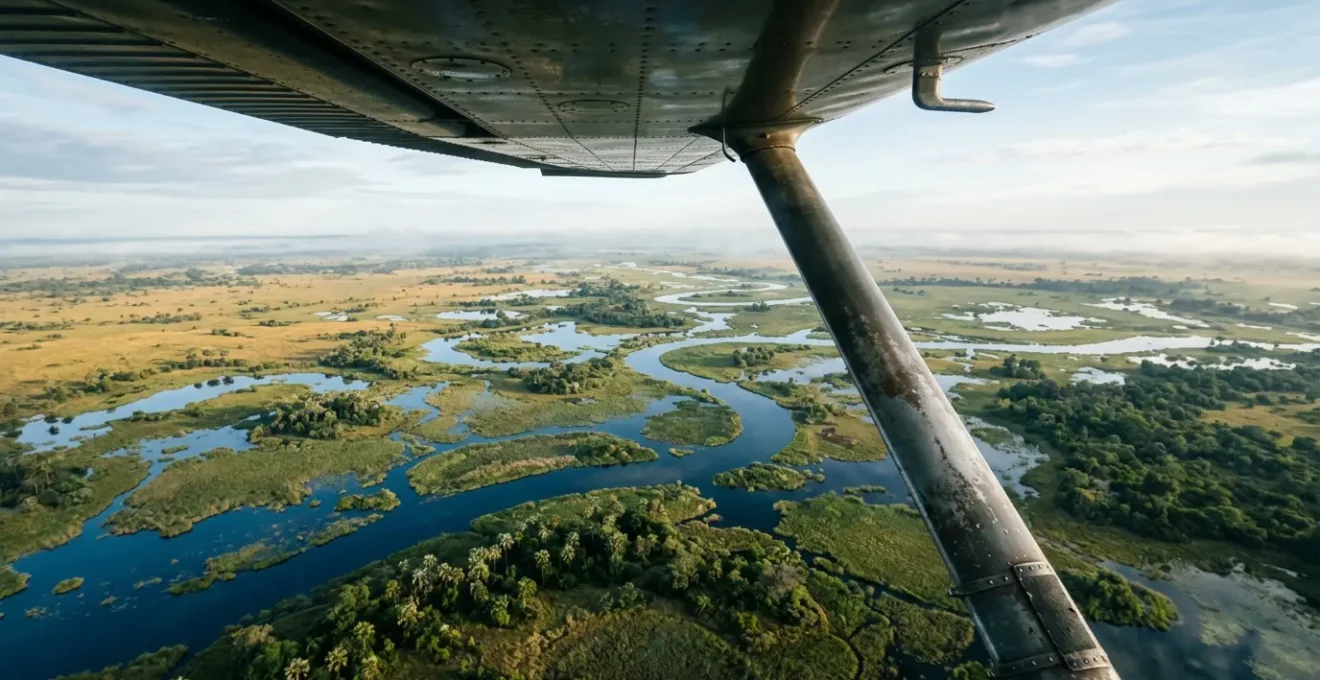
From the cockpit, a flight over the Delta isn’t a gamble on safety; it’s a demonstration of meticulous risk management that is far more controlled than any road on the ground.
- Procedures that seem unusual to passengers, like asking for your weight, are fundamental parts of a robust safety system based on the non-negotiable physics of flight.
- The flexible flight schedules are not a sign of disorganization but a critical safety tool, allowing pilots to adapt to weather and ensure conditions are always optimal for landing.
Recommendation: Trust the process. Understand that your pilot is operating within a highly regulated and predictable environment, and reframe the flight not as a risk, but as the most privileged and secure way to experience the vastness of the Okavango.
The first thing you notice is the sound. Not the distant roar of a jet, but the close, personal thrum of a single propeller pulling you into the vast blue sky over Botswana. For a nervous flyer, every vibration can feel like a question mark. The small cabin, the sight of the pilot making adjustments just feet away, the sun glinting off a window that seems impossibly thin—it can all feel a world away from the sterile, detached safety of a commercial airliner.
Many people assume that safety is a trade-off for the incredible intimacy of a bush flight. They weigh the jaw-dropping views of elephants carving paths through the floodplains against the perceived risk of a smaller aircraft. But from my seat in the cockpit, after thousands of hours navigating this unique landscape, I can tell you that this assumption is fundamentally wrong. The real conversation isn’t about fear versus reward; it’s about understanding the difference between perceived risk and actual, managed safety.
The truth is, what might look like a casual, seat-of-your-pants operation from the passenger seat is anything but. It is a system of immense precision, where every procedure—from seating arrangements to flight altitude—is a deliberate calculation. This guide is designed to pull back the curtain on our world. We won’t just tell you « it’s safe. » We will show you *why* it’s safe by breaking down the very elements that might make you nervous, explaining the rigorous logic and system integrity behind every decision we make before and during your flight over the Okavango Delta.
To give you a clear overview from a pilot’s perspective, this article breaks down the key questions passengers often have. We’ll explore the real safety protocols, the practicalities of aerial photography, the dual role of your pilot, and the operational logic that governs every flight in this incredible part of the world.
Summary: Is Flying Over the Delta a Scarier or Safer Experience Than Driving?
- How Safe Are Single-Engine Planes in Remote Botswana?
- How to Shoot Through Scratchy Airplane Windows Without Reflections?
- Why Is Your Bush Pilot Also a Tour Guide?
- What Happens if a Storm Prevents Your Plane from Landing at Camp?
- Why Do Pilots Fly at Different Altitudes Depending on the Season?
- Why Does the Pilot Ask Your Weight Before Assigning You a Seat?
- Why Is a Doors-Off Helicopter Flight Essential for Pro Photographers?
- Helicopter vs. Fixed Wing: Which Offers the Best Scenic Flight Over the Delta?
How Safe Are Single-Engine Planes in Remote Botswana?
Let’s address the elephant in the room—or rather, the single propeller on the nose of the aircraft. For many, a single-engine plane like the Cessna Caravan, our workhorse in the Delta, seems inherently less safe than a multi-engine jet. This is a common misconception. Modern aviation safety isn’t about the number of engines; it’s about system integrity, rigorous maintenance, and pilot proficiency. A single, meticulously maintained turbine engine is extraordinarily reliable. Commercial aviation as a whole has an incredible safety record, with a global rate of about 1 accident per 880,000 flights according to IATA’s 2024 report.
More specifically, the operational environment in Botswana adds another layer of security. The safari industry here is built on aviation. Northern Botswana has one of the most experienced fleets of planes, pilots, and mechanics in Africa, with decades of accumulated expertise flying these specific routes. This isn’t a fledgling industry; it’s a mature, well-regulated ecosystem where both safari operators and the government are deeply invested in maintaining a stellar safety reputation. Any turbulence you feel is typically due to thermals rising from the heated land—a matter of comfort, not a threat to the aircraft’s stability.
From a pilot’s viewpoint, we are operating in a highly controlled environment. We fly VFR (Visual Flight Rules), meaning we are in constant sight of the ground, and the low volume of traffic is nothing like a busy international airport. We know the terrain, we know the weather patterns, and most importantly, we know our aircraft inside and out. The machine is reliable, but the human system of expertise surrounding it is what truly ensures your safety.
How to Shoot Through Scratchy Airplane Windows Without Reflections?
One of the biggest frustrations for any photographer on a scenic flight is returning home to find their epic shots of hippos in the channels ruined by the reflection of their own shirt or the sun’s glare on the plexiglass window. The windows on bush planes live a hard life; they get scratched and weathered, which can diffuse light and soften your images. However, getting professional-quality shots is entirely possible with the right technique. It’s not about having a perfect window, but about controlling the light that passes through it.
The core principle is to eliminate the light bouncing between your lens and the window. Reflections are caused by light inside the cabin hitting the plexiglass and bouncing back into your camera. By creating a dark seal around your lens, you can shoot through the window as if it weren’t even there, capturing the raw texture and color of the Delta below. The scratches on the window become almost invisible when your focus is set to infinity on the landscape.
Action Plan: Eliminating Window Reflections
- Use a rubber lens hood and press it directly against the window glass to create a light-proof seal.
- If using a circular polarizing filter, rotate the front element while looking through the viewfinder until reflections are minimized.
- Wear dark clothing (black is ideal) to minimize your own reflection in the window.
- For angled shots, use your free hand or a dark jacket to create a « shroud, » blocking any light from entering the gap between your lens and the window.
- Ask if it’s possible to dim any internal cabin lights, as these are a primary source of unwanted reflections.
Why Is Your Bush Pilot Also a Tour Guide?
On a commercial flight, the pilots are anonymous voices from a locked cockpit. In the Okavango, your pilot is your navigator, your commentator, and your first safari guide. This isn’t a cost-saving measure; it’s a deliberate enhancement of the safari experience. The logic is simple: the person with the unobstructed 180-degree view of the landscape is in the best possible position to interpret it for you. We see the subtle signs from the air that are invisible from the ground—the congregation of vultures that signals a kill, the faint trails made by hippos creating new channels, or the dust kicked up by a distant herd of buffalo.
This dual role requires a unique skillset. Bush pilots in Botswana are not just trained to fly; they are steeped in the ecology of the Delta. We undergo continuous training on wildlife behavior, seasonal changes, and the geology of the region. This allows us to provide context to what you’re seeing, transforming a simple transfer flight into a rich narrative experience. As one operations specialist noted, this model adds immense value.
The pilot-guide hybrid model ensures the person with the best aerial view has the ecological knowledge to interpret it, adding immense value to the flight.
– Safari operations specialist, Okavango Delta flight operations overview
This concept of aerial interpretation is fundamental to the Okavango flying safari. While guests in a vehicle are immersed in the details, we provide the grand perspective, explaining how the individual ecosystems you’ll visit are connected by the lifeblood of the annual flood. We can point out the exact location of your camp from miles away and align the aircraft to give everyone the best possible view of a magnificent elephant herd. It’s a synergy of piloting skill and ecological passion.
What Happens if a Storm Prevents Your Plane from Landing at Camp?
You’re scheduled to fly from Camp A to Camp B, but a towering thunderhead is building right over your destination. To a passenger, this can cause anxiety. Will the flight be canceled? Will we be stranded? This is where the concept of operational tempo in the bush comes into play. Unlike commercial airlines bound by rigid schedules, Okavango charter flights are fluid and adaptable. Our schedule is set the day before, not weeks in advance, precisely so we can react to changing conditions.
My primary job is not to be on time; it’s to be safe. We will never, under any circumstances, attempt to fly through a significant storm or land on a wet, compromised airstrip. If weather prevents a landing, we have a clear and practiced set of protocols. The most common solution is simple: we wait. Most Delta storms are intense but short-lived. We may circle in a safe, clear area or even return to our departure point and wait on the ground for the storm to pass, enjoying a coffee while staying in constant radio contact with the destination camp.
In the rare event a storm is widespread and persistent, we initiate Plan B. This involves diverting to the nearest safe airstrip, which may be another camp or the main hub of Maun. The charter companies have robust logistical networks. They will arrange for a vehicle to meet us if possible, or we will wait for a clear weather window to complete the final leg of the journey. The key takeaway for any nervous passenger is this: a delay or a diversion is not a sign of a problem. It is a sign that the safety system is working perfectly. We are proactively managing risk, and your well-being is the only factor in our decision-making.
Why Do Pilots Fly at Different Altitudes Depending on the Season?
Passengers often notice that some flights feel like they are skimming the treetops, while others are at a much higher altitude. This variation isn’t random; it’s a calculated decision based on the flight’s purpose, the time of day, and, most importantly, the season. Our altitude is another tool we use to optimize both safety and the passenger experience. Broadly, we operate in two main flight levels: low-level for scenic viewing and a higher cruising altitude for transit.
For scenic flights and the beginning/end of transfer flights, we typically fly low, often around 100 metres (about 330 feet) above the ground. This altitude is the sweet spot—high enough to offer a panoramic perspective of the winding channels and island networks, but low enough to spot large animals like elephants, giraffes, and hippos without disturbing them. During the dry season, when water is scarce and animals congregate around remaining waterholes, flying low offers unparalleled game viewing.
Conversely, during the main transit portion of a longer flight, or during the hottest part of the day in the hot season, we will climb higher. A higher altitude gets us into cooler, smoother air, providing a more comfortable ride and better fuel efficiency. In the wet season, when the floodplains are vast, shimmering expanses of water, a higher altitude is necessary to truly appreciate the immense scale of the inundation. From up high, you can see how the water from the Angolan highlands breathes life into the entire Kalahari. The altitude is always a conscious choice, balancing a smooth ride with the best possible interpretation of the landscape below.
Why Does the Pilot Ask Your Weight Before Assigning You a Seat?
Of all the procedures in bush flying, this is often the one that makes passengers most uncomfortable. It can feel personal and intrusive. But let me reassure you from a pilot’s perspective: this question has absolutely nothing to do with personal judgment and everything to do with the fundamental physics of flight. An aircraft, especially a small one, is like a perfectly balanced scale. My job is to ensure that scale remains level, not just on the ground but through every phase of flight. This is called « weight and balance, » and it’s one of the most critical safety calculations I make before every single departure.
An aircraft has a specific center of gravity (CG) envelope. If the load is too heavy, or if the weight is distributed too far forward or too far aft, the aircraft’s flight characteristics can be dangerously altered, making it difficult or even impossible to control. To perform this calculation, I need to know the weight of everything on board: passengers, luggage, and fuel. When I assign you a specific seat, I am physically placing your weight in a precise location to ensure the aircraft’s CG is safely within its limits.
Charter companies must enforce strict weight policies for this reason. In order to book a flight, passengers must provide their body weight, and some operators have a limit where passengers over a certain weight (often around 100 kgs) may be required to purchase an additional seat. This isn’t a penalty; it’s a mathematical necessity to ensure the total weight doesn’t exceed the aircraft’s maximum takeoff weight, as confirmed by charter operators’ safety regulations. So, when a pilot asks for your weight, see it for what it is: the ultimate sign of a professional, safety-conscious aviator doing their job to protect everyone on board.
Why Is a Doors-Off Helicopter Flight Essential for Pro Photographers?
While fixed-wing aircraft are the backbone of Delta transport, helicopters offer a specialized experience, particularly for photographers. And for the most serious shooters, the « doors-off » option is considered non-negotiable. The reason is simple and absolute: to achieve completely unobstructed visibility. Even the cleanest, most scratch-free plexiglass window will create some level of distortion, reflection, or color cast. It puts a layer between the lens and the subject. By removing the doors, a photographer can shoot with nothing but air between them and the landscape.
This allows for the use of any lens without being constrained by the size of a window opening. You can use a wide-angle lens to capture the grand sweep of the floodplains or a long telephoto lens to zoom in on a specific animal, all without interference. The ability to bank and turn, with a clear line of sight straight down, opens up creative compositions that are impossible from a fixed-wing plane. It’s the difference between taking a photo *of* the Delta and being fully immersed *in* it.
Safety, of course, remains paramount. On a doors-off flight, every passenger is securely fastened into their seat with a multi-point harness system. All camera equipment is strapped either to the photographer or to a hard point in the cabin. There is zero risk of falling out. You are provided with a headset to communicate with the pilot, who can then maneuver the helicopter into the perfect position for your shot. It’s an exhilarating experience that combines the thrill of open-air flight with the ultimate photographic freedom.
Key Takeaways
- System over parts: The safety of a bush flight lies not in the number of engines, but in the rigorous system of maintenance, pilot expertise, and operational protocols.
- Adaptability is safety: Flexible flight schedules and contingency plans for weather are not inconveniences; they are core features of a system designed to eliminate risk.
- Physics is non-negotiable: Procedures like asking your weight are not personal; they are essential calculations for ensuring the aircraft’s weight and balance are perfectly maintained for a safe flight.
Helicopter vs. Fixed Wing: Which Offers the Best Scenic Flight Over the Delta?
The final question for many travelers is choosing the right aircraft for their scenic flight. There is no single « best » option; the ideal choice depends entirely on your priorities, budget, and what you hope to achieve. The fixed-wing plane and the helicopter offer two fundamentally different ways to experience the Okavango from the air. The fixed-wing is about efficient travel and grand overviews, while the helicopter is about surgical precision and intimate detail.
Fixed-wing scenic flights are often integrated into the necessary transfer flights between camps. They cover large areas efficiently, giving you a brilliant sense of the Delta’s immense scale. They are also significantly more cost-effective. The helicopter, by contrast, is a dedicated activity. Its unique ability to hover, fly low and slow, and access remote areas that fixed-wings cannot makes it unparalleled for photographers and those seeking to observe wildlife behavior up close. The trade-off is a higher cost and a more localized area of exploration. The following table breaks down the key differences based on data from operators.
| Feature | Helicopter | Fixed-Wing |
|---|---|---|
| Flight Duration Options | 30, 45, or 60 minutes | 15-45 minutes typical |
| Cost (30 min) | $325 per person | $220-260 per person |
| Door-off Option | Available | Not available |
| Hovering Capability | Yes | No |
| Coverage Area | Targeted exploration | Broader coverage |
| Best For | Photography, detail viewing | Transfers, overview |
If you are a serious photographer who needs the creative freedom of a doors-off flight and the ability to hover over a subject, the helicopter is the only choice. If you want a breathtaking overview of the landscape and an efficient way to travel between camps, a fixed-wing scenic transfer offers fantastic value. For the best lighting, pilots for both aircraft recommend booking flights for the early morning or late afternoon, when the low sun creates long shadows and brings out the texture of the landscape.
Ultimately, seeing the Okavango Delta from the air is not just a method of travel; it is an essential part of the safari. To truly understand its vast, intricate beauty, you must see it from above. Making an informed choice on the right aircraft is the final step in crafting an unforgettable and profoundly reassuring adventure.