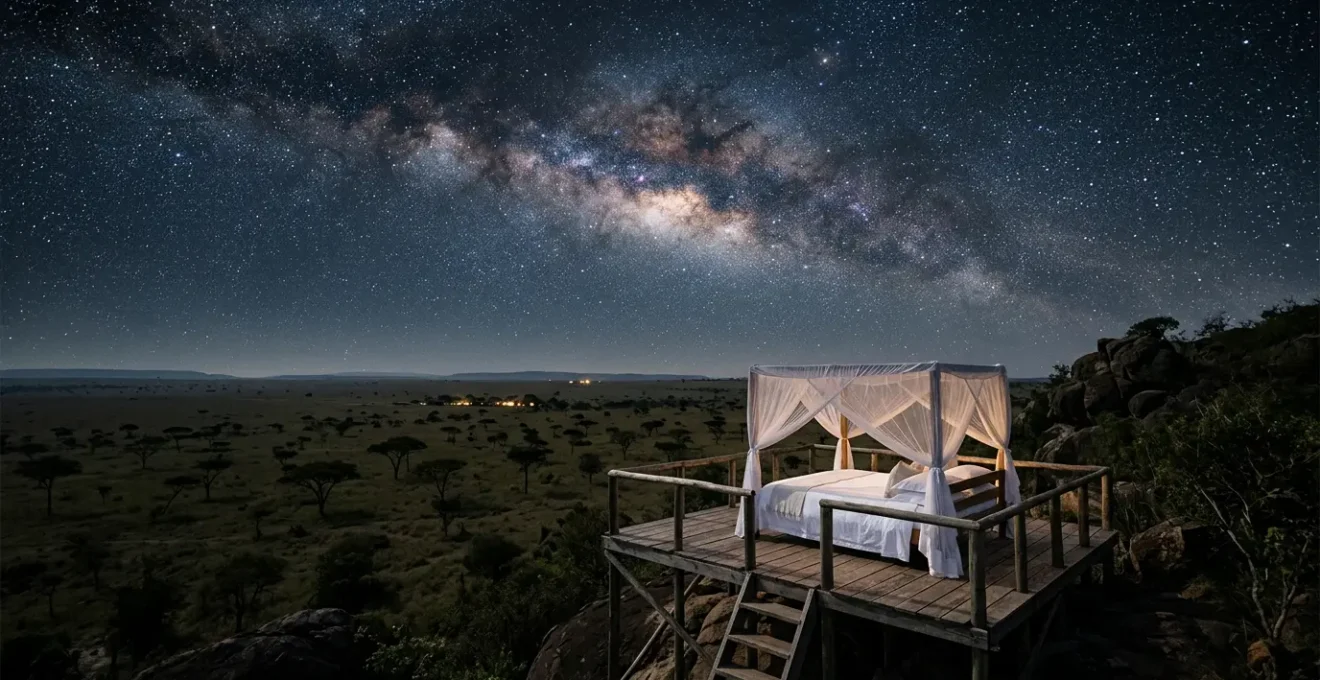
Yes, it’s perfectly safe from lions, but the real challenge is managing your own fear to fully embrace the thrill.
- Safety in the bush isn’t a matter of luck; it’s a sophisticated, multi-layered architecture of elevation, technology, and expert human oversight.
- The intimidating sounds of the night, like a hyena’s call, are transformed from a source of anxiety into a fascinating part of the acoustic landscape once you learn to decode them.
Recommendation: The key to an unforgettable experience is choosing an operator who doesn’t just promise safety, but transparently explains the ‘how’ and ‘why’ behind it, turning your primal fear into profound awe.
The thought is both intoxicating and terrifying. You and your partner, alone under a brilliant blanket of stars, the vast African bush stretching out around you. It’s the pinnacle of romance and adventure. But then, a primal question, whispered or thought, cuts through the fantasy: « What about the lions? » It’s a valid fear, one that separates a dream trip from a booked trip. Many will tell you it’s a magical experience, but they often brush past the very real, heart-pounding concerns that come with sleeping in the wild.
You’re not just asking about safety; you’re asking for permission to relax. You’re wondering if you can truly savour the romance without a knot of anxiety in your stomach. The answer isn’t just a simple « yes, it’s safe. » The real answer lies in understanding the concept of managed wildness. This isn’t about building a fortress in the bush; it’s about an intricate dance between you, nature, and an incredibly sophisticated safety architecture designed to make you feel like the only two people in the world, while never truly being alone.
This guide won’t just reassure you. It will empower you by pulling back the curtain on the systems and psychology that make a star bed experience not just safe, but a transformative highlight of any safari. We’ll explore the tangible amenities that keep you secure, the practical ways to handle smaller nuisances like mosquitoes, and the mental tools to turn the roar of a distant lion from a threat into the bass line of a lifelong memory.
To understand how this unique blend of thrill and tranquility is achieved, let’s explore the structure of your private haven in the wild. This guide breaks down every element, from the physical platform to the psychology of the night sounds.
Summary: Is Sleeping in a Star Bed in the Middle of the Bush Safe from Lions?
- What Amenities Do You Have on a Sleep-Out Platform?
- How to Sleep Under the Stars Without Getting Eaten by Mosquitoes?
- Why a Star Bed Experience Is the Ultimate Honeymoon Highlight?
- How to Overcome the Fear of Hearing Hyenas While Sleeping Outside?
- Why Choose a Treehouse Over a Ground-Level Sleep-Out?
- How Does 3 Days of Wilderness Isolation Affect Your Cortisol Levels?
- How Safe Are You Sleeping in a Tent When Elephants Walk Through Camp?
- Why Is Silence the Most Expensive Amenity in a Botswana Safari?
What Amenities Do You Have on a Sleep-Out Platform?
When you imagine a « sleep-out, » you might picture basic camping. The reality is a masterpiece of engineering and hospitality designed for comfort and, above all, security. This is your personal fortress of tranquility, and its amenities form a robust safety architecture. The most critical amenity is elevation. Predators like lions and hyenas are ground-based hunters; a platform raised even a few metres off the ground is as inaccessible to them as a second-story balcony.
Beyond height, your connection to the main lodge is paramount. Every reputable star bed is equipped with a two-way radio system, tested daily, that provides a 24-hour link to a dedicated response team. You are never truly « alone. » An armed guard is also typically stationed discreetly within range—close enough for immediate response, but far enough away to preserve your sense of perfect isolation. These human elements are supported by physical comforts, which are themselves a layer of safety.
High-end platforms, like the three-story Skybeds by Wilderness Safaris, demonstrate this brilliantly. They often feature an open-air bedroom on the top floor for ultimate stargazing, with a full dressing area and an outdoor bathroom on the lower levels. This means no midnight scrambles in the dark; every need is catered for within your secure, private structure. It’s this thoughtful design that transforms a rustic concept into a five-star experience, where your only job is to relax and watch the cosmos.
How to Sleep Under the Stars Without Getting Eaten by Mosquitoes?
While your mind might be on lions, a much smaller, more persistent creature is a more realistic nuisance: the mosquito. Protecting yourself from them is a straightforward science and a crucial part of a comfortable night. The first and most elegant line of defence is the mosquito net. Draped over your bed, this fine mesh creates a breathable, bug-proof cocoon, allowing you to enjoy the night air without the buzz and bites. It’s romantic, practical, and incredibly effective.
For added protection when you’re outside the net, personal repellents are key. Not all are created equal. As a guideline for safari-goers, a DEET-based repellent is often recommended for its high efficacy. In fact, studies show there is an over 90% reduction in mosquito bites with DEET-based repellents. This makes it a reliable choice for peace of mind in regions where mosquito-borne illnesses are a concern. Wearing long, loose-fitting pyjamas in a light colour also adds a physical barrier that makes you less attractive to insects.
To make an informed choice, it’s helpful to see how different repellents stack up. The most effective options provide hours of protection, allowing you to sleep soundly through the night.
This table, based on common findings for safari environments, breaks down the effectiveness of popular repellent types against the species you might encounter.
| Repellent Type | Active Ingredient | Effectiveness Against Anopheles | Duration |
|---|---|---|---|
| DEET-Based | N,N-diethyl-meta-toluamide | 95-99% protection | 8-10 hours |
| Picaridin | KBR 3023 | 85-90% protection | 7-8 hours |
| Natural (Citronella) | Essential oils | 30-40% protection | 1-2 hours |
| Permethrin (clothing treatment) | Synthetic pyrethroid | 70% reduction in landing | 6 washes |
Why a Star Bed Experience Is the Ultimate Honeymoon Highlight?
A safari is an adventure, but a star bed experience elevates it to something deeply personal and transformative, making it an unparalleled choice for a honeymoon. It strips away the distractions of the modern world—Wi-Fi, television, even walls—and leaves you with the two most important things: each other and the immense, silent beauty of the universe. It’s an opportunity to connect on a level that everyday life rarely permits. It’s just you and your partner, with the world standing still as you delight in the romance of an African safari.
The experience is a powerful cocktail for the senses. The sky is darker than you’ve ever seen, making the stars appear brighter and closer than you could imagine. The only sounds are the authentic calls of the night—an elephant’s deep rumble, the distant whoop of a hyena, or the evocative roar of a lion asserting its domain. Sharing this raw, visceral experience creates a unique form of intimacy. There is a shared vulnerability in being exposed to the wilderness, even within a completely safe environment, that fosters a profound sense of closeness.
Neuroscientists refer to these kinds of intense, multi-sensory moments as « peak bonding experiences. » They are powerful, shared events that become keystone memories for a relationship. Years from now, you won’t just remember the safari; you’ll remember the feeling of holding hands under the Southern Cross, the shared thrill of hearing a lion’s roar vibrate through the platform, and the quiet awe of watching the sunrise together from your bed. It’s this shared emotional journey that cements the experience as more than just a beautiful night; it becomes a cornerstone of your story together.
How to Overcome the Fear of Hearing Hyenas While Sleeping Outside?
Hearing a hyena’s « whoop » for the first time can be an unnerving experience. It sounds wild, alien, and close. The key to transforming this fear into fascination lies in a simple psychological technique: « name it to tame it. » The anxiety comes from the unknown. Once you can identify a sound and understand its meaning, your brain shifts from a state of alarm to one of curiosity. This is where your safari guide becomes your best asset, often spending time before your sleep-out to « decode » the night’s acoustic landscape for you.
You’ll learn that the hyena’s « whoop » isn’t a sound of aggression, but a contact call, clan members checking in with each other. The deep, guttural roar of a lion is a territorial announcement, a broadcast that can travel up to 8km, meaning the animal is likely far away. The rasping ‘saw’ of a leopard is simply it marking its territory. By learning this new language, you become an active participant in the nocturnal world, not a frightened bystander. You are also safe, as star beds are elevated and out of the reach of these animals.
As it turns out, I slept like a rock. In fact on my first night camping, I fell asleep to the sound of giggling hyenas, happily scrutinizing through our dinner’s left overs. I entered dreamland completely oblivious that about an hour later, lion’s roars were heard nearby the campsite… But, no seriously, it is VERY SAFE!
– A first-time safari camper
This process of sensory acclimatization is incredibly empowering. To help you get started, you can use a simple mental checklist to decode the sounds you hear, calming your nervous system and deepening your appreciation for the experience.
Your Action Plan: Decoding the Bush Soundscape
- Hyena ‘whoop’: Identify the rising ‘whoo-OOP’ sound. Remind yourself this is a contact call between clan members, not an aggressive act.
- Lion roar: Feel the deep rumble that vibrates through the ground. Acknowledge it as a territorial announcement that travels for miles.
- Leopard’s ‘sawing’ cough: Listen for the rhythmic, rasping sound like sawing wood. Recognize it as a territorial marking.
- Apply ‘Name It to Tame It’: Speak the name of the animal and the meaning of the call out loud. This engages your analytical brain and reduces fear response.
- Practice Box Breathing: If you feel anxious, breathe in for 4 counts, hold for 4, breathe out for 4, and hold for 4. This simple act physically calms your nervous system.
Why Choose a Treehouse Over a Ground-Level Sleep-Out?
The term « star bed » encompasses a variety of structures, but they generally fall into two categories: elevated ground-level platforms and true treehouses. Both offer incredible experiences, but they cater to slightly different comfort levels regarding the feeling of immersion and security. Choosing between them allows you to customize the intensity of your « managed wildness » experience. A treehouse, by its very nature, offers a greater sense of separation from the ground and its inhabitants.
Typically built at a higher elevation (10-16 feet or more), a treehouse is completely inaccessible to any ground predator. This physical reality provides an extra layer of psychological comfort. The perspective is also different; you are in the canopy, sharing a world with birds and primates. An elevated ground-level platform (3-5 feet), while perfectly safe, offers a more visceral, eye-level intensity. You might feel the ground vibrate as an elephant ambles past, a thrillingly immersive experience that a treehouse might buffer.
The Ngala Treehouse is a prime example of design excellence in this category. This four-level structure is not only a secure, permanent engineering marvel but also offers the best of both worlds: a covered, weatherproof king-size bedroom and an open-air sleep-out platform. This provides a crucial fallback option in case of unexpected weather or a sudden loss of nerve. The choice often comes down to your personal risk-reward calculation.
To help you decide which style is right for you, here is a direct comparison of their key features, based on information from safari experts like Go2Africa’s analysis of star beds.
| Feature | Treehouse (10-16ft elevation) | Ground-Level Platform |
|---|---|---|
| Predator Accessibility | Completely inaccessible to ground predators | Elevated 3-5ft, relies on deterrence |
| Wildlife Perspective | Canopy-level: birds, primates, aerial view | Eye-level intensity with passing elephants |
| Structural Integrity | Permanent engineered structure with regular inspections | Temporary/semi-permanent setup |
| Emergency Evacuation | Fixed stairs/ladder, weatherproof shelter option | Quick ground-level exit possible |
| Sensory Experience | Serene observation, removed from ground activity | Visceral immersion, feel ground vibrations |
How Does 3 Days of Wilderness Isolation Affect Your Cortisol Levels?
The initial thrill and slight fear of a night in the bush might feel like a stressor, but the physiological effect is profoundly restorative. Your body’s primary stress hormone is cortisol. While useful in short bursts for « fight or flight, » chronically high levels are detrimental. The wilderness provides a powerful antidote. Immersing yourself in a natural environment, a practice sometimes called « biophilia » or « forest bathing, » has a measurable calming effect on your body’s chemistry.
Scientific studies consistently back this up. In fact, research on forest bathing and biophilia demonstrates that spending time in nature can lead to significant drops in cortisol. Even a short period of isolation from artificial noise and light pollution triggers a reset in your nervous system. The experience of a star bed amplifies this effect by providing a full 24-hour cycle of immersion. You’re not just visiting nature; you’re living within its rhythm.
The initial excitement you feel—the slightly faster heartbeat as you listen to a distant call—is part of the process. It’s a short-term, healthy stress response that is quickly replaced by a state of deep relaxation as your body and mind adapt to the tranquil environment. Safari wellness experts describe this unique physiological arc in a way that should reassure any nervous adventurer.
The initial excitement and slight fear of the sleep-out can cause a short-term cortisol ‘peak,’ which is then followed by a profound ‘trough’ as the body adapts, leading to a deeper relaxation and stress reset.
– Safari Wellness Research, Wilderness Destinations Experience Report
So while you’re consciously marvelling at the stars, your body is unconsciously undergoing a powerful therapeutic process, recalibrating itself to a more natural, healthier state. The experience leaves you feeling not just rested, but fundamentally reset.
How Safe Are You Sleeping in a Tent When Elephants Walk Through Camp?
The question of safety extends beyond the star bed to the entire safari experience. You might hear stories of elephants walking silently through a tented camp at night, and wonder about the inherent risks. This is a perfect example of « managed wildness » in action. Safari lodges and camps are intentionally designed and located to offer these incredible, authentic encounters without compromising safety. The operators’ number one priority is always guest and staff security.
Reputable operators select their locations with immense care, balancing exceptional wildlife viewing with security. Camps are often situated in vast, private concessions far from any human settlement, creating a naturally secure buffer. The structures themselves, whether canvas tents or permanent lodges, are respected by most animals as solid objects to be navigated around. Elephants, in particular, are intelligent and sensitive; they perceive tents as obstacles and will typically walk around them. Your guide will brief you on camp etiquette—like not leaving food in your tent—which is the most critical part of this symbiotic relationship.
Statistically, the risks are infinitesimally small. When you consider the millions of people who go on safari each year, the safety record of the industry is extraordinary. Comprehensive research by Fauna Travel reveals that major incidents are incredibly rare. This remarkable record is not an accident; it is the result of decades of experience, meticulous planning, expert training, and a deep, respectful understanding of animal behaviour. The star beds, being elevated 10 feet or more, simply add an additional, insurmountable layer of separation from the pathways of these gentle giants.
Key Takeaways
- Safety is by Design: Star bed safety isn’t a hope, it’s an engineered system of elevation, communication, and expert oversight.
- Fear is Manageable: The strange sounds of the night can be « decoded » and understood, transforming anxiety into a fascinating part of the experience.
- It’s a Peak Bonding Experience: The shared vulnerability and thrill of sleeping in the wild creates powerful, lasting memories, especially for couples.
Why Is Silence the Most Expensive Amenity in a Botswana Safari?
In our hyper-connected world, true silence—or more accurately, the pure soundscape of nature—has become the ultimate luxury. On a safari, particularly in exclusive areas like Botswana’s private concessions, the high price tag is not just for a comfortable bed; it’s for the purchase of solitude and silence. You are paying for what is *not* there: no road noise, no light pollution, no other tourists. This is the final and most profound layer of your « managed wildness » experience.
Achieving this level of isolation is an immense logistical and financial undertaking. It involves leasing tens of thousands of hectares of pristine wilderness to ensure exclusivity. It means enforcing strict limits on the number of vehicles, often only two or three at any wildlife sighting, to prevent crowding. It requires building infrastructure with minimal impact, such as using solar power to eliminate the hum of generators, and positioning platforms in acoustically optimal locations. This is why you can hear an elephant’s stomach rumble from a hundred metres away.
This curated silence is the canvas upon which your experience is painted. Far from the unnatural light of cities, the night sky reveals its full, staggering glory. As Wilderness Destinations notes, these wild places are the best places to appreciate the night sky. The absence of human noise allows the authentic acoustic landscape of the bush to emerge—the chirps, the calls, the rustles, and yes, the roars. The price of admission buys you an exclusive ticket to the greatest show on Earth, performed as it has been for millennia.
Ultimately, the safety and magic of a star bed come from the deep expertise of those who run them. When you choose your trip, you’re not just booking a room; you’re placing your trust in an operator. Ask them the tough questions. Ask them about their safety protocols, their guide training, and their communication systems. A great operator won’t just tolerate these questions; they will welcome them, proud to show you the thought and care that goes into creating your once-in-a-lifetime night. Your journey to sleeping soundly among the lions begins with choosing the right people to make it happen.