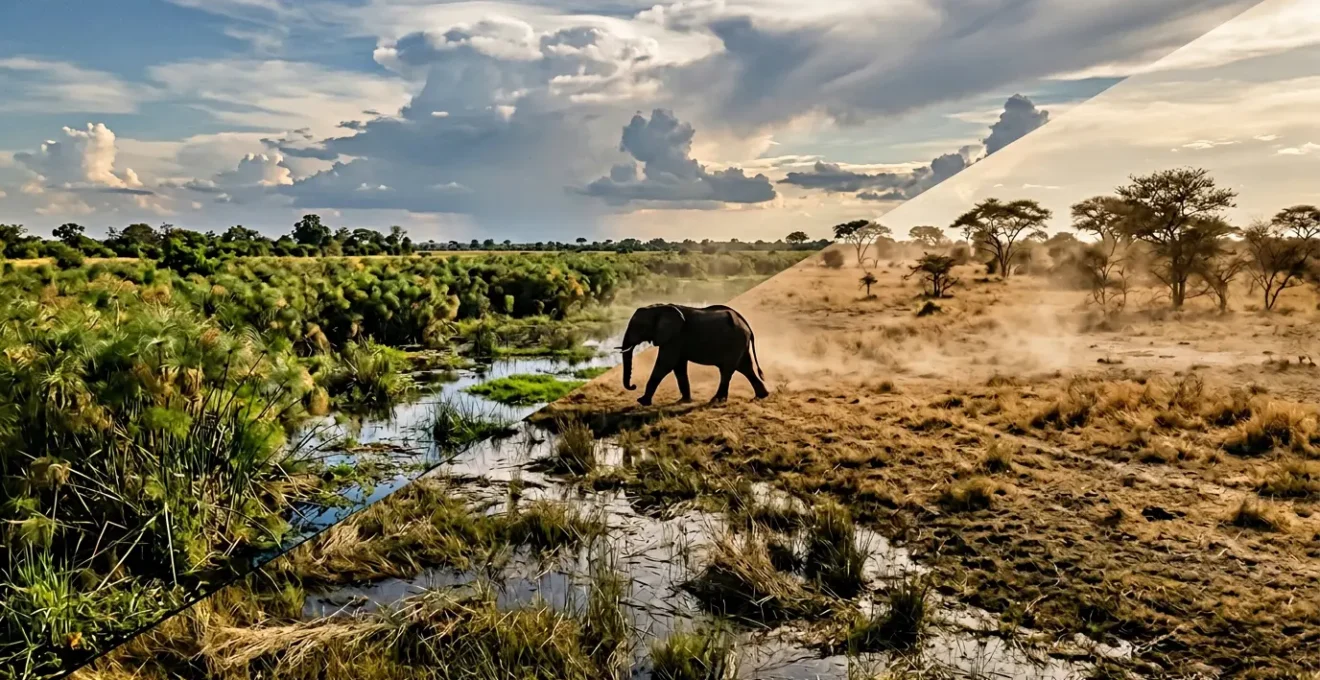
The real question isn’t Linyanti vs. Savuti; it’s how you sequence them to create a compelling story.
- A great Botswana itinerary is built on ecological and experiential contrast, not just ticking off famous names.
- Pacing is critical: short stays break immersion, while longer stays allow the local narrative to unfold.
Recommendation: Shift your mindset from a location checklist to that of a storyteller, crafting a journey with a beginning, a dramatic middle, and a meaningful end.
For the discerning traveler, the Botswana safari conversation quickly moves beyond the Okavango Delta. The names Linyanti and Savuti emerge, whispered like insider secrets. The typical debate ensues: the exclusive, water-rich privacy of Linyanti versus the raw, dramatic predator theatre of Savuti. This is a valid, but fundamentally limited, starting point. Most guides will give you a simple comparison, a checklist of pros and cons. They’ll tell you about Savuti’s elephant-hunting lions and Linyanti’s wild dogs, and leave you to pick a winner.
But what if this « A vs B » choice is the wrong question entirely? For the repeat visitor or the dedicated researcher, the art of a truly transformative Botswana safari isn’t about picking the « best » spot. It’s about understanding how to craft a journey. It’s about narrative sequencing—the deliberate ordering of locations to create a story with rising action, profound contrasts, and an emotional payoff. This is not about collecting sightings; it’s about curating an experience that builds, day by day, from subtlety to spectacle, from water to dust, from intimacy to immensity.
This guide abandons the simple versus debate. Instead, we’ll explore the strategic pillars of exceptional itinerary design. We will treat each region not as a standalone destination, but as a chapter in a larger narrative. You will learn not just where to go, but *why* and in what order, transforming your trip from a disconnected series of highlights into a cohesive, unforgettable story arc.
This article delves into the core strategies for designing an advanced Botswana itinerary. Discover how to leverage seasonal secrets, balance iconic locations with hidden gems, and structure your journey for maximum narrative impact.
Summary: Linyanti or Savuti: Which Hidden Gem Should You Add to Your Itinerary?
- Why Is the Green Season the Best Kept Secret for Photography?
- Why Visit Nxai Pan Specifically During the Zebra Migration?
- Is Chief’s Island Worth the Hype or Should You Go to a Smaller Concession?
- How to Combine Must-Sees and Hidden Gems in a Logical 10-Day Loop?
- Why Sleep Out on the Salt Pans When There Is « Nothing » to See?
- Why You Should Never Stay Only 1 Night in a Safari Camp?
- Why Is the Dithubaruba Festival Crucial for Kwena Heritage?
- North to South or South to North: How to Flow Your Botswana Itinerary?
Why Is the Green Season the Best Kept Secret for Photography?
The conventional wisdom, repeated in countless brochures, champions Botswana’s dry season (May to October) for its concentrated wildlife around shrinking water sources. For the first-timer, this advice holds. But for the photographer and the seasoned traveler, this ignores the country’s most dramatic and atmospheric chapter: the Emerald, or ‘Green’, Season (roughly November to April). This isn’t just about baby animals and lush landscapes; it’s a complete shift in the photographic palette.
The secret lies in the quality of light and atmosphere. The dry season offers clear, harsh blue skies. The Green Season, by contrast, delivers towering cumulonimbus clouds, creating a natural, dramatic softbox. The brief, intense afternoon thunderstorms wash the dust from the air, leaving behind a world of saturated colors and unparalleled clarity. This is when you capture those award-winning shots of golden light breaking through dark, moody skies, backlighting a herd of lechwe as they splash through vibrant green floodplains.
Furthermore, this season presents a compelling financial and experiential argument. With fewer visitors, you gain a sense of exclusivity that is rare even in Botswana. An insider analysis reveals that Green Season safaris frequently cost up to 25% less, while offering superior photographic conditions. As one professional photographer noted after a Green Season trip, the sightings remain prolific: their tally included six herds of sable, numerous rhino, a dozen leopards, and wild dogs, proving that the wildlife doesn’t disappear; it simply disperses into a more beautiful setting.
Why Visit Nxai Pan Specifically During the Zebra Migration?
When planning a narrative itinerary, you need an inciting incident—a dramatic event that sets the story in motion. In Botswana, one of the most spectacular is the zebra migration into Nxai Pan. Following the first rains, typically from December to April, this seemingly stark and empty landscape is transformed into a stage for one of Africa’s great spectacles. It’s a chapter defined by scale, movement, and the inevitable drama of predator versus prey.
This isn’t just a handful of animals. Recent tracking has confirmed that the migration involves over 20,000 zebras undertaking a 500km journey, Africa’s second-longest land migration. They converge on the sweet, nutritious grasses of Nxai Pan, creating a breathtaking sea of black and white stripes against the green plains. The sheer density of animals is staggering, offering a completely different experience from the more scattered wildlife of the Delta.
But for the safari connoisseur, the real story is the drama that follows. This sudden abundance of prey acts as a magnet for predators. The Nxai Pan lions, famed for their size and power, are never far behind the herds. Cheetahs, with their need for open spaces, find the pans an ideal hunting ground. As one local guide explained, this is a time of incredible concentration: « Large concentrations of zebra, elephant, wildebeest, and predators such as lions, leopards, and cheetahs can be seen in a small area… big cats like lions and brown hyenas follow the zebra herds closely—eagerly waiting to pounce. » Visiting at this time isn’t just about seeing zebra; it’s about witnessing an entire ecosystem in high gear, a perfect, action-packed chapter for your safari narrative.
Is Chief’s Island Worth the Hype or Should You Go to a Smaller Concession?
Every great story needs a blockbuster scene, and in Botswana’s safari narrative, that is Chief’s Island. Located in the heart of the Moremi Game Reserve, it boasts the highest density of wildlife in the country and is rightly known as the « Predator Capital. » For guaranteed, high-impact sightings of the Big Five, it is simply without peer. The question for the savvy planner isn’t *if* it’s worth the hype—it is—but how to integrate this intense, action-packed chapter without letting it overshadow the more nuanced parts of your story.
The mistake is to see it as an either/or choice against smaller, more intimate concessions. The expert approach is to use a blended strategy. Chief’s Island provides the wildlife « heavy hitters, » the almost-certain lion kills and leopard sightings. A smaller, water-focused concession in the Delta offers the sensory contrast: the silent glide of a mokoro, the jewel-like flash of a malachite kingfisher, the deep grunt of a hippo. A walking-focused camp offers yet another layer—an intimate, ground-level perspective that connects you to the subtleties of the bush. It’s this ecological contrast that makes each experience more potent.
This strategy also delivers value. While nightly rates on Chief’s Island are high, they often yield a superior « cost-per-sighting » for iconic species. Balancing a few nights here with stays in more peripheral (and often less expensive) concessions creates a rhythm of intensity and calm, maximizing both your budget and the narrative arc of your trip.
Your Strategic Blueprint for a Balanced Safari
- Budget for 2-3 nights on Chief’s Island for guaranteed Big Five sightings and the highest wildlife density.
- Complement this with 2-3 nights in a water-focused concession for mokoro experiences and bird photography.
- Consider adding a walking-focused camp for intimate bush experiences away from vehicles.
- Calculate cost-per-sighting: Acknowledge that Chief’s Island’s higher rates often deliver more consistent marquee encounters.
- Book Chief’s Island first as its prime camps fill up fastest, then build your complementary, contrasting chapters around it.
How to Combine Must-Sees and Hidden Gems in a Logical 10-Day Loop?
With the core elements understood—the seasonal setting, the dramatic incident, and the blockbuster location—the next step is architecting the journey. This is narrative sequencing in practice. A well-designed 10-day loop isn’t just about logistics; it’s about creating a flow that builds interest and makes ecological sense. The order in which you experience Botswana’s diverse habitats dramatically changes your perception of them.
For instance, starting in the lush, water-logged Okavango Delta and then flying to the arid, stark Savuti creates a powerful sense of environmental contrast. The abundance of water makes the subsequent dryness more impactful. Conversely, starting in the harsh Kalahari and ending in the Delta can feel like a journey towards paradise—an « arrival » that provides a wonderful narrative conclusion. There is no single « correct » route, only the one that tells the story you want to experience.
Expert Itinerary: A Proven 10-Day Narrative
A classic and highly effective loop demonstrates this principle. It begins with a charter flight into the Moremi Game Reserve for 3 nights, immersing you immediately in prime game-viewing territory. The story then moves north with a short flight to the Linyanti Swamp for 2 nights in an intimate camp, shifting the focus to a different ecosystem and more exclusive viewing. The climax unfolds over three nights in the legendary Savuti region, known for its epic predator-prey battles. The journey concludes with a flight back to Maun, having completed a logical arc from the Delta’s heart to its dramatic northern frontiers.
The following table outlines several strategic approaches to itinerary design, each offering a different narrative flavor. This is your toolkit for moving beyond a simple checklist and becoming the author of your own safari adventure.
As this comparative analysis of safari loops shows, the structure of your itinerary dictates the story it tells. Choosing the right flow is as important as choosing the right camps.
| Loop Type | Route | Best For | Key Advantage |
|---|---|---|---|
| Water to Dryland | Okavango Delta → Linyanti → Savuti/Chobe | First-time visitors | Natural landscape progression |
| Predator Focus | Chief’s Island → Savuti → Linyanti | Wildlife photographers | Different predator habitats |
| Hub and Spoke | Base in Maun with fly-outs | Comfort seekers | Efficient but less immersive |
| Linear Journey | Connected camps via game drives | Adventure seekers | Continuous narrative experience |
Why Sleep Out on the Salt Pans When There Is « Nothing » to See?
A truly sophisticated itinerary embraces not just spectacle, but also subtlety and space. This is why a sleep-out on the Makgadikgadi Salt Pans is a masterful stroke in safari design. To the uninitiated, the appeal of spending a night in a vast, flat expanse with « nothing » to see seems baffling. This is the ultimate test of shifting from a « sighting-focused » mindset to one of sensory immersion. The value here is not in what you see, but in what you feel.
The experience is about perspective. As you travel across the pans, the horizon expands to a full 360 degrees, and the sky becomes a dome of impossible scale. This profound sense of space and silence recalibrates the senses. It’s a necessary pause in the narrative, a quiet chapter that makes the subsequent action-packed game drives feel even more vibrant. During the dry season, the pans offer surreal, moon-like landscapes. This is where you can have close, habituated encounters with meerkats or gain cultural insights from the local San people, who have thrived in this environment for millennia.
But the true spectacle happens after sunset. As safari operators and astronomers agree:
Botswana’s salt pans offer some of the darkest skies on Earth.
– Common knowledge in astronomy safari circles
With no light pollution, the universe unfolds in a way that is simply not possible anywhere else. Lying on a bedroll under a blanket of stars, the Milky Way so bright it feels tangible, is an experience of profound humility and wonder. It’s a reminder that the « nothing » of the pans is actually « everything. » This chapter isn’t about the Big Five; it’s about the big picture.
Why You Should Never Stay Only 1 Night in a Safari Camp?
One of the most common mistakes in itinerary planning is trying to see too much, resulting in a series of one-night stands with safari camps. This is a cardinal sin against narrative crafting. A safari is not a city-hopping tour; it requires time for the local story to reveal itself. Rushing through breaks the narrative flow and reduces a profound experience to a superficial checklist. The secret to a successful safari lies in proper experience pacing.
From a purely practical standpoint, a one-night stay is terrible value. You arrive in the afternoon, have one game drive, and leave the next morning. Your expensive transfer cost is amortized over just one or two activities. A two-night stay, for the exact same transfer cost, gives you four game drives, effectively halving your cost-per-activity. But the real cost of a one-night stay is the missed opportunity for immersion.
The bush has a rhythm that cannot be rushed. It takes at least 24 hours to decompress from travel, shed your urban anxieties, and truly start to *notice* things—the subtle alarm call of a squirrel, the faint track of a leopard, the way the light changes at dusk. Your guide also needs time to build a narrative, to follow up on tracks from the previous day, to revisit a den site, or to anticipate the movement of a herd. The magic moments—the unexpected kill, the rare sighting—almost always happen on day two or three, once you and your guide are fully in sync with the local environment. Here’s how the timeline of immersion typically unfolds:
- Day 1 Afternoon: Arrival and orientation. You’re still in « travel mode, » and the first game drive is an introduction to the area.
- Day 2 Morning: Your senses begin to sharpen. You start noticing subtle tracks and bird calls you would have missed before.
- Day 2 Afternoon: Your guide begins to develop narrative threads, connecting sightings from earlier drives. You’re no longer just observing; you’re part of a developing story.
- Day 3 and beyond: This is the peak experience zone, where full immersion is achieved and the most memorable moments are born.
Why Is the Dithubaruba Festival Crucial for Kwena Heritage?
A truly masterful safari narrative can culminate not just in a wildlife spectacle, but in a moment of genuine cultural connection. For the traveler seeking depth beyond the safari circuit, timing a trip to coincide with an event like the Dithubaruba Festival offers an authentic culmination that is both rare and deeply rewarding. This is not a performance for tourists; it is a living, breathing expression of heritage.
The festival commemorates the Kwena people’s historical resilience, specifically their re-occupation of Dithubaruba Hill after colonial-era conflicts. It’s a powerful act of cultural memory. Unlike staged « cultural villages, » this is a real community event where praise poems (dithoko), traditional dances, and specific ceremonial foods connect the present generation to their ancestral lineage. Attending is to be a respectful witness to a community celebrating its own identity, on its own terms.
Cultural Memory and Living Heritage
The Dithubaruba Festival provides an unparalleled window into the soul of the Kwena people. The event is a vibrant tapestry of history and celebration, marking their return to a sacred ancestral site. By participating, you move from a passive observer of « culture » to an active guest in a community’s most important annual gathering. This offers a layer of meaning and connection that a game drive, however spectacular, simply cannot provide. It adds a human heart to the story of Botswana’s wild landscapes.
Experiencing such an event requires a different approach than a standard safari booking. It means planning around specific dates, not just lodge availability. It involves respect, humility, and a willingness to engage. For the destination scout, this is the ultimate hidden gem—an experience that provides a powerful, human-centric final chapter to your Botswana story.
- Attend during the actual festival dates when the community gathers for its own purposes, not for tourist schedules.
- Participate respectfully in ceremonies—observe dress codes and ask permission before taking photographs.
- Learn a few key Setswana greetings and cultural protocols before you arrive to show respect.
- Support local artisans by purchasing crafts directly from the creators during the festival, ensuring your money benefits the community.
- Consider arranging a homestay with a local family for a truly immersive experience, rather than staying in a distant lodge.
Key Takeaways
- Shift from « A vs. B » choices to a « narrative sequencing » mindset, focusing on how destinations connect.
- Embrace ecological contrast by deliberately moving between wet and dry, or dense and sparse, environments.
- Respect experience pacing: A minimum of two, ideally three, nights per camp is essential for genuine immersion.
North to South or South to North: How to Flow Your Botswana Itinerary?
We arrive at the final, master-level question of itinerary design: the direction of flow. Having assembled the chapters—the seasons, the wildlife events, the cultural moments—the ultimate expression of safari craft lies in arranging them in a sequence that honors the natural systems of Botswana itself. The choice between a north-to-south or south-to-north journey is not arbitrary; it can be aligned with the very pulse of the ecosystem: the annual flood.
The lifeblood of the Okavango Delta originates not in Botswana, but as rainfall in the Angolan highlands. In a fascinating paradox, the fascinating water pattern shows the flood’s peak reaching the upper panhandle of the Delta months after the rains have fallen, typically around June, and only permeating the entire system by August or September. This creates the unique phenomenon of a vast wetland that is at its fullest during the driest time of year. Planning your itinerary to follow or move against this flow of water is the ultimate insider strategy.
A south-to-north itinerary in the dry season might follow the water’s arrival, moving from the drier fringes of the Kalahari up into the heart of the flood in the Delta, a journey of increasing abundance. A north-to-south flow offers a different story, perhaps starting with the concentrated predator action of the Chobe Riverfront or Linyanti and ending in the sublime isolation of the Makgadikgadi Pans. Ultimately, the Linyanti vs. Savuti question that started our journey is best answered not with a choice, but with a sequence, as this final comparison shows.
This table, based on insights from a deep dive into the distinct characters of Savuti and Linyanti, provides the final piece of the puzzle. It helps you decide which « character » best fits the role you need filled in your specific narrative.
| Aspect | Linyanti – Curated Wilderness | Savuti – Epic Drama |
|---|---|---|
| Access Method | Fly-in only (exclusive) | Self-drive possible |
| Wildlife Philosophy | Private concessions, off-roading, night drives allowed | National park rules, no off-roading |
| Crowd Level | Fewer vehicles, more exclusive | More visitors but spread across vast area |
| Best For | Solitude seekers, photographic purists | Safari first-timers, self-drive adventurers |
| Cost Range | Higher (all-inclusive luxury) | Variable (budget to luxury options) |
| Terrain | Water-based and land viewing blend | Drier, more rugged landscape |
You now have the tools to move beyond the simple questions and start designing a Botswana journey with the nuance and foresight of a seasoned destination scout. The next step is to take these principles and begin sketching out the unique story that you want your safari to tell.