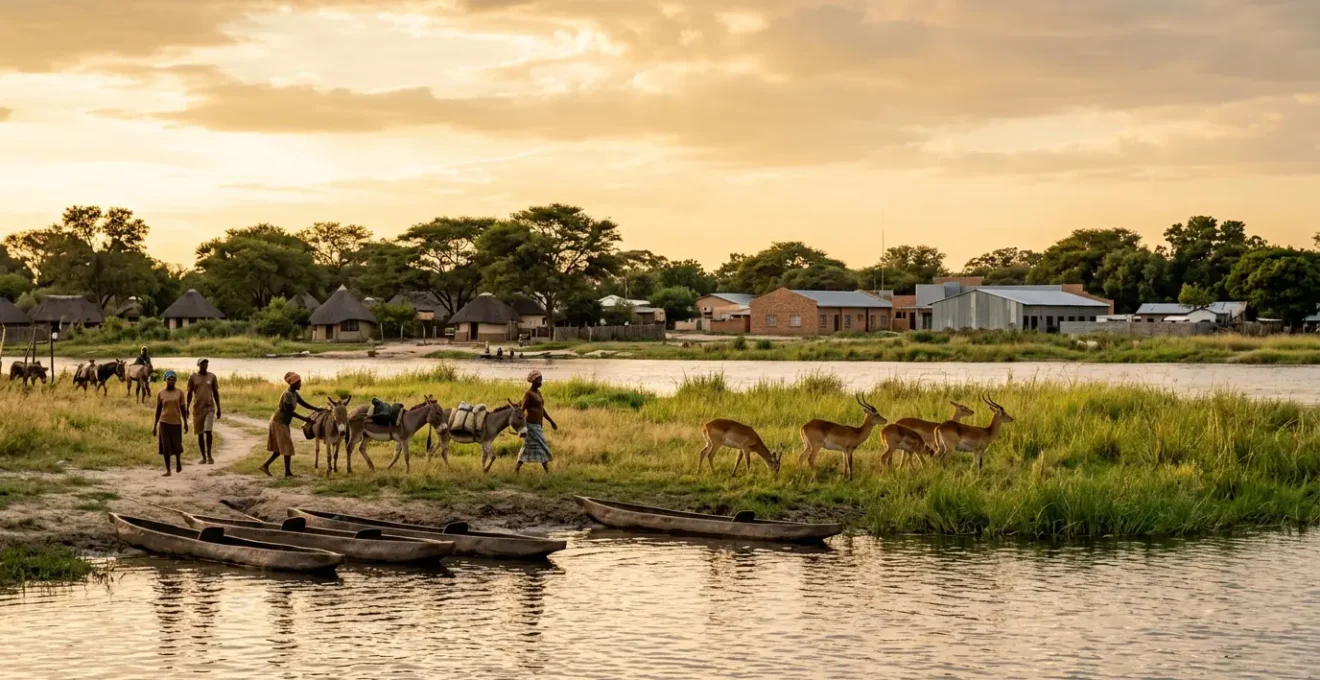
Contrary to its reputation as a mere safari stopover, Maun is a vibrant economic and cultural hub where deep traditions and modern life dynamically intersect.
- The weekend exodus to the « cattle post » isn’t a leisure trip; it’s participation in a core economic system that underpins the national agricultural GDP.
- Everyday items at the local market, like Mopane worms, are part of a multi-million dollar regional trade network with deep cultural practices.
Recommendation: To truly understand Botswana, engage with its citizen-owned economy—from the market stall to your choice of safari operator—to see how your travel dollars can directly support these resilient local systems.
For most travelers, Maun is a brief, functional pause—a hot tarmac, the hum of propeller planes, and the organized bustle of safari companies whisking you away to the pristine wilderness of the Okavango Delta. The town itself often registers as little more than a dusty transit point, a place for stocking up on supplies or spending a necessary night before the « real » adventure begins. The common advice reinforces this: find a decent restaurant, check into your lodge, and focus on the logistics of your upcoming safari. This perception, however, creates a bubble, separating the visitor from the vibrant, complex reality of a town that is the beating heart of northern Botswana.
But what if the true essence of Maun isn’t found in the tourist-facing lodges, but in the seemingly mundane scenes of daily life? What if the key to understanding this gateway town lies in the weekend exodus of its residents not to resorts, but to the « cattle post »? The story of modern Botswana is one of a fascinating dual economy, where ancestral traditions like cattle farming and basket weaving coexist and often fuel the modern world of safari guiding and urban development. To see Maun only as an airport is to miss the intricate social and economic web that makes it one of the most unique towns in Southern Africa.
This article moves beyond the airport fence and into the town’s core. As an urban geographer, I’ll guide you through the « why » behind what you see: from the cultural significance of the weekend migration to the cattle posts to the hidden ecosystems of local music. We will explore how housing reflects changing aspirations, how ancient knowledge is adapting to new laws, and most importantly, how your choices as a traveler can fundamentally change the impact of your journey.
To navigate the rich layers of daily life in Botswana’s gateway towns, this guide explores the essential, often-overlooked aspects of the local culture and economy. The following sections provide a map to understanding the real Maun, far from the familiar tourist trail.
Summary: Maun Beyond the Airport: What Is Daily Life Really Like in the Gateway to the Delta?
- Why Do Most City Dwellers Disappear to the « Cattle Post » on Weekends?
- Basket Weaving to Mopane Worms: What to Buy at the Maun Market?
- How Does a Local Kid from the Village Become a Top Safari Guide?
- Where to Go in Kasane to Hear Local Hip-Hop and Afro-Pop?
- Traditional Rondavels vs. Modern Brick: How Is Housing Changing?
- How Are the Bushmen Adapting to Modern Conservation Laws?
- How to Check if a Safari Company Is Truly 100% Citizen Owned?
- Why Booking with a Citizen-Owned Operator Changes the Impact of Your Dollar?
Why Do Most City Dwellers Disappear to the « Cattle Post » on Weekends?
If you spend a Friday afternoon in Maun, you’ll witness a curious migration: a steady stream of vehicles, laden with supplies and families, heading out of town. They are not going to luxury lodges, but to the « moraka »—the cattle post. To an outsider, this might seem like a simple weekend retreat. In reality, it is a pilgrimage to the very heart of Botswana’s cultural and economic identity. The cattle post is far more than a farm; it is a symbol of wealth, a social anchor, and a parallel economy that runs alongside tourism. For many Batswana, identity and status are not measured by a job in the city but by the health and size of their herd.
This is not merely a nostalgic tradition; it’s a formidable economic force. While tourism dominates the headlines in Ngamiland, it is cattle that form the backbone of the nation’s agricultural sector. In fact, an analysis of Botswana’s economy shows that cattle farming accounts for an estimated 80% of agricultural GDP. This traditional system is deeply integrated into the global economy. Through trade agreements, local farmers can access lucrative international markets, receiving significantly higher prices for their beef than they would in regional markets. The weekend trip to the cattle post is, therefore, an act of managing a critical family asset that connects a dusty plot of land to international commerce.
The cultural significance is just as profound. It is at the cattle post where family histories are shared, where children learn the deep ecological knowledge of the land from their elders, and where important social bonds are reinforced. It represents a space away from the Westernized pressures of the town, a place to reconnect with the core values of Motswana life. So, when you see the town empty out, you are not witnessing an escape, but a deeply meaningful return to the source of both wealth and identity.
Basket Weaving to Mopane Worms: What to Buy at the Maun Market?
The Maun market is a vibrant, sensory experience, but it’s easy to misinterpret as just a place for tourist trinkets. To see it correctly, you must view it as a crucial interface between Botswana’s formal and informal economies. Here, the beautiful hand-woven baskets and local delicacies are not just souvenirs; they are the end products of sophisticated, often cross-border, value chains that support thousands of people. These items tell a story of resourcefulness, tradition, and micro-enterprise.
Take, for example, the iconic Botswana baskets. The intricate patterns woven from the Mokola palm are not random; they tell stories and represent one of the most celebrated craft forms in Africa. Buying a basket directly from a weaver or a local cooperative ensures the money supports this heritage. But perhaps the most misunderstood product is the Mopane worm (phane). Far from being just a novelty snack for brave tourists, these caterpillars are a staple protein and a massive economic driver. In fact, a recent report on regional food systems revealed that the mopane worm trade generates between $39-100 million annually in Southern Africa, with much of the supply originating in Botswana.
The quality of Botswana’s phane is renowned, a fact tied directly to sustainable, traditional harvesting practices. As one expert noted in a University of Cape Town study:
The mopane worms from Botswana are bigger, purely based on the time at which people harvest. There’s still an understanding that one doesn’t just harvest when they see a caterpillar on a tree.
– Sekonya, University of Cape Town study on cross-border mopane worm trade
This insight reveals a deep ecological knowledge at play. When you buy a bag of dried Mopane worms at the market, you are participating in a complex economic system that respects tradition and ecological cycles, a stark contrast to mass-produced souvenirs.
How Does a Local Kid from the Village Become a Top Safari Guide?
The safari guide is an iconic figure in Botswana: knowledgeable, charismatic, and seemingly born with an innate ability to spot a leopard in a distant tree. While this connection to the bush is genuine and often fostered from a young age, the path from a rural village to a lead guide in a five-star lodge is a structured journey of professionalism, ambition, and rigorous training. It is a career path that represents one of the most powerful forms of local empowerment within the tourism industry, turning ancestral knowledge into a highly respected and well-compensated profession.
For many, the journey begins at the ground level, not in a classroom. A young person might start as a camp assistant, tracker’s helper, or mokoro poler. This is the crucial first step for gaining essential « bush experience » and demonstrating a passion for wildlife. It’s an apprenticeship where they absorb knowledge from senior guides and prove their reliability and work ethic. From there, the path to becoming a licensed guide is formalized through organizations like the Botswana Guides Association (BOGA), which helps aspiring guides acquire the necessary certifications from the Botswana Qualifications Authority (BQA).
The progression is a clear and merit-based ladder, showcasing a structured career path that many visitors may not be aware of:
- Entry-Level Role: Start as a camp hand, cleaner, or mokoro poler to gain foundational bush experience and prove commitment.
- Tracker-in-Training: Progress to a tracker position, honing wildlife spotting and tracking skills under the mentorship of senior staff.
- BQA Certification: Obtain official certification, often with assistance and training support from BOGA, which formalizes their skills.
- Junior Guide: Begin leading parts of game drives, co-guiding with experienced mentors who provide feedback and advanced training.
- Lead Guide / Specialist: Achieve full lead guide status, often developing specialized expertise in areas like birding, botany, or photography.
- Leadership Roles: Top guides can advance further to become camp managers, guide trainers, or even start their own mobile safari operations.
This path transforms a « job » into a lifelong career, creating leaders and business owners within the community. It is a powerful testament to how the tourism industry, when structured correctly, can create profound opportunities for local talent.
Where to Go in Kasane to Hear Local Hip-Hop and Afro-Pop?
While Maun is the gateway to the Okavango, Kasane is the bustling hub for Chobe National Park. After the sun sets and the safari vehicles return, a different kind of life emerges, one driven by the rhythms of local and regional music. For a traveler wanting to experience the authentic soundtrack of modern Botswana, the answer isn’t in the quiet hotel bar. It’s in the vibrant, informal venues and unique distribution networks that define the local music scene.
The most authentic experience is found in the local shebeens. These are informal neighborhood taverns, worlds away from the tourist-oriented restaurants. A shebeen is a community living room, a place where people gather after work to talk, relax, and listen to music. Here, the playlist is not curated for international tastes. Instead, you’ll hear what is genuinely popular: the infectious beats of South African Amapiano, the lyrical storytelling of Botswana’s own hip-hop genre, Motswako, and the enduring energy of Kwaito. It’s in these spaces that you can feel the true pulse of youth culture and local identity.
What’s equally fascinating is how new music spreads. This isn’t a world of Spotify playlists and official charts. It’s an informal, hyper-local ecosystem. The DJs in « combis » (minibus taxis) are major tastemakers, blasting the latest hits on their daily routes. Music is shared virally through WhatsApp groups and passed around on USB sticks loaded with mp3s. This creates a dynamic and resilient « cultural infrastructure » that operates completely independently of the formal tourism economy. Asking a young local what they’re listening to or which combi has the best music is one of the most direct ways to connect with the contemporary culture of Kasane.
Traditional Rondavels vs. Modern Brick: How Is Housing Changing?
As you move through the residential areas of Maun, you’ll notice a distinct architectural conversation taking place. In many family compounds, a traditional, circular thatched-roof house, the « rondavel, » stands alongside a modern, rectangular brick-and-mortar home. This is not a random mix of styles; it is a visual story of a society in transition, balancing heritage with the powerful aspirations of modernity. The influx of tourism dollars and the growth of the formal economy have profoundly reshaped what a « home » signifies.
Historically, the rondavel was the primary dwelling. Its design is a masterclass in climate-appropriate architecture, with the thick thatch roof providing superior natural cooling in the fierce Kalahari heat. Today, however, there is a clear shift towards square, cinder-block homes with tin or tile roofs. This change is driven by a complex set of social and economic factors. The modern house has become a powerful symbol of success and upward mobility. Crucially, it is also an asset that banks recognize. While it is difficult to secure a loan to build a traditional rondavel, a brick house is eligible for a mortgage, giving families a pathway to formal property ownership.
The following table, based on common observations and local realities, breaks down the key differences that are driving this architectural evolution, as reflected in analyses of Maun’s development.
This table, drawn from common knowledge detailed in resources like guides analyzing Maun’s urban landscape, highlights the trade-offs families face.
| Aspect | Traditional Rondavel | Modern Brick House |
|---|---|---|
| Climate Control | Superior natural cooling with thatch roof | Requires electric fans/AC |
| Social Status | Traditional heritage value | Symbol of modern success |
| Bank Loans | Difficult to secure financing | Eligible for mortgages |
| Maintenance | Regular thatch replacement needed | Lower maintenance with tin/tile roofs |
| Current Use | Often kept as kitchen or guest space | Primary family residence |
However, the rondavel is not disappearing. Instead, its role is evolving. In many compounds, it is lovingly maintained as a kitchen, a guesthouse, or a cool place to gather during the day, preserving its cultural importance while the family’s primary residence shifts to the modern structure. This hybrid homestead is a perfect metaphor for Maun itself: a place where tradition is not erased by modernity, but rather repositioned alongside it.
How Are the Bushmen Adapting to Modern Conservation Laws?
The relationship between indigenous communities and modern conservation can be fraught with tension, particularly for the San/Basarwa (Bushmen) people, whose ancestral lands often overlap with today’s national parks and wildlife management areas. Historically, conservation laws that restricted hunting and gathering rights were seen as a direct threat to their traditional way of life. However, in Botswana, a more progressive model is creating new pathways for adaptation, transforming ancient knowledge into a valuable asset within the modern conservation economy.
The key to this evolution is the Community-Based Natural Resource Management (CBNRM) program. This government-supported framework empowers local communities, including the San, to become stakeholders in the management and economic benefits of the wildlife and land around them. Instead of being excluded, communities are brought into the fold. This program has been a catalyst, allowing San communities to leverage their unparalleled tracking skills and deep knowledge of the bush. Many have become elite trackers and guides in high-end safari lodges, earning a sustainable livelihood by sharing their unique heritage with visitors. This model ensures that biodiversity conservation and sustainable economic development can be mutually reinforcing goals.
This collaborative approach has attracted significant international support, further strengthening the program’s impact. For instance, to support communities in the Kavango-Zambezi (KAZA) Transfrontier Conservation Area, which spans five countries including Botswana, international partners have made substantial contributions. A 2021 report noted that in 2020, the Government received P65.8 million from Germany to support these community-based initiatives. This funding helps build capacity and ensures that the people who live alongside wildlife are the primary beneficiaries of its conservation, turning a potential conflict into a powerful partnership.
How to Check if a Safari Company Is Truly 100% Citizen Owned?
In Botswana’s tourism landscape, the term « citizen-owned » is more than just a label; it’s a statement of economic empowerment. Choosing a 100% citizen-owned safari operator ensures that your tourism dollars are retained within the country, fostering local entrepreneurship and creating meaningful careers for Batswana. However, navigating the claims can be tricky, as many international companies operate with local branding. A conscious traveler needs a clear method to verify ownership and ensure their spending has the most positive impact.
Going beyond a company’s marketing claims requires a bit of due diligence. True citizen ownership is about more than just having local staff; it’s about Batswana holding the equity, making the strategic decisions, and occupying senior management roles. By asking the right questions and checking the right places, you can determine whether a company is genuinely contributing to the local economy or if profits are primarily flowing out of the country. This audit is the most direct way to align your travel ethics with your spending.
Verifying a company’s ownership structure is a practical way to ensure your trip contributes directly to the local economy. The following checklist, based on information from official bodies like the Botswana Tourism Organisation and trade guides, outlines concrete steps a traveler can take.
Your Action Plan: Verifying Citizen Ownership
- Check Official Registries: Before booking, ask for the company’s registration number. You can verify ownership details on the public online registry of Botswana’s Companies and Intellectual Property Authority (CIPA).
- Gather Credentials: Inquire if the company is a member of the Hospitality and Tourism Association of Botswana (HATAB) and check its certification status with the Botswana Tourism Organisation (BTO).
- Assess Management Structure: Don’t be afraid to ask direct questions: « What percentage of your senior management team are Batswana? » and « Who are the ultimate beneficial owners of the company? » A transparent company will answer clearly.
- Evaluate Local Investment: Look for evidence of genuine local empowerment. Ask about their guide training and career advancement programs for local staff. Do they invest in their people beyond entry-level jobs?
- Make an Informed Decision: Weigh the evidence. A truly citizen-owned company will have clear registration, local leadership, and demonstrable investment in its community. Base your booking on this complete picture.
Key Takeaways
- The « cattle post » is not just a farm; it is the cultural and economic heart of Motswana life, deeply connected to both tradition and the global economy.
- Everyday life in towns like Maun is powered by a resilient « dual economy » where formal tourism coexists with vibrant informal sectors like the Mopane worm trade and local music distribution.
- Your choice of a truly citizen-owned safari operator is a powerful economic act that directly supports local jobs, careers, and community wealth.
Why Booking with a Citizen-Owned Operator Changes the Impact of Your Dollar?
The choice of a safari operator might seem like a simple logistical decision, but in an economy as heavily influenced by tourism as Botswana’s, it is a profound economic act. The distinction between an international, foreign-owned company and a 100% citizen-owned operator is crucial. When you book with a citizen-owned business, you are actively voting with your wallet to combat « economic leakage »—the process where tourism revenue flows out of the host country and into the pockets of foreign shareholders. Instead, you ensure that the wealth generated by Botswana’s incredible natural heritage stays within its borders.
The scale of this impact is immense. In the Ngamiland District, where Maun and the Okavango Delta are located, tourism is the single largest employer. It is estimated that tourism-related activities account for about 40 percent of all formal employment in the region. When the businesses driving this employment are locally owned, it creates a virtuous cycle. Profits are more likely to be reinvested locally, spent in local markets, and used to build local homes. It creates not just jobs, but careers, as seen in the progression from camp hand to safari guide and eventually to business owner.
Furthermore, citizen ownership fosters a deeper, more authentic connection to the land and culture. Local owners have a vested, long-term interest in the sustainable management of their natural resources and the preservation of their cultural heritage. Some of Botswana’s largest citizen-owned tourism companies have even gone public on the local stock exchange, creating a mechanism for broad-based community ownership. As noted by a tourism overview:
The listed companies, Chobe Holdings and Wilderness Holdings, provided a mechanism for the broad community of the nation to own a stake in the tourism industry.
– Okavango Delta Tourism Authority, Okavango Delta Tourism Overview
This innovative approach demonstrates a commitment to ensuring that the benefits of tourism are distributed as widely as possible. Choosing a citizen-owned operator is therefore not just a better ethical choice; it is an investment in a more sustainable, equitable, and authentic model of tourism for Botswana’s future.
By consciously choosing where your money goes, you transform your trip from a passive holiday into an active partnership with the people whose home you are visiting. Start by researching and booking with a 100% citizen-owned safari operator for your next Botswana adventure.
Frequently Asked Questions about Maun Beyond the Airport: What Is Daily Life Really Like in the Gateway to the Delta?
What’s the difference between formal clubs and shebeens in Kasane?
Shebeens are informal local taverns where the most authentic music experience happens, while formal nightclubs cater more to tourists. Shebeens offer a more genuine connection to local music culture and community.
What music genres dominate the local scene?
South African Amapiano has strong influence, alongside local Motswako hip-hop and the enduring popularity of Kwaito. These genres reflect youth culture and identity in modern Botswana.
How do locals share and discover new music?
Music spreads through DJs in ‘combis’ (minibus taxis), WhatsApp sharing, and USB sticks loaded with latest hits – creating a hyper-local music distribution ecosystem unique to the region.