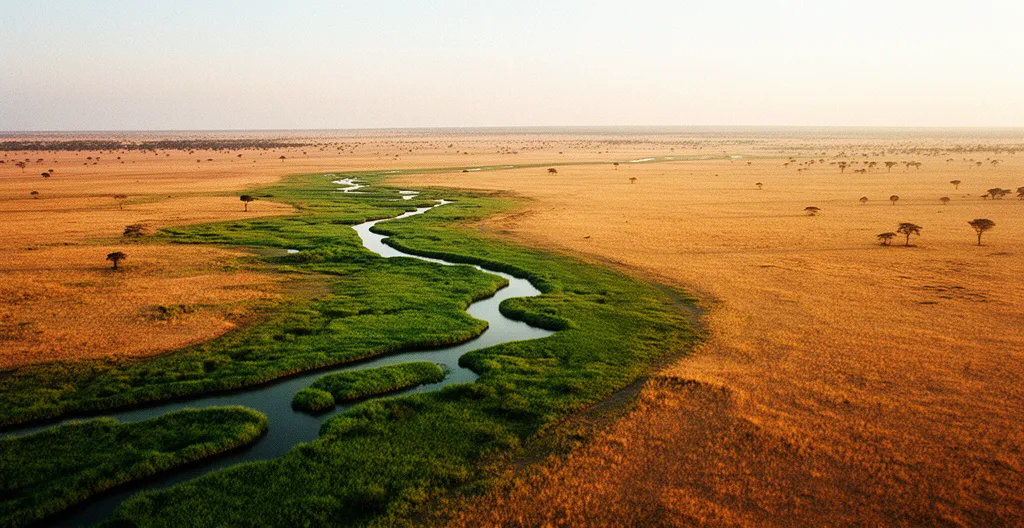
The optimal Botswana itinerary flow isn’t about direction (North vs. South), but about designing a narrative arc that builds in intensity, diversity, and wonder.
- The most efficient route is a one-way progression, typically starting in Maun (Delta) and ending in Kasane/Victoria Falls, which avoids backtracking.
- A successful trip balances high-energy game drives with tranquil water activities and strategically places the ‘climax’ destination at the end.
Recommendation: Frame your itinerary as a story. Start with immersion (Delta), build through contrasting landscapes (Savuti/Linyanti), and end with a high-impact finale (Chobe/Victoria Falls).
Planning a Botswana safari presents a classic logistical puzzle for the do-it-yourself traveller: where to start? Do you fly into Maun and travel north, or begin in Kasane and head south? This single decision seems to dictate the entire flow of the trip, leading to analysis paralysis. The common advice revolves around flight paths and camp combinations, often treating an itinerary as a simple checklist of destinations like Chobe, Savuti, and the Okavango Delta. While logistically sound, this approach misses the most critical element of a truly unforgettable safari.
The secret weapon of a master itinerary designer isn’t a map, but a storyline. The true art of crafting the perfect Botswana journey lies in understanding the « experience arc »—a deliberate progression of activities, landscapes, and wildlife encounters that builds towards a satisfying climax. It’s about managing your energy, diversifying your perspective, and ensuring the end of your trip is as powerful as the beginning. Instead of just asking « North to South or South to North? », the more strategic question is: « What story do I want my safari to tell? »
This guide deconstructs that narrative logic. We will explore the foundational principles of safari pacing, the importance of ecological contrast, and how to structure your trip to build momentum, avoid burnout, and create a journey that feels less like a series of transfers and more like a seamless, escalating adventure through Africa’s greatest wilderness.
By understanding these core principles, you’ll be equipped to design an itinerary that is not only efficient but also experientially profound. The following sections provide a framework for making those critical decisions, ensuring your journey through Botswana flows perfectly from start to finish.
Summary: Crafting the Perfect Botswana Safari Narrative
- Why You Should Never Stay Only 1 Night in a Safari Camp?
- Why Combine a « Wet » Camp and a « Dry » Camp for the Full Experience?
- Which Camp Should Be the Grand Finale of Your Trip?
- How to Combine Victoria Falls (Zimbabwe) with Chobe Efficiently?
- Where to Splurge and Where to Save in a 10-Day Circuit?
- How to Space Out Activities to Avoid Safari Fatigue by Day 4?
- Why Combining the Delta and Kalahari Creates the Perfect 10-Day Trip?
- Linyanti or Savuti: Which Hidden Gem Should You Add to Your Itinerary?
Why You Should Never Stay Only 1 Night in a Safari Camp?
The most common mistake in DIY safari planning is underestimating the time needed to truly connect with a location. A one-night stay is little more than a « drive-by, » offering a fleeting glimpse but denying you the depth that makes a safari meaningful. The logic behind a multi-night stay isn’t just about « seeing more »; it’s about shifting from a passive observer to an active participant in the wilderness’s daily drama. An extended stay allows for a crucial calibration and immersion process.
This process unfolds over several days:
- Day 1 (Arrival & Calibration): This is the orientation phase. You settle in, and more importantly, your guide begins to understand your specific interests. Are you a birder? A photographer focused on big cats? This initial connection allows the guide to personalize the days ahead. A single game drive offers a generic overview; the first drive of a multi-day stay is a strategic reconnaissance mission.
- Day 2 (Full Exploration): With a full day, you can embark on both morning and evening game activities. Your guide, now aware of your preferences, can focus on tracking specific animals or exploring territories that are most likely to yield the experiences you’re looking for. This is when the safari begins to feel tailored to you.
- Day 3 (Deep Immersion): By the third day, a profound shift occurs. You start to understand the rhythms of the territory—the paths an elephant herd follows to water, the hunting grounds of a lion pride, the denning area of wild dogs. As one traveler on an extended Botswana safari noted, it’s only through patient observation over several nights that you witness unique behaviors like wild dog pups at their den or lion prides following established hunting patterns. A one-night stay offers only two game activities, while a two-night stay doubles that, providing the time needed for these deeper stories to unfold.
A safari is a slow-burn narrative, not a highlight reel. Granting each camp a minimum of two, or ideally three, nights is the foundational rule for crafting an itinerary with depth and substance.
Why Combine a « Wet » Camp and a « Dry » Camp for the Full Experience?
The soul of Botswana’s wilderness is its duality, defined by the interplay of water and land. To experience only one is to read just half the story. Combining a « wet » camp, typically deep within the Okavango Delta’s channels, with a « dry » camp on the savanna plains is the cornerstone of a comprehensive itinerary. This strategy is not about ticking boxes; it’s about creating experiential contrast that enriches your entire perspective on the ecosystem.
The difference between these environments is fundamental, affecting everything from the activities you do to the wildlife you see and even the energy of the experience itself. A wet camp offers a world viewed from water level, while a dry camp provides vast, terrestrial vistas. This contrast is key to maintaining engagement and providing a multi-dimensional safari.
The following table breaks down the distinct experiences offered by each type of camp, illustrating why a combination is so essential for a complete safari narrative.
| Aspect | Wet Camp (Delta) | Dry Camp (Savanna) |
|---|---|---|
| Activities | Mokoro canoe, boat safari | Game drives, walking safari |
| Wildlife Focus | Hippos, crocodiles, water birds | Big cats, elephants, antelopes |
| Perspective | Water-level intimate views | Wide landscape vistas |
| Energy Level | Meditative, quiet | High adrenaline, active |
As the table and image show, gliding silently in a mokoro through narrow channels offers an intimate, almost meditative connection with the smaller details of the Delta—reed frogs, water birds, and the gentle lapping of water. In contrast, a 4×4 game drive in a dry concession is a high-energy pursuit across open plains, tracking predators and large herds. One is about quiet immersion; the other is about the thrill of the chase. By including both, you create a richer, more dynamic « experience arc. »
Which Camp Should Be the Grand Finale of Your Trip?
How a journey ends has a disproportionate impact on how we remember it. This is a well-understood principle in behavioral psychology, and master itinerary designers apply it to safari planning. Your final camp isn’t just the last stop; it’s the climax of your safari narrative. The choice of where to spend your final 48 hours is a strategic decision that should seal the entire experience with the perfect emotional tone.
The final 48 hours of a trip disproportionately shape its memory.
– Behavioral psychology principle, applied to safari planning by luxury travel advisors
The question isn’t « which camp is best? » but rather « what kind of finale do I want? ». Your choice generally falls into two categories: the Crescendo Finale or the Contemplative Finale. A Crescendo Finale delivers high-density wildlife and iconic, dramatic sights, ensuring you leave on a high-adrenaline note. A Contemplative Finale, conversely, offers profound wilderness immersion and a sense of peaceful isolation, allowing you to quietly reflect on your journey.
Action Plan: Selecting Your Finale Camp
- Review Itinerary Theme: Is your trip’s goal high-action sightings or remote wilderness connection? Let this guide your choice.
- Assess Finale Type: Decide between a « Crescendo » (e.g., Chobe Riverfront for elephant density) or « Contemplative » (e.g., a remote Delta camp for solitude) finale.
- Check Logistics: Factor in your departure airport. Ending near Kasane provides easy road access to Victoria Falls Airport (VFA), while a remote finale may require a charter flight back to Maun (MUB).
- Evaluate Experience Purity: A remote camp maintains the « safari bubble » to the very end, while a location near a town offers a gentle re-entry into civilization.
- Confirm Booking: Secure your chosen finale camp, as these key locations often book up far in advance, especially during peak season.
Choosing to end at Chobe’s riverfront, for example, offers the spectacular sight of massive elephant herds, creating a powerful, memorable final image. Ending in a secluded Delta concession, however, provides a quiet, intimate conclusion, solidifying the feeling of being truly away from it all. Both are valid, but they create entirely different memories. The key is to make this choice deliberately.
How to Combine Victoria Falls (Zimbabwe) with Chobe Efficiently?
Integrating the iconic Victoria Falls into a Botswana safari is a classic combination, but its efficiency hinges on one key principle: one-way flow. The most logical and cost-effective routing strategy avoids backtracking, saving both time and money. For the DIY planner, understanding this flow is crucial to maximizing your time on the ground and minimizing transit costs.
The proven method is to treat the safari as a northward progression. In what is known as the « One-Way Flow Routing Strategy, » travelers fly into Maun (MUB) to begin their Botswana circuit. From there, they move north through the Okavango Delta and/or Savuti, with the safari portion culminating in the Chobe National Park area, near the town of Kasane. From Kasane, Victoria Falls is just a 1.5 to 2-hour road transfer away, including the border crossing into Zimbabwe. You can then depart from Victoria Falls Airport (VFA). This approach eliminates the need for an expensive return flight from Kasane back to Maun. This strategy is not just about convenience; it offers significant savings, with travelers reporting a cost reduction of $300-600 per person by avoiding the extra internal flight.
A typical timeline for this integration would look like this:
- Days 1-7: The core Botswana safari experience, moving through the Delta, Moremi, and/or Savuti, ending in a lodge or camp in the Chobe/Kasane area.
- Day 8: Enjoy a final morning activity in Chobe (either a game drive or a river cruise), followed by an afternoon road transfer to your hotel in Victoria Falls.
- Days 9-10: Dedicate these days to exploring Victoria Falls. This allows ample time for activities like viewing the falls, taking a helicopter flight, or visiting the town before your international departure from VFA.
This linear progression creates a seamless narrative, moving from the pristine wilderness of Botswana to the thundering power of one of the world’s natural wonders, all while maintaining logistical efficiency.
Where to Splurge and Where to Save in a 10-Day Circuit?
Botswana has a reputation for being one of Africa’s most expensive safari destinations, but this is by design. The country’s high-value, low-volume tourism model prioritizes conservation and exclusivity. For the planner, this means a strategic approach to budgeting is essential. The key is not to find the « cheapest » option, but to understand where your money delivers the most impact. Pricing analysis shows a wide spectrum, with rates between $200-$400 for community camps and $800-$1500 for luxury camps per person per night.
The « splurge vs. save » decision should be directly tied to your itinerary’s narrative arc. You should allocate your budget to enhance the peak moments of your journey. Saving on transitional stays (e.g., the first or last night in a functional Maun or Kasane lodge) allows you to splurge on the camps that deliver truly unique and exclusive experiences.
This table outlines a strategic framework for budget allocation, helping you decide where your investment will yield the highest return in terms of experience.
| Where to Splurge | Where to Save | Why |
|---|---|---|
| Remote Delta concessions | Maun/Kasane lodges | Exclusivity vs accessibility |
| Unique activities (walking with San) | Standard game drives | Once-in-lifetime vs repeatable |
| Mid-trip camps (days 4-7) | Start/end camps | Peak experience placement |
The logic is clear: splurge on exclusivity and unique experiences. A remote private concession in the Delta offers off-road driving, night drives, and a feeling of solitude that you simply cannot get in more accessible areas. Similarly, activities like guided walks with San trackers are profound cultural experiences worth the premium. By concentrating your budget on the heart of your trip (days 4-7), you ensure the core of your « experience arc » is as powerful as possible, creating memories that justify the entire investment.
How to Space Out Activities to Avoid Safari Fatigue by Day 4?
Early morning wake-up calls, long hours in a vehicle, and the intense focus required for spotting wildlife can lead to a common but rarely discussed phenomenon: safari fatigue. By day four, the initial excitement can wane, replaced by a sense of repetition. A master itinerary designer prevents this by building a varied « safari rhythm, » consciously altering the type and intensity of activities throughout the trip.
The key is to move beyond a monotonous schedule of twice-daily game drives. By introducing different modes of exploration, you engage different senses and muscles, keeping the experience fresh and exciting. Photography groups on 10-day trips, for instance, maintain high levels of enthusiasm by alternating between land drives, boat safaris, and walking experiences. This variety in perspective—from the elevated view of a 4×4 to the water-level intimacy of a boat—is critical for preventing burnout.
A well-paced schedule might look like this:
- Day 1-2: Begin with traditional 4×4 game drives. This is an excellent way to get your bearings and see a wide range of wildlife quickly.
- Day 3: Switch things up entirely. Move to a water-based activity like a mokoro trip or a motorboat safari. The change of pace and perspective is immediately refreshing.
- Day 4: Plan a mid-trip reset. Intentionally skip the pre-dawn game drive. Sleep in, enjoy a leisurely breakfast, and relax at the camp. This downtime is crucial for recharging.
- Day 5: Introduce a walking safari. Being on foot in the bush, focusing on tracks, plants, and smaller creatures, provides a completely different and deeply engaging connection to the environment.
- Daily: Respect the siesta. The hours between 11 am and 3 pm are hot and animal activity is low. Use this time for rest, swimming, or viewing wildlife from the comfort of your camp’s deck, not for more driving.
By thoughtfully sequencing activities, you create a sustainable rhythm that ensures your energy and excitement levels remain high for the entire duration of your safari.
Why Combining the Delta and Kalahari Creates the Perfect 10-Day Trip?
For the planner looking to design an itinerary with the ultimate ecological contrast, the combination of the Okavango Delta and the Kalahari Desert is unparalleled. This pairing moves beyond the simple « wet vs. dry » dynamic and presents a profound story of water and life in its most extreme forms: abundance and scarcity. As one conservation ecologist described it, this journey shows you two sides of Botswana’s soul.
The Delta is a ‘feast’ ecosystem, lush and teeming with life sustained by water. The Kalahari is a ‘famine’ ecosystem, where life is uniquely adapted to scarcity.
– Conservation ecologist description, African ecosystem contrasts study
This combination creates an « experience arc » of incredible depth. Travelers who spend time in the water-rich channels of the Delta, surrounded by hippos and birds, and then journey to the vast, arid salt flats of the Makgadikgadi Pans (part of the greater Kalahari) report a powerful appreciation for adaptation and resilience. Witnessing desert-adapted species like the brown hyena or meerkats against a backdrop of seemingly endless salt pans, after just having left the lush papyrus swamps, is a lesson in biodiversity that no single ecosystem can offer. The contrast is stark, memorable, and deeply educational.
Timing is also a critical factor in this combination. While the Delta is a year-round destination, wilderness planning experts note that the December-March green season transforms the Kalahari. During this period, rains can bring a surprising flush of green to the desert and attract migratory herds of zebra and wildebeest, offering a completely different experience from the stark beauty of the dry season. A 10-day trip, split with 5-6 days in the Delta and 3-4 in the Kalahari, provides ample time to absorb the unique character of both these ‘feast’ and ‘famine’ ecosystems.
Key Takeaways
- The Foundation Rule: Never stay only one night in a camp. A minimum of two nights is essential for the guide-guest calibration and deep immersion required for a meaningful experience.
- The Principle of Contrast: Always combine different ecosystems. Pairing a ‘wet’ Delta camp with a ‘dry’ savanna camp provides the experiential variety needed to avoid fatigue and appreciate Botswana’s full biodiversity.
- The Narrative Climax: Design your itinerary with a clear finale. Strategically choose your last camp to be either a high-action ‘crescendo’ or a reflective ‘contemplative’ end to your safari story.
Linyanti or Savuti: Which Hidden Gem Should You Add to Your Itinerary?
Once you’ve locked in the foundational elements of your itinerary—the Delta, a dry-land area, and a finale—you might have room to add a « hidden gem. » For many, this choice comes down to two legendary names whispered among safari connoisseurs: Linyanti and Savuti. Both are renowned for exceptional predator viewing but offer distinctly different experiences, largely dictated by their location and management. The choice between them depends entirely on your priorities as a traveler.
Linyanti is a vast private concession area north of the Okavango. Its key advantage is exclusivity. Because it’s private, activities are far more flexible, allowing for off-road driving to get closer to sightings and thrilling night drives to witness nocturnal predators. Linyanti is particularly famous for its massive dry-season elephant herds and as one of the best places in Africa to see the highly endangered African wild dog.
Savuti, by contrast, is a section of the public Chobe National Park. It is wild, raw, and untamed, famous for its dramatic history of lion-hyena rivalries and epic lion-on-elephant conflicts. The Savuti Channel, which flows and dries up in unpredictable cycles, dictates the entire ecosystem’s dynamics. However, being a national park means stricter rules: all driving is on-road, and night drives are not permitted. The choice is between the flexibility of a private concession and the raw, unpredictable nature of a public park.
| Feature | Linyanti | Savuti |
|---|---|---|
| Main Draw | Massive elephant herds, wild dogs | Predator dynamics, lion-elephant conflicts |
| Access Type | Private concessions | Public park section |
| Activities | Off-road driving, night drives allowed | Road-bound, daytime only |
| Best Season | Dry season for river congregations | Variable with Savuti Channel flow |
Ultimately, your decision should be based on your safari philosophy. Choose Linyanti if your priorities are exclusivity, flexibility in tracking wildlife, and a high chance of seeing African wild dogs. Choose Savuti if you are drawn to the legendary tales of its predator territories and prefer a more rugged, self-sufficient park experience where the raw drama of the ecosystem is the main event.
Now that you are equipped with the strategic principles of safari design, the final step is to translate this logic into a concrete plan. By framing your journey as a narrative and making deliberate choices about pacing, contrast, and climax, you can craft a Botswana itinerary that flows perfectly and delivers an experience far greater than the sum of its parts.