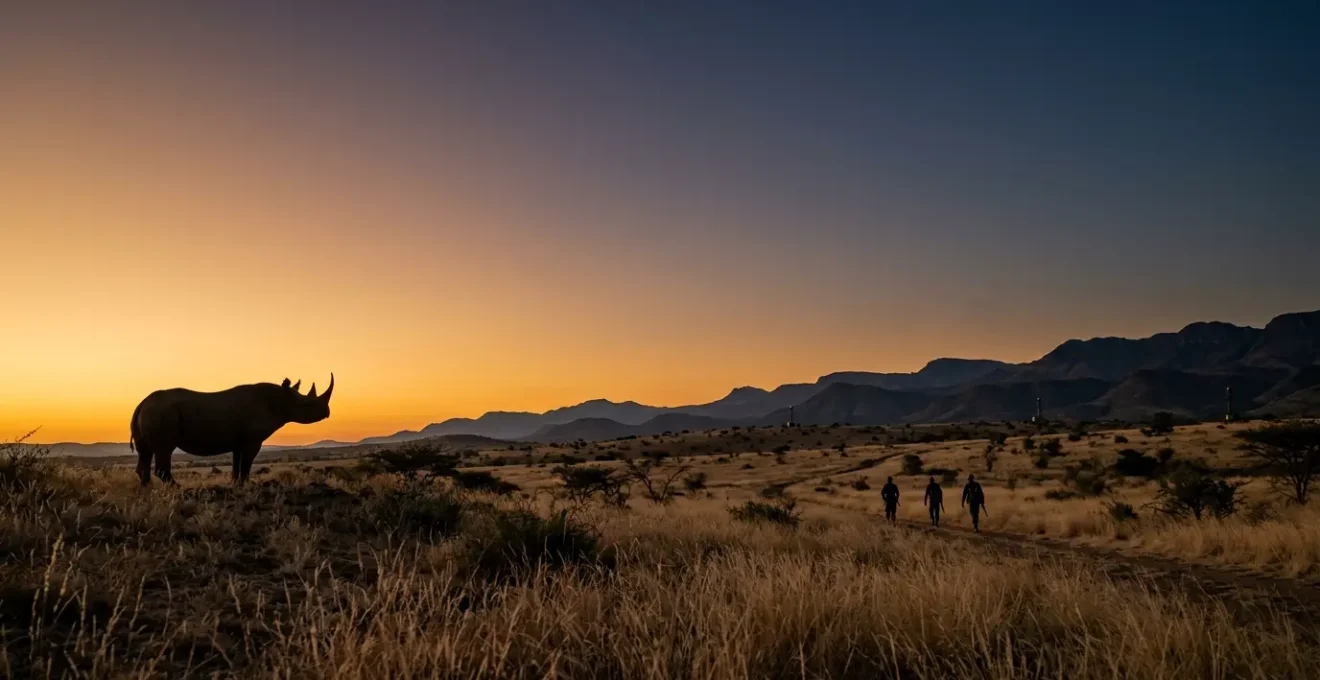
The restrictions on your camera and GPS are not about animal disturbance; they are a critical counter-intelligence measure in a high-tech war against organized crime.
- Your device’s metadata (geotags) can provide poachers with the exact location of high-value rhino populations.
- Drone prohibitions are in place to prevent criminal reconnaissance and maintain aerial security superiority for ranger teams.
Recommendation: Treat these rules as part of your contribution to conservation. Your compliance actively denies intelligence to poaching syndicates and helps protect these critically endangered animals.
When you arrive at a high-security conservation area like the Khama Rhino Sanctuary or a private reserve in the Okavango Delta, the list of prohibitions can be startling: « No Drones, » « No GPS Devices, » « Restricted Camera Use. » The immediate assumption for many visitors is that these rules are in place simply to prevent disturbing the animals or to protect the privacy of other guests. While there is truth to that, it’s a dangerously incomplete picture. The reality is far more serious.
You have not just entered a wildlife park; you have stepped into a live operational security zone. My role as an anti-poaching operations manager is to mitigate threats, and in the 21st century, the biggest threats often start with a single, innocent-looking piece of data. The seemingly harmless digital footprint you leave behind—a geotagged photo, a flight path from a personal drone—can be weaponized. These items can be collected and analyzed by sophisticated criminal syndicates to pinpoint and target the very animals you’ve travelled so far to see.
This is not an exaggeration. It is the frontline reality of modern conservation. The fight to protect rhinos has evolved into an asymmetric war fought with technology, intelligence, and military-level strategy. The rules you encounter are not designed to hinder your experience; they are designed to save lives. They are a crucial layer in a complex defence system. This article will explain the operational doctrine behind these rules, detailing the threats we face and the measures we take to secure these magnificent animals.
To understand the full scope of these protective measures, we will explore the strategic decisions, technologies, and intelligence operations that form the backbone of rhino conservation in Botswana. The following sections break down exactly why this level of security is not just necessary, but absolutely critical.
Summary: The Unseen Battle for Rhino Survival
- Why Did Botswana Move Rhinos from South Africa to the Delta?
- Why Are There Soldiers with Anti-Aircraft Guns in Chobe National Park?
- How Do Rangers Use Intelligence to Stop Poachers Before They Strike?
- What Should You Do if You See Suspicious Tracks or Activity in the Park?
- Why Black Rhinos Are the Most Elusive of the Big Five in Botswana?
- Is the Conservation Levy in Private Concessions Worth the Extra $100/Day?
- Why Are Drones Strictly Illegal in All Botswana National Parks?
- How Do Farmers in Botswana Protect Livestock from Lions Without Shooting Them?
Why Did Botswana Move Rhinos from South Africa to the Delta?
The decision to move over 100 rhinos from South Africa to Botswana’s remote wilderness areas was not a simple relocation; it was a strategic military-style extraction driven by a brutal escalation in poaching. South Africa was the epicenter of a crisis, losing 1,215 rhinos in 2014 alone. The threat level had become unsustainable. Botswana, with its vast, inaccessible landscapes and strong defence force, was identified as a potential stronghold—a safer territory to protect and rebuild the species.
This operation, known as a translocation, was a massive logistical and security undertaking. It involved the Botswana Defence Force (BDF) providing armed protection for the newly introduced rhinos in secret locations within the Okavango Delta. The goal was to create a security buffer, making it exponentially harder for poaching syndicates to find and target these « assets. » For a time, it worked. However, the threat landscape is dynamic. Poachers are persistent and well-funded. Official Botswana government data revealed a shocking turn: after losing only two rhinos between 2012 and 2017, the nation lost 138 rhinos between 2018 and 2022.
This dramatic increase shows that the syndicates eventually discovered the new locations. The war didn’t end; it just shifted battlegrounds. This history is crucial to understanding the current security posture. The initial move was a strategic retreat to a more defensible position. Now, the focus is on fortifying that position against an intelligent and adaptive enemy, which explains the extreme security measures you see today. Every rhino’s location is a classified piece of information.
Why Are There Soldiers with Anti-Aircraft Guns in Chobe National Park?
The presence of heavily armed soldiers, and even rumors of anti-aircraft weaponry in conservation areas, sends a clear and deliberate message: Botswana’s wildlife is protected by military force. While the sight of such hardware can be jarring for a tourist, it is a direct response to the sophisticated nature of modern poaching syndicates. These are not small-time opportunists; they are international criminal organizations that use helicopters, night-vision equipment, and advanced surveillance techniques. The response must be proportional to the threat.
The Botswana Defence Force (BDF) is not just a deterrent; it is an active anti-poaching unit. Their involvement signifies that poaching is treated as a threat to national security. The results of this militarized approach are stark; reports indicate that at least six poachers were killed by the BDF in 2020 during engagements. This is not a « shoot-to-kill » policy but the outcome of direct, armed confrontations with dangerous criminals. These engagements prove that the BDF’s role is far from ceremonial.
technology suggestion > wildlife presence. Entirely free of legible elements. »/>
The « anti-aircraft » component is symbolic of a larger strategy: airspace control. Poachers use drones and aircraft for reconnaissance to locate rhinos and scout for ranger patrols. Denying them this aerial advantage is a cornerstone of our defence. This involves sophisticated radar, thermal imaging, and ground patrols capable of responding to aerial threats. The heavy military presence is a physical manifestation of a high-tech battle for surveillance and control over these vast, remote landscapes.
How Do Rangers Use Intelligence to Stop Poachers Before They Strike?
Modern anti-poaching is no longer about simply tracking footprints in the sand. It has become an intelligence-driven operation, focused on pre-emption. Our goal is to stop poachers *before* they can pull the trigger, and this requires a proactive, data-centric approach. We operate on the principle that every incursion leaves a data trail, and our job is to detect it in real-time. This is where technology becomes our most valuable informant.
We deploy a network of sensors, including seismic, acoustic, and magnetic detectors, alongside thousands of hidden cameras. However, this creates a new problem: data overload. A ranger team cannot possibly monitor 25,000 images from a single camera trap every few months. This is where artificial intelligence (AI) becomes a game-changer. In a groundbreaking project in South Africa’s Hluhluwe-iMfolozi Park, a system powered by Microsoft Azure AI was deployed to analyze camera trap images automatically. The AI was trained to identify humans and vehicles, flagging only potential threats for review.
Case Study: AI-Powered Threat Detection
In a collaboration between Microsoft and the Peace Parks Foundation, an AI system was tested in a major rhino reserve. Over three months, it processed 25,000 images but correctly filtered them down to just 1,300 relevant images showing potential human threats. This allowed the small ranger team to focus their attention where it was needed most, transforming an overwhelming amount of data into actionable intelligence and preventing them from being swamped by false positives of animal movements.
This is the essence of our strategy: use technology to filter the noise and pinpoint the signal. This intelligence is fed into a central command center, where we can dispatch Rapid Response teams or aerial surveillance to intercept incursions. We are not just waiting for poachers to appear; we are actively hunting for their digital and physical signatures across millions of hectares.
What Should You Do if You See Suspicious Tracks or Activity in the Park?
As a visitor, you are an extra set of eyes and ears on the ground. Your vigilance can be an invaluable asset, but only if you follow the correct protocol. If you come across anything suspicious—unusual human tracks, a snare, a dead animal, or people in an area they shouldn’t be—your actions in the first few minutes are critical. The most important rule is: do not interfere. You have stumbled upon a potential crime scene, and preserving its integrity is paramount for any future investigation and prosecution.
atmosphere > human element. No readable text or displays. »/>
Do not be a hero. Do not attempt to follow the tracks or confront anyone. Poachers are armed and extremely dangerous. Your personal safety is the top priority. Your role is to be a good witness. Note your exact location—using a GPS if you have one (and are in an area where it’s permitted) or by identifying clear landmarks. Note the time, what you saw, and the direction of any tracks. Then, leave the area the same way you came in to minimize disturbance and report the information to your guide, the camp manager, or the nearest park authority immediately. Every detail is a piece of a puzzle that can help our tracking teams.
Action Plan: Protocol for Suspicious Sightings
- Observe and Assess: From a safe distance, note key details. If it’s a carcass, check if the horn or tusks are present. If they are, poachers could still be nearby. Stay hidden and quiet.
- Mark and Transmit Location: Record your precise GPS coordinates. If not possible, use distinct landmarks. Immediately transmit this information to your guide or park headquarters. Time is critical.
- Secure the Area (By Leaving): Do a 360-degree visual scan from your position without moving closer. Then, retreat along your original entry path to avoid contaminating the scene.
- Await Instructions: Once you have reported the incident, wait for the professional tracking or anti-poaching team. Do not return to the scene.
- Preserve Evidence: Absolutely never touch anything. Footprints, shell casings, or discarded items are vital forensic evidence. Your intervention could compromise the entire investigation.
Why Black Rhinos Are the Most Elusive of the Big Five in Botswana?
The elusiveness of the black rhino in Botswana is not just a quirk of its behavior; it is a direct consequence of its immense value and extreme vulnerability. Black rhinos are critically endangered, and their numbers in Botswana are perilously low. According to official documentation submitted to CITES, it was estimated that as of 2022, Botswana was home to only 23 black rhinos and 285 white rhinos. With a population this small, the location of every single individual is a matter of state-level security.
They are « elusive » by design. These rhinos are kept in undisclosed locations, often within heavily guarded Intensive Protection Zones (IPZs). Their movements are monitored 24/7 by dedicated teams, and access to these areas is severely restricted. We deliberately make them hard to find not just for tourists, but for everyone. Any leak of information regarding their whereabouts could be a death sentence. This is why photography is often banned in their presence and why guides will be vague about their locations. Sharing a picture with a geotag is tantamount to broadcasting a target’s coordinates to the enemy.
The strategy is to create « fortresses » for these animals, giving them the space to breed and recover under constant guard. This approach has proven successful in other parts of Africa when properly funded and executed. As one expert on the front lines noted about a similar sanctuary:
We have not suffered a poaching incident in Ngulia since 2016, and every year, new calves are born.
– Kenneth Kimitei, AWF Ecologist on Intensive Protection Zones
This is our goal in Botswana. The black rhino’s scarcity makes it the ultimate high-value asset. Its protection requires a level of secrecy and operational security that far surpasses that of any other species, making it the most elusive and protected member of the Big Five.
Is the Conservation Levy in Private Concessions Worth the Extra $100/Day?
That extra $100 or more per day on your bill, often labeled a « conservation levy, » can feel like just another tourism tax. In reality, it is one of the most direct and effective ways to fund the frontline defence of wildlife. This money does not disappear into a general fund; in reputable private concessions, it is the lifeblood of the anti-poaching operations. It pays for ranger salaries, maintains vehicles, and, most importantly, finances the sophisticated technology that gives us an edge.
Think of it as your investment in the security infrastructure. A landmark study published in the journal *Science* revealed that despite a massive expenditure of $74 million between 2017 and 2023 in the Greater Kruger area, 1,985 rhinos were still poached. This proves that simply throwing money at the problem isn’t the solution. The key is *smart investment* in targeted, effective technologies—which is exactly what the levy supports.
professional atmosphere > security suggestion. No readable elements visible. »/>
Case Study: Return on Investment from the Connected Conservation Foundation
In South Africa’s Sabi Sand Reserve, private investments in a Reserve Area Network—connecting thermal cameras, automated movement sensors, and LoRa networks—achieved a staggering 96% reduction in poaching within the first two years of deployment. This technology, funded in part by conservation levies, provides real-time intelligence to a 24/7 operations room, enabling a rapid response force. This system has been credited with directly preventing 12 armed poaching incursions in 2024 alone. This is the tangible, life-saving return on the investment made by every visitor.
When you pay that levy, you are funding the command center, the thermal cameras, and the intelligence analysts who work through the night to protect these animals. It is a direct contribution to operational security, transforming a luxury safari into a partnership for conservation. It is, without question, worth every dollar.
Why Are Drones Strictly Illegal in All Botswana National Parks?
The blanket ban on drones in all of Botswana’s national parks and reserves is an absolute and non-negotiable pillar of our security strategy. To an amateur photographer, a drone is a tool for capturing stunning aerial shots. To an anti-poaching manager, an unidentified drone is a potential enemy reconnaissance aircraft. We have no way of knowing a drone’s pilot or their intent. Is it a tourist, or is it a poacher scouting rhino locations and patrol movements? In the context of operational security, any ambiguity is a threat.
This is not a case of being anti-technology. On the contrary, we heavily rely on aerial surveillance, but it must be *our* surveillance. We use our own drones, equipped with advanced thermal imaging, to patrol vast areas, especially at night. The success of this approach is well-documented. For instance, the WWF reports that a Kenyan conservancy saw zero rhinos poached since 2017 after deploying a FLIR thermal system. This highlights the power of controlled aerial technology. A private drone jeopardizes this entire system. It can be mistaken for a hostile craft, diverting critical resources, or it can be a genuine threat itself.
The capabilities of different technologies show why controlling the airspace is so vital. Each tool has a specific role, and an unknown drone disrupts this controlled ecosystem.
| Technology | Detection Range | Primary Use | Success Rate |
|---|---|---|---|
| Thermal Cameras | Real-time 24/7 | Human intrusion detection | 96% reduction at Sabi Sand |
| LoRa Sensors | Park-wide network | Movement tracking | 12 incursions prevented 2024 |
| Satellite Monitoring | 5 million hectares | Habitat mapping | Detected deceased rhinos from space |
The penalties for violating the drone ban are severe, including hefty fines and confiscation of equipment. The rule is absolute because the risk is unacceptable. Allowing private drones would be equivalent to allowing unknown aircraft to fly over a military base. In the war to save the rhino, our parks are exactly that.
Key Takeaways
- The fight against poaching is a high-tech war of intelligence and counter-intelligence, not just random acts of crime.
- Visitor-generated data, especially from cameras and GPS, represents a significant security risk that can be exploited by criminal syndicates.
- Effective conservation relies on a layered security approach: military force, advanced technology, and crucial community partnerships.
How Do Farmers in Botswana Protect Livestock from Lions Without Shooting Them?
The success of a rhino sanctuary cannot exist in a vacuum. It is deeply intertwined with the well-being and cooperation of the local communities living on its borders. For decades, the primary source of conflict has been predation on livestock by lions, leopards, and other carnivores, often leading to retaliatory killings of these predators. A core part of our broader conservation strategy is to provide effective, non-lethal solutions to this problem, turning farmers into partners rather than adversaries.
One of the most successful methods involves using the same GPS technology we use to monitor our own assets. By fitting GPS collars to key predators in a given area, we can create virtual « geofences » around community kraals and grazing lands. The system, like that used by TG Tracking with Digital Matter’s Oyster2 devices, works automatically. If a collared lion approaches a designated boundary, an alert is sent directly to the farmers and our ranger teams. This early warning allows farmers to move their livestock to safety and enables us to deploy a vehicle to chase the predator away from the conflict zone. This proactive approach prevents the loss of livestock and removes the motivation for retaliatory killing.
Building this trust and partnership does more than just save lions; it is a fundamental aspect of our counter-intelligence network. A cooperative community is our best source of information. They know the land, they see who comes and goes, and they notice things that are out of place. As one veteran ranger explained, this human intelligence is irreplaceable.
As an anti-poaching ranger, it is important to be involved with local communities around the area. Because it is of immense importance to use informants as a source of intelligence.
– Pete Clemence, Rhino Force Zimbabwe Camp
By helping a farmer protect his cattle from a lion, we are not just solving his problem; we are strengthening our first line of defence against rhino poachers. This holistic approach is essential for long-term security.
Therefore, understand that when you adhere to the rules of a sanctuary, you are doing more than just being a respectful tourist. You are becoming an active, if silent, participant in a complex and critical security operation. Your compliance is a small but vital act that denies intelligence to a ruthless enemy and directly contributes to the survival of one of the planet’s most iconic species.