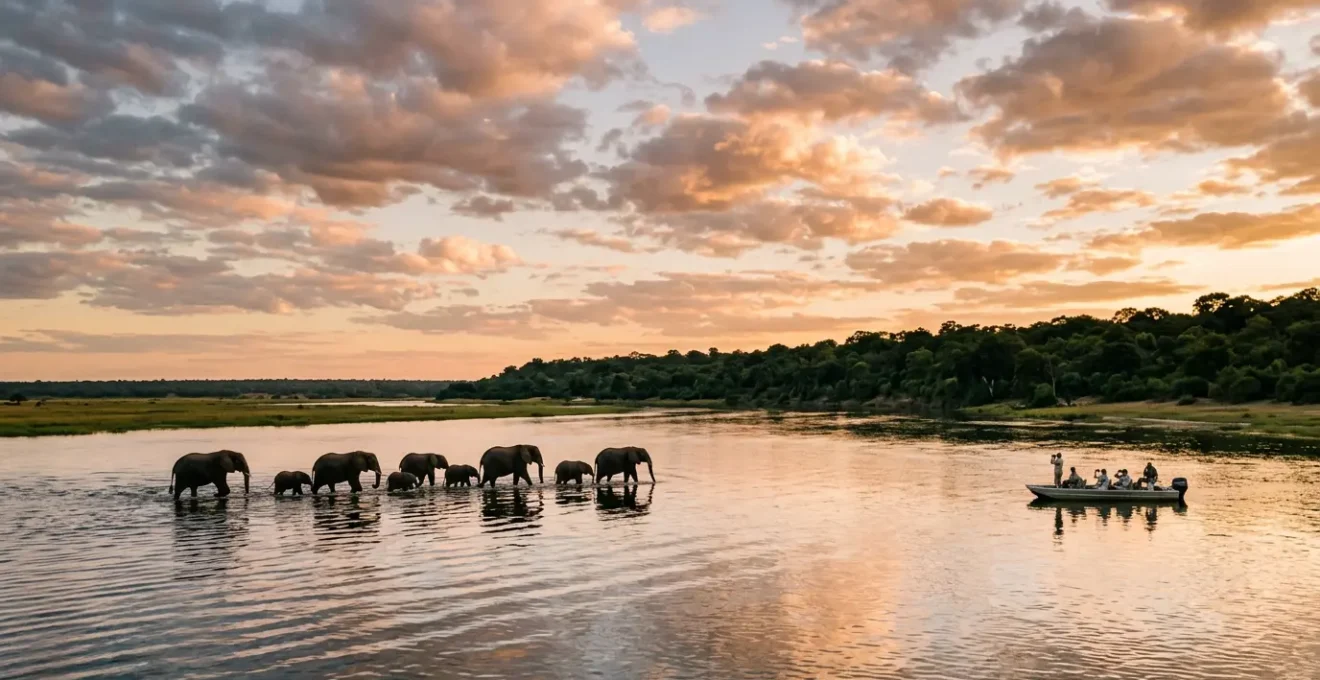
Choosing between Chobe’s Riverfront and Savuti isn’t about which has ‘better’ wildlife, but about what kind of safari story you want to experience.
- The Riverfront offers a guaranteed, high-density « wildlife spectacle » powered by the constant Chobe River, ideal for boat safaris and first-time visitors.
- Savuti delivers a tense, unpredictable « predator drama » on a vast, dry stage, perfect for seasoned travelers seeking raw, unscripted wilderness encounters.
Recommendation: Match the region’s « ecological engine »—the reliable river or the phantom channel—to your travel personality and safari goals for the most rewarding trip.
Planning a trip to Botswana’s legendary Chobe National Park often leads to a critical question: Riverfront or Savuti? Most guides offer a simple answer: the Riverfront is for elephants and boat cruises, while Savuti is for lions and 4x4s. While true on the surface, this oversimplification misses the fundamental point. The choice isn’t just about a different checklist of animals; it’s a choice between two entirely different safari narratives, each shaped by a unique ecological engine.
The Chobe Riverfront is a story of abundance and certainty, a predictable wildlife spectacle powered by the permanent, life-giving Chobe River. It’s an immersion in sheer numbers. In stark contrast, Savuti is a tense drama of survival and unpredictability, staged on a vast, semi-arid plain where life revolves around the whims of a phantom channel that flows and vanishes for decades at a time. This is a story of patience, suspense, and raw, unscripted moments.
But if the core of the choice isn’t the animals, but the story, how do you decide which one is right for you? This guide moves beyond the basic distinctions. We will dissect the character of each region, analyzing how its unique environment shapes everything from animal behavior and viewing opportunities to the very rhythm of your safari day, enabling you to choose the experience that truly aligns with your travel style.
To help you navigate this choice, this article breaks down the key differences and unique characteristics of both the Chobe Riverfront and the Savuti region. The following sections will guide you through the specifics of wildlife, activities, and logistics for each area.
Contents: Deciding Your Chobe Safari Narrative
- Why Does Chobe Have the Highest Elephant Concentration in Africa?
- Morning or Sunset: Which Chobe Boat Cruise Offers Best Photography?
- Can You Visit Chobe for a Day Trip from Victoria Falls?
- How to Camp Safely in Savuti Where Lions Roam Through Campsites?
- Why Does the Savuti Channel Dry Up and Flow Again Unpredictably?
- Why Chobe Has 120,000 Elephants and How That Impacts Your Viewing?
- Are Large Riverboats in Chobe Too Crowded for Serious Viewing?
- North to South or South to North: How to Flow Your Botswana Itinerary?
Why Does Chobe Have the Highest Elephant Concentration in Africa?
The Chobe Riverfront isn’t just a place with elephants; it is the global epicenter for them. The reason for this incredible density is twofold: a reliable water source and a vast, unfenced landscape. The Chobe River acts as a powerful ecological engine, providing a permanent water supply even during the harshest dry seasons (typically May to October). This makes it a giant magnet for wildlife from across the region.
This effect is amplified by the park’s location within the massive Kavango-Zambezi Transfrontier Conservation Area (KAZA TFCA). According to UNESCO data on the KAZA initiative, this protected zone allows elephants to migrate freely across borders. During dry months, elephants pour in from the arid plains of northwestern Zimbabwe and southeastern Angola, seeking the life-sustaining waters of the Chobe. This seasonal compression creates a breathtaking wildlife spectacle, with recent data confirming Chobe hosts approximately 120,000 elephants, the largest continuous population on earth.
The impact of this density is visibly etched into the landscape. As a visitor, you can witness this firsthand by observing a few key signs:
- The pronounced « browse line » on riverine forests where elephants have stripped leaves as high as they can reach.
- Vast networks of « elephant highways »—wide, trodden paths carved through the mopane woodlands.
- Damaged baobab and acacia trees, their bark stripped for moisture and nutrients, a testament to the immense pressure on vegetation.
This concentration, driven by the river, is the defining feature of the Riverfront experience. It’s not just a chance to see an elephant; it’s an immersion into their world on a scale seen nowhere else.
Morning or Sunset: Which Chobe Boat Cruise Offers Best Photography?
A boat cruise on the Chobe River is the quintessential Riverfront activity, but the time of day you choose dramatically alters the photographic opportunities. The decision between a morning or sunset cruise isn’t just about timing; it’s about choosing between crisp documentary-style shots and iconic, dramatic silhouettes. Both offer spectacular scenes, but they cater to different photographic goals and require different technical approaches.
The morning light is clear and sharp, perfect for capturing the details of birdlife, as avian activity is at its peak. You’ll see hippos returning to the water after their nocturnal foraging, creating ‘day in the life’ photographic moments. The light becomes harsh quickly, so the prime window is short. In contrast, the sunset cruise is pure drama. The famous « golden hour » bathes the landscape in soft, warm light, creating the perfect conditions for those iconic African silhouettes of elephants drinking at the water’s edge.
The choice also impacts the technical aspects of your photography. The bright morning light allows for lower ISO settings and smaller apertures for greater depth of field, while the fading light of sunset demands higher ISOs and wider apertures to capture the scene. To help you decide, here is a breakdown of what to expect:
| Aspect | Morning Cruise (6-9am) | Sunset Cruise (3-6pm) |
|---|---|---|
| Light Quality | Crisp, clear, gets harsh quickly | Golden, soft but fades fast |
| Animal Activity | Hippos returning, birds most active | Elephant herds drinking, predators stirring |
| Photography Style | ‘Day in the Life’ documentary shots | ‘Iconic Africa’ dramatic silhouettes |
| Technical Settings | Lower ISOs (100-400), smaller apertures | Higher ISOs (800-3200), wider apertures |
| Crowds | Fewer boats, more intimate | Peak traffic, multiple vessels |
Ultimately, the « best » time depends on your photographic vision. For clean, detailed wildlife portraits, the morning is superior. For breathtaking, emotive landscapes and silhouettes that scream « Africa, » the sunset cruise is unbeatable.
Can You Visit Chobe for a Day Trip from Victoria Falls?
Yes, a day trip to the Chobe Riverfront from Victoria Falls (in either Zimbabwe or Zambia) is not only possible but also extremely popular. It’s a logistically straightforward option that provides a fantastic ‘taster menu’ of a Botswana safari. For travelers short on time or those wanting to confirm their interest in wildlife before committing to a longer safari, it’s an excellent choice. After all, as many guides will attest, elephant sightings in Chobe are the closest thing Africa offers to a wildlife sighting guarantee.
However, it’s crucial to understand what this condensed experience includes and, more importantly, what it omits. A typical day trip is a packaged deal that maximizes efficiency but compromises on the quality of viewing time. You get the highlights, but you miss the magic hours that define a true safari experience.
Here’s a realistic breakdown of what a day trip entails versus what you miss by not staying overnight:
- Included: A 90-minute road transfer to the border, a three-hour game drive often during the midday heat when animals are least active, and a three-hour sunset cruise during the river’s busiest period.
- Missed: The golden hour of the early morning when predators are most active, the evening game drive as lions and leopards begin to hunt, and the quieter, more intimate park experience enjoyed by overnight guests before the day-trippers arrive.
From a cost perspective, a day trip is tempting, averaging $150-$200 per person. However, adding just one night at a lodge inside or near the park (ranging from $300-$500) can triple your quality game-viewing time. You gain access to the prime morning and evening drives, fundamentally changing the nature of your safari from a quick tour to an immersive wildlife experience.
How to Camp Safely in Savuti Where Lions Roam Through Campsites?
Camping in Savuti is an exercise in exhilarating vulnerability. Unlike the more developed Riverfront, this is a raw, unfenced wilderness where the drama of the wild can unfold right in your campsite. The experience is deeply immersive, but it demands a heightened level of awareness and strict adherence to safety protocols. There is no barrier between you and some of Africa’s most formidable predators.
The seriousness of this environment is underscored by official guidelines. As the operations team at Expert Africa states in their Savuti Camp Safety Guidelines, the situation is unambiguous.
This is a dangerous game area, there are no fences… Parents must keep all children under close and constant supervision as dangerous animals can wander through this camp at any time.
– Expert Africa Safari Operations, Savuti Camp Safety Guidelines
Living this close to nature means internalizing a set of non-negotiable rules. The key is to be respectful, vigilant, and predictable, minimizing your impact and avoiding any behavior that might attract unwanted attention from curious or opportunistic animals. These aren’t just recommendations; they are essential practices for a safe and rewarding stay.
Action Plan: Essential Safety Protocols for Savuti Camping
- Footwear Check (Boot Shake Protocol): Before putting on any footwear, always shake it out vigorously. Scorpions and spiders often seek shelter inside shoes overnight.
- Campsite Discipline (Sound and Scent): Keep your campsite clean of all food scraps and waste. Avoid loud noises, especially after dark, as unusual sounds can attract curious predators investigating a disturbance.
- Encounter Protocol (Stand Your Ground): If you encounter a predator like a lion or hyena outside your tent, never run. Stand tall to make yourself look large, maintain eye contact, and back away slowly without turning your back.
- Tent Security (Zipper Integrity): Keep your tent fully zipped at all times, even when you are in camp during the day. Baboons, monkeys, and honey badgers are intelligent and highly opportunistic thieves.
- Night Movement (Scan and Stick to Paths): Never walk around camp at night without a powerful flashlight. Only use designated pathways and perform a slow, 360-degree scan for eye-shine before moving between your tent and communal areas.
By treating the wilderness with the respect it demands, camping in Savuti becomes one of the most authentic and unforgettable safari experiences possible—a true immersion in the predator drama.
Why Does the Savuti Channel Dry Up and Flow Again Unpredictably?
The Savuti Channel is the enigmatic ecological engine of the entire region, and its defining characteristic is its profound unpredictability. It is a ‘phantom river,’ appearing and disappearing for decades at a time, and its presence—or absence—dictates the rhythm of life and death in Savuti. Unlike the constant Chobe River, the Savuti Channel is not fed by local rainfall. Instead, its flow is a distant consequence of tectonic plate activity deep beneath the earth’s crust.
Subtle shifts in the Chobe/Linyanti fault line, miles away, can either block the channel’s source or allow water to push through from the Linyanti wetlands, sending a flood of life-giving water across the parched landscape. This geological uncertainty creates a dramatic boom-and-bust cycle. When the channel flows, the Savuti Marsh transforms into a lush paradise, attracting vast herds. When it’s dry, it becomes a stark, dusty landscape where the remaining waterholes are fiercely contested killing grounds.
This cycle is not a recent phenomenon. The channel’s history is one of long dry spells and erratic resurgences. For instance, after flowing for years, it dried up in 1982 and remained a dusty riverbed for over a quarter of a century. As one historical overview notes, the channel experienced its most recent major dry spell lasting 26 years, from 1982 to 2008. It flowed again until 2015, but has been mostly dry since. As observers on site noted, even by late 2024, the channel was a mere trickle, a ghost of its former self. This unpredictability is the very heart of the Savuti experience; you are witnessing a landscape in constant, dramatic flux.
Why Chobe Has 120,000 Elephants and How That Impacts Your Viewing?
The sheer number of elephants on the Chobe Riverfront has a profound and complex impact on the visitor experience. On one hand, it guarantees sightings on a scale that is simply unimaginable elsewhere. You won’t just see an elephant; you will see hundreds. You’ll witness massive breeding herds, playful young ones, and enormous bachelor herds engaging in complex social interactions. This density allows for observation of unique behaviors rarely seen in areas with lower populations.
These are Kalahari elephants, a subspecies noted for being larger-bodied than other elephants, though their tusks are often shorter and more brittle due to calcium deficiencies in the local soil. The high density creates incredible scenes at water sources, but it can also lead to increased stress among the animals as they compete for resources during the peak dry season.
On the other hand, this incredible abundance can lead to a curious phenomenon known as « elephant fatigue. » The sightings are so frequent and numerous that they can, for some, begin to feel commonplace. It’s a unique ‘problem’ to have on safari. As one observer from the GANP noted in the Chobe National Park Official Guide, the reaction of visitors often changes throughout the day.
By the end of the day, a typical response sounds something like, ‘Oh, more elephants.’ The enthusiasm for elephant sightings subsides as the day goes on.
– GANP Wildlife Observer, Chobe National Park Official Guide
This is not a complaint but an observation on the sheer spectacle. The impact on your viewing is a double-edged sword: you are guaranteed an unparalleled elephant show, but the very frequency of sightings can dilute the thrill of a rare encounter. It transforms the experience from a hunt for a sighting into an observation of a society in action.
Are Large Riverboats in Chobe Too Crowded for Serious Viewing?
The question of boat size on the Chobe River is a classic trade-off between comfort and intimacy. There is no single « better » option; the ideal choice depends entirely on your priorities as a traveler and, especially, as a photographer. Large, multi-deck riverboats and small, nimble photo boats offer fundamentally different experiences.
Large riverboats, which can accommodate 20 to 80 guests, provide superior stability, which is a major advantage for those using long telephoto lenses. They also offer significant comfort, with amenities like shade canopies, restrooms, and even refreshment bars, making a 4-6 hour cruise very pleasant. Their elevated viewing decks provide a great vantage point for seeing over reeds and getting a clear view of hippo pods. However, this comes at the cost of maneuverability and personal space. These boats are confined to the main river channel and you may have to compete for a prime spot along the railing.
In contrast, small boats designed for 4-8 guests are all about agility and perspective. They can navigate shallow side channels, getting you closer to the action and away from the crowds. The water-level perspective is far more intimate and creates powerful, eye-to-eye photographs. The trade-off is less stability and exposure to the elements. The following table breaks down the key differences:
| Aspect | Small Boats (4-8 guests) | Large Riverboats (20-80 guests) |
|---|---|---|
| Maneuverability | Can approach channels, position for best angles | Limited to main river channel |
| Stability | More movement, challenging for telephoto | Superior stability for long lenses |
| Viewing Height | Water level, intimate perspective | Elevated deck, aerial advantage for hippo pods |
| Comfort | Basic seating, weather exposed | Shade, restrooms, refreshment bar |
| Photography | Unobstructed 360° shooting | Compete for rail positions |
| Duration | 2-3 hours maximum | Can cruise 4-6 hours comfortably |
For many serious photographers and those seeking a more exclusive experience, the small boat is superior. However, for those prioritizing comfort, stability, and a leisurely overview, the larger vessel is a perfect choice. Some travelers even opt for a hybrid strategy, staying on a houseboat and using its smaller tender boats for targeted photo excursions.
Key Takeaways
- Choose a Narrative, Not Just a Place: The Riverfront offers a reliable « wildlife spectacle, » while Savuti provides an unpredictable « predator drama. »
- Water is Destiny: The permanent Chobe River guarantees high-density sightings, whereas the phantom Savuti Channel creates a tense environment of scarcity and competition.
- Match Activity to Environment: Your experience is defined by water-based activities (boats) at the Riverfront versus land-based patience (4×4 drives) in Savuti.
North to South or South to North: How to Flow Your Botswana Itinerary?
The direction you travel through Botswana can fundamentally shape the narrative of your safari. Starting in the north at Kasane (the gateway to the Chobe Riverfront) and moving south, or starting in the south at Maun (the gateway to the Okavango Delta) and moving north, creates two distinct emotional arcs. There’s no right or wrong way; the choice depends on whether you prefer a dramatic crescendo or immediate immersion followed by deepening solitude.
Logistically, both entry points are well-serviced. Kasane International Airport has daily flights connecting it to Johannesburg and Victoria Falls, and the main gate of Chobe is a short drive away. This makes a northern start easy and cost-effective, offering immediate and guaranteed wildlife sightings. Maun is the primary hub for accessing the Okavango Delta and Moremi Game Reserve, often involving light aircraft transfers to more remote camps.
The key is to craft your safari narrative by considering the flow of the experience:
- South-to-North (‘The Crescendo’): Start in Maun, explore the intimate waterways of the Okavango Delta, move through Moremi, then to the predator-rich plains of Savuti, and finish with the overwhelming elephant herds of the Chobe Riverfront. This builds the experience from quiet isolation to a spectacular, high-density finale.
- North-to-South (‘Immersion to Isolation’): Start in Kasane for the guaranteed ‘wow’ factor of the Chobe Riverfront. From there, journey into the vast, dry wilderness of Savuti, then into Moremi, and end in the serene, exclusive water-camps of the Delta. This begins with a bang and progresses towards a more profound sense of isolation and tranquility.
Your choice may also be influenced by international flight connections, as Kasane pairs naturally with a visit to Victoria Falls, while Maun often links more directly with Johannesburg. By considering the story you want to tell, the direction of your journey becomes a powerful tool in designing your perfect Botswana adventure.
Now that you understand the distinct personalities of the Riverfront and Savuti, the next step is to overlay your own travel style, budget, and timeline to begin crafting your personal Botswana safari narrative.