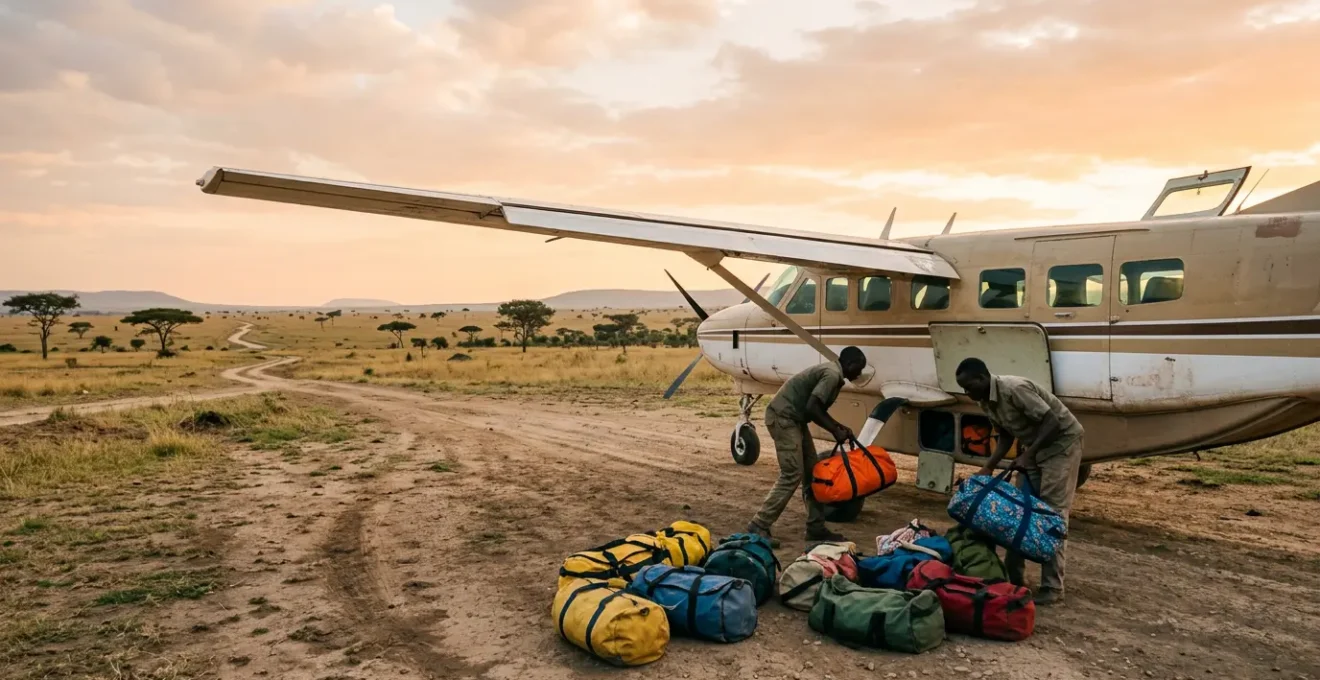
Your standard hard-shell suitcase, a trusted companion on international flights, becomes a critical safety liability on a bush plane. The strict « soft bag only » rule isn’t about convenience; it’s a non-negotiable requirement dictated by the physics of weight distribution and the unique design of small aircraft cargo holds. Understanding this operational logic is the key to a smooth start to your safari, ensuring both your luggage and your safety are secured.
As a ground operations manager, I see the same scene play out almost daily on the sun-baked tarmacs of safari airstrips. A traveler, accustomed to the familiar rules of international carriers, stands incredulous as a pilot politely but firmly refuses to load their expensive, rigid suitcase. The frustration is palpable. « But it’s under the weight limit! Why can’t it go? » The common assumption is that the bag simply needs to be « squished » into a small space. This is a fundamental misunderstanding.
The reality has little to do with just fitting your luggage on board. It’s about complex, non-negotiable principles of aviation safety that govern these specialized flights. The rules about soft bags, passenger weights, and even where you sit are not arbitrary restrictions designed to make packing difficult. They are direct applications of the physics of flight, specifically concerning weight and balance, load distribution, and the structural integrity of the aircraft itself. For travelers with valuable equipment, like a professional camera and a 600mm lens, this can seem like an impossible challenge.
But it’s not. The key is to shift your mindset from the logic of a commercial jetliner to that of a high-performance bush plane. This isn’t about fighting the rules; it’s about understanding the operational reality behind them. Once you grasp the ‘why,’ the ‘how’ of packing becomes simple and logical.
This guide will walk you through the critical reasoning behind each of these seemingly strict rules. We will move beyond the simple instructions and delve into the operational and safety imperatives that your pilot is managing. From the science behind luggage restrictions to practical strategies for protecting your gear, you will gain the knowledge to pack with confidence and ensure your safari adventure begins without a hitch.
Summary: A Guide to Safari Flight Luggage and Logistics
- Soft Bags vs. Hard Shells: Why Are Pilots So Strict About Luggage?
- How to Protect a 600mm Lens in a Soft Bag Without Breaking It?
- Why Does the Pilot Ask Your Weight Before Assigning You a Seat?
- What Medication Must You Keep on Your Person During Short Hops?
- Cessna 206 vs. Caravan: Which Plane Is Better for Claustrophobic Travelers?
- How to Book an « Extra Seat » for Your Luggage if You Can’t Pack Light?
- How to Manage the « African Time » Factor in Flight Schedules?
- What to Pack for a Luxury Safari Where Laundry Is Done Daily?
Soft Bags vs. Hard Shells: Why Are Pilots So Strict About Luggage?
The absolute insistence on soft-sided bags is the most common point of friction, yet it is the most critical rule. This is not a matter of preference; it is a structural and safety requirement. The cargo holds on small aircraft like the Cessna Caravan are not the large, square containers you find on an Airbus. They are often small, irregularly shaped pods attached to the belly of the plane. A hard-shell suitcase, with its rigid frame and corners, simply cannot be manipulated to fit into these spaces without wasting significant volume and, more importantly, potentially damaging the aircraft’s skin or structural components.
The core principle here is load distribution. A pilot needs to pack luggage tightly, with no empty space, to prevent items from shifting during flight, which could dangerously alter the plane’s center of gravity. A soft duffel bag can be molded and compressed to fit snugly against other bags and the curved walls of the cargo pod, creating a single, stable mass. The frame and wheels on a hard case create rigid points and empty voids, making a secure load impossible. This is why even small, wheeled « carry-on » style hard bags are rejected. Typical weight allowances are a strict 15kg (33lbs) in East Africa and 20kg (44lbs) in Southern Africa, including all your camera gear and hand luggage. Exceeding this is not an option.
Your compliance is not just about following rules, but about contributing to the safety of the flight. A pilot’s refusal is not personal; it is a professional decision to protect the aircraft, you, and the other passengers.
Your Pre-Flight Luggage Audit
- Structural Check: Confirm your bag is a soft-sided duffel with no internal frame, spines, or rigid structure of any kind.
- Wheels and Handles: Select a bag with no wheels. If wheels are present, they must be extremely small and integrated, not external.
- Dimension Compliance: Measure your bag. It must not exceed 62cm in length, 30cm in height, and 25cm in width (24x12x10 inches).
- Material Choice: Use a durable bag like a medium-sized canvas or polyester duffel that can withstand handling.
- Visual Identification: Choose a bag in a distinct color. This will make it much easier to identify quickly from a pile of otherwise identical black bags on the airstrip.
How to Protect a 600mm Lens in a Soft Bag Without Breaking It?
For any serious photographer, the thought of packing thousands of dollars worth of camera equipment—especially a large telephoto lens—into a soft bag is daunting. The fear is that the lack of a hard shell means a lack of protection. However, the problem isn’t the bag; it’s the packing methodology. The solution is to create a protective « hard case » inside your compliant soft duffel bag.
Professional photographers have been navigating these restrictions for decades using a simple and effective system: the padded camera cube or « ICU » (Internal Camera Unit). These are dense, foam-padded inserts with customizable dividers that are designed to fit inside a larger bag. You pack your camera body, lenses, and accessories securely within the cube, and then place the entire cube inside your soft-sided duffel. You then pack your clothes and other soft items tightly around the cube, creating an additional layer of shock absorption.
This approach offers the best of both worlds: your delicate gear is protected by a rigid, padded structure, while the outer bag remains soft and pliable to meet the airline’s loading requirements. Remember, all this equipment, including the cube, must fit within your total 15kg weight allowance. Many travelers regret hauling heavy kits they barely use. A versatile DSLR or mirrorless body with a 200-300mm zoom lens is often more than sufficient for incredible shots without the logistical headache. A pair of binoculars (8×32 or 10×42) is also essential and should be kept easily accessible.
Why Does the Pilot Ask Your Weight Before Assigning You a Seat?
Being asked for your personal weight at check-in can feel intrusive, but it is one of the most critical safety procedures in bush flying. Unlike on a large commercial jet where the weight of individual passengers is averaged out, on a 6- or 12-seater plane, the specific weight and position of every single person has a direct and significant impact on the aircraft’s Center of Gravity (CG). The pilot is not being nosy; they are performing a complex calculation known as the « weight and balance » assessment.
An aircraft’s CG is the point over which the entire aircraft could be perfectly balanced. For a plane to be stable and controllable in the air, its CG at takeoff must be within a very narrow, pre-defined range. The pilot inputs the weight of the fuel, the luggage in each cargo pod, and the precise weight of each passenger into a formula. They then assign you a specific seat—not based on your preference, but to distribute the total mass correctly along the length of the aircraft to achieve a safe CG. As aviation safety experts warn, an aircraft exceeding its maximum takeoff weight or with an incorrect CG may struggle to gain altitude or even become uncontrollable.
This is a matter of pure physics, a non-negotiable part of the pilot’s responsibility. The experts at Phoenix East Aviation, a flight training academy, put it clearly:
Pilots must understand how weight and balance checks work to ensure that they fly safely and are able to complete each flight with minimal issues along the way.
– Phoenix East Aviation, Aircraft Weight and Balance Guide
Therefore, providing your accurate weight is a direct contribution to the safety of your own flight. The seating arrangement is not random; it is a carefully calculated decision that ensures everyone on board arrives safely.
What Medication Must You Keep on Your Person During Short Hops?
On a commercial flight, your « hand luggage » is the bag you store in the overhead bin or under the seat in front of you. On a bush plane, this concept does not exist. This is a critical distinction that has serious implications for essential items like medication. You must assume you will have zero access to any of your bags from the moment you board until the moment you land.
There is no room beneath the seats for storage, and for weight and balance reasons, all bags—even small backpacks you might consider a personal item—are stored in the luggage pods or at the very back of the cabin, inaccessible during flight. Furthermore, you will not be able to get up and move around the cabin once airborne. This means any item you might need during the flight must be physically on your person: in your pockets or in a very small waist pack or pouch.
This includes, but is not limited to:
- All prescription medications: Especially emergency medications like inhalers, EpiPens, or heart medication. Do not pack them in any bag.
- Passports and travel documents: Keep them secure on your person.
- A sweater or light jacket: Cabins are unpressurized and can get surprisingly cold at altitude.
- Snacks or entertainment: If you need anything for the short flight, it must be in your pockets.
This operational reality cannot be overstated. When packing, your guiding principle should be: if my life or immediate comfort depends on it, it stays with me, not in a bag.
Cessna 206 vs. Caravan: Which Plane Is Better for Claustrophobic Travelers?
For travelers who are nervous about small spaces, the type of aircraft used for a bush flight can be a source of anxiety. The two most common workhorses of the safari circuit are the Cessna 206 and the larger Cessna Caravan. While both are small, unpressurized aircraft where turbulence is more keenly felt, there are differences that can impact passenger comfort.
The primary difference is size and capacity. A Cessna 206 is a smaller aircraft, typically seating 4-6 passengers in a tighter configuration. The Cessna Grand Caravan, by contrast, is significantly larger, often configured for up to 14 passengers. For a claustrophobic traveler, the Caravan is almost always the better choice. Its wider, taller cabin provides a greater sense of space and more separation from other passengers. Both aircraft feature a high-wing design and large windows, which provides exceptional, unobstructed views of the landscape below. This can be a welcome distraction and help create a feeling of openness, mitigating the sense of being confined.
The following comparison breaks down the key aspects for passenger comfort, based on data from safari travel experts.
| Aspect | Cessna 206 | Cessna Caravan |
|---|---|---|
| Typical capacity | 4-6 passengers | Up to 14 passengers |
| Wing configuration | High wing design | High wing design |
| Window size | Large windows | Large windows |
| View quality | Exceptional viewing | Exceptional viewing |
| Cabin pressure | Unpressurized | Unpressurized |
| Turbulence feel | More keenly felt | More keenly felt |
While you may not always have a choice of aircraft, if you have concerns about claustrophobia, you should discuss them with your safari operator. They can often request routes that are primarily serviced by the larger Caravan aircraft, helping to make your travel between camps as comfortable as possible.
How to Book an « Extra Seat » for Your Luggage if You Can’t Pack Light?
For some travelers, particularly professional photographers with extensive gear, adhering to the 15kg limit is simply not feasible. The airlines and safari operators have a standard, professional solution for this: you can book and pay for an « extra seat » on the plane. This is not a penalty; it is a pre-planned purchase of additional freight capacity.
Booking an extra seat is a formal arrangement that must be made well in advance of your travel dates through your safari consultant. It is not something that can be decided on the tarmac. This purchase effectively doubles your luggage allowance. Safari operators confirm that booking an extra freight seat provides a total baggage allowance of up to 70kgs (154 lbs) distributed across your bags, with the same soft-sided bag restrictions still applying. This allows you to carry the necessary equipment without compromising the flight’s safety or operational limits.
This is the standard procedure for anyone whose equipment needs exceed the personal allowance. It acknowledges the weight and balance constraints of the aircraft by ensuring the additional weight is properly accounted and paid for in the pilot’s calculations.
Case Study: The Professional’s Approach to Heavy Gear
Photographers carrying heavy equipment often find the standard allowance restrictive. The established solution is to book an extra freight seat on the plane. This provides a generous baggage allowance of up to 70 kgs (154 lbs) total for the two « seats. » This procedure is not an afterthought; it must be arranged and confirmed with the safari consultant organizing the trip well in advance to ensure the capacity is reserved and factored into the flight’s payload manifest.
If you know your gear is heavy, approaching your operator proactively to book an extra seat demonstrates professionalism and an understanding of the operational constraints. It is the correct and only way to transport excess baggage.
How to Manage the « African Time » Factor in Flight Schedules?
One of the biggest mental adjustments for travelers is the concept of flight scheduling. A bush flight does not operate like a commercial domestic flight with a fixed timetable. The notion of « African time, » often used to describe a relaxed attitude towards punctuality, is a misnomer in this context. The fluid schedule is not a result of casualness, but of a highly complex and efficient logistical system I call operational fluidity.
It’s best to stop thinking of it as a scheduled flight and more like a shared taxi service in the sky. As the experts at Extraordinary Journeys explain, this is a fundamental shift in perspective:
Bush flights operate more like a flying shuttle than a domestic flight, with stops to pick up and drop off passengers en route to your destination.
– Extraordinary Journeys, Safari Bush Plane Guide
Flight times are often not finalized until the afternoon of the day before departure. Your aircraft might make several stops at other remote airstrips to collect or drop off other guests. This system allows lodges and air charters to cooperate, sharing aircraft to keep costs reasonable and services efficient. To manage this system, you must be flexible and proactive:
- Reconfirm everything: Always reconfirm your flight booking and timing 72 hours before departure, as schedules are dynamic.
- Expect multiple stops: Your journey from A to B may include stops at C, D, and E. This is a normal part of the process.
- Trust the schedule: Transfers are scheduled to fit between safari activities or to connect with international flights. The lodges and operators are experts at this coordination.
- Be prepared: Have your bags packed and be ready for pickup at the time your lodge provides. The system is fluid, but it relies on everyone being ready when the plane arrives.
Embracing this operational fluidity, rather than fighting it, is key to a stress-free travel day. The system is designed for efficiency across a vast, remote area, and it works remarkably well.
Key Takeaways
- Soft bags are mandatory for safe load distribution in irregular cargo pods, not just for ‘squishing’.
- Passenger weight and seating are part of a critical, non-negotiable ‘weight and balance’ calculation for flight stability.
- Plan for zero in-flight access to any luggage; essential items like medication must be kept on your person.
What to Pack for a Luxury Safari Where Laundry Is Done Daily?
After understanding the strict physical and logistical constraints of bush flying, the final piece of the puzzle is to embrace the solution: packing smarter, not harder. For travelers on a luxury safari, this is made incredibly simple by a service that many overlook: daily laundry. Most high-end camps and lodges offer a complimentary daily laundry service. This single amenity fundamentally changes your packing strategy, making the 15kg limit not just achievable, but easy to meet.
You do not need to pack clothes for your entire trip. By packing just 3 to 4 days’ worth of clothing, you can have a fresh set of clothes every morning. This immediately eliminates the bulk and weight that plagues most over-packers. The focus should be on a small, versatile set of safari-neutral clothing (khakis, greens, browns) that you can rotate through the laundry service. Heavy makeup, multiple pairs of shoes, and hair appliances are unnecessary luxuries that have no place in a lightweight duffel bag.
Case Study: An Expert’s Packing Evolution
Safari expert Leah Green reflects on her own journey: « The way I pack today is vastly different from my first safari adventure years ago. I unnecessarily over packed and filled my bag with items I didn’t need and even brought some that were provided by the hotels and lodges. » Now, for a two-week trip with daily laundry, she packs significantly lighter. She notes that many properties provide essential gear like rain protection and gaiters, meaning travelers only need to bring their core layering tops and a single pair of broken-in hiking boots.
By leveraging the amenities provided, you can shed kilos from your luggage. This not only ensures compliance with flight rules but also makes your entire travel experience more nimble and enjoyable. The goal is to arrive with a light bag and a clear understanding of the system, ready to enjoy your adventure from the moment you land.
Adopting this intelligent packing mindset is the final step. By respecting the operational realities of bush flying and leveraging the amenities available, you transform packing from a source of stress into a simple, logical process that guarantees a smooth start to your incredible safari experience.