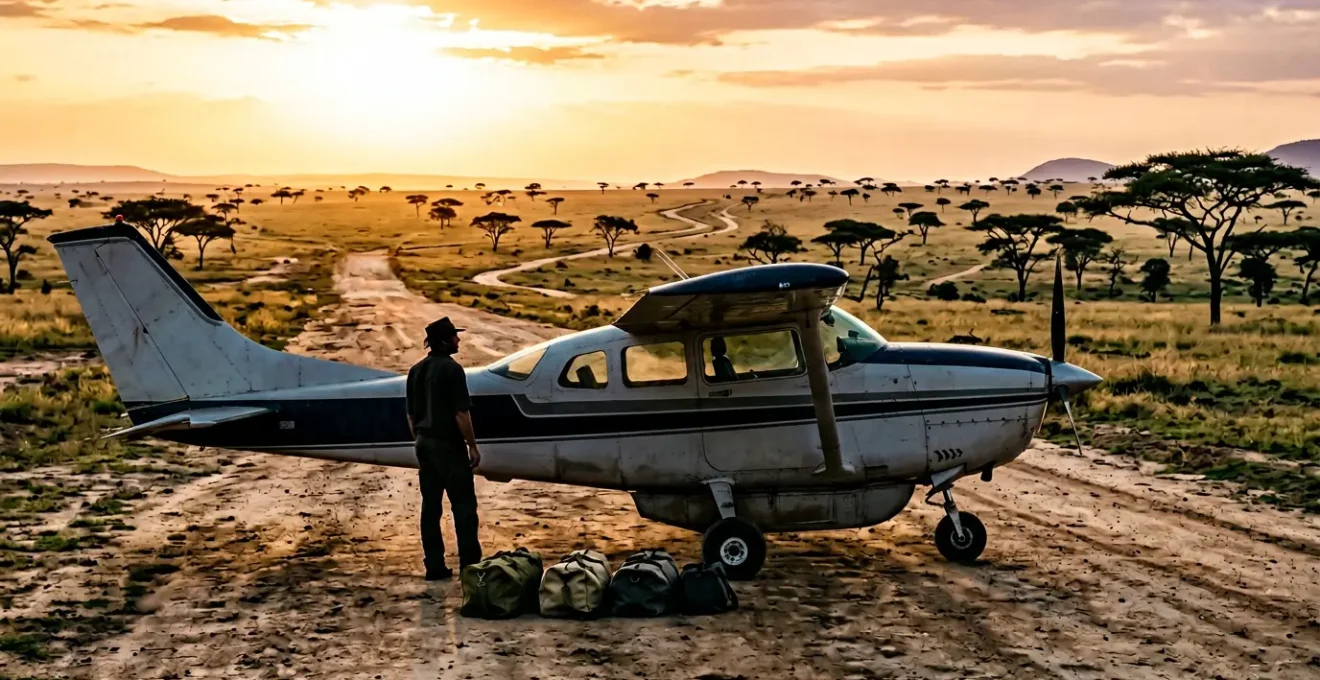
The 15kg soft-sided bag rule is not an arbitrary inconvenience; it is the non-negotiable keystone that ensures the safety and operational integrity of the entire remote safari flight network.
- Hard luggage physically does not fit into the cargo pods and cannot be manipulated to achieve the critical weight and balance required for a safe flight.
- A single overweight or hard-shell bag creates a ripple effect, causing delays for every subsequent flight and passenger on that aircraft’s daily circuit.
Recommendation: Complying with the luggage rule is the single most important thing a traveler can do to guarantee their own safety and ensure a smooth, on-time safari experience for everyone.
You’ve booked the trip of a lifetime, and the packing instructions are bafflingly strict: one soft-sided duffel bag, no wheels, no rigid frames, and a non-negotiable weight limit of 15kg (33 lbs), including your camera gear. The frustration is understandable. You’ve traveled the world with your trusty hard-shell roller bag, so why the sudden draconian rule? The immediate answers you find online seem simplistic: « the planes are small, » or « the bags need to be squished in. » While true, these explanations barely scratch the surface and often increase a traveler’s sense of annoyance.
The reality is far more complex and critical. That luggage restriction isn’t a matter of preference or airline policy; it’s a fundamental law of physics governing the high-stakes world of bush aviation. It is the single most important element ensuring the operational integrity of a system that moves hundreds of guests between remote, unpaved airstrips. Forgetting this is the fastest way to disrupt not just your own itinerary, but an entire circuit of carefully planned logistics. As a ground agent, I’ve seen it all, and my job is to ensure the system works. And the system only works with soft bags.
This guide will take you beyond the frustrating rule and into the cockpit and onto the airstrip. We will explore the interconnected web of factors—from flight scheduling and motion sickness to cost and safety—that all hinge on that one simple piece of luggage. By understanding the complete operational picture, you will see that the soft bag rule isn’t a restriction; it’s your ticket to a seamless and safe adventure.
This article delves into the specific operational realities of bush flying that make the luggage rules so absolute. By understanding the full context, you’ll see why compliance is not just a suggestion, but a cornerstone of your safari’s success.
Table of Contents: Understanding the Rules of the Bush
- How to Manage the « African Time » Factor in Flight Schedules?
- How to Prevent Motion Sickness in Small Cessnas During Mid-Day Heat?
- Why Should You Have Your Camera Ready During Inter-Camp Flights?
- Why Are Short 20-Minute Flights So Expensive in Botswana?
- When Is a 4-Hour Road Transfer Better Than a 30-Minute Flight?
- How Safe Are Single-Engine Planes in Remote Botswana?
- Can You Bring Hard Luggage if You Charter the Whole Plane?
- Is Flying Over the Delta a Scarier or Safer Experience Than Driving?
How to Manage the « African Time » Factor in Flight Schedules?
The term « African Time » is often used with a chuckle to describe a relaxed attitude towards punctuality. In the context of bush flying, however, time is a fiercely managed resource, and delays are a serious operational challenge. Your flight is not a standalone event; it is one link in a long chain. A single aircraft may service six to eight camps in one day, and a delay at the first stop creates a ripple effect that impacts every single passenger down the line. While every effort is made to be punctual, external factors like weather are a constant variable.
The most common and preventable cause of these cascading delays? Luggage issues. A single passenger arriving with an overweight or hard-shell bag can ground an aircraft for 30 minutes or more while the pilot and ground crew scramble for a solution. This involves frantic radio calls, recalculating the entire day’s weight and balance matrix, and potentially having to leave a bag—or a passenger—behind. These are not commercial jets with massive tolerances; these are precision-tuned machines where every kilogram matters. Depending on the day’s schedule, you may share flights with other passengers, and one person’s non-compliance can directly cause another group to miss their afternoon game drive hundreds of miles away.
The Cascading Effect of Bush Flight Delays
Safari operators report that a single luggage weight issue at one camp can create delays affecting three subsequent camps, as aircraft must recalculate weight distribution and sometimes make additional stops. This not only frustrates passengers but also puts immense pressure on pilots to make up time, a situation that safety protocols are designed to prevent.
Understanding this interconnectedness is key. Your punctuality and compliance are not just for your benefit; they are a fundamental courtesy to every other traveler and operator in the bush. Instead of viewing potential delays with frustration, see them as an inherent part of the adventure and an opportunity to soak in the unique airstrip environment.
Action Plan: 5 Proactive Strategies During Bush Flight Delays
- Stay Prepared: Keep your camera ready for unexpected wildlife sightings on or near the airstrip while you wait.
- Be Productive: Use the downtime to organize and back up photos from your previous game drives, clearing memory cards for the next leg.
- Power Up: If the airstrip has an office or waiting area, ask politely if you can charge your electronic devices and power banks.
- Engage and Learn: Talk to the local camp staff and your pilot. They are a treasure trove of incredible bush stories and local knowledge.
- Document the Moment: Use your travel journal to write about the experience. The sounds, the heat, the anticipation—it’s all part of the story.
How to Prevent Motion Sickness in Small Cessnas During Mid-Day Heat?
Let’s be direct: the ride in a small bush plane, especially during the middle of the day, can be bumpy. As the ground heats up, it creates thermal updrafts, which feel like air pockets or turbulence. For those prone to motion sickness, this can be a source of significant anxiety. However, from our perspective, we want you to enjoy the spectacular views you’ve paid for, not endure the flight with your head between your knees. Fortunately, there are several pilot-endorsed techniques that are extremely effective at mitigating or preventing motion sickness entirely.
The most important principle is to keep your brain and inner ear in sync. Your eyes need to see the same motion your body is feeling. This means looking out of the aircraft, preferably at the distant horizon, and not down at your phone or a book. The single best seat for this is the co-pilot’s seat. It offers the clearest, most stable view forward. This seat is often available, and you should not hesitate to request it when you check in for your flight. It’s a game-changer for many passengers.
Beyond your visual focus, airflow is your best friend. The cool air from the aircraft’s vents directed at your face can do wonders. It’s a well-known trick among pilots and frequent flyers. Combined with proper hydration and a light, non-greasy breakfast, these simple, proactive steps can transform a potentially uncomfortable experience into a thrilling and enjoyable part of your safari journey. Remember to pack any necessary motion sickness medication, as it’s not something the camps or pilots can provide.
- Request the co-pilot seat for the best view of the horizon. Ask the ground crew when you check in.
- Use the aircraft’s fresh air vents and direct the flow onto your face throughout the flight.
- Keep your brain occupied by actively scanning the landscape for wildlife. This distraction is a powerful tool.
- Pack and take motion sickness tablets if you know you are susceptible. Midday flights are often the bumpiest due to rising heat.
- Eat a light, high-protein breakfast and hydrate with water. Avoid coffee, sugary drinks, and heavy foods before flying.
Why Should You Have Your Camera Ready During Inter-Camp Flights?
Many travelers make the mistake of packing their camera away for the short flight between camps. This is a missed opportunity of colossal proportions. These inter-camp flights are not just a transfer; they are a scenic aerial safari in their own right. The perspective you get from a few hundred feet in the air is something you simply cannot experience from a vehicle on the ground. The world unfolds below in a tapestry of abstract patterns and immense scale. You’ll see the intricate network of hippo trails weaving through the wetlands, the vast, shimmering expanses of salt pans, and the dramatic change in vegetation from one ecosystem to another.
Because these aircraft fly relatively low and slow, the wildlife viewing opportunities can be spectacular. It’s not uncommon for pilots, who have an eagle eye for spotting game, to bank the aircraft to give passengers a better view of a large herd of elephants crossing a channel or a pod of hippos basking in a lagoon. These moments happen fast, and if your camera is in your bag, the opportunity is gone forever. This is why keeping it in hand, ready to go, is essential. The proximity to the pilot also gives you a more personal experience, and they often provide commentary on the sights below.
The design of bush planes is a photographer’s ally. Unlike commercial airliners, every passenger enjoys exceptional viewing as bush planes provide what is effectively a 100% window seat access. The wings are typically mounted on top of the fuselage, meaning your view downwards is unobstructed. To make the most of it, however, you need to be technically prepared.
Expert Settings for Aerial Photography from Small Aircraft
Professional photographers advise a few key settings to overcome the challenges of shooting from a vibrating, moving aircraft through a window. First, use a very high shutter speed—1/1000s or faster—to freeze motion and negate engine vibration. Second, use a polarizing filter to cut through the inevitable glare and reflections from the plexiglass window. Finally, keep your lens short; a wide-to-medium zoom (like a 24-70mm) is far more practical in the cramped cabin than a large telephoto lens. Always have your camera secured with a wrist or neck strap.
Why Are Short 20-Minute Flights So Expensive in Botswana?
The sticker shock is real. You look at the map, see two camps that are a mere 20-minute flight apart, and then see a charge of several hundred dollars for the transfer. The immediate reaction is often, « This must be a mistake. » It is not. The high cost of these short hops is a direct reflection of the incredibly challenging and expensive economics of operating an airline in one of the world’s most remote environments. You are not paying for the time in the air; you are paying for the availability and safety of that aircraft at that exact location when you need it.
The hidden costs are immense. First, there are « positioning flights. » The plane that picks you up may have had to fly for an hour, empty, just to get to your airstrip. That cost is factored in. Second, aviation fuel (AVGAS) in the bush is astronomically expensive. It has to be trucked or flown into these remote locations, a logistical feat in itself. Third, maintenance standards are rigorous and costly, and spare parts are thousands of miles away. Finally, there’s the payload calculation. Charter companies must operate on strict assumptions, and charter companies need to be aware if passengers weigh more than 100kgs so they can limit the total passengers and baggage accordingly, sometimes requiring them to charge for an additional seat to compensate for the lost capacity.
When you compare the cost of a flight to a road transfer, it’s crucial to factor in the hidden value. A four-hour drive is a half-day lost from your safari. That’s a missed game drive, which itself has a value of hundreds of dollars, not to mention the value of your limited vacation time.
The following table, based on typical operational costs, breaks down the true comparison. As this cost analysis demonstrates, the flight’s value is in the time it saves and the experiences it enables.
| Factor | 20-Minute Flight | 4-Hour Road Transfer |
|---|---|---|
| Direct Cost | $300-500 per person | $150-250 per vehicle |
| Time Lost from Safari | 30 minutes total | Half day (4-5 hours) |
| Wildlife Viewing En Route | Aerial perspectives | Ground-level sightings |
| Physical Comfort | Quick but bumpy | Long and dusty |
| Missed Activities Value | None | $200+ (afternoon game drive) |
When Is a 4-Hour Road Transfer Better Than a 30-Minute Flight?
While flying is often the most efficient way to travel between camps, it’s not always the best. There are specific circumstances where a longer road transfer offers a richer, more rewarding experience. The decision to drive instead of fly is a strategic one, based on your specific interests, your itinerary, and the landscape you’re traversing. It’s a question of turning the journey itself into the destination.
A ground transfer is essentially a full-day game drive. If you are moving between two camps located within a game-rich corridor, the drive can be incredibly productive for wildlife viewing. It allows for a more intimate, ground-level observation of flora and fauna that you would simply fly over. For those with a deep interest in botany, insects, or smaller creatures, a road transfer is an unparalleled opportunity to stop, look, and learn from your guide. It provides a sense of the land’s scale and texture that is impossible to grasp from the air.
There are also practical reasons to choose the road. If you are a specialist photographer carrying equipment that exceeds the strict 20kg flight limit, a private road transfer is often the only way to move your gear. Furthermore, weather can play a role; during the rainy season, low clouds or waterlogged airstrips can occasionally ground aircraft, making road transfers an essential backup plan. The key is to discuss these options with your safari planner. A well-designed itinerary might intentionally include a mix of flights and drives to give you a complete and varied experience of the country.
Consider the following points when deciding:
- Botany and Small Details: Choose the road if you want to observe vegetation changes, identify trees, and spot smaller animals and birds.
- Photography: Opt for a drive if you are carrying specialized, heavy camera equipment that exceeds flight weight limits.
- The Journey as Destination: Select a road transfer if the route itself is through a known game-rich area, effectively turning the transfer into an extended game drive.
- Ecosystem Transition: A drive is perfect for observing the gradual shift from one ecosystem to another, for example, from the wetlands of the Delta to the dry savannas of the Kalahari.
How Safe Are Single-Engine Planes in Remote Botswana?
It’s a valid question. The sight of a small, single-engine propeller plane waiting on a dirt airstrip can be intimidating for those accustomed to commercial jets. However, any apprehension is quickly dispelled by understanding the staggering safety record and rigorous standards of the bush aviation industry. Statistically, you are far safer in that Cessna Caravan than you are driving your car to the airport back home. This is not by accident; it’s the result of meticulous maintenance, extensive pilot training, and aircraft designed specifically for this environment.
The safety data is compelling. For context, recent safety data shows African bush flying improved to an incredible rate of approximately 1 accident per 127,000 flights, a record that rivals general aviation in first-world countries. These are not just numbers; they represent a deeply ingrained culture of safety. Pilots in Botswana are among the most experienced in the world for this type of flying. They undergo extensive training that goes far beyond basic piloting, including advanced mechanics, remote meteorology, and emergency procedures tailored to the African bush. They know these planes and this terrain inside and out.
Bush Pilot Training and Experience Standards
A typical bush pilot in Botswana has thousands of hours of flight time, much of it accumulated in this specific region. They are required to be proficient in landing on short, unpaved strips and in making complex ‘weight and balance’ calculations on the fly. As part of a program pioneered with organizations like the Kenya Wildlife Service, pilots are also trained in anti-poaching patrols and wildlife tracking from the air, giving them an unparalleled understanding of the environment they operate in.
Furthermore, the aircraft themselves are built for this. The Cessna Caravan, the workhorse of the delta, is renowned for its reliability and robustness. And in the highly unlikely event of an engine failure, the design of these planes gives pilots plenty of options.
These planes are designed to glide for many miles without power, giving the pilot ample time and options to land safely on a pan, road, or designated bush strip.
– Aviation Safety Expert, African Flying Adventures Bush Flying Guide
Key takeaways
- Luggage rules are about physics and safety (weight, balance, physical fit), not preference.
- The safari flight system is an interconnected circuit; one delay has a cascading effect on all other travelers.
- Bush flights are a prime photographic and scenic opportunity, not just a transfer.
- Safety in bush aviation is paramount, with highly experienced pilots, robust aircraft, and rigorous maintenance standards.
Can You Bring Hard Luggage if You Charter the Whole Plane?
This is a common question from travelers looking for a way around the rules, and the logic seems sound: « If I’m paying for the entire plane, I should be able to bring whatever I want, right? » The answer, unequivocally, is no. This is perhaps the most critical point for frustrated travelers to understand, as it moves the argument from a question of weight to one of pure, unchangeable physics. The prohibition on hard-shell luggage is not just about the 15kg weight limit; it is about the physical shape and inflexibility of the bag itself.
The cargo pods on bush planes like the Cessna 206 or Cessna Caravan are irregularly shaped, small, and often have curved entryways. A rigid, rectangular suitcase, even a small one, simply may not fit through the cargo door. Furthermore, the pilot’s job is to load the luggage like a game of Tetris, packing it tightly to prevent shifting during flight and to distribute the weight precisely according to their weight-and-balance calculations. A soft duffel bag can be molded, squeezed, and manipulated to fit into odd spaces. A hard-shell bag cannot. It is a rigid, empty void of space that cannot be compressed, creating dangerous potential for load shifting and making a correct balance impossible to achieve.
Charter Flight Luggage Reality Check
Even on a fully private charter, the pilot has the final, absolute say on what is carried. An operator in the Okavango Delta shared a story of a client who chartered an entire Cessna 206 for his family. They arrived with brand-new, expensive hard-shell luggage. Despite the plane being ‘theirs’ for the flight, the bags physically could not pass through the opening of the cargo pod. The flight was delayed by over an hour as the clients were forced to hastily repack their belongings into spare soft bags provided by the camp, leaving their hard luggage behind to be collected days later at great expense.
This real-world example illustrates the point perfectly. The rule is not a suggestion, and chartering the plane does not change the laws of physics or the dimensions of the aircraft. Complying with the soft-bag rule is the only way to guarantee your luggage will fly with you.
Is Flying Over the Delta a Scarier or Safer Experience Than Driving?
For a first-time visitor, the thought of flying in a small plane can feel more intimidating than driving in a rugged 4×4. The experience is more visceral—you feel the bumps, hear the engine, and see the ground just a few hundred feet below. However, when we look at the objective risks, the conclusion is clear: flying is, by a significant margin, the safer method of transport between remote camps in Botswana. The perceived risk of flying is an emotional response, while the actual risk is a matter of statistics and logistics.
The safety record of commercial bush flying, as governed by bodies adhering to IATA standards, is stellar. While the overall African aviation data is impressive, the latest IATA safety report shows airlines on the IOSA registry (which includes many safari operators) had a rate of just 0.92 accidents per million flights. On the other hand, ground transfers face a host of unpredictable variables. Road conditions can be treacherous, especially after rains, and vehicle breakdowns in remote areas are not uncommon, potentially leaving travelers stranded for hours without communication.
The most significant risk in a ground transfer is wildlife. While exciting, an unexpected encounter with a breeding herd of elephants on a narrow track can be a genuinely dangerous situation. Guides report being held up for hours by elephants blocking the road. By contrast, a pilot is in constant radio contact with other aircraft and with every camp in the region. They have a real-time picture of weather and airstrip conditions. Most critically, in the event of a medical emergency—a snakebite, a sudden illness, or an injury—an aircraft can have that person at a fully equipped medical facility within 30 to 60 minutes from anywhere in the delta. A vehicle might take six hours or more. This rapid-response capability alone makes flying the overwhelmingly safer choice.
Ultimately, the feeling of fear is subjective, but the metrics of safety are not. The entire bush flying system is built on a foundation of risk mitigation, making it a reliable and secure web that connects the most remote corners of this wild paradise.
Now that you understand the intricate system behind your safari transfers, you can see that compliance is not about following an arbitrary rule. It’s about respecting a system designed for your safety and the seamless enjoyment of your trip. The next logical step is to ensure you have the right equipment for the journey.