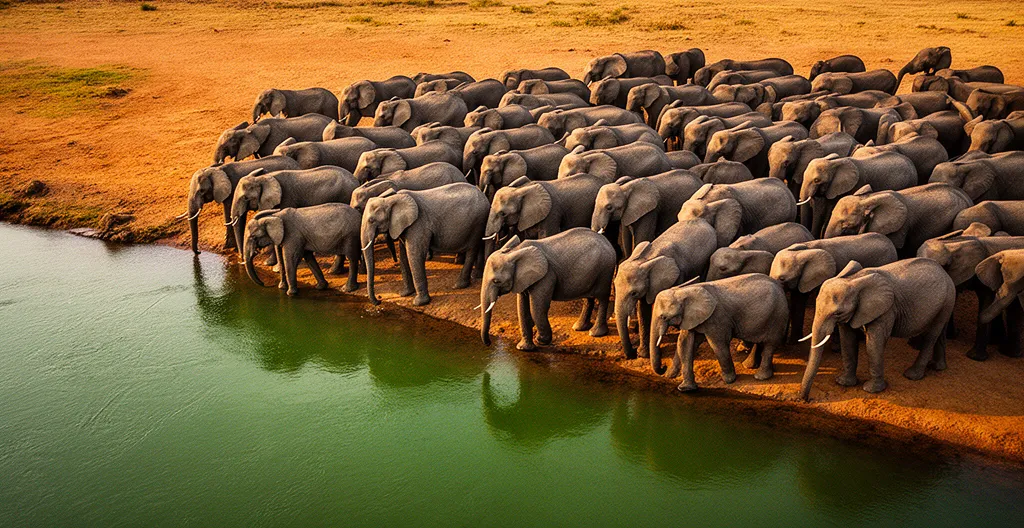
The spectacle of Africa’s mega-herds is not a matter of luck, but a predictable outcome of immense ecological pressure forcing animals into specific ‘resource funnels’.
- Chobe National Park acts as a dry-season sanctuary due to its permanent river and protective policies, concentrating a staggering portion of the region’s elephants.
- The peak viewing experience in October is a trade-off between unparalleled herd density and extreme heat, a factor serious wildlife observers must weigh.
- These congregations are not passive; they are powerful ‘landscape engineers’ that actively reshape the environment, from carving river channels to determining forest structure.
Recommendation: To witness true mega-herd density, focus your efforts on the Chobe Riverfront between August and October, but be prepared for the intense conditions that make this spectacle possible.
For the dedicated wildlife enthusiast, the sight of a lone bull elephant appearing through the morning mist is a profound experience. But the ultimate pilgrimage, the event that truly defines the scale of the African wilderness, is witnessing a super-herd—hundreds, even thousands, of animals moving as one. The common wisdom points to the dry season, a time when dwindling resources force a great congregation. This is true, but it’s a dramatic oversimplification. Merely showing up during these months is no guarantee of witnessing the true spectacle.
Most guides will list a few famous parks. They’ll mention that animals gather around water. But they rarely delve into the intricate ecological clockwork that dictates these movements. They fail to explain the precise interplay of vegetation, historical migration routes, and intense predator-prey dynamics that make these gatherings not just possible, but inevitable. This isn’t just about finding water; it’s about survival in a landscape where every resource has been stripped away, creating a powerful funnel effect.
This guide moves beyond the surface-level advice. We will not just tell you *where* the herds are; we will explain the powerful ecological pressures that forge them. Understanding this seasonal engine—the role of specific woodlands like Mopane, the strategies of lion prides facing immense prey, and the very real impact of thousands of tonnes of animal life on the landscape—transforms a viewing experience into a deep appreciation of a dynamic, living system. This is the key to moving from a passive tourist to a knowledgeable observer, capable of reading the land and predicting its dramas.
To truly grasp this phenomenon, we will dissect the key ecosystems and their seasonal rhythms. This article explores the mechanics behind Africa’s most impressive wildlife congregations, providing the insight needed to place yourself at the heart of the action.
Summary: The Mechanics of a Mega-Herd
- When Does the Zebra Migration Arrive at the Boteti River?
- Why Does Chobe Have the Highest Elephant Concentration in Africa?
- Why Chobe Has 120,000 Elephants and How That Impacts Your Viewing?
- Mopane Worms and Trees: Why Is This Vegetation Crucial for Ecosystem Health?
- How Do Huge Herds Reshape the Okavango Landscape Every Year?
- How Do Lion Prides Strategy Change When Hunting Buffalo Herds?
- October Heat: Is It Worth the Discomfort for the Best Herd Sightings?
- Riverfront or Savuti: Which Chobe Region Fits Your Safari Style?
When Does the Zebra Migration Arrive at the Boteti River?
While elephants are often the headline act, understanding the seasonal clockwork of other species, like zebra, provides a perfect blueprint for large-scale animal movement. The zebra migration in Botswana is the second-largest in Africa and a stunning example of how herds respond to environmental cues. It’s a drama dictated entirely by the availability of water and grazing. There are, in fact, two distinct zebra movements, a rediscovery made possible when veterinary fences were moved in the mid-2000s, allowing ancient migratory patterns to re-emerge.
The most relevant for dry season viewing is the Okavango-Makgadikgadi migration. As the vast pans of the Makgadikgadi dry out after the rains, the herds are pushed west in search of permanent water. Their destination is the Boteti River, which becomes a critical lifeline. This westward surge is a direct response to ecological pressure, a predictable journey towards the only viable water source in the region.
The peak concentration occurs during the critical dry season months from July to October, when up to 25,000 zebras line the banks of the river. For an observer, this isn’t just a gathering; it’s the final act of a long journey, a dense congregation at a geographical bottleneck. Witnessing this provides a foundational understanding of the resource-driven movements that govern all great herds in the dry season.
Why Does Chobe Have the Highest Elephant Concentration in Africa?
Chobe National Park’s reputation as the « Land of Giants » is not hyperbole; it is a statistical fact rooted in a unique combination of geography and forward-thinking policy. The park sits at the heart of the Kavango-Zambezi Transfrontier Conservation Area (KAZA), a colossal five-country initiative protecting a vast habitat. Recent analysis confirms the scale of this success, with the 2022 KAZA Elephant Survey revealing an estimated population of 227,900 savannah elephants, the majority of which are hosted by Botswana.
But why here? The primary driver is the Chobe River itself. As the dry season intensifies from June onwards, seasonal pans across northern Botswana and neighbouring countries evaporate, turning vast areas of woodland into a waterless desert. The Chobe River remains a permanent, flowing water source, acting as a powerful magnet. Elephants, with their incredible memory and vast home ranges, trek hundreds of kilometres to reach this life-sustaining ‘resource funnel’.
This natural concentration is amplified by a robust, long-standing conservation ethic. Botswana’s anti-poaching policies have created a genuine sanctuary effect, where elephants recognize the relative safety within the country’s borders compared to surrounding regions. This combination of ecological necessity and security is the engine behind Chobe’s unparalleled elephant density. As the Botswana Tourism Board aptly summarises, the nation’s policies have been instrumental in this success.
Botswana’s elephant population is more than stable… The relative difficulty in accessing the wildlife areas coupled with the military threat to poachers has allowed the elephant population in Botswana to grow.
– Botswana Tourism Board, Elephant Population of Botswana Report
This is not an accidental gathering, but the result of a perfect storm of environmental pressure and successful conservation strategy, creating a haven that draws elephants from across Southern Africa.
Why Chobe Has 120,000 Elephants and How That Impacts Your Viewing?
The sheer number is difficult to comprehend: Chobe National Park’s extraordinary elephant density reaches up to 120,000 individuals within its 11,700 square kilometres during the dry season peak. This isn’t just a large population; it is the highest concentration of elephants anywhere in Africa. For the wildlife viewer obsessed with density, this translates into an experience of overwhelming scale. It’s a shift from seeking out animals to being completely enveloped by them.
This density fundamentally changes the nature of a safari. You are not tracking a single herd; you are navigating a landscape saturated with them. Along the Chobe Riverfront in September and October, it becomes impossible to look in any direction without seeing elephants. They are in the river, on the banks, in the woodlands behind you. The air fills with the low rumble of their communications and the scent of dust and vegetation.
This spectacle is a living portrait of a successful conservation area. The numbers are not just stable; in protected zones like Chobe, they have increased, in stark contrast to surrounding hunting blocks. This creates a viewing experience where you are witnessing a thriving, dynamic ecosystem at its peak capacity. The impact is visceral: the ground trembles, dust clouds billow on the horizon, and the social interactions of thousands of animals play out on a panoramic stage.
What you witness is more than just a large number of animals; it’s a functioning, high-density society. You observe complex social structures, from matriarchs guiding vast family units to boisterous bachelor herds interacting on the river’s edge. This is the ultimate reward for the density-seeker: a total immersion in the world of the African elephant.
Mopane Worms and Trees: Why Is This Vegetation Crucial for Ecosystem Health?
The secret to sustaining such a colossal biomass of elephants through the punishing dry season isn’t just water; it’s the remarkable resilience of the local vegetation, particularly the Mopane tree (Colophospermum mopane). While other plants wither and lose their nutritional value, Mopane woodlands provide a critical larder that fuels the great herds when all else has failed. This unassuming tree is a cornerstone of the entire ecosystem.
Mopane leaves are rich in protein, containing up to 12%, and they possess a unique quality: they remain highly palatable and nutritious even after they have dried and fallen. This creates a vital food source that elephants and other browsers can rely on deep into the dry season. The Mopane woodlands of Chobe are not just a habitat; they are a strategic food reserve that dictates where elephants can survive when the lush grasses have vanished.
The presence of these woodlands is so significant that you can literally read the story of elephant activity on the trees themselves. An experienced guide will point out the distinct « browse line »—a visible trim line at about five to six meters high, marking the maximum reach of an elephant’s trunk. You can identify recent feeding by looking for freshly stripped bark or broken branches at shoulder height, a sign of elephants pulling down foliage. These ecological markers turn the landscape into a living narrative of the herds’ daily struggle for sustenance.
Furthermore, the Mopane is famous for the protein-rich Mopane worm, the caterpillar of the Gonimbrasia belina moth. While a delicacy for humans, these caterpillars also form part of the complex food web, highlighting the tree’s multifaceted role in the health of the entire ecosystem, from the smallest insect to the largest mammal.
How Do Huge Herds Reshape the Okavango Landscape Every Year?
To view elephants as mere inhabitants of a landscape is to miss their most profound role: they are its primary architects. In ecosystems like the Okavango Delta, these mega-herbivores are powerful ‘landscape engineers’, and their daily activities of feeding, moving, and drinking actively shape the physical environment on a grand scale. The Okavango, a 15,000 square kilometre wetland wilderness, would be an impassable swamp in many areas if not for the constant work of its elephant population.
The scale of their impact is driven by their immense appetite. A single adult elephant can consume up to 300 pounds of food in a single day. When multiplied by thousands of individuals, this translates into a colossal force of ecological change. They are responsible for creating and maintaining vital channels through dense papyrus beds, which in turn directs water flow and creates new habitats for other species. Their well-trodden paths become ‘animal highways’ that are used by countless other creatures, especially during the annual floods.
This engineering extends to the forests and woodlands. By pushing over trees to access foliage or stripping bark, they open up the canopy, allowing sunlight to reach the forest floor and promoting the growth of different plant species. This process, while seemingly destructive, creates a mosaic of different habitats—thickets, grasslands, and open woodland—that supports a far greater biodiversity than a uniform forest would. They are also critical seed dispersers, with their dung effectively planting new trees across the delta, ensuring the regeneration of the very forests they modify.
When you witness a herd moving through the delta, you are watching a force of nature at work, a living, breathing process of creation and renewal that has sculpted this unique wetland for millennia.
How Do Lion Prides Strategy Change When Hunting Buffalo Herds?
Where there are massive congregations of prey, a sophisticated predator response is sure to follow. In the Savuti region of Chobe, this dynamic reaches its zenith in the dramatic confrontations between large lion prides and formidable buffalo herds. This is not simple predation; it is a high-stakes, strategic arms race. The sheer size and power of a buffalo herd force lions to abandon their typical hunting tactics and adopt highly coordinated, specialized strategies.
A single lion is no match for a healthy adult buffalo. Therefore, the Savuti prides, which are famously large, must work as a cohesive unit. Their strategy revolves around chaos and isolation. The hunt often begins with the pride creating panic within the buffalo herd, trying to break its defensive formation—a wall of horns and muscle. Once the herd is scattered, the lions can focus their efforts on isolating a weaker individual, often a young, old, or infirm animal.
This predator-prey theatre is most intense during the dry season. As water sources become scarce, both hunter and hunted are drawn to the same predictable locations, such as the few remaining waterholes or the banks of the Savuti Channel. This forced proximity elevates the tension and increases the frequency of these epic encounters. For an observer, learning to read the subtle signs of this impending drama is the key to witnessing it unfold. A seemingly calm buffalo herd might betray its anxiety with rapid tail flicking or a nervous bunching-together, signalling that predators have been detected.
Your Field Guide: Reading Predator-Prey Dynamics
- Analyze Herd Energy: Watch for nervous energy in buffalo herds. Constant, rapid tail flicking and tight, defensive bunching are clear indicators of a nearby predator threat.
- Observe Defensive Formations: Note how elephant herds react. When a threat is detected, they will instinctively push young calves into the protected center of the group.
- Monitor Waterhole Approaches: Predators are masters of ambush. In the dry season, they will strategically position themselves downwind of predictable game paths and river crossing points.
- Track Alarm Calls: The bush has its own alarm system. The sharp, barking snorts of impala or the frantic barks of baboons are reliable signals that a predator is on the move.
- Look for Vulture Activity: Spiraling vultures on the horizon are the most definitive sign of a recent kill. Locating their position can lead you directly to a predator on a carcass.
By learning this language of the bush, you shift from being a spectator to an active participant in the ecological narrative, anticipating the action before it happens.
October Heat: Is It Worth the Discomfort for the Best Herd Sightings?
For the wildlife purist focused on maximum density, the period from August to October represents the absolute pinnacle of the viewing season in northern Botswana. This is when the dry season is at its most brutal, and the ecological pressures are at their peak. Consequently, the concentration of wildlife, particularly elephants along the Chobe River, is simply staggering. It’s a time when you can’t move for big herds in September and October, with hundreds upon hundreds lining every accessible metre of the riverbank.
However, this unparalleled spectacle comes at a cost: the heat. October is locally known as « suicide month » for a reason. Temperatures regularly soar to 35-40°C (95-104°F), and the air is thick with dust. Game drives during the middle of the day can be intensely uncomfortable. This raises a critical question for any visitor: is the reward of witnessing these mega-herds worth the physical discomfort of the extreme heat?
For the serious photographer and density-obsessed observer, the answer is an unequivocal yes. The harsh conditions that are challenging for humans are precisely what create the photographic magic. The dust kicked up by thousands of feet catches the low, golden light of dawn and dusk, creating ethereal, dramatic scenes. The animals’ predictability is at an all-time high, as they are completely tethered to the few remaining water sources. The trade-off is clear, and understanding it is key to planning your trip.
This table breaks down the core advantages and challenges of a safari during this peak, intense month.
| Aspect | Advantages | Challenges |
|---|---|---|
| Wildlife Density | Maximum elephant concentrations (120,000 in park) | Crowded viewing spots at key locations |
| Predictability | Animals are highly concentrated at permanent water sources | Limited dispersal means less exploration of remote areas |
| Photography | Dramatic dust, intense light, and backlit conditions | Extremely harsh and flat midday light |
| Temperature | Clear, blue skies with virtually no chance of rain | Extreme heat, often exceeding 35-40°C (95-104°F) |
| Comfort | Dry, firm ground makes for easy driving on tracks | High levels of dust can affect comfort and visibility |
Ultimately, the decision hinges on your priorities. If your goal is to witness the most awesome concentration of wildlife imaginable and you are prepared for the heat, October is, without question, the time to go.
Key Takeaways
- The dry season’s immense wildlife gatherings are not random, but a predictable result of ecological pressure forcing animals toward permanent water like the Chobe River.
- Chobe’s world-leading elephant density is a product of both geography (the permanent river) and long-term, successful anti-poaching policies creating a true sanctuary.
- The peak viewing in late dry season (Sept/Oct) offers unparalleled herd density but requires tolerance for extreme heat and dusty conditions.
Riverfront or Savuti: Which Chobe Region Fits Your Safari Style?
Now that you understand the ecological forces at play, the final piece of the puzzle is choosing your stage. Within Chobe National Park, two regions offer vastly different experiences, each tailored to a specific safari style: the Chobe Riverfront and the Savuti Marsh. Your choice between them will define the character of your entire trip. The Riverfront is about overwhelming scale and water-based viewing, while Savuti is about raw, predator-driven drama in a remote wilderness.
The Chobe Riverfront, in the north-east of the park, is the epicentre of the elephant mega-herds. It is easily accessible from the town of Kasane and offers a wide range of accommodations. Its defining feature is the combination of traditional game drives with water-based safaris. A boat cruise on the Chobe River during the late afternoon is an essential experience, offering a unique, eye-level perspective of elephants drinking, swimming, and socializing in their thousands. This region is the undisputed champion for anyone whose primary goal is to be immersed in the sheer density of elephant herds.
In contrast, Savuti lies in the park’s remote western corridor. It is a harsh, dry, and dramatic landscape known for its legendary predator action. It requires a 4×4 to access and has far fewer camps, lending it an air of exclusivity and wildness. Savuti’s fame is built on the intense interactions between its large lion prides and the resident buffalo herds, as well as frequent sightings of leopard and wild dog. While you will certainly see elephants, the experience here is less about mega-herd density and more about the thrilling dynamics of the predator-prey arms race in an untamed setting.
This comparative table summarises the key differences to help you make an informed decision based on your personal safari priorities.
| Factor | Chobe Riverfront | Savuti |
|---|---|---|
| Best For | Elephant super-herds, boat safaris, accessibility | Intense predator action, remote wilderness, dramatic landscapes |
| Peak Season | July-October (Dry Season) | April-June, November-January (Shoulder/Green Seasons) |
| Accessibility | Easy access from Kasane airport, well-developed infrastructure | Remote, requires 4×4 or fly-in, limited number of camps |
| Wildlife Density | Highest elephant density in the world during dry season | Excellent predator sightings, but more dispersed game |
| Budget Range | Wide range, from budget-friendly to high-end luxury | Generally mid-range to high-end, more exclusive |
| Unique Features | River cruises alongside thousands of elephants, incredible birdlife | Mysterious Savuti Channel, ancient rock paintings, famous lion prides |
By understanding the deep ecological drivers behind these great gatherings, you are now equipped to plan a journey that goes beyond simple sightseeing and connects you to the powerful, seasonal pulse of the African wilderness. The next step is to translate this knowledge into a tangible itinerary.