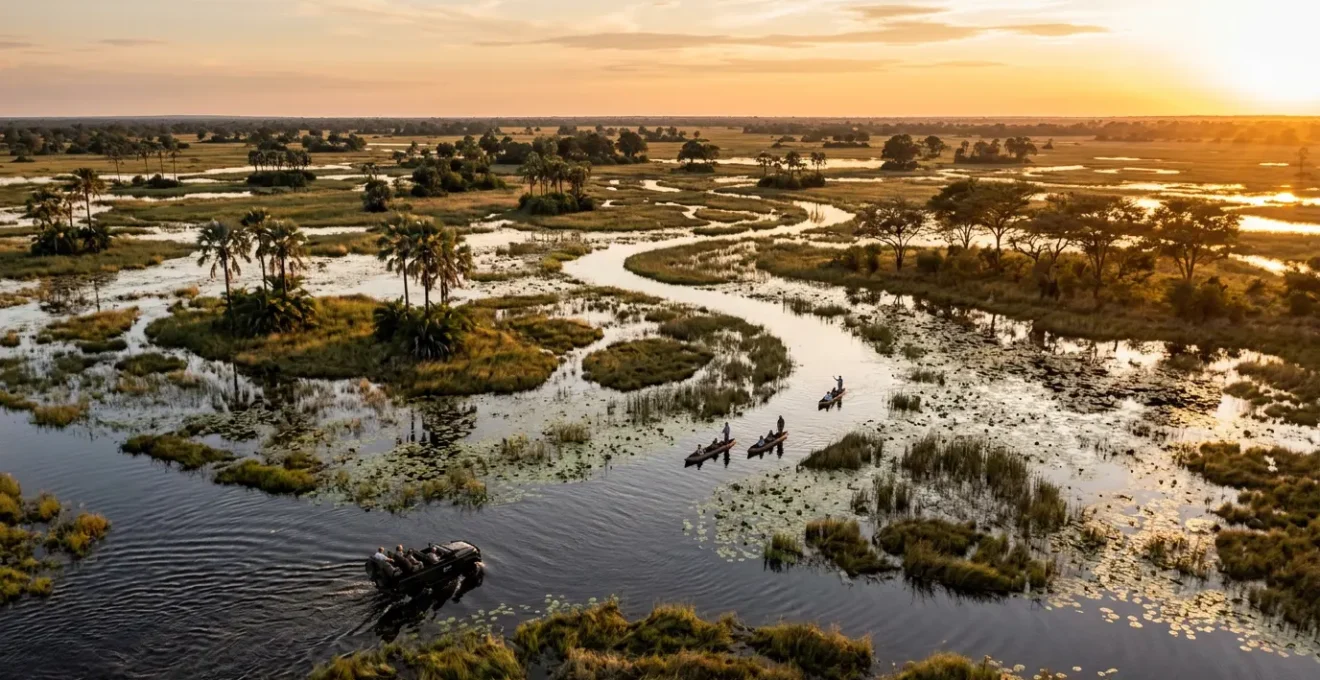
For travellers planning a safari between June and August, the fear is that high water means no game drives. The reality is more nuanced. High-water season in the Okavango Delta isn’t a limitation but a strategic shift in how you experience the ecosystem. It replaces some traditional land routes with unique water-based opportunities, offering access to different wildlife and spectacular landscapes that are inaccessible any other time of year.
A common question from travellers booking a safari for the peak season of June through August is a practical one: with the Okavango Delta’s floodwaters at their highest, will I be stuck on a boat all day? The concern is understandable. You’ve dreamt of epic game drives, and the thought of missing out on land-based predators can cause anxiety. Many guides will speak poetically of the « magical water wonderland, » but this doesn’t answer your core logistical question.
Let’s set aside the romance and look at the mechanics. As a seasonal logistics expert, my view is that the high-water season doesn’t cancel your safari; it redefines it. The key is understanding that this isn’t a simple case of « land vs. water. » It’s a fundamental shift in the entire ecosystem’s operation, from how a vehicle navigates a crossing to how an antelope evades a predator. This shift requires different tools, techniques, and a new way of seeing the landscape.
This guide will break down the operational realities of a high-water safari. We will explore the technical capabilities of safari vehicles, the unique wildlife adaptations you’ll witness, which areas become exclusively water-based, and how to best capture the stunning photographic opportunities that arise. Understanding these logistics will transform your trip from a potential compromise into a strategic, once-in-a-lifetime experience.
To navigate this unique environment, it’s essential to understand the different safari methods and their specific advantages during the flood. This article breaks down everything from vehicle capabilities to wildlife behaviour, helping you make the most of this spectacular season.
Summary: A Logistical Guide to the Okavango Floods
- How Deep Can a Land Cruiser Go Before the Engine Floods?
- Why Do Red Lechwe Run Faster in Water Than on Land?
- Which Camps Become Boat-Access Only During the Peak Flood?
- How to Capture the Mirror Effect on the Floodplains at Sunset?
- Motorboat or Game Viewer: Which Is Better for Spotting Sitatunga?
- Golden Hour on the Water: How to Expose for Silhouettes and Sun?
- When Is the Speed of a Motorboat an Advantage for Sightings?
- Motorboat Safari: How Is It Different from a Mokoro or Game Drive?
How Deep Can a Land Cruiser Go Before the Engine Floods?
The sight of a safari vehicle plunging into a channel is a classic Delta image, but it’s a calculated manoeuvre, not a reckless gamble. The viability of « game drives » during the flood often comes down to the depth of these water crossings. For the Toyota Land Cruisers that are the workhorses of the safari industry, the limit is surprisingly high. A key factor is the snorkel, an air intake extension that rises along the windscreen. An industry guide confirms that most Land Cruisers equipped with snorkels can safely cross water up to 70-80 cm (about 2.5 feet) deep.
However, depth is only one part of the equation. Success depends on the guide’s skill and a precise technique. They don’t just drive through; they create a ‘bow wave’—a wave pushed by the front bumper that effectively lowers the water level around the engine bay. Stopping or slowing down is catastrophic, as it allows water to rush in and flood critical electronics. It’s a high-stakes ballet of momentum and physics.
Experienced guides follow a strict protocol for every significant crossing, ensuring both safety and the continuation of your drive. These are the non-negotiable steps they take:
- Maintain a consistent pace to create a ‘bow wave’, which uses the vehicle’s bumper to keep water away from the engine.
- Know the vehicle’s layout: the air intake is high in the passenger front fender, but computers are lower, though protected inside the cabin.
- Attach recovery straps before entering the water, with the other end coiled on the roof for quick extraction if stuck.
- Lock differentials and maintain a steady speed; never stop mid-crossing, as this allows the engine bay to fill with water.
- If the vehicle does get stuck, the engine must be shut down immediately. Every second counts as water can spread to all systems.
So, while many tracks are submerged, strategic game drives are still very possible in areas where the water level remains within these operational limits. The experience is often more thrilling than a dry-season drive.
Why Do Red Lechwe Run Faster in Water Than on Land?
On a high-water safari, you quickly notice that the floodplains are not an obstacle for all animals; for some, they are an advantage. The Red Lechwe antelope is the quintessential floodplain specialist. While they may look slightly clumsy on dry land, they are poetry in motion once they hit the water, bounding through it with incredible speed and grace. This isn’t just an illusion; they are genuinely faster and more efficient in their preferred knee-deep habitat.
This remarkable ability comes from a series of specialised adaptations. According to their Wikipedia entry, their specialized adaptation includes legs covered in a water-repellant substance, which reduces drag. Furthermore, their long, splayed-out hooves give them a better grip on the slippery substrate below. Their powerful hind legs are longer than their front legs, built for the explosive, bounding leaps that propel them through the water with minimal resistance.
detail > atmosphere. »/>
This adaptation completely changes the predator-prey dynamic. Predators like lions and leopards, built for short bursts of speed on solid ground, are at a significant disadvantage in the water. Even cheetahs, the fastest land animals on earth, are utterly confounded. A documented case study observed two cheetahs struggling to hunt a lechwe in marshy water, forced to drag the antelope from its aquatic refuge where it was far more vulnerable. For the lechwe, water is safety. For the safari-goer, it’s a chance to witness a unique ecological chess match where the rules of the savannah are turned upside down.
Which Camps Become Boat-Access Only During the Peak Flood?
The defining feature of the high-water season is the sheer scale of the inundation. When the flood from the Angolan highlands arrives, it transforms the landscape. Each year approximately 11 cubic kilometers of water spreads over a 6,000 to 15,000 km² area. This turns vast tracts of savannah into a mosaic of islands and waterways. Consequently, many safari camps that are accessible by road during the dry season become true islands, reachable only by boat or light aircraft.
This isn’t a negative; it’s a mark of a truly immersive water-based experience. Camps located in the permanently flooded, or « permanent swamp, » areas of the Delta are designed for this. They offer a unique perspective where the primary mode of transport shifts from the rumbling game viewer to the nimble motorboat and the silent mokoro. Areas like the Jao Concession are famous for this. Instead of planning a game drive, your guide might discuss exploring a hippo-filled channel or searching for a Pel’s Fishing Owl along the riverine forest.
As one long-term resident highlights, being in these areas during the early part of the high season is a strategic advantage. According to Tessa, an Okavango resident of 16 years, in a piece for Far and Wild Travel:
Jao and its sister camps are wonderful water-based camps to see the floods with spectacular game viewing year-round. The newly rebuilt camp is spectacular and a sufficient reason to visit. If you are travelling early in the high season the camps in this area offer you the best chance of seeing the flood
– Tessa (Okavango resident, 16 years), Far and Wild Travel
Knowing which camps are land-based versus water-based is critical when planning. A « water camp » during flood season guarantees an authentic immersion into the flooded world, while a « land camp » will offer more traditional game drives, potentially with some long drives to reach the water’s edge.
Action Plan: Auditing Your High-Water Itinerary
- Activity Mix: List the camps on your itinerary and verify the primary activities offered (water, land, or mixed). Ensure it matches your expectations.
- Access Logistics: For each camp, confirm the mode of transfer. Is it by vehicle, light aircraft, or a final boat transfer? This reveals its level of isolation.
- Camp Type Check: Confront the camp’s marketing with reality. Ask your agent directly: « Is this considered a ‘water camp’ or a ‘land camp’ during my travel dates? »
- Wildlife Speciality: Check if the camp’s signature wildlife sightings (e.g., Sitatunga, Pel’s Fishing Owl) align with water-based viewing. This indicates its focus.
- Contingency Plan: Ask what happens if water levels are unexpectedly high or low. Does the camp have alternative activity options to ensure a full experience?
How to Capture the Mirror Effect on the Floodplains at Sunset?
While some may worry about limitations, photographers know that the high-water season offers unparalleled creative opportunities. The most iconic of these is the « mirror effect, » where the calm, shallow floodplains transform into a perfect, glassy mirror reflecting the dramatic African sky. As one professional photographer for &Beyond magazine notes, the visual rewards are immense: « The reflections in flood season will have you seeing double. »
Achieving this effect isn’t just about being in the right place at the right time; it requires a specific set of conditions and technical know-how. The « golden hour »—the first and last hour of sunlight—is prime time. The low, warm light creates incredible colours, long shadows, and turns the water’s surface into liquid gold. The key is finding a location sheltered from the wind. Even a slight breeze can create ripples that break the reflection. Your guide will know the best lagoons and will often cut the boat’s engine, allowing you to drift in silence as the water settles into a perfect mirror.
For photographers, capturing this scene requires moving beyond automatic settings and taking manual control to balance the bright sky with the dark reflections. Here are the key technical steps to master:
- Use a circular polarizing filter (CPL) to cut surface glare and enhance the depth of reflections.
- Apply exposure bracketing (taking multiple shots at different exposures) to capture the huge dynamic range between the bright sky and the dark water.
- Find sheltered lagoons or channels protected from the wind to ensure a calm, glass-like water surface.
- Insist on cutting the engine and allowing all ripples to dissipate completely before shooting.
- For a sunburst effect, shoot with a narrow aperture (f/16-f/22) when the sun is partially blocked by the horizon or a cloud.
- Switch to manual focus and use the crisp edge of a silhouette against the bright sky as your focusing point, as autofocus can struggle.
This isn’t just taking a picture; it’s crafting an image. The reward is a photograph that is both a landscape and an abstract work of art, a perfect memory of the Delta’s liquid soul.
Motorboat or Game Viewer: Which Is Better for Spotting Sitatunga?
The high-water season grants access to a creature that is almost impossible to see otherwise: the shy and elusive Sitatunga. This semi-aquatic antelope has uniquely splayed, banana-shaped hooves that allow it to walk on the floating papyrus beds of the deepest swamps. Trying to find one from a game viewer is a futile exercise; you simply cannot drive into their habitat. This is where the perspective shift from land to water becomes a clear strategic advantage.
To spot Sitatunga, you must enter their world. The choice between a motorboat and a game viewer is therefore not a choice at all. A motorboat is the only tool that can get you to the deep, papyrus-choked channels they call home. The technique involves cruising along the edges of these dense reed beds, scanning patiently for any movement. A skilled guide will cut the engine and let the boat drift silently, listening for the tell-tale splash or rustle of reeds that betrays the antelope’s presence.
texture > atmosphere. »/>
The differences in approach and success rate are stark, making the motorboat the undisputed champion for this specific task.
| Aspect | Motorboat | Game Viewer |
|---|---|---|
| Access to habitat | Can reach deep papyrus reed beds | Cannot access sitatunga’s wetland habitat |
| Noise level | Can cut engine and drift silently | Loud diesel engine alerts shy animals |
| Viewing style | Patient scanning from stationary position | Covers ground actively searching |
| Success rate | Higher – reaches actual habitat | Very low – wrong environment |
| Alternative option | Mokoro for ultimate silence | Not suitable for this species |
As the table shows, there is an even more specialized tool for the task: the mokoro (a traditional dugout canoe). A case study on water-based safaris notes that while you won’t see large herds, the silent approach of a mokoro gives you the best chance of spotting specialist species like reed frogs, otters, and the Sitatunga itself. It is the ultimate expression of adapting your method to the quarry.
Golden Hour on the Water: How to Expose for Silhouettes and Sun?
The « golden hour » light is legendary among safari photographers, and during the flood season, its effects are amplified. As Muchenje Safari Lodge’s guide notes, early departures are planned specifically to « give guests the ‘golden hour’ of light for photography. » When this magical light combines with the vast reflective surfaces of the water, it creates opportunities for incredibly dramatic and artistic shots, particularly silhouettes.
Creating a powerful silhouette is about celebrating shape and form over detail and colour. The goal is to intentionally underexpose your subject (an elephant drinking, a fish eagle in a tree) so that it becomes a crisp, black shape against a brilliantly coloured sky. The water then doubles this effect, creating a second silhouette in its reflection. This is high-impact, minimalist photography that tells a powerful story.
This technique requires you to override your camera’s desire to create a « correctly » exposed image. You must tell it to expose for the bright sky, not the dark subject. This can be done in a few ways:
- Set your camera to Spot Metering mode, which measures light from a very small area of the frame.
- Point this spot at the bright part of the sky right next to your subject. This tricks the camera into underexposing the rest of the scene, creating a perfect silhouette.
- As a faster alternative, use negative Exposure Compensation (-1 to -3 stops) to manually darken the entire image.
- For a starburst effect from the sun, use a narrow aperture (f/16 to f/22).
- Position the sun so it is partially peeking out from behind your subject, like the curve of an elephant’s head, to create a dynamic flare.
- Switch to manual focus, using the sharp edge of the silhouette as your reference point.
- Choose between a fast shutter speed to freeze the reflection, or a slow shutter (with a tripod) to create a soft, ethereal blur on the water.
Mastering silhouettes on the water is a rewarding skill. It moves you from simply documenting an animal to creating a piece of art that captures the mood and atmosphere of the Okavango at its most beautiful.
When Is the Speed of a Motorboat an Advantage for Sightings?
While the quiet stealth of a mokoro is perfect for intimate sightings, there are times when the speed and range of a motorboat offer a distinct advantage. The Okavango is vast, and the flood season connects channels and lagoons that are miles apart. A motorboat is a tool for covering distance efficiently, turning travel time into a game-viewing opportunity in itself.
This speed is a strategic asset when trying to reach specific, time-sensitive wildlife events. For example, large heronries or carmine bee-eater colonies are often located in remote parts of the river system. A motorboat can get you there and back within a single activity, something impossible in a mokoro. Similarly, if a guide at another camp radios in a rare sighting like a Pel’s Fishing Owl, a motorboat gives you a chance to get there before it disappears. It allows you to explore the vast waterways where vehicles simply cannot go, maximizing the area you can cover.
This strategy is most effective during the peak of the season. According to Tett Safaris, the best wildlife viewing occurs during the June-July peak flood season. This is when the water has spread to its widest extent, concentrating land animals on islands and making the channel network fully navigable. The motorboat becomes your key to this interconnected world, allowing you to move between « hotspots » of activity with relative ease. It’s less about a peaceful glide and more about a purposeful expedition to access the most productive areas of the flooded ecosystem.
Ultimately, the speed of a motorboat transforms the vastness of the Delta from a barrier into a network. It’s an advantage whenever your objective requires covering significant ground on the water to reach a specific destination or sighting, making the most of the unique geography of the high-water season.
Key Takeaways
- Logistical Shift: High-water season limits some land access but opens up vast new areas to watercraft, requiring a change in safari strategy.
- Unique Sightings: Water-based activities provide the only way to see specialist species like Sitatunga and access remote bird colonies.
- Photographic Goldmine: The combination of water and low light creates exceptional photographic opportunities like mirror-like reflections and dramatic silhouettes.
Motorboat Safari: How Is It Different from a Mokoro or Game Drive?
To the first-time visitor, a safari vehicle is a safari vehicle. But in the high-water season, understanding the distinct roles of a game viewer, a motorboat, and a mokoro is the key to appreciating the logistical genius of an Okavango safari. Each offers a fundamentally different perspective and is a specialized tool for a specific job. It’s not about which is « better, » but which is right for the task at hand. Your safari is a blend of these three distinct experiences.
A game drive provides an elevated, panoramic view, ideal for spotting predators across open plains and navigating the network of sandy tracks on the islands. A motorboat offers a water-level perspective, perfect for covering large distances on main channels and getting close views of hippos, crocodiles, and elephants crossing. The mokoro provides the most intimate, water-surface view, designed for silently exploring the narrowest, shallowest channels to find frogs, birds, and other small wonders. The differences in perspective, sound, and access are profound.
This table breaks down the core differences, helping you understand what to expect from each activity.
| Aspect | Game Drive | Motorboat Safari | Mokoro |
|---|---|---|---|
| Perspective | Elevated, panoramic view | Water-level view of channels | Intimate water-surface view |
| Coverage | Most ground, restricted to dry land | Large water area, main channels | Smallest area, shallow channels |
| Soundscape | Engine rumble, radio chatter | High-speed wind, then silence | Near-total natural silence |
| Best Wildlife | Terrestrial predators, plains game | Hippos, crocs, elephants crossing | Frogs, water birds, sitatunga |
| Speed | Moderate on roads | Fast on open water | Very slow, peaceful |
| Access | Roads and tracks only | Main water bodies | Shallowest, most intricate areas |
The mokoro experience, in particular, is often highlighted as the soul of the Delta. As the team at Brave Africa describes it, it’s an enchanting and immersive journey.
A traditional mokoro safari is an enchanting way to explore the Okavango Delta. You’ll journey through reed-lined channels in a dug-out canoe, propelled with poles by local experts. As you glide in relative silence through peaceful waters, you’ll enjoy nature sounds – from the croak of frogs to hippo grunts. From the water, everything becomes larger and grander
– Brave Africa, 2024 Okavango Delta Flood Update
A well-planned high-water safari isn’t about choosing one activity over the other. It’s about combining all three to create a complete, multi-dimensional portrait of the Delta in its most dynamic state.
By understanding these different modes of exploration, you can work with your travel planner to ensure your itinerary includes a rich mix of activities, guaranteeing you experience the full spectrum of what the high-water season has to offer.