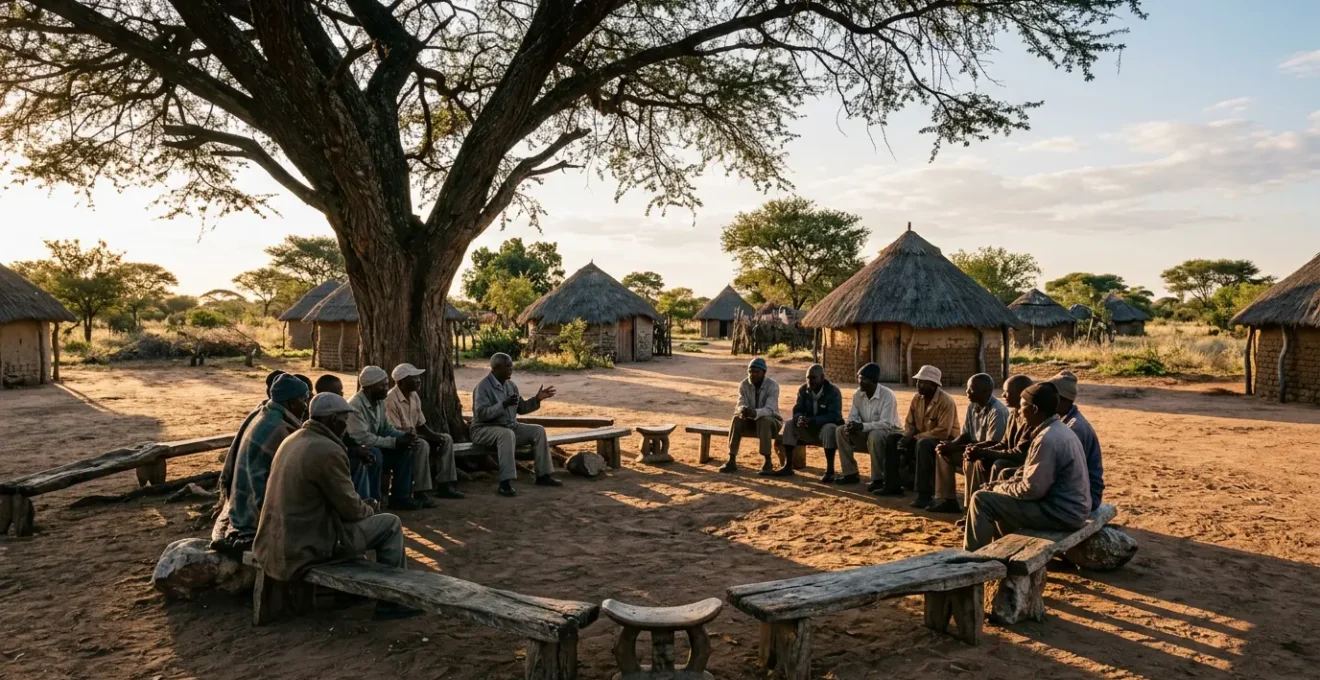
In a world of rapid change, Botswana’s traditions remain remarkably intact. This isn’t by accident. The Kgotla court, often seen as a simple tribal meeting place, is actually the operational heart of a deep cultural philosophy called botho. It’s a dynamic system that doesn’t just preserve customs but actively adapts them, ensuring that everything from marriage rites to community gatherings retains its meaning and function in the 21st century.
A traveler visiting Botswana today might be struck by a profound contrast. In Gaborone, modern glass-and-steel skyscrapers reflect a nation that is one of Africa’s most stable and prosperous democracies. Yet, just a short drive away, in any village, life revolves around a simple enclosure, often under a large tree: the Kgotla. It’s easy to dismiss this as a quaint relic, a place where elders settle minor disputes. But this view misses the point entirely.
The true power of the Kgotla lies not in its physical form but in its function as the living engine of Tswana culture. It is the most visible manifestation of botho, a philosophy of mutual respect, compassion, and community that underpins the entire society. While other cultures see their traditions fade into museum exhibits, the Batswana use the Kgotla and the principles of botho to actively debate, interpret, and adapt their customs for the modern world. It is the mechanism that ensures tradition is not a rigid cage but a flexible framework for a cohesive society.
This article explores this dynamic process. We will not just list customs, but reveal how the Kgotla’s influence—and the philosophy it represents—is the thread that connects the ancient value of cattle in marriage to the patterns on a dress, the proper way to greet an elder, and even why city dwellers feel an irresistible pull to return to their rural « cattle post » on weekends. It is the story of how a nation thrives by respecting its past while embracing its future.
The following sections delve into specific customs that, on the surface, seem distinct. As we explore them, you will see how each is a testament to a resilient and interconnected cultural fabric, continuously woven and repaired within the communal space of the Kgotla.
Summary: The Enduring Power of Custom in Modern Botswana
- Why Are Cows Still Used as Dowry in Tswana Marriages Today?
- How Does Your Animal Totem Influence Who You Can Marry or Eat?
- Leteisi: How to Distinguish the Different Tswana Fabric Patterns?
- Why Is Greeting Elders with Two Hands Mandatory in Botswana?
- How Is the Segaba Instrument Played Using Only One String?
- Why the San Healing Dance Is Still Performed at Night in the Kalahari?
- Why Do Most City Dwellers Disappear to the « Cattle Post » on Weekends?
- Maun Beyond the Airport: What Is Daily Life Like in the « Gateway to the Delta »?
Why Are Cows Still Used as Dowry in Tswana Marriages Today?
In Tswana culture, marriage is not merely a union of two individuals but a formal joining of two families. At the heart of this process is bogadi, often translated as ‘dowry’ or ‘bridewealth’. Traditionally, bogadi involves the groom’s family giving a number of cattle to the bride’s family. Far from being a simple payment, this exchange symbolizes gratitude, the creation of a lasting bond between families, and respect for the bride’s upbringing. It is a powerful cultural anchor that remains deeply relevant.
Even in a modern, cash-based economy, the practice endures with incredible strength. Research into Botswana’s marriage customs shows that around 70-80% of Tswana marriages still involve bogadi negotiations. This demonstrates not a resistance to change, but a remarkable capacity for adaptation. The Kgotla court often plays a crucial role in mediating these negotiations, ensuring fairness and adherence to custom.
The evolution of bogadi is a prime example of cultural resilience. While rural families may still exchange physical cattle, many urban families have adapted the practice to modern life. It is now common for the value of the cattle to be calculated and paid via bank transfer or mobile money. This practical shift allows the tradition to continue, preserving its profound symbolic meaning while accommodating the logistics of contemporary living. The essence of the agreement—honoring the union of families—remains unchanged, proving that the spirit of the custom is more important than its literal form.
How Does Your Animal Totem Influence Who You Can Marry or Eat?
Every Motswana belongs to a clan, and each clan is associated with a specific totem, or sereto. This totem is most often an animal—such as the Kwena (crocodile), Kgabo (monkey), or Nare (buffalo)—and it forms a foundational part of an individual’s identity, linking them to their ancestors, their community, and the natural world. This is not a quaint historical footnote; it is a living system of social organization with tangible rules that govern daily life.
The totem serves as a powerful symbol of kinship. As the Botswana Cultural Research Institute explains, « The totem serves as a symbolic representation of a strong association with a specific animal, and with the natural world in general. » This association comes with two primary, strictly observed rules:
- Dietary Restrictions: A person is forbidden from eating the meat of their totem animal. This act of avoidance is a sign of respect and acknowledges the spiritual connection to the creature.
- Marriage Prohibitions: Traditionally, individuals who share the same totem are considered to be from the same family line and are therefore forbidden from marrying. This rule of exogamy was crucial for creating alliances between different clans and strengthening the broader social fabric.
While modernization has relaxed some social norms, totem identity remains a significant factor, especially in rural areas and during marriage negotiations. The Kgotla may be consulted if disputes or questions arise regarding totemic lineage and marriage eligibility. The totem system acts as a constant reminder of one’s place within a larger collective, reinforcing community bonds and a shared history that transcends the individual. Many clans, like the Bakalanga, revere multiple animals, creating a complex web of relationships and respect for the environment.
Leteisi: How to Distinguish the Different Tswana Fabric Patterns?
Clothing in Botswana is far more than functional; it is a vibrant language. The most iconic of all fabrics is Leteisi, also known as German print or shweshwe. Characterized by its intricate geometric patterns and typically dyed with indigo, this cotton fabric is the visual heartbeat of Tswana culture, worn by women at nearly every significant social gathering, from weddings to funerals and national holidays.
Distinguishing the patterns is not just a matter of aesthetics. Different designs, colors, and motifs carry specific social meanings and are appropriate for different occasions. A trained eye can read a wealth of information from a woman’s dress. While the variations are countless, they often fall into recognizable categories that communicate a message to the community.
The table below provides a glimpse into this symbolic language, showing how a simple pattern can signify everything from marital status to respect for the ancestors. This visual communication is a key part of the social decorum expected at community events, including formal Kgotla meetings where attire reflects the seriousness and respect of the proceedings.
| Pattern Type | Color Scheme | Occasion | Social Significance |
|---|---|---|---|
| Three Cats | Indigo Blue | Weddings | Marital unity and prosperity |
| Flowers | Brown/Earth tones | Funerals | Respect for ancestors |
| Geometric Diamonds | Red/White | Kgotla meetings | Community respect and formality |
| Small Circles | Multiple colors | Daily wear | Regional identity marker |
Why Is Greeting Elders with Two Hands Mandatory in Botswana?
To understand almost any aspect of Tswana culture, one must first understand the concept of botho. Roughly equivalent to the Zulu term ubuntu, it translates to « humanity » but encompasses a much deeper philosophy of mutual respect, interconnectedness, and compassion. It is the belief that « I am because we are. » This is not an abstract ideal but the fundamental operating system for social interactions in Botswana.
As the travel experts at Goway Travel note in their guide, botho is a core principle guiding all behavior:
There is a closely adhered concept followed in Botswana, known in Setswana as botho, or ubuntu, which puts emphasis on respect, kindness, and compassion for one another. It highlights accepting others as they are, and not exhibiting aggressive or abrasive behaviors. This translates into a strong sense of community and supporting one another.
– Goway Travel, Botswana Culture and Traditions Guide
This philosophy manifests in countless daily actions, the most prominent being the etiquette of greeting. When greeting an elder or someone of high social standing, it is mandatory to show respect through specific physical gestures. This includes a slight curtsy and, most importantly, offering a handshake with both hands, or with the right hand while the left hand supports the right elbow. This two-handed gesture signifies humility and acknowledges the other person’s importance. A one-handed, casual greeting would be seen as deeply disrespectful.
The principle is so ingrained that it transcends social settings. Even in the modern corporate boardrooms of Gaborone, this traditional gesture of respect persists. It is a constant, physical reaffirmation of the social harmony and collective identity that binds the Batswana people together, a unity that the Kgotla is designed to protect.
How Is the Segaba Instrument Played Using Only One String?
Tswana folk music is a rich and soulful tradition, historically performed with unique instruments that reflect the ingenuity of the people. Among the most fascinating is the Segaba, a type of single-string fiddle or mouth-bow. Its construction is deceptively simple: a curved wooden bow, a single string (traditionally made from animal tendon, now often wire), and a small tin can or gourd that acts as a resonator. What makes it extraordinary is the playing technique.
The musician holds one end of the bow to their mouth, using their oral cavity as a variable resonance chamber. By changing the shape of their mouth, they can amplify specific harmonics, creating a haunting and complex melody from a single vibrating string. The string itself is bowed with a separate, smaller bow, producing a sound often described as a vocal-like lament. It is an instrument that is literally given its « voice » by the player’s own body.
For a time, the Segaba was nearly lost. As explained in historical accounts of Tswana music, the arrival of the guitar, which could be played with a similar rhythm but offered greater versatility, led to a decline in the instrument’s popularity. However, in a powerful display of cultural resilience, the Segaba was brought back from the brink. Prodigies like the legendary Ratsie Setlhako became champions of the instrument, and their music, popularized by radio in the 1980s, sparked a national revival. Today, the Segaba is celebrated as a vital piece of Botswana’s musical heritage, a testament to the nation’s ability to cherish and reclaim its unique artistic identity.
Why the San Healing Dance Is Still Performed at Night in the Kalahari?
While the Batswana form the majority ethnic group, Botswana is also home to the San people, one of the oldest cultures in the world. Deep in the Kalahari Desert, they continue to practice one of their most sacred and distinctive rituals: the all-night healing dance. This is not a performance for tourists but a vital community event aimed at curing sickness and dispelling social tensions. The dance is held at night around a central fire, with the entire community participating.
The ceremony is an intense, marathon-like experience. As documented in recordings by anthropologists, the ritual often involves an all-night duration of 8-10 hours. Women form a circle around the fire, clapping complex rhythms and singing songs with yodeling-like vocals, while the men dance in a counter-rhythm around them. The goal is to activate a spiritual energy or life force known as n/um. Certain men are trained as healers and, through the exhausting dance, they enter a powerful trance state.
In this trance, the n/um becomes « hot » and allows the healer to connect with the spirit world. As the healer Kinachau described the experience: « You dance, dance, dance. Then n/um lifts you up in your belly and lifts you in your back, and then you start to shiver. N/um makes you tremble, it’s hot. » In this altered state, the healer lays hands on the sick or those in distress, pulling the illness out of them and into their own body before expelling it into the darkness with a shriek. The dance continues until dawn, serving to heal individuals and restore harmony to the entire community, a practice that has endured for millennia.
Key Takeaways
- Cultural Adaptation: Traditions like bogadi (dowry) are not disappearing but evolving, with symbolic cattle payments now made via bank transfer.
- The Power of Botho: The philosophy of mutual respect and community is the driving force behind customs, from two-handed greetings to conflict resolution in the Kgotla.
- Identity and Social Structure: Totems and traditional attire (Leteisi) are not merely decorative but serve as a living language that defines kinship, social rules, and respect within the community.
Why Do Most City Dwellers Disappear to the « Cattle Post » on Weekends?
For many urban Batswana with well-paying jobs in Gaborone, the weekend brings a familiar ritual: a long drive out of the city to the family « cattle post » (meraka). To an outsider, this might seem like a simple retreat to the countryside. In reality, it is a profound pilgrimage to the very source of family wealth, status, and identity. In Botswana, land is a birthright; every family is entitled to a plot for planting crops and a separate cattle post for their livestock.
Cattle are not just animals; they represent the ultimate symbolic economy. Historically and even today, the size of a family’s herd is a direct measure of their influence and social standing. As noted by the Botswana Tourism Board, « Cattle still retain a prominent place in rural Botswana, and for many the herd remains the preferred store of wealth. » Returning to the cattle post is a way of reconnecting with this heritage and participating in the shared labor that reinforces family bonds.
The modern cattle post is a fascinating blend of tradition and innovation. While the core activities of herding and subsistence farming continue, they are now supplemented by modern technology and diversified practices to ensure economic resilience. This fusion is essential for maintaining the viability of the rural homestead.
Action Plan: Key Activities at a Modern Cattle Post
- Infrastructure Upgrade: Install solar panels for electricity to power lights and charge phones, and set up satellite dishes for communication and entertainment.
- Economic Diversification: Maintain herds of goats alongside cattle, as they are more resilient to drought and provide a different source of income and food.
- Subsistence Farming: Cultivate staple crops like maize and sorghum, and maintain small vegetable gardens to ensure food security for the family.
- Foraging and Harvesting: Collect seasonal wild foods from the surrounding bush, such as the prized morula fruits, nuts, and berries, supplementing the family diet.
- Social Maintenance: Reinforce family and community ties through shared labor, where, as custom dictates, tasks were distributed based on age and gender, a practice that continues in modified forms today.
Maun Beyond the Airport: What Is Daily Life Like in the « Gateway to the Delta »?
Maun is known globally as the bustling « Gateway to the Okavango Delta, » a transit hub where tourists board small planes for luxury safari camps. But beyond the airport and safari operators lies a complex and vibrant town that is a microcosm of Botswana itself. Maun is a melting pot where different ethnic groups, traditional lifestyles, and modern commerce intersect daily.
The town is not a homogenous entity but a patchwork of distinct communities, each with its own primary activities and relationship to the region’s resources. The Kgotla system remains highly relevant here, serving as the forum where disputes over land use, water rights, and property are negotiated between these diverse groups. For example, conflicts between safari operators needing river access and BaYei fishermen whose livelihoods depend on the same waters might be brought before the local chief.
The following table illustrates the different social layers of Maun and how they coexist, often turning to traditional authority to maintain harmony.
| Community Group | Primary Activities | Location in Maun | Interaction with Kgotla |
|---|---|---|---|
| Safari Operators | Tourism services, lodge management | Airport area, riverside | Business disputes, land use |
| Local Batswana | Commerce, traditional farming | Old town, residential areas | Family matters, property disputes |
| Herero Communities | Cattle herding, crafts | Outskirts, cattle posts | Livestock disputes, grazing rights |
| BaYei People | Fishing, mokoro services | River areas, Delta entrance | Water rights, fishing territories |
One of the integral communities is the BaYei, who are intrinsically linked to the Delta. As experts in river navigation, they are credited with inventing the mokoro, the traditional dugout canoe that is now an iconic symbol of the Okavango. Their deep knowledge of the waterways, passed down through generations, remains essential for both subsistence fishing and the modern tourism industry. This peaceful coexistence of different cultures and economies, arbitrated by traditional structures, is the quiet success story of Maun and, by extension, all of Botswana.
For any traveler wishing to truly understand Botswana, the key is to observe with respect. Look for these living traditions, engage with humility, and you will discover a nation that has masterfully woven its ancient social fabric into the fabric of a modern, peaceful, and thriving democracy.
Frequently Asked Questions About Tswana Culture and the Kgotla
What does « Batswana » mean?
The collective name « Batswana » translates to « people of Botswana. » It fosters a strong sense of national unity that transcends tribal identities, allowing individuals to feel part of a greater whole while maintaining their specific cultural heritage.
Are all totems animals?
While a guide on the Culture and Traditions of Botswana notes that most Tswana groups have animals as their totem, some communities do have non-animal totems, such as plants or natural phenomena. The principle of respect and the associated social rules remain the same.
Who participates in the Kgotla meetings?
Traditionally, Kgotla meetings were attended by all adult men of the village. Today, they are much more inclusive, and women are often active participants in discussions and decision-making, reflecting the evolution of custom in line with Botswana’s modern democratic values.