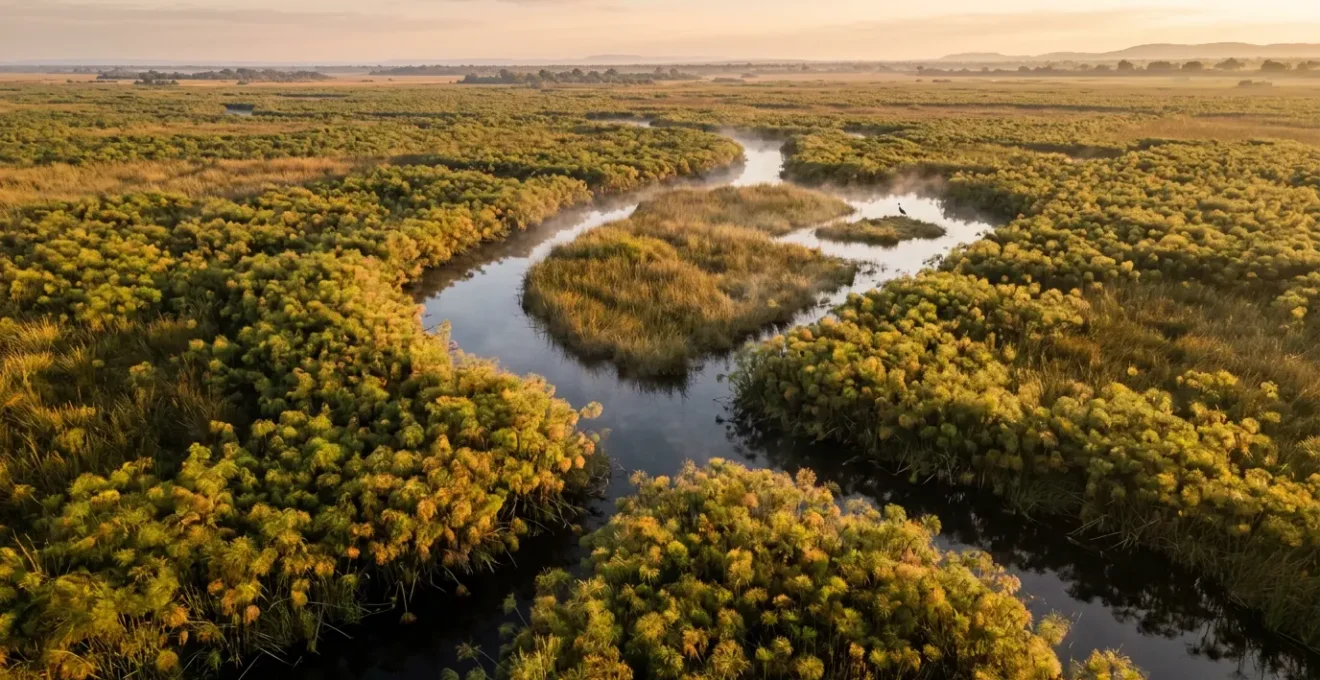
The dense papyrus of the Okavango is not a barrier; it’s a multi-story city with its own rules of physics, sound, and light.
- Creatures use specific sound frequencies and reflective biology to communicate and hunt through the dense vegetation.
- Extreme physical adaptations, from splayed, elongated hooves to specialized diets, are the keys to survival in this unique environment.
Recommendation: To truly see this world, shift your focus from simply ‘what’ is there to understanding ‘how’ and ‘why’ each creature has engineered its existence within the reeds.
To the casual observer on a mokoro, the vast papyrus beds of the Okavango Delta can appear as an impenetrable, uniform wall of green. It’s a beautiful backdrop, certainly, but one that seems to hide its secrets well. Most visitors are trained to look past it, searching the horizon for elephants or the riverbanks for lions. The focus is often on the grand scale, treating the reeds as little more than scenery for the larger drama of the savanna.
This approach, however, misses the most intricate and fascinating story the Delta has to tell. The common advice is to « be patient » or « use binoculars, » but this advice fails to capture the fundamental truth of the reed bed. It’s not a wall; it’s a living, breathing, vertical metropolis. Each stalk of papyrus is a pillar, each layer of vegetation a different floor, and every inhabitant, no matter how small, is a master of its own specialized niche.
But what if the real key to unlocking this world wasn’t just better eyesight, but a better understanding of the physics at play? The secret isn’t just in looking, but in comprehending the unique dynamics of sound, light, and water that govern life within. This guide abandons the generic approach. Instead, we will explore the reed bed as a biologist would: a complex ecosystem where survival is an engineering marvel. We’ll decipher the acoustic signals, understand the structural adaptations, and learn how to see the life that thrives in plain sight, yet remains perfectly hidden.
This exploration will take you through the different layers of the papyrus world, from the hidden life at water level to the tiny hunters at the very top of the reeds. The following sections break down the specific strategies you can use to spot, identify, and appreciate the secret life of this incredible habitat.
Summary: The Secret World of the Reed Beds
- How to Spot the Tiny Painted Reed Frog at Night?
- Why Is the Okavango a Hotspot for Rare Dragonflies?
- Why Does the Sitatunga Antelope Only Live in Deep Reeds?
- What Makes the Clicking Sounds You Hear in the Reeds at Sunset?
- How to Focus on a Bird Hidden Behind Thick Reeds?
- How to Spot Malachite Kingfishers Hiding in the Papyrus?
- Wattled Crane or Grey Crowned Crane: Which One Is Critically Endangered?
- How to Photograph the Mirror Reflections of the Delta Without Glare?
How to Spot the Tiny Painted Reed Frog at Night?
The painted reed frog (Hyperolius marmoratus) is one of the most vibrant and vocal residents of the papyrus, yet one of the most challenging to see. During the day, they are masters of camouflage, but at night, the reed bed comes alive with their calls. Finding them requires engaging senses beyond sight. The key is to stop looking for a frog and start looking for the specific signs of its presence. The first step is acoustic: listen for the male’s distinctive, high-pitched ‘tink-tink’ bell-like chorus, which is faster and more regular than the chirps of crickets.
Once you’ve located a chorus, the visual hunt begins, but it’s a hunt for light, not color. This is where a biologist’s technique comes into play. Hold your headlamp or torch right at eye level, shining it into the reeds. You are looking for a tiny, orange-red glint of reflected light. This is the tapetum lucidum, a reflective layer in the frog’s eyes, which can be visible up to 10 meters away. They often climb to broadcast their calls, so focus your search on the tips of reed stems, typically one to two meters above the water where humidity is optimal for sound transmission. As a detailed study on their navigation confirmed, females can pinpoint male locations with remarkable precision using these acoustic cues alone, navigating through complete darkness.
drama > saturation »/>
This technique of using eye-shine is fundamental to nocturnal wildlife observation. The reflected light cuts through the visual clutter of the reeds, turning the frog’s own biology into a beacon. By combining acoustic location with this specific visual search method, you transform a near-impossible task into a repeatable scientific process. You are no longer randomly searching; you are decoding the signals of the ecosystem.
Why Is the Okavango a Hotspot for Rare Dragonflies?
The Okavango Delta is a paradise for Odonata enthusiasts. The sheer diversity is staggering; comprehensive biodiversity studies have documented 94 dragonfly species thriving here. But why this specific location? The answer lies not just in the presence of water, but in its unique and varied chemical properties. The Delta creates a mosaic of perfect dragonfly nurseries, with conditions fine-tuned for every stage of their life cycle.
The secret is the gradient of water habitats, from the permanent, deep channels to the ephemeral, seasonal floodplains. Each offers a different set of chemical parameters that favors different species. The permanent channels, filtered and oxygenated by papyrus roots, provide the stable, clear water that hunting nymphs need. In contrast, the warmer, more variable seasonal floodplains can accelerate metamorphosis for other species adapted to a faster life cycle. It’s this patchwork of conditions that allows such a high number of species to coexist without directly competing.
This table, based on water chemistry analysis, illustrates how different parts of the Delta create ideal, specialized nurseries for dragonfly life.
| Water Parameter | Permanent Channels | Seasonal Floodplains | Impact on Dragonflies |
|---|---|---|---|
| Dissolved Oxygen | High (papyrus roots) | Variable | Supports nymph respiration |
| pH Range | 6.0-7.5 (neutral) | 5.7-9.2 | Optimal for exoskeleton development |
| Water Temperature | 20-25°C | 27-34°C | Accelerates metamorphosis |
| Sediment Load | Low | Moderate-High | Clear water aids hunting |
Therefore, the Okavango’s status as a dragonfly hotspot isn’t an accident of geography. It is a direct result of its complex hydrochemistry. The interplay between water flow, vegetation, and seasonal change creates a dynamic system that supports an incredible breadth of specialist and generalist species, making it a living laboratory for insect biodiversity.
Why Does the Sitatunga Antelope Only Live in Deep Reeds?
The sitatunga (Tragelaphus spekii) is the Delta’s true swamp specialist, an antelope so perfectly adapted to the reed beds that it is rarely seen outside of them. Its survival hinges on a remarkable set of structural adaptations, most notably its hooves. Unlike any other antelope, anatomical studies reveal that sitatunga possess hooves that reach up to 18cm in length. These elongated, widely splayed hooves function like snowshoes, distributing the animal’s weight over a large surface area and allowing it to walk on submerged vegetation and boggy ground that would trap any other herbivore of its size.
This physical adaptation dictates its entire life. The deep reeds are not just a food source; they are its fortress. As the Okavango Delta Wildlife Authority notes, this is the antelope most suited to the heart of the Delta. Their official species profile states:
This is the antelope most suited to the dense reed beds and deep waters of the centre of the Delta. They have extraordinary splayed hooves which allow them to travel across submerged beds of aquatic plants. When threatened, they will submerge themselves in water leaving only their nostrils above the surface.
– Okavango Delta Wildlife Authority, Wildlife Species Profile
This submersion behavior is their ultimate anti-predator defense, a strategy that terrestrial hunters like lions and leopards, who avoid deep water, cannot counter. The sitatunga effectively vanishes into the aquatic environment, using the water and reeds as an impenetrable shield.
Case Study: The Sitatunga’s Anti-Predator Submersion
The sitatunga’s survival strategy is a masterclass in using the environment as a tool. Research shows they can remain almost fully submerged for extended periods, with only their nostrils breaking the surface. This is made possible by the unique flexibility of their foot joints and their elongated hooves, which provide stability on unstable, underwater terrain. This behavior makes them virtually invisible to predators, effectively removing them from the terrestrial food chain whenever a threat is perceived. They don’t run from danger; they sink beneath it.
The sitatunga doesn’t just live in the reeds; it is a physical manifestation of the swamp itself. Its entire biology is an answer to the specific challenges of this environment, making it a powerful example of niche specialization.
What Makes the Clicking Sounds You Hear in the Reeds at Sunset?
As the sun sets over the Delta, the visual world recedes and an acoustic world emerges. The air fills with a complex symphony of clicks, whistles, and snaps that can be baffling to the uninitiated. These sounds are not random noise; they are the language of the reed bed. Deciphering them is key to understanding the activity that is just beginning. The most prominent sound is often the sharp, piercing whistle of the male painted reed frog, which can be almost deafening up close as they call to attract mates.
But other sounds weave into this chorus. As the evening air cools, the papyrus stalks themselves contribute to the soundscape. The cellulose fibers within the hollow stems contract at different rates, producing distinct mechanical ‘snapping’ sounds. This is the sound of the architecture of the reed bed settling. Furthermore, different insects and frogs partition the acoustic space to avoid being drowned out. High-frequency sounds penetrate the dense vegetation more effectively than low-frequency ones, allowing them to communicate over distance despite the physical barriers. Each species claims its own frequency band, a concept known as acoustic niche partitioning.
Learning to map these sounds is a fundamental skill for a wetland biologist. It involves more than just listening; it requires an analytical approach to isolate and identify each component of the chorus.
Your Action Plan: Sound Mapping Reed Bed Acoustics
- Positioning: Position yourself 10-15 meters from the reed edge for optimal acoustic clarity and to avoid disturbing the animals.
- Isolation: Use a directional microphone if available, or simply cup your hands behind your ears to help isolate the direction of different sound sources.
- Timing: Note the timing of sounds. Frog calls often peak at dusk, many insects continue throughout the night, and mechanical reed snaps are most common during periods of rapid temperature change.
- Frequency Mapping: Listen for different pitches. Painted reed frogs typically call in the 2-4 kHz range, while many crickets are higher at 4-6 kHz, and some katydids can reach up to 15 kHz.
- Correlate with Environment: Record the temperature. A sudden drop of 5°C can trigger the maximum number of reed contraction sounds, helping you distinguish them from animal calls.
By actively dissecting the soundscape, you are no longer a passive listener. You are reading the nightly bulletin of the reed bed, identifying its inhabitants and even the physical state of the environment itself.
How to Focus on a Bird Hidden Behind Thick Reeds?
Spotting a bird in a dense reed bed is a significant challenge, but getting a clear, focused view—or photograph—can feel impossible. The dense vertical lines of the papyrus create a curtain of visual noise that constantly tricks the eye and confuses camera autofocus systems. Success requires abandoning the wide-view approach and adopting a strategy of finding and exploiting « optical windows. » This means actively searching for the small, transient gaps in the vegetation through which a subject can be clearly seen.
For photographers and observers using modern equipment, technology can be a powerful ally. A few professional techniques can make a significant difference:
- Enable focus peaking on your camera or binoculars if available. Set it to a bright color like red. As you manually adjust focus, the edges of the bird will light up, even if it’s only visible through a tiny gap.
- Use the smallest possible single-point autofocus setting. This allows you to precisely target the bird’s eye through a gap, ignoring the distracting reeds in the foreground and background.
- Pre-focus on a reed stem at the same distance as the bird, then switch to manual focus and wait. When the bird moves into a clear patch, you’ll be ready to capture the moment without the camera hunting for focus.
However, the most crucial tool is not technological, but mental: patience. Wildlife in the reeds is often habituated to a static environment. A silent, motionless observer becomes part of the scenery. This is a game of waiting for the subject to reveal itself. As one professional guide operating in the Delta explains, the reward is worth the wait.
The key is patience – I once waited 47 minutes for a malachite kingfisher to move just 6 inches into a clear window between papyrus stems. That single frame was worth the entire morning.
– Mark Stone, Professional Guide
This approach transforms frustration into a deliberate strategy. You are no longer fighting the reeds, but using your knowledge of animal behavior and optical physics to wait for the perfect, fleeting moment of clarity.
How to Spot Malachite Kingfishers Hiding in the Papyrus?
The malachite kingfisher is a living jewel, but one that is expertly hidden within the green tapestry of the papyrus. Its small size and tendency to sit motionless for long periods make it easy to overlook. However, its own biology provides the clues needed to find it. The key is to stop looking for a bird and start looking for the signs of a kingfisher’s territory and the specific flash of its plumage.
First, you must learn to read the environment like a kingfisher. They are ambush predators of small fish and aquatic invertebrates, so they need a specific type of perch. Scan the water’s edge not for the bird itself, but for exposed branches or bent papyrus stems about 30-100cm above the water. These perches must have a clear, unobstructed line of sight and diving access to a shallow pool below. Finding these potential hunting posts is the first step to finding the bird. Next, listen for its call: a distinctive, high-pitched ‘seep-seep’ that it often repeats when patrolling its territory.
drama > saturation »/>
The final clue is the most dramatic. The kingfisher’s brilliant color is not from pigment but from the microscopic structure of its feathers, a phenomenon called structural coloration. This scatters blue light in a way that creates an iridescent, metallic sheen. The result is an electric flash of cobalt and turquoise that is unmistakable. Field observations confirm that this electric blue iridescence is visible up to 50 meters away, even in low light. So, watch for the flash. A slight turn of the bird’s head can catch the light, creating a momentary, brilliant signal that gives away its position long before you can make out its shape.
Key takeaways
- The reed bed is a stratified ecosystem: Life is organized vertically, from submerged roots to sunlit tops, with each « floor » hosting specialists.
- Survival is engineered: Inhabitants rely on extreme physical and behavioral adaptations related to sound, sight, and movement to thrive.
- Observation requires active analysis: To see this world, one must shift from passive looking to actively decoding acoustic signals and searching for specific environmental cues.
Wattled Crane or Grey Crowned Crane: Which One Is Critically Endangered?
Both the Wattled Crane and the Grey Crowned Crane are magnificent, iconic birds of African wetlands, but their conservation statuses tell two very different stories of vulnerability. While both populations are declining and considered at risk, it is the Wattled Crane that is classified as Critically Endangered and faces a much more immediate threat of extinction. The Grey Crowned Crane is listed as Endangered, a serious but less critical category.
The core reason for this difference lies in one fundamental ecological principle: specialist versus generalist. The Grey Crowned Crane is a generalist. It has a varied diet of seeds, insects, and small vertebrates and can adapt to a range of habitats, including grasslands and agricultural areas. The Wattled Crane, however, is an extreme specialist. Its diet consists almost exclusively of the tubers and rhizomes of specific aquatic plants found only in large, pristine, and stable wetland environments. This dietary specialization ties its fate directly to the health of these fragile ecosystems.
As Dr. Richard Beilfuss of the International Crane Foundation explains, this dependence is the Wattled Crane’s greatest vulnerability. In a report on wetland conservation, he states:
The Wattled Crane’s extreme dependence on specific, stable wetland habitats for breeding makes it far more vulnerable than the adaptable Grey Crowned Crane. Its decline directly measures the degradation of large, pristine wetland habitats.
– Dr. Richard Beilfuss, International Crane Foundation Report
This table breaks down the key differences that place the Wattled Crane at such high risk:
| Feature | Wattled Crane | Grey Crowned Crane |
|---|---|---|
| Conservation Status | Critically Endangered | Endangered |
| Diet Specialization | Aquatic tubers (specialist) | Seeds, insects, frogs (generalist) |
| Habitat Requirements | Large pristine wetlands only | Various wetlands and grasslands |
| Population Trend | Declining rapidly | Declining but stable in some areas |
| Breeding Dependency | Requires stable water levels | Adapts to seasonal variations |
The Wattled Crane thus serves as a critical indicator species. Its struggle for survival is a direct reflection of humanity’s impact on the world’s major wetlands. Its conservation is not just about saving a single species, but about protecting the vast, complex ecosystems upon which it, and many other species, depend.
How to Photograph the Mirror Reflections of the Delta Without Glare?
The calm, dark waters of the Okavango Delta often create perfect, mirror-like reflections, offering a chance for stunningly symmetrical photographs. However, these same waters can produce harsh, overpowering glare that washes out detail and ruins the shot. Managing these reflections is a technical skill that separates a good photo from a great one. The primary tool for this task is a circular polarizing filter (CPL), but its effective use is more nuanced than simply screwing it onto a lens.
A polarizer works by cutting out specific light waves reflected from non-metallic surfaces like water. By rotating the filter, you can control the intensity of this effect. To eliminate glare and reveal the detail beneath the water’s surface, you should rotate the CPL slowly while looking through the viewfinder. The maximum effect is typically found when your lens is angled at approximately 90 degrees to the sun. However, for a more natural look, it’s often best to dial the effect back to about 75% of maximum strength. This preserves a slight shimmer on the surface, which maintains the « wet » look of the water.
The time of day and your physical position are just as crucial. Glare is naturally reduced during the « golden hours » shortly after sunrise and before sunset, when the sun’s angle is below 30 degrees. Furthermore, getting your camera as low to the water’s surface as possible creates the most dramatic and perfect mirror reflections, as the angle of incidence equals the angle of reflection. Sometimes, however, a photographer might choose to use glare as a creative element.
Creative Study: Transforming Glare into Sun-Stars
Rather than eliminating glare, some photographers embrace it. By using a small aperture (like f/22) and positioning the sun so it is just partially obscured by a reed stem or a tree branch, harsh glare can be transformed into a dramatic, multi-pointed sun-star. Photographer Cory Richards used this technique in the Okavango to capture magical images of wildlife, where the sun-stars reflecting off the water’s surface added an ethereal quality to the scene, turning a technical problem into an artistic feature.
Ultimately, controlling reflections is about making a conscious choice: do you want to eliminate the surface to see what lies beneath, or do you want to manage the reflection itself to create a specific artistic effect? Mastering this control gives you command over how you portray the boundary between the world above and below the water.
Frequently Asked Questions about What Lives Inside the Papyrus: The Secret World of the Reed Beds?
What creates the sharp ‘click’ sound in papyrus reeds?
At dusk painted reed frogs become active, and males begin to call with an incredibly loud, high-pitched, piercing whistle that can be quite deafening if you are standing close to several little frogs.
How do physical reed movements contribute to evening sounds?
Drying papyrus stalks contract in cooling evening air, creating mechanical ‘snapping’ sounds as cellulose fibers shrink at different rates throughout the hollow stems.
Why are high-frequency clicks more effective in dense vegetation?
High-frequency sounds penetrate dense reed barriers better than low frequencies, allowing insects and frogs to communicate over greater distances despite visual obstruction.