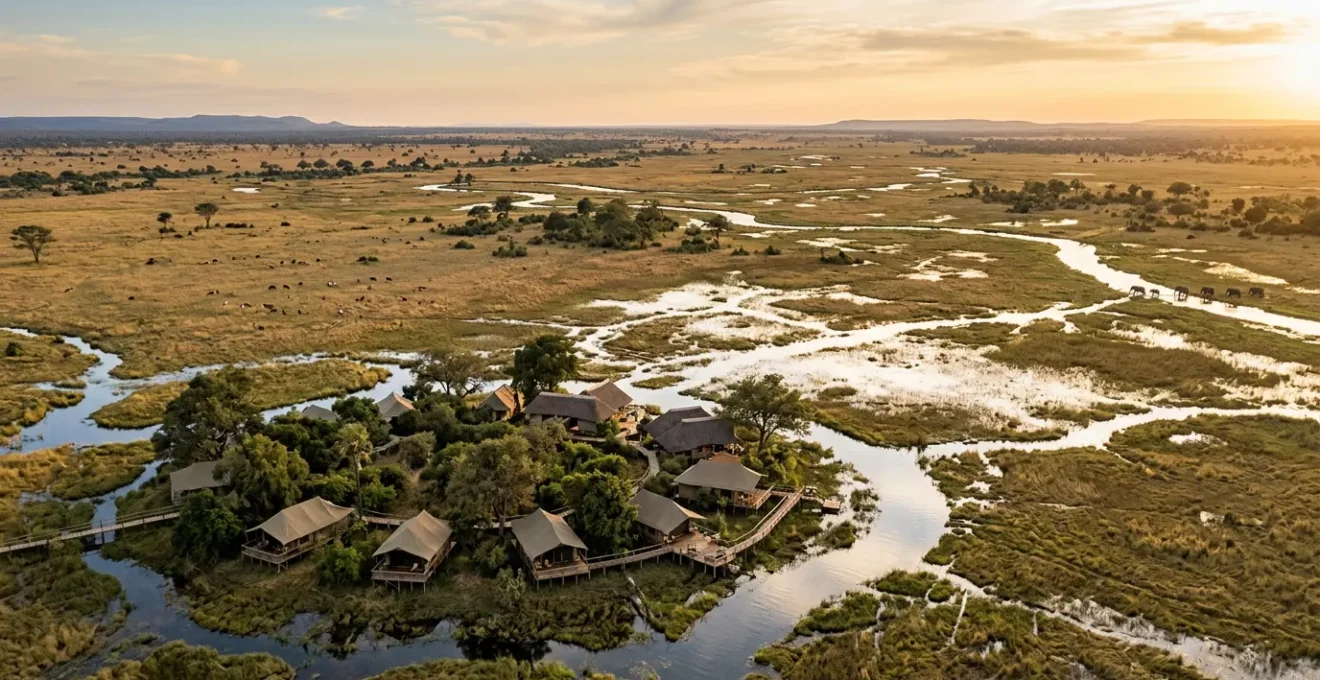
The premium price of a Botswana safari is a strategic economic tool designed for conservation, not just a luxury tax.
- It enforces a « low-volume, high-impact » model that prevents ecosystem collapse by staying within ecological limits.
- Up to 35% of your cost directly funds staff salaries and community development, with each high-end bed supporting up to 14 local individuals.
- Strict vehicle limits result in healthier, less-stressed wildlife and a profoundly more authentic and exclusive safari experience for you.
Recommendation: Vet your safari operator by asking precisely how their pricing structure contributes to concession fees, anti-poaching efforts, and direct local employment.
The moment of sticker shock is a rite of passage for many travelers planning a trip to Botswana. A price tag of $1,500 per person, per night—often for a tent, albeit a luxurious one—can feel staggering. The common justifications often sound vague: « it’s for conservation, » « it’s exclusive, » or « it supports communities. » While true, these statements barely scratch the surface of the sophisticated economic engine you are buying into. This isn’t just a vacation; it’s a direct investment in a meticulously engineered system designed to make wilderness preservation economically self-sufficient.
Forget thinking of it as a cost. It’s a capital injection into what can be best described as a « Conservation Economy. » This model was a deliberate, strategic choice by Botswana to avoid the pitfalls of mass tourism that have degraded ecosystems elsewhere. The high price acts as an economic moat, protecting the invaluable asset at its heart: pristine, thriving wilderness. To understand the value, you have to follow the money and see the tangible return on your investment, not in dividends, but in thriving lion prides, empowered communities, and unfenced landscapes.
This article will deconstruct that $1,500 price tag. We will analyze the financial architecture of Botswana’s « High-Value, Low-Volume » policy, tracing every dollar from your bank account to the anti-poaching ranger on the ground. We will quantify the impact on local employment, compare the wildlife experience to high-traffic parks, and reveal the precise mechanisms that make this model one of the world’s greatest conservation success stories. This is the balance sheet of the wild.
To fully grasp this economic model, we will break down its core components, from the ecological principles that dictate tourist numbers to the direct financial benefits that flow back into the ecosystem and its surrounding communities. The following sections provide a transparent audit of your investment.
Summary: Deconstructing Botswana’s Conservation Economy
- How Does Keeping Tourist Numbers Low Save the Ecosystem from Collapse?
- How Many Local Jobs Are Created by One High-End Safari Bed?
- Botswana vs. Kruger: Why Fewer Jeeps Mean Better Animal Behavior?
- How Much of the Park Fees Reaches the Anti-Poaching Units?
- Does the High-Value Model Exclude Locals from Visiting Their Own Parks?
- Why Animals in Botswana Are Less Stressed Than in the Serengeti?
- Where Does Your $1,500 Per Night Actually Go When You Sleep in a Tent?
- How Does Botswana’s Low Volume Policy Change Your Safari Experience?
How Does Keeping Tourist Numbers Low Save the Ecosystem from Collapse?
The foundation of Botswana’s tourism model is an economic principle applied to ecology: managing a scarce resource to maximize its long-term value. The « resource » is the wilderness itself, and its scarcity is its fragility. The « Low-Volume » policy is not arbitrary; it’s a direct response to the concept of Ecological Carrying Capacity—the maximum number of individuals an environment can sustain without negative effects. Overcrowding a national park is no different from overstocking a farm; the land degrades, resources are depleted, and the system eventually collapses.
While data for the Okavango Delta is proprietary, research from the Himalayas shows that ecological carrying capacity ranges from 11,833 to 15,778 visitors per day for a protected area. Exceeding this leads to soil erosion, water contamination, and wildlife displacement. Botswana’s strategy is to operate well below this theoretical maximum, treating tourist access as a limited « share » in the ecosystem. By pricing these shares high, the country generates the necessary revenue for conservation without destroying the asset it’s selling.
This is most evident in the structure of the concessions. As the African Safari Magazine Research Team notes in their « Best Luxury Safari Companies Report 2026, » « Ultra-luxury camps often sit on vast private concessions where government-mandated low guest density protects ecosystems. » A camp with only 20 beds might have exclusive access to hundreds of square kilometers. This creates a massive buffer zone, allowing natural ecological processes to continue undisturbed and preventing the concentrated environmental stress seen in mass-market destinations. It’s a calculated decision to trade high footfall for high value and ecological integrity.
How Many Local Jobs Are Created by One High-End Safari Bed?
A significant portion of your nightly rate is channeled directly into the most critical component of the conservation economy: people. The high-value model is labor-intensive by design, requiring a high staff-to-guest ratio to deliver its signature service level. This creates a powerful economic ripple effect that extends far beyond the lodge itself. The financial impact is best understood through the « per-bed multiplier, » a metric that quantifies how many individuals benefit from a single tourist’s stay.
The numbers are compelling. A study on southern African lodges reveals a significant social return on investment, as research from southern African lodges demonstrates that up to 14 people can benefit from every high-end tourism bed through direct employment, dependent families, and local supply chains. This is not charity; it is a sustainable economic loop. The camp needs chefs, guides, housekeepers, and maintenance staff, who in turn support local farmers, artisans, and service providers. Your stay directly finances this entire micro-economy.
Leading operators provide concrete evidence of this impact. Wilderness, a major operator in Botswana, employs over 1,100 people in the country, with an impressive 96% being local citizens. Many of these employees come directly from the villages adjacent to the concessions, creating a direct link between the presence of the lodge and the prosperity of the community. This turns locals into the most passionate guardians of the wildlife; they are not just neighbors to the park, but shareholders in its success. The « job » of a guide or tracker is not just a wage; it’s a career path that preserves and values traditional knowledge.
Botswana vs. Kruger: Why Fewer Jeeps Mean Better Animal Behavior?
The difference between a low-volume safari in Botswana and a high-volume experience in a park like South Africa’s Kruger is not just about the number of other vehicles you see; it’s about the quality of the wildlife encounters. Animal behavior is a direct indicator of environmental stress. In areas with high traffic density, animals become habituated to vehicles in a way that can alter their natural patterns. They may become either unnaturally bold or chronically stressed, neither of which represents their true wild behavior.
In Botswana’s private concessions, the opposite is true. With strict limits—often no more than two or three vehicles at a single sighting—the impact on animals is minimized. You are a temporary, quiet observer, not part of a constant parade of traffic. This allows for more intimate and authentic sightings. A leopard is more likely to continue its hunt, and a breeding herd of elephants will go about its social interactions undisturbed. You are witnessing wildlife, not wildlife-viewing tourism. This lack of pressure means guides have the freedom to follow a sighting for an extended period, allowing a story to unfold rather than rushing to the next « tick-box » animal on a checklist.
The entire philosophy is built on this principle. As the Wilderness Conservation Team states, « Botswana’s high-value, low-volume model generates maximum revenue per visitor while minimizing environmental impact. » Fewer jeeps are a direct consequence of this model. It ensures that the wildlife remains truly wild and that your presence as a tourist does not degrade the very thing you came to see. It transforms the experience from a passive viewing to an active, respectful immersion in an intact ecosystem.
How Much of the Park Fees Reaches the Anti-Poaching Units?
A primary justification for the high cost is its role in funding wildlife protection, particularly anti-poaching. In many countries, this funding chain is opaque, with park fees disappearing into centralized government budgets. Botswana’s model, however, creates a more direct and accountable flow of funds through concession fees, which are substantial payments made by operators for the exclusive right to use an area. These fees are a core part of your nightly rate and a primary revenue stream for conservation.
The scale of this funding is significant. For example, a single operator, Wilderness alone has contributed over BWP 269 million (approx. $23 million USD) in concession fees and paid over BWP 1 billion (approx. $85 million USD) to staff between 2014 and 2023. This is a massive, privately-funded conservation budget generated entirely by tourism. This revenue stream is predictable and stable, allowing for long-term planning and investment in protection infrastructure, which is a stark contrast to conservation efforts that rely solely on fluctuating government allocations or philanthropic donations.
Furthermore, this funding supports one of the most effective security apparatuses on the continent. According to Green Global Travel, « Botswana’s anti-poaching unit is largely run by the country’s military forces, with top-notch training, helicopters, military-grade weapons and supplies. » This is not a small-scale ranger patrol; it is a highly professionalized, well-equipped, and militarized force. The high revenue from tourism gives the government both the means and the political will to invest heavily in protecting its most valuable natural asset. Your safari fee is, in a very real sense, paying for the helicopter fuel, ranger salaries, and intelligence-gathering operations that keep Botswana’s elephant and rhino populations secure.
Does the High-Value Model Exclude Locals from Visiting Their Own Parks?
A common critique of the high-value model is that it creates « conservation for the rich, » effectively fencing off a nation’s natural heritage from its own citizens. While the price of a luxury lodge is indeed prohibitive for most Batswana, this perspective overlooks the broader, more systemic ways in which communities benefit and participate. The model is not about selling park access to locals; it’s about making conservation a profitable local enterprise.
The primary mechanism for this is the Community-Based Natural Resource Management (CBNRM) program. A study on Botswana’s conservation politics highlights that this program was designed to devolve power and ensure local communities benefit from and participate in decisions affecting their traditional lands. Many safari concessions are on community-owned land, with operators paying substantial lease fees directly to community trusts. These trusts then use the funds for local development projects like building schools, clinics, and providing clean water. The community doesn’t need to afford a $1,500/night stay when they are, in effect, the landlords profiting from it.
Furthermore, operators are heavily invested in fostering the next generation of conservationists. They run extensive educational programs, bringing local schoolchildren into the parks for game drives and conservation lessons. This builds a foundational understanding and appreciation for wildlife from a young age. It ensures that the value of the ecosystem is understood not just in economic terms (jobs and fees), but in cultural and ecological ones as well. The goal is to create a society where conservation is an integral part of the national identity, not a luxury accessible only to foreigners.
Why Animals in Botswana Are Less Stressed Than in the Serengeti?
The term « animal stress » can be scientifically measured, and it provides a stark biological case for Botswana’s low-volume model. Chronic stress, often caused by vehicle overcrowding and unpredictable human encounters, has physiological consequences. Research published in Nature’s Scientific Reports confirms that « Chronic stress from vehicle over-crowding elevates cortisol levels in animals, affecting reproduction and immune systems. » A stressed animal is an unhealthy animal, and an unhealthy population is not sustainable.
This is where the contrast with a high-volume destination like the Serengeti becomes clear. In some parts of the Serengeti, it’s not uncommon to see dozens of vehicles surrounding a single pride of lions. The constant engine noise and jockeying for position create a stressful environment. In response to this pressure, conservation authorities warned that a planned 250% increase in lodges within the greater Serengeti ecosystem raised serious concerns about exceeding the area’s tolerance. This level of development fundamentally alters the wilderness character and animal behavior.
In Botswana’s private concessions, the experience is the polar opposite. A strict vehicle limit at sightings means that animals are not encircled. Guides, who are often some of the best-trained in Africa, are skilled in understanding animal behavior and maintaining a respectful distance. They know how to position a vehicle so that it doesn’t block an animal’s path or feel like a threat. This low-pressure environment means animals continue their natural behaviors—hunting, nursing, playing—often ignoring the vehicle’s presence entirely. The result is not only a better experience for the tourist but a healthier, more resilient animal population.
Where Does Your $1,500 Per Night Actually Go When You Sleep in a Tent?
Deconstructing the $1,500 nightly rate reveals a clear and defensible allocation of funds. It’s not arbitrary; it’s a price point calculated to cover immense operational costs, substantial conservation levies, and significant community investment. An analysis of safari pricing structures reveals that conservation and community levies are built directly into the nightly rates, forming a large percentage of the total cost. This is the financial engine of the entire model.
The remote nature of these camps means logistical costs are exceptionally high. Everything from fresh food to fuel and building materials must be flown or trucked in over vast distances, contributing to the « Operations & Infrastructure » slice of the pie. The luxury element, while present, is often secondary to the exclusivity of the location and the quality of the guiding. The tent you sleep in may have Egyptian cotton sheets, but its true value comes from the sustainable materials used and the millions of dollars in concession fees paid for the ground it sits on.
A breakdown from industry analysis provides a transparent view of where the money goes. While figures vary between operators, the following table offers a representative allocation that justifies the high tariff.
| Cost Component | Percentage | Impact Area |
|---|---|---|
| Staff & Community | 30-35% | Local employment, training, lease fees |
| Conservation & Park Fees | 25-30% | Anti-poaching, research, concession fees |
| Operations & Infrastructure | 20-25% | Logistics, maintenance, food, fuel |
| Marketing & Distribution | 10-15% | Guest acquisition, agent commissions |
This data, sourced from reporting by publications like National Geographic’s analysis of conservation travel, demonstrates that a majority of your fee—potentially over 60%—is reinvested directly into the local economy and the ecosystem’s protection. It is a clear, financially sound model.
Action Plan: Auditing Your Safari’s Economic Impact
- Request a Breakdown: Ask potential operators if they can provide a general percentage breakdown of how their rates support conservation, community, and operations. Transparency is a sign of a responsible partner.
- Inquire about Concession Fees: Ask if their camps are on private concessions or community trust lands and how their fees contribute to land management and local revenue.
- Verify Community Projects: Look for specific, named community projects they support. Vague promises of « giving back » are less credible than partnerships with specific schools or health clinics.
- Check Employment Policies: Ask about their percentage of local staff, especially in management positions. A commitment to upskilling local talent is a key indicator.
- Assess Guide Training: A high-end safari’s value is in its guides. Inquire about their guide certification and ongoing training programs, which represent a significant investment in human capital.
Key Takeaways
- Botswana’s « High-Value, Low-Volume » model is a deliberate economic strategy to fund conservation by limiting ecological impact.
- A majority of your high-end safari cost (often over 60%) is directly reinvested into conservation fees, anti-poaching, and local community employment.
- The exclusivity you pay for results in healthier, less-stressed wildlife and a more authentic, immersive safari experience compared to mass-market parks.
How Does Botswana’s Low Volume Policy Change Your Safari Experience?
Ultimately, the economic model translates into a fundamentally different and superior safari experience. The policy of low-volume is not about elitism; it’s about quality control. By limiting the number of visitors, Botswana ensures that every traveler has a front-row seat to the wilderness, uncrowded by other vehicles and undisturbed by the pressures of mass tourism. This exclusivity is the tangible return you get for your investment.
This commitment to quality has been repeatedly recognized on the world stage. The success of the model is not just anecdotal; Botswana has been recognized for the fourth time as Africa’s best safari destination as of 2025, a direct endorsement of its strategy. You feel this difference the moment you land on a remote airstrip and realize your camp may be the only sign of human life for miles. You feel it when you sit with a leopard for an hour without another car in sight, or when your guide shuts off the engine to let you listen to the sounds of the bush without interruption.
Low volume is not elitism; it’s a conservation strategy. Botswana opted for fewer people in wilder places rather than many people in tamer ones.
– Nomad Horizons Africa, Cost of Botswana Safari Analysis
This quote perfectly encapsulates the philosophy. The high price tag is a filter that selects for a type of traveler who seeks profound immersion over a superficial checklist. It ensures that those who do visit are contributing meaningfully to the preservation of the environment they are enjoying. It is a self-reinforcing loop where high value funds pristine wilderness, and pristine wilderness justifies the high value.
Your journey to Botswana is therefore a conscious choice. It’s a decision to participate in a proven conservation success story. The next step is not to hunt for the cheapest price, but to select a partner who is transparently and passionately committed to the principles of this powerful conservation economy, ensuring your investment delivers the greatest possible return for the wild.