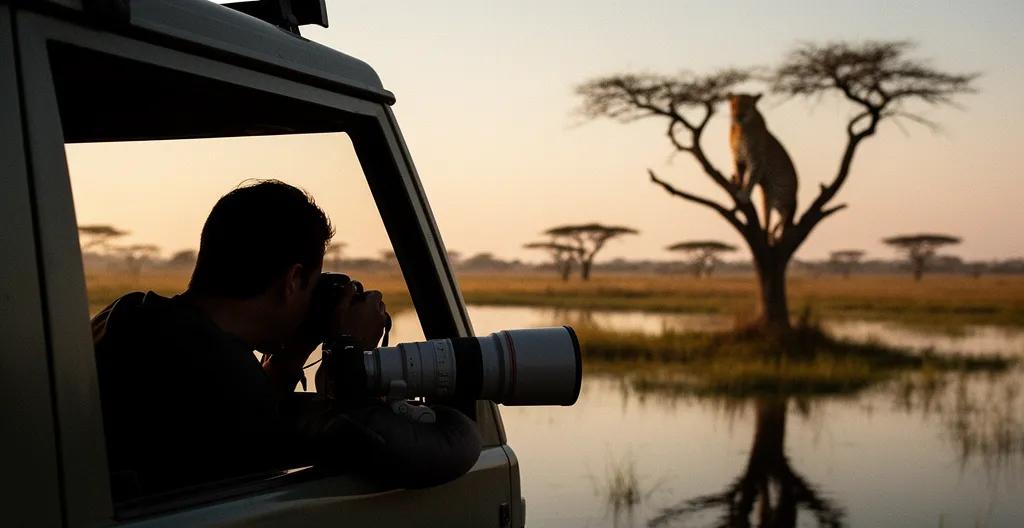
The essential « lens » for the Okavango isn’t a single piece of glass, but a complete system where your telephoto choice dictates your entire photographic workflow—from spotting wildlife to mastering the Delta’s unique light.
- Success depends less on having a specific focal length and more on integrating your lens with vehicle positioning, low-light techniques, and animal behaviour anticipation.
- Advanced skills like auditory triangulation and understanding lens compression are more impactful than marginal differences between high-end zoom lenses.
Recommendation: Instead of focusing solely on your primary lens, evaluate your entire gear and technique as a cohesive system. Prioritise a photography-focused safari that provides the time and flexibility to deploy these advanced strategies effectively.
For the dedicated photography enthusiast, the Okavango Delta is a paradox. It’s a canvas of unparalleled beauty, offering some of the most intimate wildlife encounters on the planet. Yet, it’s also a technical gauntlet of dappled light, challenging terrain, and fast-moving subjects. You’ve likely packed your 100-400mm or 200-500mm zoom, brought a beanbag on a friend’s advice, and read countless articles on the « golden hour. » Yet, the professional-grade, impactful images you envision remain just out of reach.
The common advice often stops at the gear list. It treats the lens as a standalone solution, a magic bullet for capturing the Big Five. This approach is fundamentally flawed. In an environment as dynamic as the Delta, your lens isn’t just a tool for magnification; it’s the core component of a much larger operational system. The real question isn’t which lens is « best, » but how you integrate your chosen optic into a complete workflow that encompasses spotting, positioning, anticipation, and technical execution under pressure.
But what if the key to unlocking professional results wasn’t found in upgrading from an f/5.6 zoom to an f/4 prime, but in mastering the intricate dance between your binoculars, your vehicle’s position, and your understanding of a leopard’s intent? This guide moves beyond the simplistic « what to pack » discussion. We will deconstruct the entire photographic process in the Okavango, revealing how to build a system around your lens to transform your images from simple snapshots into compelling wildlife portraits.
This article will explore the interconnected techniques that separate amateurs from professionals in the field. From the critical hand-off between your binoculars and camera to advanced low-light shooting strategies, you will learn to think and operate not just as a photographer, but as a field-savvy naturalist with a camera. Let’s delve into the system that truly makes a difference.
Summary: The Okavango Photographic System
- Binoculars 8×42 vs. 10×42:Maun Beyond the Airport: What Is Daily Life Like in the « Gateway to the Delta »?
- Where to Sit in the Land Cruiser to Get Eye-Level Shots of Lions?
- How to Anticipate Where a Leopard Will Drag Its Kill?
- How to Shoot Sharp Wildlife Photos in Low-Light Dawn Conditions?
- How Close Can You Legally Get to an Elephant in Chobe?
- How to Spot a Leopard in the Moremi Game Reserve Without a Tracker?
- How to Spot Malachite Kingfishers Hiding in the Papyrus?
- What Makes a « Premier » Game Drive Different from a Standard Park Tour?
Binoculars 8×42 vs. 10×42:Maun Beyond the Airport: What Is Daily Life Like in the « Gateway to the Delta »?
Your photographic workflow in the Okavango doesn’t begin when you raise your camera; it starts the moment you lift your binoculars. The choice between 8×42 and 10×42 optics is often debated, but for the photographer, the answer is clear. While 10x magnification offers more « reach, » the wider field of view of 8×42 binoculars is a decisive advantage. This wider perspective makes it significantly easier to locate subjects initially and, more importantly, to track animals moving through the dense bush or across open floodplains. The stability of 8x power also reduces hand-shake, allowing for longer, less fatiguing scanning sessions.
The goal is a seamless transition from spotting to shooting. A clumsy hand-off means missed opportunities. The key is to use your binoculars to acquire the target and then use landscape features—a distinctive termite mound, a fork in a leadwood tree—as a reference point. You lower your optics while keeping your eyes locked on that reference, not the animal itself. This allows you to bring your camera to your eye and quickly reacquire the scene at your lens’s widest setting before zooming in to compose. This disciplined process is far more efficient than sweeping a heavy 600mm lens across the landscape hoping to find a subject you saw moments before.
Your Action Plan: Essential Camera-to-Binocular Hand-Off Workflow
- Start with 8×42 binoculars for initial wildlife spotting; the wider 8.1° field of view makes tracking moving animals significantly easier than with 10×42 models.
- Once a target is acquired through the binoculars, note distinctive landscape features like tree shapes or termite mounds to serve as reference points.
- Lower the binoculars while maintaining eye contact with the reference point, not the animal itself. This is the crucial step to avoid losing your bearings.
- Bring your camera with pre-set ‘safari mode’ (e.g., 1/1000s shutter, Auto-ISO 100-3200, continuous autofocus with a wide zone) to eye level.
- Start at your lens’s widest zoom setting (e.g., 100-200mm) to quickly reacquire the subject using your landscape references, then smoothly zoom in to compose the shot.
Ultimately, your binoculars are not just for spotting; they are the first stage of your composition. They save your arms from the strain of holding a heavy lens and allow you to develop a mental picture of the shot before the camera even comes into play. Treating them as an integral part of your photographic system is a fundamental step toward more professional results.
Where to Sit in the Land Cruiser to Get Eye-Level Shots of Lions?
Capturing a truly compelling wildlife portrait, especially of a predator like a lion, is often about perspective. A top-down shot from a high safari vehicle feels like a snapshot; an eye-level photograph creates an intimate connection, drawing the viewer into the animal’s world. Achieving this low angle from a Land Cruiser requires a deliberate strategy, not just luck. The best seat isn’t always the one with the clearest view, but the one that offers the most flexibility for getting low. This often means the front passenger seat or a middle-row seat with a door that can be opened (where regulations permit).
The single most valuable tool for this is not a tripod, but a large beanbag. By placing a beanbag on the floor of the vehicle or on the door sill, you can create a stable, low-profile platform for your lens. This technique allows you to lie prone and shoot from just inches above the ground, transforming your perspective. It’s physically demanding but is the secret behind many stunning, ground-level wildlife shots. As professional photographer Paolo Sartori notes, this commitment is part of the process.
Are you willing to accept the physical strain of shooting a heavy prime all day in 40°C heat from a moving vehicle? That’s a real thing.
– Paolo Sartori, Professional Safari Photography Guide
This approach works best with long focal lengths. You don’t need to be physically close to the lion; you need to be compositionally close. A study of thousands of photos from Kruger National Park revealed a critical insight for vehicle-based photographers: 87% of shots were taken at focal lengths between 404-600mm. This demonstrates that stability from a window sill or beanbag, combined with a long lens, is a proven formula. It provides the reach to maintain a safe distance while the low angle creates the intimacy.
How to Anticipate Where a Leopard Will Drag Its Kill?
Photographing a leopard is a challenge; photographing it with its kill is a masterclass in patience and prediction. Simply following a leopard is not enough. The most powerful images come from anticipating its behaviour and positioning yourself for the shot before it happens. When a leopard makes a kill, its immediate priority is to secure it from scavengers like hyenas and lions. This is a critical imperative, as field studies reveal that up to two of every three tree-cached kills are eventually lost to competitors.
This instinct drives their next move. A leopard will almost always seek to drag its prey to a secure, elevated location. Your job is to read the landscape like the leopard does. Look for large, sturdy trees with strong, low-hanging horizontal branches—sausage trees and jackalberry trees are classic choices. The leopard needs a branch substantial enough to hold its weight and the weight of the carcass. GPS collar studies have confirmed this, showing that kill sites are overwhelmingly chosen in areas with dense vegetation cover and available tree refugia, often at slightly higher elevations.
Beyond visual cues, sound can be your most reliable guide. An experienced guide shared an invaluable piece of fieldcraft: the calls of other animals are often the first sign of a leopard’s presence and intentions. As he explained, « One of the most interesting sounds I have learned that has always led me to a leopard sighting is an unusual call of the African Fish Eagle. » While monkeys and birds give alarm calls, the specific, agitated calls from multiple sources can help you triangulate a leopard’s path as it drags its kill through the bush. By combining these auditory cues with an analysis of the landscape, you can make an educated guess about its destination and get there first.
How to Shoot Sharp Wildlife Photos in Low-Light Dawn Conditions?
The first and last hours of daylight—the « golden hours »—are when the predators of the Okavango are most active. This is also when the light is most beautiful and most challenging. Shooting in these low-light conditions is where equipment choices and technical skill are put to the ultimate test. The debate between a « fast » prime lens and a versatile zoom lens becomes critically important here. A prime lens like a 400mm f/2.8 offers a significant two-stop advantage in light-gathering ability over a typical f/5.6 zoom, but its fixed focal length can be restrictive. A high-quality zoom like a 100-400mm f/4.5-5.6 offers framing flexibility, which is crucial when light and animal positions are changing rapidly.
The choice depends on the specific scenario you anticipate, as each lens has distinct advantages and limitations in the dim light of dawn. A professional must understand this trade-off intimately.
| Lens Type | Low Light Advantage | Practical Limitations | Best Use Case |
|---|---|---|---|
| 400mm f/2.8 Prime | 2-stop advantage, 95mm entrance pupil | Fixed framing, requires repositioning | Stationary subjects in deep shade |
| 100-400mm f/4.5-5.6 Zoom | Versatile framing for changing light | 1-2 stops slower than prime | Dawn patrol when animals are active |
| 600mm f/4 Prime | Maximum reach with f/4 aperture | Heavy, limited flexibility | Distant leopards at first light |
Regardless of your lens choice, the right technique is paramount for capturing clean, sharp images. Simply increasing your ISO is a blunt instrument that can lead to excessive noise. A more sophisticated approach is the « Expose to the Right » (ETTR) technique. This involves intentionally overexposing the image slightly without clipping the highlights, capturing the maximum amount of light and data in your RAW file. This gives you far more latitude in post-processing to bring down the exposure and reduce noise, resulting in a cleaner final image than one that was underexposed and brightened later. Mastering ETTR requires practice and a solid understanding of your camera’s histogram.
Your Action Plan: ETTR Technique for Dusty Dawn Photography
- Set your exposure compensation to +1/3 to +2/3 of a stop to push the histogram to the right, capturing maximum light data.
- Use Spot metering mode during dawn drives with a spotlight, metering on the subject to ignore the vast dark areas around it.
- Enable your camera’s live histogram display and watch carefully to ensure the data approaches the right edge without « clipping » or bunching up against it.
- Always shoot in RAW format. This is non-negotiable as it retains the full dynamic range needed for highlight recovery in post-processing.
- Apply lens-specific Image Stabilization (IS) or Vibration Reduction (VR): use Mode 1 for static subjects and Mode 2 for panning with moving animals.
By combining a deliberate lens choice with a disciplined technical approach like ETTR, you can conquer the challenges of low light and capture the dramatic moments that the dawn patrol offers. This is one of the most technical but rewarding skills in wildlife photography.
How Close Can You Legally Get to an Elephant in Chobe?
The question of proximity to wildlife, especially a massive bull elephant in Chobe National Park, is a critical one. While park regulations dictate a minimum legal distance, the more important question for a photographer is about « photographic distance. » As professional photographer Nick Dale states, Botswana is a premier destination for this very reason.
I’m not a great fan of elephants… but if you love elephants, the best place to go is definitely Botswana. One of the good things about Botswana is the presence of water.
– Nick Dale, Professional Wildlife Photographer
The goal is not to get as physically close as possible, which can be dangerous for you and stressful for the animal. The goal is to create the *illusion* of intimacy through technique. This is where your long telephoto lens becomes a creative tool, not just a tool for magnification. The key technique is lens compression. An extreme telephoto lens (400mm and above) has the effect of compressing the perceived distance between your subject and the background, making distant elements appear closer and larger than they really are. This allows you to fill the frame with the elephant while also pulling the beautiful Chobe riverfront or distant hills into the composition, creating a layered, powerful image from a safe and respectful distance.
Instead of trying to « get close, » focus on your position and composition. Use the long end of your lens to isolate the elephant against a clean background. Let the compression do the work of creating impact. This technique not only results in more artistically compelling photographs but also embodies the ethical principle of wildlife photography: observing without disturbing. A truly great elephant portrait tells a story about the animal in its environment, and that’s an effect achieved with optics and skill, not by breaking the animal’s personal space.
How to Spot a Leopard in the Moremi Game Reserve Without a Tracker?
The leopard, known as the « Prince of Darkness, » is the most elusive of the Big Five. Its secretive nature and preference for nocturnal activity make daytime sightings a rare prize. Indeed, research from South Africa shows that 69% of camera trap photos of leopards are taken at night, underscoring why finding one during a game drive is so difficult. Without the aid of a professional tracker, your eyes alone are often not enough. You must learn to listen.
The bush has its own alarm system, and learning to interpret it is a skill that dramatically increases your chances. This method, known as auditory triangulation, involves paying close attention to the warning calls of other species that share the leopard’s habitat. Vervet monkeys and baboons have specific, frantic alarm calls reserved for leopards, which are distinct from the calls they use for snakes or eagles. By noting the direction of these calls from multiple sources, you can begin to pinpoint the leopard’s location.
The process is a dynamic one, requiring you to follow the « wave » of alarms as the leopard moves. Here are the key sounds to listen for:
- Vervet Monkeys & Baboons: A sharp, repetitive, high-pitched bark is the most common and reliable indicator.
- Francolins & Guineafowl: These ground birds erupt in a harsh, cackling chorus that intensifies when a leopard is moving nearby.
- Grey Go-away-bird: This bird’s nasal « go-waaaay » call often persists long after other alarms have subsided, helping to track a leopard’s path.
Even with these skills, patience is paramount. A compelling case study from the Serengeti highlights this: photographers spent hours observing a young female leopard that was seemingly inactive on a rocky outcrop. By waiting patiently, they noticed her ears twitching and her gaze fixed on a specific spot. This quiet observation, lasting hours, eventually revealed she had cubs hidden nearby—a sighting they would have missed entirely if they had moved on after a few minutes. Patience, combined with listening, turns a game of chance into a game of skill.
How to Spot Malachite Kingfishers Hiding in the Papyrus?
While the Big Five dominate most safari wish lists, the Okavango Delta offers incredible opportunities for bird photography, presenting its own unique set of challenges. Spotting a tiny, jewel-like Malachite Kingfisher amidst a dense wall of papyrus reeds is a test of both vision and technique. These birds are small, fast, and expertly camouflaged. From a moving vehicle on land, it’s nearly impossible. The key to success lies in getting on the water.
The water-based environment of the Okavango requires a specific platform. As one experienced wildlife photographer advises, the right boat is critical for the stability needed for sharp images with a long lens.
While you can use a vehicle in some parts, some of the best opportunities for wildlife photography, especially for photographing birds, are by boat… I would advise sticking to a motorized flat-bottomed boat for stability.
– David (Wildlife Photographer), Nature TTL Photography Guide
From this stable platform, the technique is about training your eye. You are not looking for the shape of a bird. You are scanning the uniform green of the papyrus wall for a single, out-of-place flash of electric blue or vibrant orange. It’s a game of pattern recognition. Your guide will slowly navigate the boat along the reed beds, and your job is to keep your eyes moving, scanning for that tiny anomaly. When you spot one, signal your guide to cut the engine, allowing the boat to drift into a stable shooting position. Because they often perch on low-hanging reeds, a boat puts you at a perfect eye-level angle, a perspective you can rarely achieve on land. This specialized pursuit is a rewarding part of a complete Okavango photographic experience.
Key Takeaways
- Your lens is part of a system, not a standalone tool; its effectiveness is determined by your workflow.
- Mastering low angles and stability from the vehicle using tools like beanbags is non-negotiable for professional-quality shots.
- Anticipating animal behaviour through auditory and environmental cues is an advanced skill that sets pros apart from amateurs.
What Makes a « Premier » Game Drive Different from a Standard Park Tour?
All the techniques discussed—mastering low angles, patiently waiting for a leopard, and positioning for the perfect light—are only possible if your environment allows for them. This is the fundamental difference between a standard park tour and a true « premier » photographic safari. A standard tour is often about ticking off a checklist of sightings, with limited time at each stop and a vehicle full of people with different interests. For a serious photographer, this model is a recipe for frustration.
A premier, photography-focused safari is built around a different philosophy. It’s about creating opportunities, not just finding animals. This is achieved through several key advantages that are often exclusive to private concessions and specialized operators. The most critical of these is the permission to drive off-road. As noted by operators like Pangolin Photo Safaris, the ability to leave the main tracks on a private concession allows a guide to position the vehicle for the best possible light and to anticipate an animal’s movement. You can’t get that perfect, backlit, rim-lit shot if you’re stuck on a road facing the wrong direction.
Furthermore, these safaris operate on a photographer’s schedule, not a tourist’s. This means leaving camp 30-60 minutes before sunrise to be in position for the first light and returning after sunset to capture the last moments of the « blue hour. » Vehicle capacity is strictly limited to 3 or 4 photographers, guaranteeing everyone a window seat, ample space for gear, and the ability to shoot from both sides. Perhaps most importantly, you have the flexibility to stay at a sighting for hours if necessary, waiting for that perfect moment, that yawn, that interaction, that leap. It is this combination of access, time, and exclusivity that unlocks the full potential of your gear and skills. As renowned photographer Greg du Toit describes the experience:
On this Okavango Delta photo safari you will search for your wildlife subjects in splendid isolation, driving for hours without seeing any other vehicles.
– Greg du Toit, African Wildlife Photographer
Ultimately, investing in a premier game drive is investing in your ability to execute the craft. It provides the platform upon which the entire photographic system—from spotting to shooting—can be successfully deployed.
The next step in your journey isn’t necessarily buying a new lens; it’s choosing an experience that allows you to master the system. When evaluating your next trip, assess potential safaris not by their price, but by their vehicle limits, their off-road policies, and the photographic expertise of their guides. This is how you truly elevate your craft and capture the Okavango you’ve always envisioned.