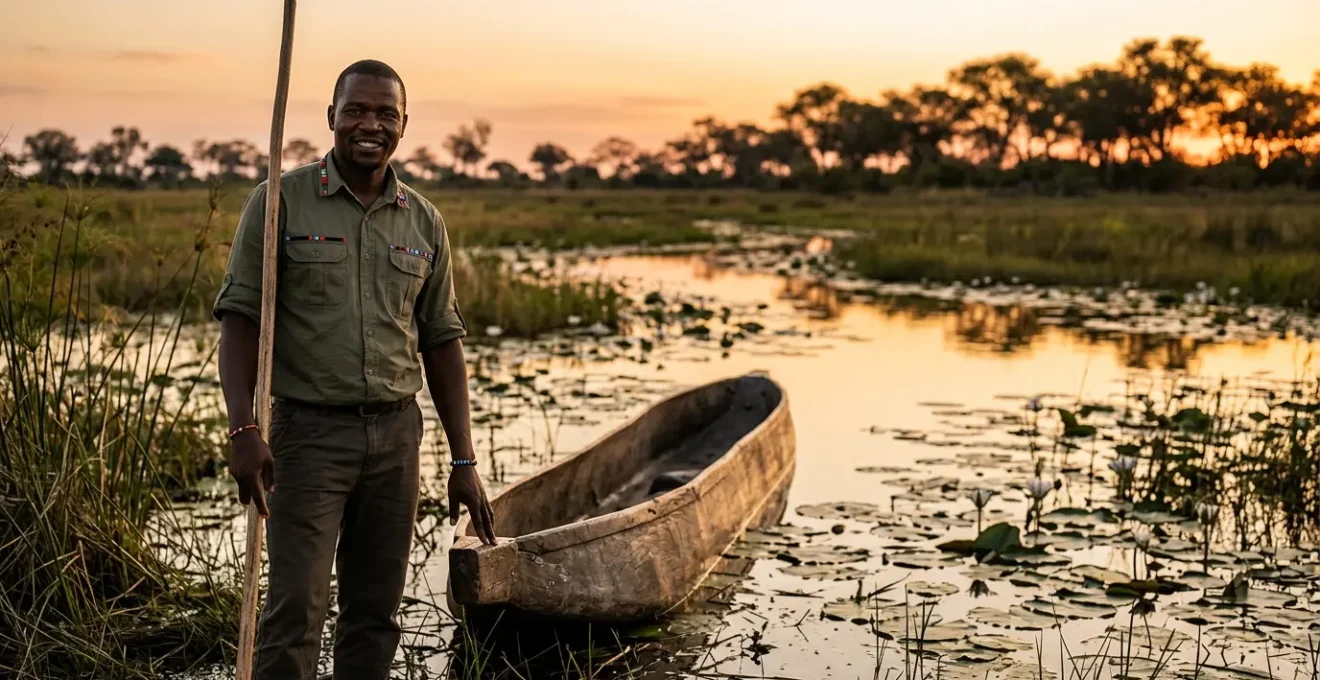
Booking direct with a citizen-owned operator is the single most powerful way to ensure your safari budget supports Batswana communities, not offshore accounts.
- Local operators retain 100% of revenue in-country, compared to the 40-60% « economic leakage » common with international agents.
- Verification is possible through public registries (CIPA, BTO), and direct communication reveals a depth of on-the-ground expertise that middlemen cannot offer.
Recommendation: Use the verification steps in this guide to question every operator and vote with your dollar for genuine local empowerment.
The dream of a Botswana safari is potent. It’s a vision of vast landscapes, unparalleled wildlife, and the hushed magic of the Okavango Delta. As a conscious traveler, you already know you want your visit to be a force for good. You’ve likely heard the advice to « book local » or look for eco-credentials. But these well-intentioned phrases often skim the surface of a much deeper issue: economic leakage. A significant portion of the money spent on tours booked through large international agencies never truly touches the local economy it promises to support.
This guide isn’t about simply feeling good; it’s about being effective. It’s for the traveler who understands that their dollar is a vote and wants to cast it with precision. What if the key wasn’t just choosing a local guide, but fundamentally rerouting your travel funds away from corporate intermediaries and directly into the hands, homes, and communities of Batswana? It’s a deliberate act of economic solidarity that transforms your safari from a passive holiday into an active investment in local prosperity.
We will equip you with the tools to see through the marketing and verify true citizen ownership. We will break down the real cost differences, manage your expectations for direct communication, and reveal why local knowledge is an invaluable asset. This is your blueprint for ensuring your adventure creates a lasting, positive ripple effect long after you’ve returned home.
This comprehensive guide is structured to empower you at every step of your decision-making process. From verifying ownership to understanding the on-the-ground realities, each section provides the clarity you need to book your Botswana safari with confidence and impact.
Summary: A Traveler’s Guide to Impactful Botswana Safari Bookings
- How to Check if a Safari Company Is Truly 100% Citizen Owned?
- Are Local Operators Cheaper or More Expensive Than International Agents?
- What to Expect When Communicating Directly with Small Local Operators?
- Why Do Local Operators Know Secret Spots That Big Chains Miss?
- How to Find Safari Companies Owned and Run by Batswana Women?
- What Percentage of Staff Are Local vs. Expat in Eco-Lodges?
- The 3 Questions to Ask Your Tour Operator Before Booking a Cultural Village Tour
- Maun Beyond the Airport: What Is Daily Life Like in the « Gateway to the Delta »?
How to Check if a Safari Company Is Truly 100% Citizen Owned?
In the world of tourism, words like « local » and « partner » can be misleading. The practice of ‘fronting’—where a non-citizen entity uses a citizen as a nominal head to gain benefits reserved for local businesses—is a real concern. To ensure your money supports genuine citizen enterprise, you must become a savvy investigator. This isn’t about suspicion; it’s about due diligence for impactful travel. True citizen-owned companies are proud of their status and transparent about their structure.
Your first step is to move beyond the company’s website and use official resources. You can perform a public search on Botswana’s Companies and Intellectual Property Authority (CIPA) registry to verify the listed directors and shareholders. Furthermore, every legitimate operator must have a Botswana Tourism Organisation (BTO) license. Ask for their license number and inquire if they are registered under the Citizen Economic Empowerment (CEE) policy. A great example of authentic citizen ownership is Desert & Delta Safaris. Established in 1982, it is wholly owned and managed by Botswanan citizens, a fact they proudly state and which can be verified, demonstrating a four-decade commitment to local leadership in prime safari locations.
Beyond paperwork, look at the people. What is the ratio of citizens to expatriates in senior management and specialist roles like head guides or lodge managers? High-quality citizen-owned companies invest in their own people for top positions. According to Kwando Safaris, a 100% citizen-owned operator, 98% of its workforce are Botswanan nationals, showcasing a deep commitment to local employment at all levels. If the citizen « owner » is consistently unavailable or seems to lack deep industry knowledge, it could be a red flag warranting further investigation.
Are Local Operators Cheaper or More Expensive Than International Agents?
It’s a common misconception that booking direct with a small local operator is always cheaper. While you cut out an intermediary’s commission, the price might appear similar at first glance. The critical difference isn’t the final price tag, but the value distribution of your dollar. The real question is: who are you paying? When you book through a large international agent, you are fueling a system prone to economic leakage, where a substantial portion of your money leaves the destination country.
This is not a minor detail. The commission taken by an overseas agent can be between 40-60% of the total cost. That’s money extracted from Botswana’s economy before it has a chance to create any local benefit. A 100% citizen-owned operator, by contrast, retains 100% of that revenue within the country. This money doesn’t just go to the owner; it pays local guides, mechanics, chefs, and suppliers. It creates a powerful positive ripple effect through the community. The following table, based on industry observations, illustrates this stark difference.
The data clearly shows how booking direct maximizes in-country benefits, as highlighted in a recent analysis on responsible tourism.
| Aspect | Local Operator | International Agent |
|---|---|---|
| Revenue Retention | 100% stays in-country | 40-60% extracted as commission |
| Job Creation | 4.5 people fed for every 1 hired | Limited local employment impact |
| Seasonal Flexibility | Direct pricing adjustments possible | Fixed rate contracts limit flexibility |
| Pre-trip Planning | Direct access to expert guide | Communication through middleman |
This isn’t an abstract economic theory. It’s the difference between funding a distant corporate office and funding a child’s education in Maun. The image below visualizes this concept: your single payment branching out to support a diverse local ecosystem of crafts, produce, and skilled labor.
Ultimately, a local operator has the flexibility to adjust pricing for seasons or custom requests, a freedom international agents with fixed contracts don’t have. So while the initial quote may be comparable, the true value and impact of where your money goes are worlds apart.
What to Expect When Communicating Directly with Small Local Operators?
Local safari operators know the region better, understand wildlife movements from experience, can interpret animal behaviour better, and tell stories that make the safari experience more meaningful.
– Safari Haven Botswana, Botswana Safari Operators Guide
Communicating directly with a small, citizen-owned operator is a fundamentally different experience from dealing with a polished international call center. It requires a shift in expectation—from expecting instant, 24/7 service to embracing a more personal, and ultimately more rewarding, process. You are not a number in a CRM system; you are a person talking directly to an expert on the ground, and sometimes that expert is literally out in the bush, away from a reliable signal.
Patience is key. Response times of 24-48 hours are normal, especially if the owner is also the lead guide. Many smaller operators in Botswana prefer WhatsApp for communication over email, as it’s quicker for informal queries. Be mindful of the time zone (CAT, GMT+2) when you reach out. This direct line of communication is a feature, not a bug. It allows you to ‘co-create’ your itinerary with the very person who knows the secret waterholes and the best time of day to see leopard cubs. This is an unparalleled level of customization that a middleman can never offer.
When it comes to payment, be prepared for bank transfers rather than credit card portals, which are expensive for small businesses to maintain. Always verify that the business bank account name matches the registered company name. This entire process is about building a relationship of trust. To help, here is a simple toolkit for direct communication:
- Use WhatsApp for quicker, informal queries—most operators prefer this.
- Be mindful of Botswana’s time zone (CAT – Central Africa Time, GMT+2).
- Expect 24-48 hour response times, as guides may be in remote areas.
- Prepare for bank transfers and verify the business bank account name.
- View the process as ‘co-creation’—you’re building a bespoke trip with a true expert.
Why Do Local Operators Know Secret Spots That Big Chains Miss?
The most coveted safari experiences are often found in places that don’t appear on any map or official park brochure. These are the « secret spots »—a secluded hippo pool, a leopard’s favorite denning tree, a private channel in the Delta. These are not assets that can be bought or contracted; they are earned through generations of knowledge and deep community trust. This is where citizen-owned operators have an unassailable advantage over large, foreign-owned chains.
Big corporations operate on legal agreements and land leases. Local operators often run on relationships. Their access to exclusive community-owned lands is built on trust, family ties, and a proven long-term commitment to the community’s well-being. A prime example is how certain operators gain access to private concessions through partnerships that include commitments to solar power, responsible water use, and direct community support—terms that a corporate entity focused on quarterly returns may not prioritize. This is the essence of Botswana’s tourism philosophy, which as Dutch, a Head Guide, explains, follows a low-volume, high-value model. This model inherently favors intimate, low-impact experiences over mass tourism, preserving the very exclusivity that makes these spots special.
This intimate knowledge extends beyond geography. A local guide whose grandfather taught him how to track lions by the call of a specific bird possesses an interpretive layer of knowledge that cannot be learned in a training manual. They offer sovereign storytelling—the narrative of the land told by those who belong to it. They don’t just show you an elephant; they tell you about this specific matriarch, her family history, and how her movements change with the seasons. This is the authentic, unscripted magic that transforms a great safari into an unforgettable one.
How to Find Safari Companies Owned and Run by Batswana Women?
Empowering women is one of the most effective ways to uplift an entire community. Yet, in the safari industry, a significant gender gap persists. Data from the African Bush Camps Foundation reveals that more than 90% of Botswana’s safari guides are men. This makes the act of finding and supporting companies owned or run by Batswana women not just a preference, but a powerful statement for gender equality and economic justice. These women are trailblazers, breaking down traditional norms and reshaping the future of tourism in their country.
The most inspiring example of this is the ‘Chobe Angels’, the only all-female guiding team at Chobe Game Lodge in Botswana’s Chobe National Park. This team of 22 professionally trained women has become a symbol of excellence and empowerment, proving that guiding is not defined by gender. Booking with a lodge like Chobe Game Lodge, or specifically requesting a female guide at progressive companies like Desert & Delta Safaris, sends a clear market signal: there is a demand for female leadership in the bush.
Finding these pioneers requires proactive effort. You must go beyond standard searches and actively seek out the organizations and programs championing this change. It means asking lodges pointed questions about their female guide training programs and their plans for promoting women into management roles. Your choice directly funds this progress, turning your holiday into a direct investment in female empowerment. To make this easier, here is a concrete plan to follow.
Your Action Plan for Supporting Batswana Women in Tourism
- Contact the Botswana Women in Tourism Association for their member directories and recommendations.
- Look for operators participating in the African Bush Camps’ Female Guides Program, which has been training cohorts since 2021.
- Specifically request Lynn Tebalo, the first female guide in Desert & Delta Safaris’ bush camps, to signal demand.
- Consider the Women Empowerment Safari by African Bush Camps, where a portion of the booking directly funds female guide training.
- Ask every lodge about their female guide training programs and their internal succession plans for women.
What Percentage of Staff Are Local vs. Expat in Eco-Lodges?
The sign on the lodge may say « eco, » but the most sustainable resource in any business is its people. A truly responsible lodge doesn’t just manage its environmental footprint; it actively cultivates its human talent. When evaluating a lodge, looking at the ratio of local Batswana staff to expatriates is a crucial indicator of their commitment to genuine local development. However, the raw numbers can be deceiving. It’s easy for a lodge to claim « 95% local staff » if those roles are exclusively low-wage positions like cleaning or groundskeeping.
The more revealing metric is the Management & Specialist Ratio. Who holds the power? Who is the head guide, the lodge manager, the head chef? These senior positions come with higher salaries, greater responsibility, and the ability to influence company policy. When these roles are held by citizens, it signifies a deep investment in local capacity building. An even better sign is a formal succession plan. Ask if there’s a mentorship program in place for expat-held roles, where a Motswana citizen is being trained over a 3-5 year period to take over that position. This demonstrates a long-term vision, not a short-term dependency on foreign expertise.
The impact of hiring a local for a senior role goes far beyond a single salary. As reported by responsible tourism advocates in Botswana, every person hired by a lodge feeds, on average, 4.5 other people. This economic ripple effect is magnified when the job is a high-skill, high-wage position. It builds a stable middle class, funds education for the next generation, and creates a virtuous cycle of community prosperity. Therefore, choosing a lodge that champions local talent in leadership roles is one of the most impactful decisions you can make.
The 3 Questions to Ask Your Tour Operator Before Booking a Cultural Village Tour
Cultural village tours offer a tantalizing glimpse into traditional life, but they walk a fine line between authentic exchange and exploitative performance. A poorly managed tour can feel like a « human zoo, » where communities are put on display for tourist consumption. A truly ethical encounter, however, is a powerful experience that is respectful, mutually beneficial, and controlled by the community itself. To distinguish between the two, you must ask your tour operator three non-negotiable questions before you book.
First: « How does the community financially benefit from my visit? » A vague answer like « your visit helps them » is a red flag. A good answer is specific: « We pay a per-person fee directly to a village committee, which they use for community-chosen projects like a new well or school supplies. » This ensures the money is controlled by the community and used for their priorities. Second: « How does the community control the narrative and experience? » An ethical operator will have empowered the village elders to decide what aspects of their culture they wish to share, when tours can happen, and which areas of the village remain private. The community must be the author of their own story, not actors in a script written by a tour company.
Finally: « What is your long-term relationship with this community? » A one-off transactional visit is less impactful than a sustained partnership. A great operator can point to specific, long-term projects they have supported. For instance, Wilderness Travel’s support for the Kazungula Children’s Ark Day Care is a model of this. They provide ongoing funding for a safe, educational environment for underprivileged children, with all money going toward tangible needs like food and educational materials. This shows a relationship built on genuine support, not just tourism profit. These three questions will reveal an operator’s true ethics and ensure your visit is a respectful exchange, not a hollow transaction.
Key takeaways
- Verify Ownership: Don’t just trust a website. Use official CIPA and BTO registries to confirm a company is 100% citizen-owned.
- Cut the Middleman: Booking direct with a local operator ensures 100% of your money stays in Botswana, preventing the 40-60% economic leakage common with international agents.
- Champion Women: Actively seek out and support female guides and women-led safari operations to promote gender equality in the industry.
Maun Beyond the Airport: What Is Daily Life Like in the « Gateway to the Delta »?
For many travelers, Maun is little more than an airstrip—a functional transit point before disappearing into the pristine wilderness of the Okavango Delta. But to see it only as a gateway is to miss the vibrant heart of Botswana’s safari ecosystem. Maun is a frontier town where the dusty realities of daily life intersect with the high-stakes world of international conservation and tourism. It’s here that the economic ripple effect of your travel dollars is most tangible.
This is not a polished tourist town; it’s a working hub. It’s the home of expert bush mechanics who can fabricate a custom vehicle part in hours, welders who build the iconic safari cruisers, and food suppliers who provision remote camps for weeks on end. It’s the headquarters for crucial conservation organizations like Elephants Without Borders and the site of the Maun Educational Park. Life here is a fascinating mix of the traditional and the modern: you’re just as likely to encounter a donkey cart traffic jam in the old town as you are to have coffee next to a world-renowned wildlife biologist at « The Duck » cafe, a local institution.
To truly understand Maun is to look beyond the tourist-facing shops and venture into the neighborhoods that pulse with local life. A typical day might involve:
- Navigating the famous donkey cart traffic in the old town.
- Tasting traditional seswaa (slow-cooked beef) and pap at a local eatery in the Old Mall.
- Visiting the Kgotla (traditional court) to see community governance in action.
- Experiencing the vibrant communities of Boseja and Botshabelo in the evening.
Spending a day or two in Maun offers a profound context for your safari. It shows you the intricate support system that makes your wilderness experience possible and connects you to the everyday lives of the people who call this gateway home. It completes the picture, reminding you that your journey is part of a much larger, interconnected story.
Frequently Asked Questions about Citizen Empowerment in Tourism
What is your Management & Specialist Ratio for citizen vs expat staff?
This reveals if citizens hold senior positions or just entry-level roles. A truly responsible lodge should have citizens in management, head guide, and head chef positions.
What is your succession plan for expat-held management roles?
Look for lodges with formal 3-5 year mentorship programs where expat managers train Motswana citizens to take over their positions.
How do you support your citizen staff’s families?
Responsible lodges often provide children’s education support, family healthcare, and merit-based advancement programs for local staff.