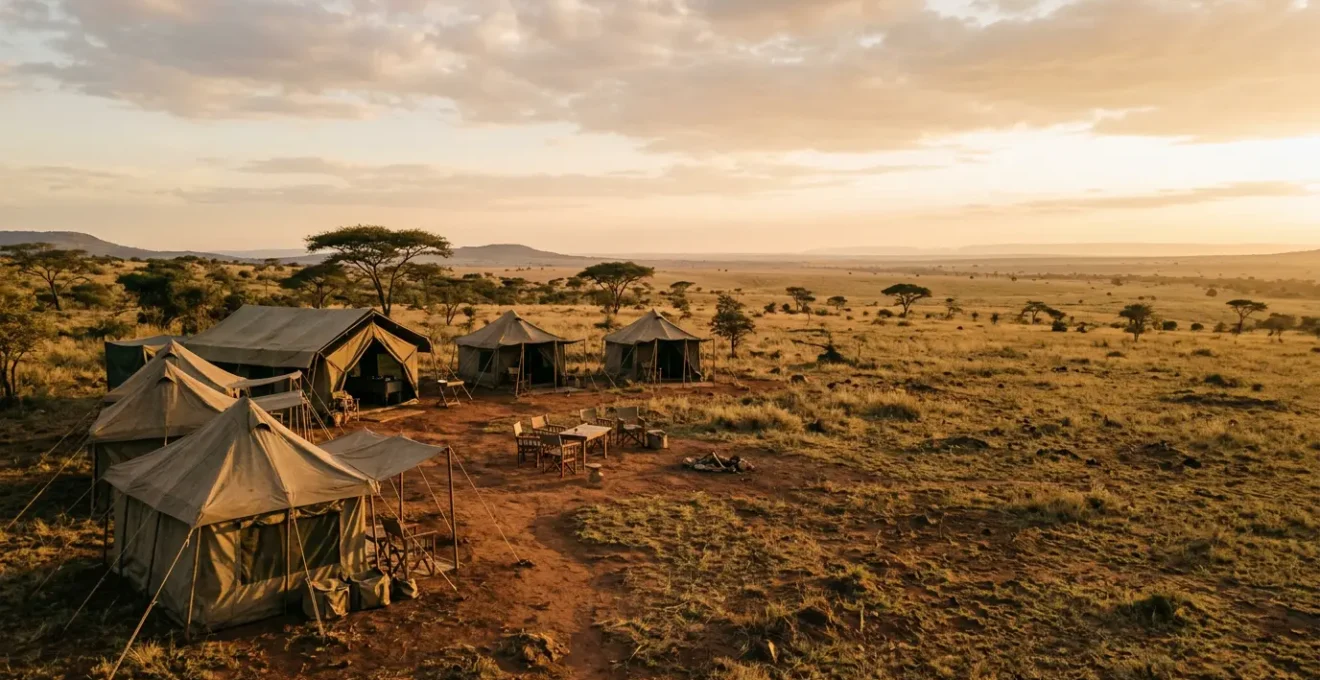
The greatest myth of modern safaris is that comfort requires walls; in reality, true authenticity is found by shedding them.
- Mobile camps don’t just move; they follow the intricate « Wilderness Rhythm, » putting you in the heart of the action where the wildlife is, right now.
- The shared, unplugged experience forges genuine bonds, creating a ‘temporary tribe’ of explorers around the campfire.
Recommendation: For the purist traveler, the choice is clear: opt for a mobile safari to experience the wild as an active participant, not a distant spectator.
You’re sitting on the veranda of a beautiful safari lodge. The gin and tonic is perfectly chilled, the infinity pool glistens, and in the distance, you hear it—the deep, guttural roar of a lion. It’s magnificent, yet you feel a subtle sense of separation, a pane of glass between you and the raw energy of the African bush. This is the paradox of the permanent lodge: it offers a flawless imitation of the wild from a position of insulated comfort.
For decades, the safari industry has equated luxury with permanent structures, Wi-Fi, and extensive menus. These are comforts, certainly, but they are the comforts of a hotel. They create a bubble that, while pleasant, can buffer you from the very thing you came to experience: the untamed pulse of the wilderness. For the traveler who yearns to feel like an early explorer, who feels that a lodge is too « hotel-like, » there is a more profound way to connect with Africa.
But what if the real luxury isn’t insulation *from* the wild, but seamless immersion *within* it? This is the core philosophy of a mobile safari. It’s an approach that deliberately sheds the unnecessary walls to follow the ‘Wilderness Rhythm’—the seasonal migrations, the shifting water levels, and the daily dramas of predator and prey. It’s not about « roughing it »; it’s about a sophisticated ‘Logistical Ballet’ designed to place you in the right place at the right time, every time, creating an experience of unparalleled authenticity.
This guide delves into the mechanics and the magic of the mobile safari. We’ll explore how these camps move with such grace, what life is really like under canvas, and why this nomadic style consistently delivers more intimate wildlife encounters and deeper human connections. It’s time to step out of the lodge and into the heart of the adventure.
Summary: The Case for a Truly Nomadic Safari
- How Does a Mobile Camp Move Location Without You Lifting a Finger?
- What Is the Difference Between a Dome Tent and a Meru Tent?
- Why Are Mobile Safaris Better for Creating Close Friendships?
- How Does a Bucket Shower Work and Is the Water Hot?
- Why Do You See More Animals When You Move Camp Every 3 Days?
- Hard Shell vs. Soft Shell: Which Roof Tent Survives the Kalahari Winds?
- How to Camp Safely in Savuti Where Lions Roam Through Campsites?
- How to Choose Between a Hilux and a Land Cruiser for Deep Sand Driving?
How Does a Mobile Camp Move Location Without You Lifting a Finger?
The idea of a camp that disappears in one location and reappears in another, fully formed, seems like magic. In reality, it’s a masterclass in logistics, a ‘Logistical Ballet’ performed by a dedicated crew. While you’re out on your morning game drive, absorbing the sights and sounds of the bush, a separate team is already at work. This is the secret to the seamless mobile experience: a behind-the-scenes crew with their own vehicle breaks down the entire camp—your tents, the mess tent, the kitchen, and all the supplies.
They travel ahead to the next designated private campsite, often hours away, to a spot chosen for its strategic wildlife viewing potential. By the time you arrive in the afternoon, after a full day of exploring new territory, your new home in the wilderness is waiting. The beds are made, the fire is lit, and drinks are ready. It’s an operation that requires immense skill and coordination.
Case Study: The Letaka Safaris Mobile Ecosystem
Letaka Safaris in Botswana has perfected this model since 2000. Their camps move between vastly different ecosystems like the Makgadikgadi Pans and the Okavango Delta. A crew of 12-15 staff transports the complete infrastructure, including mobile kitchens that produce three-course dinners, water filtration systems that process 500 liters daily, and strict ‘leave no trace’ waste management. The entire camp can be relocated in under 4 hours while guests are on their game drive, arriving to find their new wilderness home completely operational and ready for their arrival.
This efficiency means your safari is never about the hassle of moving. It’s about the pure joy of discovery, of waking up to a new landscape, a new set of sounds, and a new world of wildlife possibilities, all without lifting a finger.
What Is the Difference Between a Dome Tent and a Meru Tent?
When people hear « camping, » they often picture a small, cramped dome tent. While this is an option for budget participation-style safaris, the quintessential comfortable mobile safari experience is defined by the Meru-style tent. Understanding the difference is key to appreciating the « rugged but comfortable » ethos. A dome tent is a simple, flexible-pole structure you might use for a weekend trip. It’s light, quick to set up, but offers limited space and height; you often can’t stand up straight inside.
A Meru-style tent, by contrast, is a ‘canvas hotel room.’ It features high, vertical canvas walls and a tall, pitched roof, allowing you to walk around comfortably inside. These are not small tents; they are spacious sanctuaries designed for extended stays. They are furnished with proper beds and comfortable mattresses, wardrobes for your clothes, a small writing desk, and often a Persian rug on the floor. Most importantly, they typically feature an en-suite bathroom area at the back, separated by a canvas flap, containing your private bucket shower and toilet.
This paragraph introduces the Meru tent concept. To fully appreciate the level of comfort and space it provides, the illustration below offers an inside view.
As you can see, the Meru tent dissolves the notion that camping must be uncomfortable. It provides a secure, insect-proof, and private space with all the essential comforts, while its canvas walls ensure you never lose the sensory immersion of the bush—the distant call of a hyena, the chirping of crickets, the morning birdsong. It’s the perfect balance of security and connection.
The following table breaks down the key differences, highlighting why a Meru tent is the standard for an authentic yet comfortable mobile safari.
| Feature | Dome Tent | Meru-Style Tent |
|---|---|---|
| Space | Compact 2.5m x 2.5m | Spacious 4m x 4m+ |
| Standing Height | Limited – crouch in center | Full 2.5m+ throughout |
| Furniture | Camping cots, basic storage | Proper beds, wardrobes, writing desk |
| Bathroom | External shared facilities | En-suite with flush toilet & shower |
| Setup Time | 15 minutes | 45-60 minutes |
| Sound Transfer | Maximum – hear everything | Good – clear wildlife sounds |
| Typical Stay | 1-2 nights per location | 3-4 nights per location |
Why Are Mobile Safaris Better for Creating Close Friendships?
A permanent lodge, with its separate tables, private plunge pools, and reliable Wi-Fi, encourages guests to retreat into their own private bubbles. A mobile safari is engineered to do the exact opposite. By its very nature, it fosters a unique and powerful sense of community, a phenomenon we call ‘accelerated intimacy’. This isn’t an accident; it’s a direct result of the camp’s design and philosophy. With a small group of guests (typically a maximum of 9-12) sharing the adventure, you are united by a common purpose.
The central campfire becomes the heart of the camp, the natural gathering point for morning coffee and evening storytelling. The absence of digital distractions is a crucial ingredient. Without the constant pull of emails and social media, conversations flourish. You share the day’s triumphs—a leopard sighting, a dramatic river crossing—and forge bonds over shared experiences. As Andre Van Kets, Co-Founder of Discover Africa, notes in a travel trends report, this environment creates something special.
The absence of Wi-Fi and the central focus of a communal campfire naturally fosters conversation, storytelling, and bonding between guests and guide, creating a temporary ‘tribe’ that wouldn’t form in a lodge setting with constant connectivity and private spaces.
– Andre Van Kets, Co-Founder, Discover Africa Travel Trends Report 2024
This shared journey transforms a group of strangers into a team. You travel with the same expert guide throughout, building a rapport and a shared history. You might even find yourselves working together to push a vehicle through a sandy patch, creating a memory that’s far more lasting than a poolside cocktail.
Case Study: The Wild Africa Safaris Bonding Effect
Mobile camp operator Wild Africa Safaris BW reports that a remarkable 92% of their guests maintain contact with fellow travelers long after their safari ends. They attribute this to the ‘accelerated intimacy’ of their format. A documented 8-night safari saw a group of strangers form deep, lasting friendships, fueled by shared dramas like witnessing predator hunts and engaging in nightly campfire discussions that stretched past midnight under the Milky Way. This is the human element of authenticity that a lodge cannot replicate.
How Does a Bucket Shower Work and Is the Water Hot?
The term « bucket shower » often conjures images of cold, rudimentary washing. The reality on a well-run mobile safari is a cherished daily ritual and a surprisingly luxurious experience. It represents the safari ethos perfectly: simple in mechanics, ingeniously practical, and deeply connected to the environment. And yes, the water is wonderfully hot.
The system is elegantly simple. A durable canvas or rubber bucket with a shower rose at the bottom is hoisted on a pulley system in your private, en-suite bathroom tent. The « on » switch is a simple chain or lever that you pull to release a gentle, gravity-fed flow of water. The beauty is in the process. You don’t have unlimited hot water, which fosters a mindful approach to its use, a core tenet of eco-tourism. A typical shower lasts a glorious 5-7 minutes—more than enough time to wash away the day’s dust.
This mindful water use has a significant positive impact on the environment. Sustainability metrics from the Safari Tourism in Africa Report show that mobile safari camps achieve a remarkable level of efficiency, using a staggering 75% less water per guest than permanent lodges. This is authenticity you can feel good about, knowing your comfort isn’t coming at an unsustainable cost to the fragile ecosystem you’re visiting.
The experience itself is magical. Showering in a private canvas cubicle, with the warm African air on your skin and the sounds of the bush all around you, is unforgettable. In many camps, a mesh window allows you to gaze out at the savanna or up at the star-filled sky. It transforms a daily routine into a highlight of the day.
Your Action Plan: The Perfect Bucket Shower Experience
- Request Your Shower: Inform the camp staff about 30 minutes before you’d like your shower. This gives them time to prepare your water.
- The Heating Process: The crew heats approximately 20 liters of water over the campfire to a comfortable 40°C (104°F).
- The Perfect Mix: The hot water is carefully mixed with cool water directly in your canvas shower bucket to achieve the ideal temperature.
- Ready for Hoisting: The bucket is then carried to your en-suite tent and hoisted on the pulley system, ready for you.
- Enjoy the Flow: Step into your private shower enclosure, pull the chain, and enjoy about 5-7 minutes of hot, blissful water flow.
Why Do You See More Animals When You Move Camp Every 3 Days?
This is the fundamental advantage of a mobile safari and the very essence of following the ‘Wilderness Rhythm’. A permanent lodge is, by definition, fixed. Its game drives operate within a limited radius, returning to the same base each night. While this area may be rich in wildlife, it represents only a single, static snapshot of a vast and dynamic ecosystem. Animals move. They follow the water, the grazing, and the seasons. To truly immerse yourself in their world, you must move with them.
A mobile safari is not a random journey; it’s a strategic pursuit. Each camp location is chosen to coincide with peak wildlife activity. In the dry season, we camp near the last remaining water sources. During the migration, we position ourselves directly in the path of thousands of moving animals. This ability to adapt and relocate gives mobile safaris a staggering advantage in coverage. Data from Go2Africa’s State of Safari 2024 report shows that mobile safaris cover an average radius of 250km over a 7-day trip, accessing 6-8 distinct ecosystems, compared to just a 60km radius and 2-3 ecosystems from a fixed lodge.
More ground covered means more diversity. You aren’t just seeing the same lion pride day after day. You are traversing multiple prides’ territories, observing different behaviors, and dramatically increasing your chances of encountering rarer, more elusive species. One day you might be in a riverine forest, the next in open grasslands, and the day after in a mopane woodland—each with its own unique cast of characters.
Case Study: The Bushways Safaris Encounter Advantage
The benefit of this mobility is quantifiable. Bushways Safaris, which operates mobile journeys through Botswana’s prime wildlife areas, tracked their encounters during the 2024 season. Their mobile camps, by following seasonal patterns, recorded 40% more predator sightings and 60% more rare species encounters than their fixed-location counterparts. A single 10-day mobile safari documented encounters with 14 different lion prides across a huge area, allowing guests to witness a far greater range of behaviors than would ever be possible from one lodge.
Hard Shell vs. Soft Shell: Which Roof Tent Survives the Kalahari Winds?
For the ultimate purist who embraces the spirit of the early explorers, a self-drive safari with a rooftop tent is the pinnacle of freedom. But not all tents are created equal, especially when facing the fierce, unpredictable winds of an environment like the Kalahari. The choice between a hard shell and a soft shell rooftop tent is a critical one, balancing speed, space, and resilience.
A soft shell tent is the traditional design, unfolding like a book with a canvas body supported by a metal frame. Their main advantage is interior space; they can often be larger and feel more airy. However, their canvas structure can flap and shudder in high winds, leading to a noisy and restless night. While they are resilient when properly secured with guy lines, they are inherently more susceptible to wind.
A hard shell tent, typically made of fiberglass or aluminum, offers a significant advantage in extreme weather. These tents often pop up in under a minute with the help of gas struts. Their rigid, aerodynamic shape is far better at deflecting wind, providing a quieter and more stable shelter. The trade-off is often a more compact interior space and a higher price point. When the Kalahari winds begin to howl across the pans at night, the superior insulation and unyielding structure of a hard shell are worth their weight in gold, providing peace of mind and a good night’s sleep.
Ultimately, the choice depends on your priorities. For a family needing maximum space on a mixed-terrain trip, a soft shell might suffice. But for the serious overlander heading into challenging, windy environments like the Kalahari or Namibian coast, the robustness and rapid setup of a hard shell tent make it the clear winner for survival and comfort.
How to Camp Safely in Savuti Where Lions Roam Through Campsites?
Camping in an unfenced wilderness area like Botswana’s Savuti is the ultimate expression of authenticity. It is here that the boundary between human and wild truly dissolves. Lions, hyenas, and elephants are not just visitors; they are your neighbors, and they frequently wander right through the campsites. This proximity is a thrilling, humbling experience, but it demands absolute respect and unwavering adherence to safety protocols. This isn’t a theme park; it’s the real bush, and safety is a discipline, not a suggestion.
The most important rule is to never be complacent. Animals are most active at dawn, dusk, and during the night. The darkness belongs to them. As Savuti Camp Management bluntly states, this is not a place for carelessness.
Parents must keep all children under close and constant supervision as dangerous animals can wander through this camp at any time. This is a dangerous game area, there are no fences.
– Savuti Camp Management, Expert Africa Safari Safety Guidelines
Your guide is your first and most important line of defense, but personal responsibility is crucial. Food is the biggest attractant. All food and rubbish must be sealed in airtight containers and locked inside your vehicle at all times—never in your tent. Even the scent from cooking can attract curious predators, which is why cooking and eating areas should be established well away from sleeping tents. A clean camp is a safe camp.
Night movements require the most caution. Never walk alone after dark, not even the few feet to your tent. Always be in a group or with your guide, and always use a powerful headlamp to constantly scan your surroundings for the tell-tale eye shine of a predator. Adherence to these strict but simple rules is what makes it possible to safely inhabit the same space as Africa’s most iconic and dangerous animals, turning fear into profound respect.
- 360-Degree Scan Rule: Before exiting your vehicle or tent, use a powerful headlamp to scan the full 360-degree perimeter, checking carefully for eye shine.
- Food Storage Discipline: All food must be sealed in hard containers and locked securely inside a vehicle. Never, ever keep food of any kind inside your tent.
- Scent Management: Cook and eat at least 50 meters from your sleeping area and dispose of wash water far from camp to minimize attractive odors.
- Night Movement Protocol: Never walk alone after dark. Always carry a powerful headlamp (minimum 300 lumens) and stay aware.
- Morning Routine: Before unzipping your tent in the morning, listen carefully and check the ground around you for fresh tracks. Lions are known to investigate camps at dawn.
Key Takeaways
- Follow the Rhythm: Mobile safaris win on authenticity by being mobile, following the ‘Wilderness Rhythm’ to place you where wildlife is most active, not where a lodge happens to be built.
- Engineered Intimacy: The small-group, unplugged nature of a mobile camp deliberately fosters ‘accelerated intimacy’, creating a ‘temporary tribe’ of explorers bonded by shared experience.
- Rugged but Comfortable: Authenticity doesn’t mean hardship. With spacious Meru tents, proper beds, and hot bucket showers, you get deep immersion without sacrificing essential comforts.
How to Choose Between a Hilux and a Land Cruiser for Deep Sand Driving?
For the self-drive enthusiast, the choice of vehicle is as personal as the choice of destination. In the demanding terrain of Botswana, especially the deep, soft sands of Savuti or the Central Kalahari, two vehicles stand as legends: the Toyota Hilux and the Toyota Land Cruiser 70 Series. While both are immensely capable, they have distinct personalities, and choosing the right one depends on the specific challenges of your route.
The Land Cruiser 70 Series is the old-school, undisputed king of toughness. Its strength lies in its low-end torque (430Nm @ 1200rpm) and robust solid-axle suspension. In deep, treacherous sand where momentum is lost, the Land Cruiser’s ability to generate massive power at very low revs allows it to crawl and churn its way through obstacles that would stop other vehicles. As a Botswana self-drive analysis noted, Land Cruisers required assistance 40% less frequently in extreme sand. Its larger 130L fuel tank and heavier payload capacity also make it the preferred choice for long, unsupported expeditions.
The Toyota Hilux, on the other hand, is the more modern, comfortable, and versatile all-rounder. Its independent front suspension (IFS) provides a significantly more comfortable ride on the gravel and tar roads between parks. It’s also more fuel-efficient, offering around 25% better economy, a crucial factor with long distances and high fuel prices. While it may not have the brute crawling power of the Land Cruiser in the absolute deepest sand, a skilled driver can use momentum to navigate most challenges. Furthermore, its widespread popularity means parts and service are available in almost any regional town, a major advantage over the more specialized Land Cruiser components.
The choice boils down to a simple trade-off. If your itinerary is focused exclusively on the most extreme, deep-sand routes and you prioritize raw power and payload above all else, the Land Cruiser is your workhorse. If your journey involves a mix of terrains and you value on-road comfort, fuel economy, and easier serviceability, the Hilux is the smarter, more balanced choice for a modern African adventure.
For your next African journey, don’t just book a room with a view. Choose to become part of the landscape. Start exploring mobile safari options and experience the bush as an explorer, not just a tourist. This is the path to true authenticity.