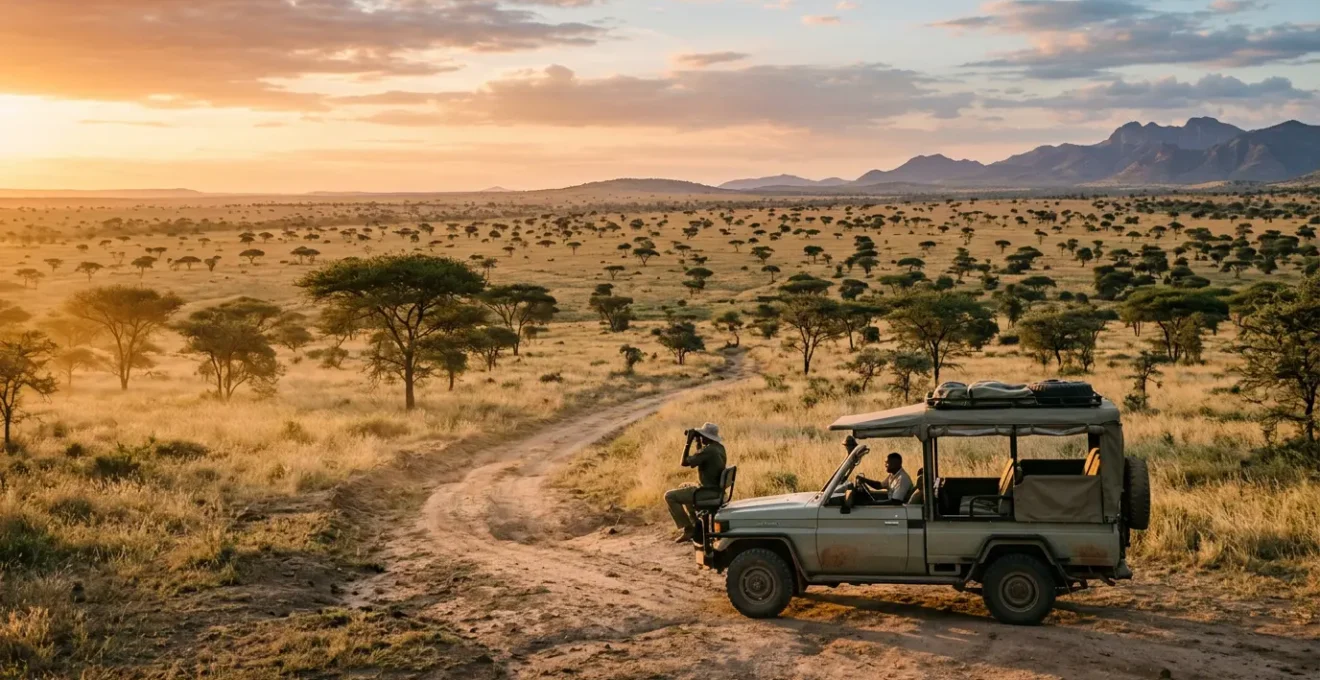
The tracker-guide team isn’t about one person finding and one person talking; it’s a seamless partnership of interpretation and translation from the language of the bush.
- The tracker is the master interpreter, reading the ‘silent language’ written on the ground, in the trees, and on the wind.
- The guide is the master storyteller, translating that complex, living narrative into an unforgettable experience for the guest.
Recommendation: Next time you’re on safari, watch the non-verbal communication between them—a subtle hand signal, a shared glance—to witness the real synergy at work.
As a guest settles into the tiered seats of a safari vehicle, a common question arises. Why are there two people in the front? The person behind the wheel is clearly the guide, the host and narrator of the experience. But what about the person perched on the special seat at the very front of the bonnet, seemingly exposed to the elements? The simple answer often given is that the tracker finds the animals and the guide drives and talks about them. But this explanation is like saying a master chef just cooks food; it misses the artistry, the deep knowledge, and the intricate partnership that defines the experience.
The truth is far more profound. This team of two represents a bridge between two worlds: the ancient, silent world of the wilderness and the modern, inquisitive world of the safari guest. The tracker is not merely looking for animals; they are reading a story written on the land—a language of subtle signs, smells, and sounds. They are the interpreter. The guide, in turn, is the storyteller, taking that complex, dynamic interpretation from the tracker and translating it into a captivating narrative that connects the guest to the very pulse of the ecosystem. It is a partnership built on immense trust, shared experience, and a silent, almost telepathic, understanding.
This guide will take you beyond the simple answers. We will explore the specific skills a tracker uses to decipher the bush, how this ancient knowledge is preserved, and how the two roles work in perfect synchrony to ensure not only incredible sightings but also your safety and a deeper connection to the wild. By understanding this dynamic, you will learn to see the bush not just as a landscape, but as a living library of stories waiting to be read.
To fully appreciate this partnership, we will delve into the specific techniques and knowledge that each member brings to the team. The following sections break down the core competencies and answer the most common questions about this unique safari dynamic.
Summary: Why Do Top Lodges Have a Separate Tracker and Guide Team?
- How to Tell How Fresh a Lion Track Is by Touching the Sand?
- How Does a Tracker Know Where a Leopard Is Heading Without Seeing It?
- How Is Indigenous Knowledge Passed Down to Modern Safari Trackers?
- Is It Dangerous to Sit on the Tracker Seat During a Lion Sighting?
- How Do Trackers Signal to Guides Without Spooking the Animals?
- Is Tracking Pure Science or Is There a Sixth Sense Involved?
- Why You Must Obey Your Guide Instantly When Walking in the Bush?
- Can You Learn to Track? Joining a Tracking Course in Botswana?
How to Tell How Fresh a Lion Track Is by Touching the Sand?
A track is more than a footprint; it’s a single word in a much longer sentence. The first question a tracker must answer is not « what? » but « when? » The freshness of a track determines whether it’s worth following. While a lion’s spoor is immense—a front foot of a male lion can measure up to 145mm—its size is less important than its age. In sandy substrates, this is a tactile science. A tracker will lightly touch the edge of the print and the sand that has been kicked out. Is it still cool and damp from the morning dew, or has the sun already baked it dry? Freshly disturbed sand holds a trace of moisture that evaporates quickly.
The definition of the track’s edges is another critical clue. A fresh track has sharp, well-defined ridges, like a freshly cut slice of bread. As time passes, wind and sun cause these fine grains of sand to collapse, softening the edges and making the track appear « melted. » According to research on track preservation, prints in sand often don’t last more than a few hours in direct sun and wind. A tracker is constantly performing a mental calculation, weighing the time of day, wind speed, humidity, and the track’s location (in shade or sun) to build a precise timeline.
This « reading of the sand » is a foundational skill. It’s the difference between following a lion that passed by last night and one that is just a few hundred meters ahead, perhaps resting behind the very next thicket. It is a moment of pure, data-driven analysis that sets the course for the entire game drive.
Action Plan: Key Tactile Indicators for Track Freshness
- Assess the raised edges: Touch the fine sand at the track’s perimeter. If it feels cool or even slightly damp compared to the surrounding surface, the track is very recent.
- Examine the kick-out: Look at the sand thrown forward by the foot’s movement. This disturbed sand loses moisture first; if it’s not completely dry, the animal is likely close.
- Analyze edge definition: A fresh track has sharp, crisp edges. Compare it to a track you make yourself nearby to see the difference between a fresh and an older print.
- Factor in weather conditions: Sand dries incredibly fast in direct sun or strong winds, which can make a one-hour-old track look like it’s from yesterday. Conversely, calm, humid conditions preserve freshness.
- Consider the time of day: Tracks made during the cool of the night or early morning have a much larger window of « freshness » than those made in the midday heat.
How Does a Tracker Know Where a Leopard Is Heading Without Seeing It?
Following a clear set of tracks in soft sand is one thing, but predicting the movement of a notoriously elusive animal like a leopard often involves reading signs far more subtle than a simple footprint. This is where the tracker moves from being a follower to a reader of the silent language of the bush. A leopard moving through its territory is not just leaving tracks; it is interacting with its environment in a thousand small ways. The tracker is looking for the entire story, not just the punctuation marks of the prints.
This involves a much wider sensory acuity. A tracker will spot a single, freshly broken twig at a specific height, indicating where the leopard pushed through a bush. They will notice a scrape mark on a termite mound, a form of territorial scent-marking. They are also listening intently. The sudden, frantic alarm call of a squirrel or a Grey Go-away-bird in a particular direction is a high-priority alert. These animals are the sentinels of the bush, and their calls can pinpoint a predator’s location with astonishing accuracy. The tracker pieces these clues together—the direction of the last known track, the alarm calls ahead, the natural game paths in the area—to form a predictive map of the animal’s likely route.
This holistic approach transforms the search from a two-dimensional exercise of following dots on the ground to a three-dimensional, immersive interpretation of the entire ecosystem. As noted in an article on the essential role of trackers, their expertise is not just about following tracks, but about interpreting a wide array of signs from the environment. This is how a good tracker can tell a guide, « The leopard is heading for the rocky outcrop to our left, » long before any tracks confirm it.
Trackers possess an exceptional understanding of the local environment, wildlife behavior, and tracking techniques. Their expertise is not just about following animal tracks; it’s about interpreting signs of nature, from broken twigs to subtle changes in the landscape.
– African Safari Magazine, Understanding the Essential Guide to Safari Trackers
How Is Indigenous Knowledge Passed Down to Modern Safari Trackers?
The profound skills of a master tracker are not learned from a book or in a classroom. They are the product of a lifetime of immersion and, for many, the inheritance of generations of ancestral wisdom. This knowledge is a living library, passed down from elder to youth through practical, daily experience. It is a deep, cultural connection to the earth that is fundamentally different from purely academic learning. Many of the most legendary trackers in regions like South Africa and Botswana come from communities with a deep historical relationship with the land.
A perfect example is the Shangaan (or Tsonga) people. At lodges like Arathusa Safari Lodge, many trackers are of Shangaan heritage. Historically, young Tsonga boys were tasked with tending their family’s cattle. This was not a passive duty; it was their first lesson in tracking. They had to learn to track their own cattle if they wandered, and more importantly, to identify the tracks of predators like lions and hyenas that posed a threat to the herd. They would spend their days in the bush, questioning their elders about every print in the dust and every bird call on the wind. This was their school, and the land was their teacher.
This deep-rooted wisdom forms the bedrock of a modern tracker’s psyche. It is an intuitive understanding of animal behavior and ecology that has been pressure-tested over centuries. At a place like Londolozi, for example, it is said that the descendants of great naturalists still work on the land today. In fact, Londolozi estimates that no less than 350 years of combined tracking wisdom reside within its team. This isn’t just a job; it’s the continuation of a legacy, blending ancient techniques with modern conservation ethics.
Is It Dangerous to Sit on the Tracker Seat During a Lion Sighting?
For a guest seeing it for the first time, the sight of a tracker perched on the front of the vehicle, just meters from a pride of lions, can be unnerving. The position seems incredibly vulnerable. However, this practice is built on a deep understanding of animal behavior and decades of established safety protocols. The crucial concept here is that the animals—especially those habituated to vehicles—do not perceive the tracker and the vehicle as separate entities. They see one large, noisy, and oddly-shaped « creature » that they have learned is not a threat.
The silhouette of the vehicle, with the guide and tracker included, becomes a familiar part of the landscape. As long as the tracker remains seated and part of that established shape, they are generally ignored. The danger would arise if the tracker were to suddenly stand up or jump off the vehicle, breaking the silhouette and suddenly appearing as a separate, bipedal ape—a shape that predators might associate with threat or food. The key is to remain a predictable, non-threatening part of the whole.
This is not to say there is no risk. The tracker’s position is one of immense trust—trust in their own knowledge of animal behavior, trust in the guide’s ability to handle the vehicle, and trust in the animals themselves. The tracker is constantly reading the animals’ body language. An irritated flick of a lion’s tail, a flattening of the ears, or a low growl are all signals that the boundary of comfort has been reached. The tracker will then silently signal the guide to give the animal more space. It is a continuous, dynamic risk assessment based on a profound understanding of the wildlife.
How Do Trackers Signal to Guides Without Spooking the Animals?
The communication between a tracker and a guide is a silent, elegant dance, refined over hundreds of hours spent together in the bush. Loud conversation is out of the question; it would instantly alert the wildlife and shatter the magic of the moment. Instead, they rely on a complex and often personalized system of non-verbal cues. This silent language is a critical component of their success and is fascinating to observe.
The most common form of communication is a sophisticated set of hand signals. A flat hand held up might mean « stop. » A finger pointing emphatically means « look there. » But the vocabulary goes much deeper. A hand cupped over the head can signify an elephant. Fingers held to the side of the head like ears might indicate a kudu. A clawed hand gesture is universally understood to mean a lion. The speed and intensity of the signal also convey information; a slow, lazy gesture might mean the tracks are old, while a rapid, urgent signal indicates the animal is very close.
Beyond hand signals, there are other subtle cues. A soft tap on the vehicle’s bonnet might be used to get the guide’s attention without making a startling noise. A low whistle, mimicking a bird call, can convey a specific message that only the guide would recognize. This communication is the thread that ties the team together, allowing them to make decisions and change direction in a fraction of a second, moving as a single, coordinated unit. As the Arathusa Safari Lodge blog notes, this bond is profound, with the guide acting as the storyteller and the tracker as the direct link to nature itself.
The guide is the animated storyteller, while the tracker is the direct link to nature itself. The bond that is forged between the two over time runs deep.
– Arathusa Safari Lodge, The importance of a tracker on safari
Is Tracking Pure Science or Is There a Sixth Sense Involved?
Many guests, after witnessing a tracker follow an almost invisible trail to find a leopard, will ask if there is a « sixth sense » involved. The skill can seem mystical, almost supernatural. The truth, however, is both more scientific and more impressive. What appears to be intuition is, in fact, an incredible form of rapid pattern recognition, a skill honed by thousands of hours of intense observation and practice. It is a science so deeply internalized that it becomes second nature.
A tracker’s brain is processing a staggering amount of data simultaneously. As one field evaluation of tracking skill noted, a novice might look at a track and see only its basic size and shape. An expert, however, subconsciously analyzes the spacing and arrangement of the toes, the overall shape, the specific contours of the heel pad, the depth of the print, the substrate, and the surrounding environmental context, all in a fraction of a second. This is not a mystical gift; it is a highly developed analytical ability. It is the ability to « reconstruct exactly what happened at a scene, right down to the thinking behind the animals’ actions, » as the Lion Guardians team puts it.
This is the « science » of tracking. It is empirical, based on evidence found on the ground. The « sixth sense » is what this science looks like after 20 years of practice. It’s the moment when the conscious, step-by-step analysis becomes an unconscious, holistic understanding. The tracker might not be able to articulate every single data point that led to their conclusion; they simply « know » the leopard turned left. This « knowing » is the culmination of countless successful and unsuccessful tracks, a mental library of cause and effect so vast that the retrieval of information feels instantaneous—like a sense, rather than a thought.
Why You Must Obey Your Guide Instantly When Walking in the Bush?
While the tracker-guide team is most visible on a vehicle, their synergy is even more critical during a walking safari. In this context, the guide, often with advanced trails guide qualifications, takes the lead, but their decisions are in constant dialogue with the tracker’s input. When a guide gives a command— »stop, » « get behind me, » or « crouch down »—it must be obeyed instantly and without question. This is not about authority for its own sake; it is the most critical safety protocol in the bush.
Your guide and tracker are operating with a level of situational awareness that is impossible for a guest to have. Their senses are tuned to the environment in a way that ours are not. They may have heard the low-frequency rumble of an elephant that your ears missed. They may have smelled the distinct scent of a predator on the wind. The tracker may have spotted a fresh track that indicates a buffalo herd just over the rise. The command you receive is the end result of a rapid, silent risk assessment based on dozens of these sensory inputs.
The level of training required to lead a walk in a dangerous game area is immense. For instance, to achieve a professional trails guide qualification in South Africa, a guide must complete rigorous training, and even then, professional trails guides must complete at least 50 mentored hours as first rifle and manage numerous encounters under supervision. They are trained to anticipate animal behavior and de-escalate potentially dangerous situations. Your hesitation, or your decision to take a photo instead of obeying, could close the critical window they need to ensure the safety of the group. Trusting their expertise is not just a courtesy; it is your most important contribution to your own safety.
Key Takeaways
- The tracker/guide team is a partnership of interpretation and translation, not just « finding and talking. »
- Tracking combines empirical science (aging tracks, analyzing signs) with deep-seated knowledge passed down through generations.
- The « sixth sense » of a tracker is actually highly developed pattern recognition, a science so deeply practiced it feels like intuition.
Can You Learn to Track? Joining a Tracking Course in Botswana?
After witnessing the incredible skill of a master tracker, many guests are inspired and ask, « Is this something I can learn? » The answer is a resounding yes. While reaching the level of a master tracker takes a lifetime, tracking is fundamentally a skill, not a magical power. It is an art and a science that can be taught, learned, and practiced. For those truly captivated by the silent language of the bush, there are structured pathways to begin your own journey.
Organizations like the Field Guides Association of Southern Africa (FGASA) offer a formal qualification pathway. The process is rigorous and respected throughout the safari industry. A tracking qualification includes modules in both « Track and Sign » (the science of identifying spoor, dung, and other signs) and « Trailing » (the art of following a trail until the animal is located). Students progress through levels, from Tracker Level 1 up to Level 4, which requires a perfect score on assessments. Beyond this are the esteemed Senior Tracker and, finally, Master Tracker qualifications, titles held by only a select few.
For visitors, many lodges and specialized operators in countries like Botswana and South Africa offer introductory tracking courses. These courses are designed to give you a taste of what’s involved. You won’t become an expert in a few days, but you will learn to see the bush with new eyes. You’ll learn to ask the right questions, to spend quiet minutes interpreting a print, and to start differentiating between the tracks of a hyena and a leopard. Even if you never find the animal you are following, the act of tracking itself creates a profound connection to the environment. The reward, as any tracker will tell you, goes far beyond the sighting itself; it’s about the process of reading the story of the bush.
The next time you are on safari, take a moment to observe this incredible partnership. Ask questions, learn to see the signs, and you will unlock a much deeper, more connected understanding of the wild that will stay with you long after you return home.