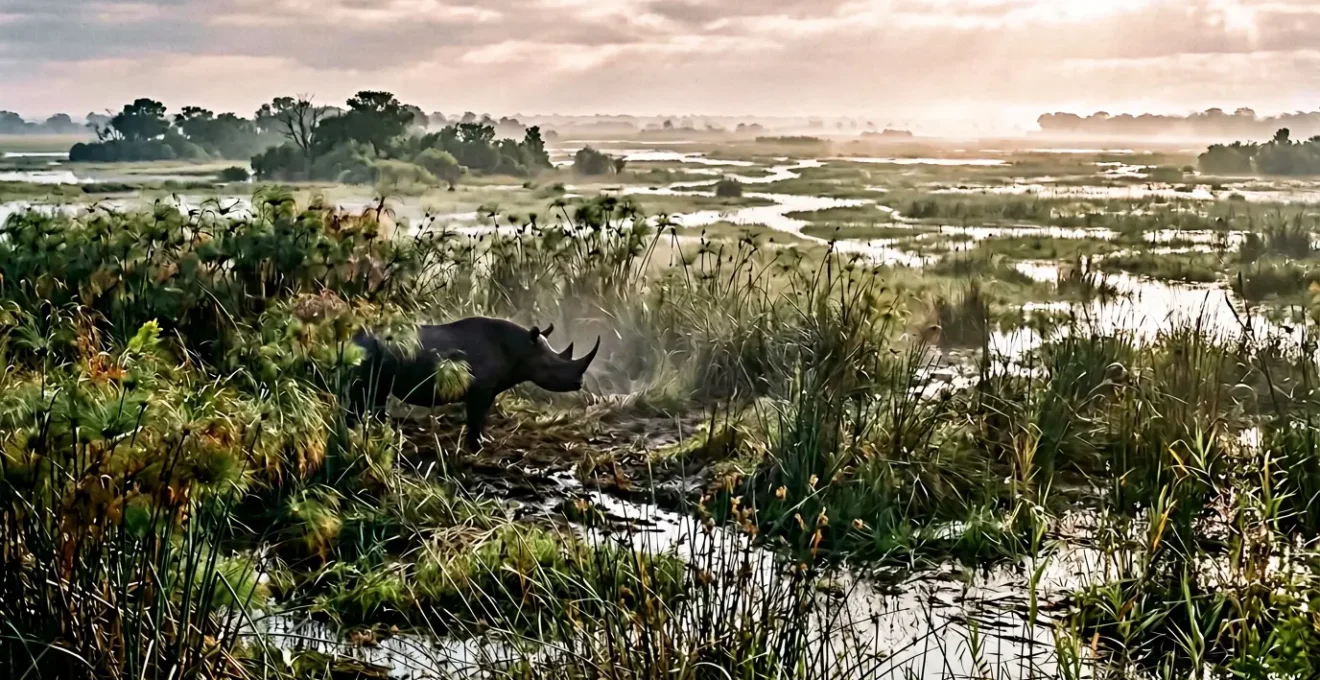
The difficulty in spotting rhinos in the Okavango isn’t a failure of your safari; it’s a testament to a successful conservation strategy that prioritizes wilderness over accessibility.
- The Delta is an « ecological fortress, » a vast, roadless wetland that makes access difficult for poachers and tourists alike, unlike the easily navigable Kruger.
- Animal behaviors here are fundamentally different, with species like lions adapting unique, water-based hunting techniques not seen elsewhere.
Recommendation: Shift your mindset from a « Big Five checklist » to ecological interpretation. The ultimate prize isn’t just a photo, but understanding this complex, thriving ecosystem.
You’ve come from parks where the Big Five are practically guaranteed. You’re an experienced wildlife enthusiast, your camera gear is top-tier, and you’ve invested significantly in this Botswana trip. Yet, the Okavango Delta feels different. The sightings are harder won. The rhinos, in particular, seem like ghosts. This frustration is common, but it’s based on a misunderstanding. Comparing the Okavango to a fenced reserve like Kruger National Park is like comparing an ocean to an aquarium. They are fundamentally different systems.
Many will tell you the platitudes: « the animals roam free, » « patience is key. » But this doesn’t explain the deep, ecological reasons behind the challenge. It doesn’t tell you why lions here hunt in water or why a buffalo might charge. I’ve spent two decades as a zoologist and guide in this pristine wilderness, and I can tell you the secret isn’t just about being patient; it’s about re-learning how to see. It’s about understanding the Delta not as a park to be conquered, but as a living, breathing system with its own rules, driven by water and ancient animal instincts.
The real value of a Delta safari lies in this deeper understanding. This guide isn’t a checklist for guaranteed sightings. Instead, it’s an insider’s brief on the « why » behind what you see—or don’t see. We’ll explore the unique behaviors of the Delta’s most iconic animals, decode the strategies of master trackers, and reveal how the very thing that makes this place a sanctuary for rhinos also makes them so elusive. By the end, you won’t just be a tourist; you’ll be an interpreter of one of the last truly wild places on Earth.
This article breaks down the essential knowledge you need to transform your safari experience. We will delve into the specific behaviors and conservation stories of the Delta’s wildlife, offering a masterclass in what it truly means to track and understand these magnificent animals.
Summary: A Guide to the Okavango’s Ecological Secrets
- Why Black Rhinos Are the Most Elusive of the Big Five in Botswana
- How to Spot a Leopard in the Moremi Game Reserve Without a Tracker
- Swamp Lions vs. Kalahari Lions: Which Pride Should You Target for Action?
- The Mistake That Provokes Buffalo Charges in 90% of Self-Drive Incidents
- Which Camera Lens Is Essential for Big Five Viewing in the Okavango?
- How to Anticipate Where a Leopard Will Drag Its Kill
- Why Did Botswana Move Rhinos from South Africa to the Delta?
- What Makes a « Premier » Game Drive Different from a Standard Park Tour?
Why Black Rhinos Are the Most Elusive of the Big Five in Botswana
The black rhino is the ghost of the Okavango. Their elusiveness isn’t an accident; it’s a direct consequence of a high-stakes conservation war. Unlike Kruger, with its dense road networks, the Delta is a maze of seasonal floodplains and impenetrable thickets. This wildness is a double-edged sword: it’s what makes the region a perfect sanctuary, but it also makes finding a solitary, browsing rhino an immense challenge. They are shy, solitary, and have a home range that can span dozens of square kilometers of this difficult terrain.
The current population is a fragile success story born from tragedy. The pressure from poaching has been relentless. In a devastating period between 2020 and 2021, a National Geographic report highlighted that 92 rhinos were killed by poachers, a crisis exacerbated by the absence of tourists during the pandemic. This forced the government into a dramatic and desperate rescue mission. In the midst of historic floods, helicopters were used to evacuate the last remaining individuals from the most vulnerable areas. Today, the population is fiercely protected, dispersed across the most remote parts of the Delta, far from any predictable routes.
Case Study: The Emergency Rhino Evacuation
During the 2020-2021 poaching crisis, the Botswana government undertook an emergency operation to save its last black rhinos. With poachers emboldened by the lack of tourist presence, anti-poaching units and conservation teams raced against time, using helicopters to airlift the remaining 40 or so individuals to safer, undisclosed locations deep within the Delta’s labyrinthine waterways. This action highlights the extreme measures taken to protect these animals, scattering them for safety and making tourist sightings an infrequent, almost sacred, event.
So, when you don’t see a rhino, remember what that means. It means the conservation strategy is working. The animal is safe, hidden away in a wilderness too vast and too difficult for its enemies to penetrate. A rhino sighting here is not a tick on a list; it’s a rare privilege and a symbol of hope.
How to Spot a Leopard in the Moremi Game Reserve Without a Tracker
While rhinos are ghosts, leopards are masters of camouflage. Yet, in places like Moremi Game Reserve, they can be found with surprising frequency if you learn to read the bush. As the safari experts at Travel 2 Botswana note, « Moremi is renowned for its frequent leopard sightings, often found draped over tree branches. » The key isn’t just looking for the leopard itself, but for the signs it leaves behind and the reactions it causes in other animals. This is the art of predictive tracking.
Instead of just scanning trees, you must engage all your senses. The forest speaks, and a leopard’s presence is announced by a chorus of alarm calls. Learning to differentiate the sharp, barking cough of a baboon that has spotted a leopard on the ground from the frantic, high-pitched chatter of a squirrel that has seen one in a tree is a fundamental skill. You also need to look for their larders. Leopards are creatures of habit and will often reuse specific, large trees with strong horizontal branches to store their kills. These trees are their pantries, and finding one is like finding a treasure map.
The image below shows a classic ‘larder tree’—a massive sausage tree. Notice the thick, horizontal branches, perfect for stashing a kill away from lions and hyenas. It’s in the golden light of late afternoon, the prime time for leopard activity.
As you can see, the structure of the tree is everything. Focusing your search on these specific types of trees, especially in the riverine forests around areas like Xakanaxa Lagoon, dramatically increases your chances. You are no longer randomly searching; you are following a strategy based on deep behavioral knowledge.
Your Action Plan: Thinking Like a Leopard Tracker
- Identify Prime Habitat: Focus your efforts on riverine forests and dense thickets. In Moremi, the Xakanaxa Lagoon area is a known hotspot due to its ideal leopard habitat and prey density.
- Tune into Alarm Calls: Learn to interpret the sounds of the bush. A baboon’s sharp bark means a leopard is likely on the move on the ground, while a tree squirrel’s frantic chatter points to a leopard in the canopy.
- Scout for « Larder Trees »: Actively search for large sausage trees or leadwoods with strong, horizontal branches. Look for tell-tale signs like old claw marks on the trunk and scattered bones at the base.
- Master the Golden Hours: Concentrate your game drives during the first and last two hours of daylight. Leopards are most active then, either returning from a night hunt or starting to move for the evening.
- Watch for Prey Behavior: Observe the behavior of other animals. A lone impala staring intently into a thicket, or vultures circling low over a dense patch of bush, can be a dead giveaway to a hidden leopard or its kill.
Swamp Lions vs. Kalahari Lions: Which Pride Should You Target for Action?
The term « lion » is too generic for Botswana. The lions of the Okavango are a world apart from their desert-dwelling cousins in the Kalahari, a prime example of behavioral adaptation. While wildlife surveys confirm the Okavango hosts some of the highest lion densities in Africa, the action you’ll witness is dictated by the landscape. Choosing which pride to target depends entirely on the kind of photographic action and behavioral display you’re hoping to capture.
The « swamp lions » of the Delta are unique. Forced by the seasonal floods, they have developed powerful muscles from constantly wading through water and have become adept at hunting buffalo in the channels. Photographing them is challenging due to low light in the reeds, but the reward is a truly unique shot: a lion bursting from the water, muscles tensed, in a primordial battle with its prey. These are behaviors you will see almost nowhere else on the planet. In contrast, the Kalahari lions are masters of endurance, hunting gemsbok across vast, open pans. The photographic conditions are often easier—clean backgrounds, golden light—and offer classic scenes of territorial disputes and dramatic, dusty chases.
This comparative table breaks down the key differences to help you decide where to focus your time and photographic efforts. The data, compiled from expert observations, highlights how profoundly the environment shapes these apex predators.
| Characteristics | Swamp Lions (Okavango) | Kalahari Lions |
|---|---|---|
| Unique Adaptations | Swimming abilities, water hunting techniques, stronger muscles from wading | Desert endurance, ability to go without water for extended periods |
| Hunting Specialties | Buffalo in water, aquatic prey, channel ambushes | Gemsbok, long-distance stamina hunting, open terrain pursuits |
| Photography Conditions | Challenging low-light in reeds, dramatic water splashing shots | Clean open shots in golden light, clear backgrounds |
| Best Action Type | Unique aquatic behaviors, water crossings | Classic territorial displays, dramatic chases across plains |
| Viewing Difficulty | Dense vegetation requires patience | Vast distances between sightings |
Ultimately, the choice is not about which lion is « better, » but which story you want to witness. Do you want the raw, water-logged power of the Delta’s specialists, or the epic, sun-drenched sagas of the desert kings? Each offers a profound insight into the adaptability of this incredible species.
The Mistake That Provokes Buffalo Charges in 90% of Self-Drive Incidents
The Cape Buffalo has a formidable reputation, but it’s not an indiscriminately aggressive animal. The vast majority of dangerous encounters, especially on self-drive safaris, are not initiated by the buffalo, but provoked by a critical and common human error: breaking the integrity of the herd. A moving herd of buffalo is a single, fluid entity. Driving a vehicle into a gap in the line, attempting to cross through them, isolates an individual or a small group. This act is perceived as a direct threat, instantly triggering a defensive response from the powerful bulls whose job is to protect the collective.
Respecting the herd as a whole is the foundation of sighting ethics. This means stopping and waiting for the entire herd to cross, no matter how long it takes. Another subtle but significant mistake is the noise of your vehicle. A constantly idling diesel engine produces a low-frequency rumble that can mimic the sound of a stalking predator, putting the herd on edge. As the official safety guidelines from major reserves often state, it’s best to switch off the engine completely. As the Hluhluwe Game Reserve advises its visitors:
Switch off your engine, there is nothing more irritating than an idling engine with a fan motor switching on and off periodically. This disturbs the animal and blocks the beautiful sounds of the birds and bush.
– Hluhluwe Game Reserve Safety Guidelines, Self Drive Safari Safety Manual
Learning to read a buffalo’s posture is also crucial for a safe encounter. A relaxed « dagga boy » (an old bull) will often be grazing with its head low. A bull with its head held high, making direct eye contact, is giving you a final warning. Paying attention to these signals and the behavior of the herd’s sentinels—the individuals on the periphery standing alert—will tell you everything you need to know about their stress level.
- Never break the line: Do not drive into gaps in a moving herd. You isolate individuals and trigger defensive charges.
- Read the posture: A head held high with direct eye contact is a warning. Head low while grazing indicates relaxation.
- Monitor the sentinels: Watch the peripheral herd members. If they are alert, snorting, or staring, the herd is stressed.
- Kill the engine: The low rumble of an idling diesel engine mimics a predator. Switch it off for a silent, less threatening observation.
Which Camera Lens Is Essential for Big Five Viewing in the Okavango?
In the vast, open landscapes of the Okavango, your camera lens is more than a piece of equipment; it’s your bridge to the wildlife. The wrong choice can lead to immense frustration. While it might be tempting to bring the longest telephoto you own, the reality of the Delta calls for versatility above all else. For this reason, professional wildlife photographers overwhelmingly recommend a versatile 100-400mm or 200-600mm zoom lens. This range gives you the flexibility to capture a distant leopard in a tree one moment and pull back for an environmental portrait of an elephant on the floodplain the next.
Beyond focal length, the most critical factor for Delta photography is lens speed. The predators you’re here to see are most active during the low-light « golden hours » of dawn and dusk. A « fast » lens with a wide aperture (f/2.8 or f/4) is essential for gathering enough light to achieve a sharp, clean shot without pushing your camera’s ISO to noisy levels. Another non-negotiable piece of gear for the Delta is a simple beanbag. Tripods are useless in a vehicle or a rocking mokoro (dugout canoe). A beanbag draped over the vehicle door or boat edge provides a surprisingly stable platform for your long lens, which is crucial for sharp images.
The setup shown here is exactly what a professional uses in the Delta. The long lens rests on a canvas beanbag, providing a stable, adaptable shooting platform from inside the vehicle. This simple tool is often more effective than a multi-thousand-dollar tripod.
Your gear list should be purpose-built for the unique challenges of this environment. Prioritizing versatility, low-light performance, and practical stability will do more for your photography than simply having the longest lens. Remember to also pack a wide-angle lens (like a 24-70mm) on a second camera body to capture the immense sense of place—the dramatic skies and vast floodplains that define the Okavango experience.
How to Anticipate Where a Leopard Will Drag Its Kill
Finding a leopard is one thing; anticipating its next move is the pinnacle of predictive tracking. When a leopard makes a kill, its immediate priority is to secure it from hyenas and lions. This means dragging the carcass, which can weigh more than the leopard itself, to a safe place—almost always up a tree. The question is, which tree? The answer lies in understanding their highly selective behavior.
Leopards do not choose just any tree. They have preferred « larder trees, » and guides who spend their lives in these territories know them intimately. These are typically large, sturdy trees like sausage trees or leadwoods, but the most important feature is a strong, clear, horizontal branch about 10-20 feet off the ground. This height is the sweet spot: high enough to be out of reach of most scavengers, but not so high that hoisting a heavy impala becomes impossible. An experienced tracker knows to scan for these specific trees in the vicinity of a kill.
They also listen. The sound of a carcass being dragged through dry grass is a soft, rhythmic « shush » that a trained ear can pick up from a surprising distance. By combining the visual search for larder trees with this auditory clue, a guide can often predict the leopard’s exact destination.
Case Study: The Three-Hour Drag in Xakanaxa
A seasoned guide at Camp Moremi once followed a female leopard that had just killed an impala. For three hours, he tracked her not by sight, but by listening for the faint sound of the carcass being dragged through the grasslands. He ignored several closer, smaller trees she passed, knowing she was heading for her preferred larder. He was right. He eventually found her caching the kill in a massive, old sausage tree that she had used repeatedly, a tree her mother had used before her. This demonstrates that leopard behavior is not random; it is learned, patterned, and, for those who know what to look for, predictable.
This level of tracking goes beyond luck. It is a deep, almost academic understanding of an animal’s habits, territory, and even lineage. It transforms a game drive from a passive viewing experience into an active, intellectual pursuit.
Why Did Botswana Move Rhinos from South Africa to the Delta?
The story of Botswana’s rhinos is inextricably linked to the geography of the Okavango and the failure of conservation in more accessible areas. In the face of an unprecedented poaching crisis in South Africa, conservation groups made a bold decision: they began to move rhinos to Botswana as part of a massive translocation effort. The Rhinos Without Borders project, for example, had already successfully moved 87 rhinos by the end of 2019. The question is, why the Delta? The answer is the concept of the « ecological fortress. »
This ‘ecological fortress’ strategy, as detailed in an official IUCN assessment of the Okavango Delta, was chosen because the very nature of the terrain acts as a powerful deterrent. Unlike Kruger National Park, which is crisscrossed by a network of public and private roads making it relatively easy for poaching syndicates to get in and out, the Delta is a vast, roadless expanse of water, islands, and thick bush. Operating here is logistically nightmarish and prohibitively expensive for poachers. Vehicles get stuck, fuel is a major issue, and movement is slow and easily detectable by anti-poaching patrols.
The Delta’s vast, roadless, and seasonally flooded terrain makes it incredibly difficult and expensive for poaching syndicates to operate in, compared to the easily accessible road networks of Kruger.
– Conservation International Botswana, Rhino Conservation Strategy Report
This natural barrier, combined with Botswana’s historically strong political will and military-style anti-poaching units, created what was believed to be the perfect safe haven. The goal was not just to save individual animals, but to establish a new, genetically viable satellite population as an « insurance policy » against catastrophic losses in South Africa. The difficulty you experience in finding these rhinos is, therefore, a direct measure of the success of this fortress strategy. They are meant to be hard to find.
Key Takeaways
- The Okavango is an « ecological fortress, » a wilderness whose inaccessibility protects wildlife but also makes sightings more challenging than in fenced parks.
- Animal behavior in the Delta is unique; lions swim to hunt, and leopards have specific « larder trees, » requiring a knowledge-based approach to tracking.
- A « premier » safari is defined by the quality of the guide and their ability to interpret the environment, not just point out animals.
What Makes a « Premier » Game Drive Different from a Standard Park Tour?
For the discerning traveler, the distinction between a standard tour and a premier safari experience is everything. It’s the difference between being a spectator and a participant in the wild. A standard tour often involves a driver who points out animals from a public road in a crowded vehicle. A premier game drive, particularly in Botswana’s private concessions, is a sensory safari led by an ecological interpreter.
The key differences lie in access, flexibility, and guide quality. In private concessions, your guide is not confined to public roads. They have the freedom to go off-road to track a leopard or position the vehicle for the perfect morning light on a lion pride. Sighting numbers are strictly limited, often to a maximum of three vehicles, ensuring an exclusive, uncrowded experience. The schedule is governed by the wildlife, not a clock. If a pride is on the hunt, a premier guide has the flexibility to stay for hours, long after a standard tour would have returned to the lodge. The guide themselves is a naturalist, part of a tracker-guide team that can predict animal movements based on wind direction, alarm calls, and subtle track signs.
The table below, based on industry expert analysis, clearly outlines the gulf in quality and experience between these two approaches. It demonstrates why investing in a premier experience is crucial for anyone serious about wildlife photography and deep ecological understanding.
| Aspect | Premier Game Drive | Standard Park Tour |
|---|---|---|
| Guide Quality | Ecological interpreter explaining lineage, behavior, predictions | Driver who points out animals |
| Access | Private concessions, off-road tracking allowed | Public roads only, no off-roading |
| Flexibility | Time governed by wildlife, continues past sunset if needed | Strict schedule (9am-5pm typical) |
| Vehicle Capacity | Maximum 6-9 guests | Often 20+ people |
| Sensory Experience | Multi-sensory: tracking, listening, smelling, touching vegetation | Primarily visual from vehicle |
| Sighting Quality | Exclusive sightings, perfect positioning for photography | Crowded sightings, limited angles |
A premier drive is an immersion. It includes elements like night drives with thermal imaging to observe nocturnal predators, walking safaris with armed guides for an intimate bush perspective, and the simple luxury of a « sundowner » stop in a breathtaking location. It’s an investment in knowledge, access, and exclusivity.
The true reward of the Okavango Delta is not in ticking a box, but in earning a sighting through knowledge and observation. It’s in understanding why the swamp lions have stronger muscles, in identifying a leopard’s favorite larder tree, and in recognizing the profound silence that means a herd of buffalo is relaxed in your presence. This is the deeper game. It’s a shift from passive viewing to active interpretation. By embracing the Delta’s complexity and its wildness, you transform potential frustration into a profound connection with one of the last true wildernesses on our planet. To begin planning an experience built on this philosophy, the next step is to consult with a specialist who understands the difference between a tour and an expedition.