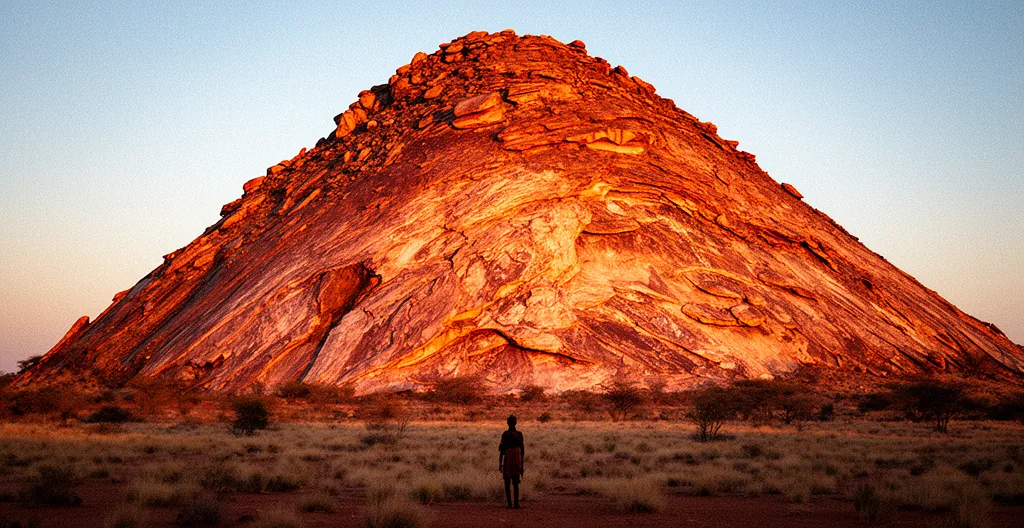
The mandatory guide at Tsodilo Hills isn’t a tourist trap; it’s a fundamental requirement for cultural and spiritual access to a living heritage site.
- Guides are trained interpreters who can « read » the complex layers of art that are invisible to the untrained eye.
- The site is a living, sacred landscape, and guides navigate the essential cultural protocols required for a respectful visit.
Recommendation: View your guide not as a constraint, but as the essential curator who transforms your visit from a simple hike into a profound cultural immersion.
For the independent, history-focused traveler, the word « mandatory » can feel like a barrier. You’ve come to the vast, quiet expanse of Botswana’s Kalahari Desert to experience the Tsodilo Hills—the « Louvre of the Desert »—on your own terms. Then you learn that visiting the rock art sites is impossible without a local guide. It’s easy to view this as a restriction, an unnecessary layer between you and the raw history you came to see. This perspective, while understandable, misses the fundamental nature of Tsodilo. The guide is not a gatekeeper to police your access; they are the key to unlocking a place that is not merely a historical gallery but a living, breathing, and sacred cultural landscape.
Many visitors arrive expecting to simply look at ancient paintings on rock walls. But to visit Tsodilo is to step into a complex world of spiritual belief, oral history, and layered symbolism that is entirely invisible to the uninitiated eye. The requirement for a guide is a core principle of this site’s management, designed to protect not just the physical art but also its profound cultural and spiritual integrity. It ensures that your presence is one of respect and understanding, rather than passive consumption. This guide moves beyond the common knowledge that the hills are a UNESCO site; it delves into the « why » behind the rule, demonstrating that the guide’s role is one of curation, interpretation, and cultural mediation.
This article will deconstruct the necessity of a guide at Tsodilo. We will explore the deep spiritual significance of the hills, the complex stories embedded in the art, the practicalities of navigating the site, and how your visit becomes a partnership in preservation. You will understand that the guide is not an obstacle to your independence, but the only authentic bridge to the soul of Tsodilo.
To fully grasp the multifaceted role of your guide, this article breaks down the essential aspects of the Tsodilo Hills experience. The following sections will guide you through the spiritual, artistic, and communal layers that make this site a global treasure.
Summary: Decoding the Mysteries of the Tsodilo Hills
- How to Interpret the « Whale » Painting in the Middle of the Desert?
- Why Do Locals Believe the Hills Are the Resting Place of the Spirits?
- Which of the 4 Hills Is the Best Hike for Views and Art?
- What Makes Tsodilo Unique Enough to Be a World Heritage Site?
- How Does Your Visit to Tsodilo Support the Hambukushu and San Communities?
- Tsodilo Hills Art: How to Distinguish San Paintings from Bantu Art?
- Why Are Cows Still Used as Dowry in Tswana Marriages Today?
- How to Experience Authentic San Culture Without Falling into Tourist Traps?
How to Interpret the « Whale » Painting in the Middle of the Desert?
At first glance, the rock art of Tsodilo might appear as a collection of simple figures. But each image is a data point in a complex narrative. A prime example is the famous « whale » painting, an enigmatic figure found hundreds of kilometers from the nearest ocean. An independent traveler might see it, note the curiosity, and move on. A local guide, however, transforms this simple observation into a deep reading of history and cosmology. They are trained to see the invisible layers of meaning that give the art its power. With over 4,500 paintings preserved in an area of only 10 km², the sheer density and variety make expert interpretation essential.
The guide’s role is to act as an art historian, anthropologist, and storyteller. They don’t just point to the whale; they contextualize it. They might discuss the pigment composition, indicating its ritual importance, or compare its location to other marine depictions like penguins, suggesting ancient contact with coastal peoples. They help you identify layers of paint, showing where Bantu art was superimposed over older San work, revealing a timeline of migration and cultural exchange on the rock face itself. This is not information found in a generic travel book; it is a live, curated analysis that brings the static image to life, connecting it to a vast web of San cosmology and oral history.
Action Plan: A Guide’s Framework for Art Interpretation
- Examine the pigment composition: red ochre mixed with blood, fat, and tree sap indicates ritual importance.
- Compare the whale painting’s position relative to other marine depictions (penguins) suggesting coastal contact.
- Identify superimposition layers showing Bantu art over older San paintings.
- Connect the whale to the water serpent mythology in San cosmology.
- Note the finger-painting technique unique to Tsodilo versus fine-line brush work elsewhere.
Without a guide, the whale is a mystery. With a guide, it becomes a gateway to understanding trade routes, spiritual beliefs, and the deep history of human movement across Southern Africa.
Why Do Locals Believe the Hills Are the Resting Place of the Spirits?
The most compelling reason for the mandatory guide rule is one that transcends archaeology: Tsodilo is not a relic of the past but a living spiritual landscape. For the Hambukushu and San communities, these are not just hills; they are the home of ancestral spirits and the site of creation itself. To walk here without understanding the required cultural protocol is not just disrespectful; it is a transgression. Your guide serves as a cultural mediator, ensuring your visit aligns with the reverence the site commands. This is a place of worship, not just a tourist destination.
This belief is deeply embedded in the physical features of the hills. A specific water spring, for instance, is not just a geological feature but a sacred site for cleansing and healing rituals. As the UNESCO World Heritage Centre notes, this reverence is a continuous tradition.
The local communities revere Tsodilo as a place of worship and as a home for ancestral spirits. Its water holes and hills are revered as a sacred cultural landscape, by the Hambukushu and San communities.
– UNESCO World Heritage Centre, Tsodilo World Heritage Site Description
Your guide embodies this living connection. They will often ask permission from the ancestors before entering certain areas or sharing specific stories. This is not a performance for tourists; it is a genuine act of cultural protocol. It is a powerful reminder that you are a guest in a sacred space. The guide’s presence ensures that the spiritual sanctity of the site remains undisturbed by those who may not be aware of its profound significance.
Case Study: The Sacred Spring Near Female Hill
A natural water spring at Tsodilo, near the Female Hill, serves as both a water collection site and a ritual site. According to archaeological documentation, it is seen as sacred and used by countless peoples to cleanse, heal, and protect. The site continues to be used for contemporary spiritual practices, with local guides following specific protocols like asking permission from ancestors before entering certain areas.
By hiring a guide, you are not just paying for a walk; you are participating in a system designed to honor and preserve the spiritual heart of Tsodilo.
Which of the 4 Hills Is the Best Hike for Views and Art?
Beyond the spiritual and artistic layers, a guide provides indispensable practical knowledge for navigating the rugged terrain of Tsodilo’s four main hills: Male, Female, Child, and the unnamed North Hill. For the independent traveler who loves to hike, a guide helps tailor the experience to match your interests and fitness level, transforming a potentially confusing trek into a targeted and rewarding exploration. Each hill offers a distinct experience, from strenuous climbs yielding panoramic views to gentle walks leading to intimate art panels.
The Female Hill, for instance, is the most rewarding for those focused on art, housing the vast majority of the paintings. British Museum research shows that there are more than 200 paintings at 20 sites on Female Hill alone, making a guide essential to locate the most significant panels, such as those along the famous Rhino Trail. In contrast, the Male Hill is the highest peak and offers the best panoramic views of the Kalahari, but its trails are more strenuous. A guide can assess the weather, your condition, and the time available to recommend the most suitable and safest route. This local expertise prevents you from wasting precious time on trails that may not align with your primary interests, whether they be art, photography, or challenging hikes.
The following table provides a clear overview, but a guide’s real-time advice is what helps you make the best choice on the day of your visit.
| Hill | Height | Rock Art Density | Trail Difficulty | Best For |
|---|---|---|---|---|
| Male Hill | 410m (highest) | Moderate | Strenuous | Panoramic views, creation stories |
| Female Hill | 300m | Highest (majority of 4,500 paintings) | Moderate with steep sections | Rock art variety, Rhino Trail, museum access |
| Child Hill | 40m | Low but well-preserved | Easy | Intimate viewing, photography |
| North Hill | Unnamed height | Minimal | No established trail | Spiritual significance (first wife legend) |
Ultimately, the guide acts as your personal curator, ensuring your physical journey through the hills is as meaningful as your intellectual and spiritual one.
What Makes Tsodilo Unique Enough to Be a World Heritage Site?
Tsodilo’s designation as a UNESCO World Heritage site is not based on its rock art alone. Its uniqueness lies in the unparalleled chronicle of human history it represents. This is a place with one of the longest records of human occupation found anywhere on Earth. UNESCO documentation confirms an astonishing 100,000 years of continuous human occupation. This isn’t just a collection of paintings; it’s a library of human history, with each generation leaving its mark. A guide helps you read the chapters of this library, pointing out subtle archaeological clues—like ancient tool fragments or the remains of early mining operations—that tell a story of survival, innovation, and spirituality across millennia.
The sheer resilience of human settlement in this harsh desert environment is what makes Tsodilo a testament to human creativity. It stands as an « outstanding » example of how humanity has adapted, thrived, and expressed itself spiritually over an immense timescale. The guide’s role is to bridge this vast expanse of time, connecting the faint red ochre lines of a 24,000-year-old San painting to the white, finger-painted cattle of Bantu herders from 1,000 years ago. They help you understand that the entire landscape is an artifact.
The World Heritage inscription is also a mandate for its protection. The guide system is a direct and effective part of this conservation strategy. It controls foot traffic, prevents vandalism, and ensures that the stories of the site are passed down accurately. The guide is, therefore, not just an interpreter but a guardian of this global treasure, and by hiring one, you become a partner in fulfilling this crucial conservation mission. You are contributing to the preservation of a site that holds a significant piece of our shared human story.
Your visit is more than tourism; it is an engagement with a place of universal value, and the guide is the appointed steward of that value.
How Does Your Visit to Tsodilo Support the Hambukushu and San Communities?
For a conscientious traveler, understanding the economic impact of your visit is crucial. At Tsodilo, the mandatory guide system is intrinsically linked to a model of community-based tourism. This is not a system where fees disappear into a government coffer or a distant corporation. Your investment in a guide is a direct and sustainable contribution to the livelihoods of the very communities whose ancestors created the art and who continue to act as its custodians. The entire operation is designed to empower the local San and Hambukushu people.
By hiring a certified local guide through the official visitor center, you are ensuring that your money funds essential community programs. This includes everything from educational bursaries for children to improved healthcare access for families. It allows the communities to maintain their cultural traditions while participating in the modern economy on their own terms. The guides themselves, trained in both scientific knowledge and traditional oral histories, earn a sustainable income that honors their unique expertise. This model turns cultural heritage into a viable economic asset for the people who own it.
Case Study: The Tsodilo Community Trust Economic Model
The Tsodilo site operates under a community trust model where entrance fees and guide services directly benefit local San and Hambukushu communities. The trust funds education bursaries, healthcare access, and cultural preservation programs. Local guides, trained in both archaeological knowledge and traditional stories, earn sustainable income while preserving oral histories for future generations.
You can further enhance this positive impact by making conscious choices during your visit. Here are a few ways to ensure your tourism is responsible and supportive:
- Book certified local San or Hambukushu guides through the official visitor center.
- Purchase authentic crafts directly from artisans at the community village, not from third-party sellers.
- If camping, stay at the community-owned campsites to ensure the revenue stays local.
- Always ask before taking photographs of people and respect their wishes.
In this context, the guide fee is not an expense; it is a powerful investment in cultural preservation and community well-being.
Tsodilo Hills Art: How to Distinguish San Paintings from Bantu Art?
One of the most fascinating aspects of Tsodilo is that its rock faces are a canvas shared by different cultures across time. The two most prominent styles are those of the San hunter-gatherers and the later Bantu-speaking pastoralists. To an untrained eye, the paintings might blur into one category of « ancient art. » However, a guide can teach you to see the distinct artistic « signatures » of each group, revealing a story of migration, interaction, and changing worldviews. Distinguishing between these styles is a key skill for a deep reading of the landscape.
The differences are subtle but profound. San art, often older and painted with fine finger-strokes in red ochre, focuses on wild animals like the eland and giraffe, as well as geometric patterns and figures in trance-like postures, reflecting deep spiritual and shamanistic themes. In contrast, Bantu art is typically rendered in thicker lines using white or black pigments. Its subjects are starkly different: domestic cattle, horsemen, and people holding spears, reflecting a society concerned with wealth, lineage, and social structure. A guide can point out these differences in technique, color, and subject matter, effectively teaching you a new visual language.
This comparative table offers a foundational guide, but nothing replaces having an expert point out these features in situ, showing you a panel where a white Bantu cow is painted directly over a faint red San eland.
| Feature | San Art | Bantu Art |
|---|---|---|
| Color | Primarily red ochre | White and black pigments |
| Technique | Fine finger painting | Thick finger-painted lines |
| Subjects | Wild animals (eland, giraffe), trance dancers, geometric patterns | Cattle, people with spears, horses, domestic scenes |
| Dating | Up to 24,000 years old | 800-1,300 years old |
| Style | Dynamic movement, spiritual themes | Static figures, wealth/lineage records |
| Location | Throughout all hills | Concentrated in White Paintings Shelter |
This is where the guide’s value becomes crystal clear: they don’t just show you paintings; they teach you how to see the layers of history painted on the rock.
Why Are Cows Still Used as Dowry in Tswana Marriages Today?
At first, a question about modern marriage customs might seem disconnected from ancient rock art. Yet, at Tsodilo, the past is never far from the present. The hundreds of Bantu cattle paintings found on the rock faces are not just depictions of animals; they are the earliest records of a value system that endures to this day in the Tswana tradition of lobola, or dowry. A guide can bridge this temporal gap, showing you how a 1,300-year-old painting directly connects to a living cultural practice.
The Bantu-speaking farmers who arrived at Tsodilo around 700 AD brought with them a society centered on cattle. As Botswana Tourism Organisation notes, these were not isolated groups; they were part of a vast network, trading « copper jewellery from the Congo, seashells from the Atlantic, and glass beads from Asia. » In this world, cattle were the ultimate symbol of wealth, social status, and a family’s honor. The act of painting cattle on the sacred rocks of Tsodilo was a way to cement their importance in both the physical and spiritual realms.
This historical precedent is the direct ancestor of modern lobola, where the exchange of cattle to formalize a marriage is not a commercial transaction but a profound ritual that binds two families and honors their ancestors. Understanding this helps the modern visitor see the paintings not as static images, but as the origin point of a deep-rooted cultural tradition.
Case Study: From Rock Art to Modern Lobola Practice
The Bantu cattle paintings at Tsodilo, dating from 700-900 AD, demonstrate the ancient significance of cattle as wealth symbols. Archaeological evidence from the Divuyu site shows early Bantu settlers were cattle farmers who used cattle in trade networks. This historical precedent directly connects to modern lobola (dowry) practices where cattle remain the preferred currency for marriage negotiations, representing family bonds and ancestral honor rather than commercial transactions.
The guide, often a member of these communities, can share personal insights into this practice, transforming an archaeological fact into a relatable human story and reinforcing the idea that Tsodilo’s history is still being written.
Key Takeaways
- The guide’s primary role is interpretation, not just navigation; they teach you to « read » the art and the landscape.
- Tsodilo is a living spiritual site, not a museum, and a guide is essential for navigating the required cultural protocols with respect.
- Your visit, when conducted through the official community trust model, directly supports the economic well-being and cultural preservation of the San and Hambukushu communities.
How to Experience Authentic San Culture Without Falling into Tourist Traps?
In a world where cultural tourism can sometimes feel staged, the independent traveler rightly seeks authenticity. At Tsodilo, the mandatory guide system, when approached correctly, is actually your best defense against inauthentic, « tourist trap » experiences. The key is to engage with the official, community-run infrastructure. Authenticity here is not about a staged performance; it is about an unscripted, respectful interaction with a guide who is sharing their personal heritage and a landscape that is their ancestral home.
An authentic experience is one where the benefits flow directly back to the community. UNESCO reports that with less than 50 San and Hambukushu families living at Tsodilo, direct support is not just helpful—it is crucial for survival. A genuine tour will be transparent about this benefit-sharing. The guide will be a certified member of the community trust, and your fees will support the projects we’ve discussed. Avoid operators who work outside this system, as they often divert revenue away from the people who need it most. True authenticity lies in this ethical and reciprocal exchange, not in a pre-packaged « cultural show. »
Look for genuine, unscripted moments. An authentic guide will share personal family stories connected to the hills, rather than reciting a learned script. They will answer your questions with personal insight. The experience should feel like a conversation, not a lecture. By vetting your choices, you ensure that your desire for a real connection is fulfilled in a way that is respectful, sustainable, and truly memorable.
- Verify that your guide is booked through the official Tsodilo Management Authority.
- Look for unscripted interactions and guides who share personal stories.
- Stay at community-run campsites to ensure revenue stays local.
- Avoid experiences based on fixed-schedule « performances » in favor of organic sharing during a walk.
- Purchase crafts directly from the artisans who made them.
By embracing the role of the local guide as a cultural partner, you become an active participant in preserving this irreplaceable heritage. Plan your visit with this understanding, and you will be rewarded with an experience of unparalleled depth and authenticity.