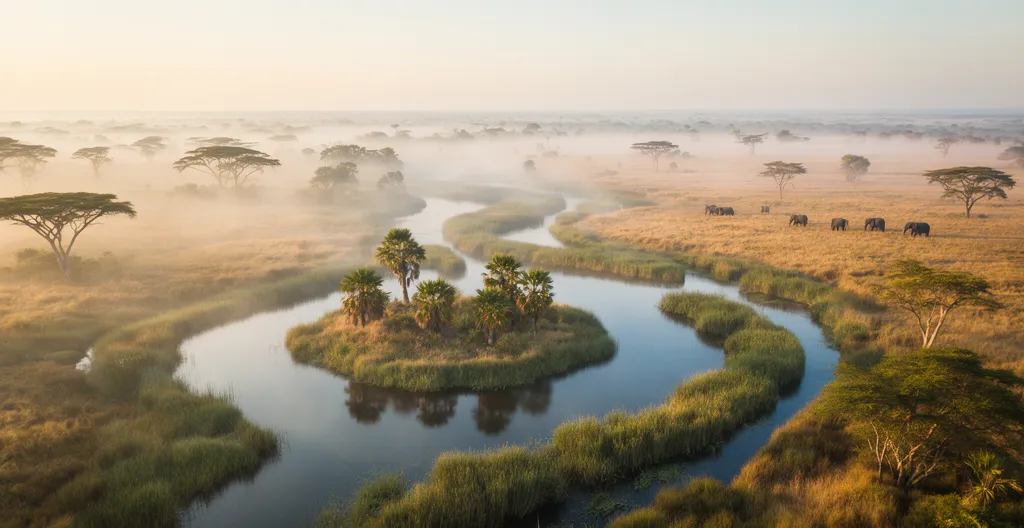
Contrary to popular belief, the high cost of a Botswana safari isn’t for material luxury, but for a neurologically restorative experience: authentic silence.
- Silence in the bush is not an absence of noise, but a rich soundscape that reduces cortisol and restores cognitive function.
- Exclusivity through private concessions and vehicles is the mechanism that protects this silence, allowing for deep, uninterrupted connection with nature.
Recommendation: Reframe your definition of luxury from what you can see and touch to what you can feel—the profound mental recharge that only true wilderness can provide.
For the stressed urban professional, the concept of a vacation often revolves around escaping noise. We book trips to quiet beaches and remote mountains, seeking a respite from the relentless hum of modern life. Yet, in the world of high-end travel, one destination has turned silence itself into the ultimate, and most expensive, amenity: Botswana. The common assumption is that the price tag is for five-star lodges and gourmet meals. But what if the real luxury you’re paying for is intangible? What if it’s for the curated absence of human-made sound and the carefully orchestrated presence of something far more valuable?
The true value of a Botswana safari lies not in what is absent, but in what is present when the noise of civilization fades. It is a meticulously managed environment designed for sensory recalibration. Research shows that 38% of Botswana’s land is protected for wildlife conservation, creating a vast sanctuary where natural acoustics dominate. This article moves beyond the surface-level explanations of exclusivity. We will explore the profound psychological and physiological impact of this immersion. This is not about simply « getting away »; it’s about actively engaging with a neurologically restorative soundscape—a bio-hack for the chronically overstimulated mind, where the amenity is your brain’s own recovery process, triggered by authentic wilderness.
This guide will deconstruct the layers of this unique experience. We will explore how the sounds of the bush become a language, how exclusivity enhances your connection to nature, and how a few days of disconnection can fundamentally reset your mental state. Prepare to understand why, in Botswana, silence is a sound worth paying for.
Summary: Why Is Silence the Most Expensive Amenity in a Botswana Safari?
- What Do the Sounds of the Bush Tell You About Safety at Night?
- Why Paying Extra for a Private Vehicle Changes Your Connection to Nature?
- How to Identify Southern Hemisphere Constellations from the Makgadikgadi?
- Why Does Going Off-Road in a Concession Increase Your Leopard Sightings?
- How Does 3 Days of Wilderness Isolation Affect Your Cortisol Levels?
- How to Overcome the Fear of Hearing Hyenas While Sleeping Outside?
- Why a Digital Detox in the Okavango Recharges Your Brain Faster?
- Is Sleeping in a Star Bed in the Middle of the Bush Safe from Lions?
What Do the Sounds of the Bush Tell You About Safety at Night?
In our urban lives, nighttime silence is often absolute, a deadened quiet created by insulated walls. In the Botswanan bush, silence is the opposite: it’s a living, breathing symphony of information. The initial unfamiliarity can be unsettling, but learning to listen transforms this ambient noise into an auditory map of the ecosystem. It’s a fundamental shift from passive hearing to active listening, where every snap of a twig or distant call carries meaning. This is the first step in the sensory recalibration process, moving from the chaotic noise of the city to the structured language of the wild.
The sounds tell you about safety because the animals themselves are your sentinels. The sharp, barking alarm call of a vervet monkey indicates a predator, likely a leopard, is on the move. The sudden stop of the cicadas’ chirping means something is passing close by. You learn that the deep, rumbling contact call of a lion is a sound of territorial spacing, not immediate threat. As one expert guide from Natural Habitat Adventures explains, this is the core of an authentic safari experience:
There’s an authentic experience when you are actually in a canvas tent and you go to sleep at night and can hear the sounds of the bush around you. You can hear a jackal calling in the distance or hippos coming out of the water.
– Natural Habitat Adventures Guide, Natural Habitat Adventures Botswana Safari Experience
By learning this language, fear is replaced with understanding. The bush is no longer a silent, menacing void but a dynamic environment communicating its state of being. You are not an intruder in the silence; you are a listener within a complex, living conversation. This shift in perspective is a powerful tool for feeling secure, transforming the night from a time of anxiety into one of profound connection.
Why Paying Extra for a Private Vehicle Changes Your Connection to Nature?
The auditory map of the bush is rich and detailed, but its clarity can be easily shattered by the cough of an engine or the chatter of other tourists. This is where the second layer of Botswana’s luxury becomes critical: the exclusivity of access. Paying a premium for a private vehicle and guide isn’t just about comfort; it’s a strategic investment in an uninterrupted sensory experience. It is the primary tool that allows you to fully immerse yourself in the natural soundscape you’ve paid so dearly to access.
With a private vehicle, you operate on what is known as « nature’s time. » You are not bound by a group’s schedule or a checklist of « must-see » animals. If you find a tranquil waterhole where birds are gathering, you can ask the guide to switch off the engine for an hour and simply listen. You can wait patiently for a leopard to descend from a tree, a moment that requires a stillness and silence impossible to achieve with a vehicle full of people. This autonomy allows you to move from being a mere spectator to an active participant in the wilderness, your presence gentle and observant rather than disruptive.
Case Study: The ‘Low-Volume, High-Income’ Model
Botswana’s government has long pursued a tourism policy of ‘low-volume, high-income’. This has resulted in one of Africa’s most exclusive safari destinations. With nearly half the country preserved as national parks and reserves, this model ensures that the wilderness is not overrun. Private vehicle safaris are a direct outcome of this philosophy, enabling guests to have personal, profound encounters with wildlife without the pressure of crowds, allowing them to spend extended time observing animal behaviors on their own terms.
Ultimately, a private vehicle grants you control over the most valuable resource on safari: your attention. It ensures the guide’s expertise is focused entirely on your interests, deepening your understanding and connection. The benefits are tangible and transformative:
- You can request the engine be cut off for deep, undisturbed listening.
- You have the freedom to reposition the vehicle for optimal photography without group consensus.
- You can choose to spend an entire morning waiting for a specific animal behavior to unfold.
- You can align departure times with your own energy levels, not a fixed schedule.
- The guide’s full attention is dedicated to answering your questions and finding what fascinates you.
How to Identify Southern Hemisphere Constellations from the Makgadikgadi?
As the auditory world of the bush envelops you, another form of profound silence reveals itself after sunset: the visual silence of a sky completely free from light pollution. In places like the Makgadikgadi Pans, this experience is taken to an astronomical level. The vast, flat salt-encrusted plains create an uninterrupted 360-degree horizon, making you feel as though you are standing on the surface of another planet. This is the ultimate stage for stargazing, where the silence is so complete it feels like you can hear the stars themselves.
Identifying constellations here is less about technical knowledge and more about awe and recognition. The first and most iconic is the Southern Cross (Crux). Look for a small, bright kite-shaped constellation. Near it, you’ll find two bright stars, Alpha and Beta Centauri, often called « The Pointers, » which point directly towards the cross. Once you’ve located it, you’ve oriented yourself to the southern celestial pole.
The next spectacle is the Milky Way itself. In the dry season (May-October), it’s not a faint, hazy band but a brilliant, textured river of light arching across the entire sky. Within it, you can spot Scorpius, a large J-shaped constellation with the bright red star Antares at its heart. Your guide will often carry a laser pointer and share local Tswana stories and names for these celestial bodies, connecting you not just to the cosmos, but to the culture of the land you’re on. Identifying these patterns is a deeply grounding experience, a reminder of your place in a universe far larger than the worries you left behind.
Why Does Going Off-Road in a Concession Increase Your Leopard Sightings?
The freedom of a private vehicle is one layer of exclusivity; the freedom to leave the road is another, and it is a privilege reserved for Botswana’s private concessions. This ability to go « off-road » is perhaps the most significant factor in increasing sightings of elusive predators like leopards. National parks have strict rules requiring vehicles to stay on designated tracks to minimize environmental impact. In a private concession, however, a different conservation model is at play.
Because these concessions have extremely low guest densities, the environmental stress of a few vehicles carefully navigating the bush is minimal. This privilege is directly underwritten by the high cost of staying there. When your guide spots fresh leopard tracks leading into the thicket, they have the authority to follow them. This changes the dynamic of a game drive from a passive search along a fixed path to an active, expert-led pursuit. You are no longer just hoping an animal crosses the road; you are entering its world to find it on its own terms.
This off-road capability is crucial for leopard sightings because these cats are masters of camouflage and often rest in dense brush or up a tree far from the main tracks. Following tracks allows your guide to circumnavigate a thicket or position the vehicle for a clear view of a leopard lounging on a branch, a sighting that would be impossible from the road. As Great Plains Conservation, a leader in this philosophy, states:
Conservation Through Exclusivity: The ability to go off-track is earned through the low vehicle density of private concessions, ensuring minimal environmental stress—a privilege the price underwrites.
– Great Plains Conservation, Great Plains Conservation Botswana Safari Philosophy
This exclusivity is maintained by design. The business model ensures that private concessions maintain strict limits on the number of lodges, beds, and therefore, vehicles. This guarantees that even when you go off-road, you are highly unlikely to encounter another vehicle. The sighting remains intimate and personal, preserving the very silence and connection to nature that defines the experience. You’re not just paying for a better chance to see a leopard; you’re paying for the privilege of seeing it alone.
How Does 3 Days of Wilderness Isolation Affect Your Cortisol Levels?
The sensory immersion and exclusive access are not just pleasantries; they trigger profound physiological changes. For the urban professional running on adrenaline and caffeine, the primary stress hormone, cortisol, is in a state of chronic elevation. This disrupts sleep, impairs cognitive function, and fuels anxiety. A three-day immersion in the Botswana wilderness acts as a powerful intervention, directly targeting and lowering these cortisol levels.
Case Study: The Three-Day Wilderness Reset
Luxury safari camps across Botswana observe a consistent pattern of guest transformation over a 72-hour period. Day 1 often involves a sense of digital withdrawal and sensory overload from the sheer volume of new sounds and sights. By Day 2, guests’ circadian rhythms begin to reset as they naturally wake with the sun and their activity aligns with daylight hours. By Day 3, a notable shift occurs. Guests report deeper, more restorative sleep and a palpable sense of calm, attributed to the combination of physical activity, natural soundscapes, and a complete break from the digital tethers of urban life.
This transformation is not just a feeling; it is a measurable biological process. The constant, low-grade stress of the city is replaced by the « soft fascination » of nature. Instead of the demanding focus required by screens and deadlines, your attention is gently held by the rustle of leaves or the movement of an animal. This allows your brain’s directed attention to rest and recover. The natural light cycles reset your internal clock, promoting the production of melatonin for sleep, while encounters with wildlife can increase oxytocin, fostering feelings of connection and well-being. The difference is stark, as this comparison illustrates.
| Time Period | Urban Environment | Botswana Wilderness |
|---|---|---|
| Day 1 | Constant notifications, artificial light exposure, traffic noise | Initial overstimulation from wildlife sounds, adjustment to silence |
| Day 2 | Continued sleep disruption, sustained cortisol elevation | Natural wake with sunrise, increased outdoor oxytocin from animal encounters |
| Day 3 | Chronic stress patterns maintained | Restored attention capacity, alpha brainwave dominance, improved sleep quality |
Within just 72 hours, the wilderness environment effectively reverses the physiological patterns of chronic stress. This rapid reset of your nervous system is one of the most significant, though invisible, returns on the investment in a Botswana safari.
How to Overcome the Fear of Hearing Hyenas While Sleeping Outside?
The pinnacle of immersion in the Botswana wilderness is often the « star bed » experience—sleeping on a raised platform in the open, with nothing but a mosquito net between you and the cosmos. This is where the sensory experience becomes most intense, and for some, where a primal fear can surface. The sound of a hyena’s whooping call, while fascinating from a vehicle, can be unnerving when you’re in bed. Overcoming this fear is the final step in truly surrendering to the wilderness.
The key is to shift your mindset from one of reactive fear to one of curious observation. This is a mental skill that can be cultivated with mindfulness techniques. Instead of letting your imagination run wild, you can engage your analytical brain. Identify the sound. Locate its direction. Recall the facts from your safety briefing: an armed guide is nearby, the location was chosen for its safety, and animals perceive your elevated bed not as a source of food but as an unknown, and therefore intimidating, object. As one expert in safari psychology notes, the entire experience is a carefully calibrated balance:
The star bed experience is expertly designed to maximize ‘perceived risk’ while ensuring ‘actual safety’. This psychological sweet spot is what creates a feeling of exhilaration and profound self-accomplishment.
– Safari Psychology Expert, Luxury Safari Design Philosophy
This « psychological sweet spot » is where the transformation happens. By consciously managing your fear, you prove to yourself that you are capable and resilient. The hyena’s call shifts from being a threat to being a beautiful, wild part of the nocturnal symphony. You are not just a tourist in a bed; you are an integral part of the nighttime landscape, safe and observant. Mastering this moment is often what guests remember most vividly—a profound sense of peace and self-accomplishment.
Your Action Plan: Mindfulness for Sleeping in the Wild
- Label and Locate: When you hear an unfamiliar sound, actively identify it (« That is a hyena’s call ») and determine its direction and distance (« It is far to the west »).
- Recall Facts: Bring to mind the safety briefing. Remember the presence of the armed guide, constant radio monitoring, and the strategic, safe placement of the star bed.
- Understand the Sound’s Purpose: Remind yourself that a hyena’s « whoop » is a long-distance social call to communicate with its clan, not a sound of aggression directed at you.
- Breathe and Observe: Focus on your breath. Practice deep, slow breathing while you listen, consciously shifting your internal state from reactive fear to one of calm curiosity.
- Trust the Placement: Remember that star bed locations are intentionally chosen to be on elevated platforms and away from high-traffic game trails, creating a natural buffer.
Why a Digital Detox in the Okavango Recharges Your Brain Faster?
The lack of Wi-Fi in the deep bush is often presented as a novelty, but its impact is a core component of the neurological restoration process. This forced digital detox is particularly potent in an environment like the Okavango Delta, a wetland wilderness so vast that the Okavango Delta spans over 5,800 square miles. The sheer scale ensures a complete disconnection, which accelerates brain recharge through a scientifically recognized phenomenon.
This process is explained by Attention Restoration Theory (ART). Our modern lives demand constant « directed attention »—the intense focus required for reading emails, navigating traffic, and sitting in meetings. This mental resource is finite and easily depleted, leading to burnout and mental fatigue. ART proposes that environments rich in « soft fascination » can restore this resource effortlessly. These are stimuli that are inherently interesting but don’t demand intense focus, allowing the brain to wander and recover.
The Okavango Delta is an environment of pure soft fascination. Watching the gentle ripples as your mokoro (dugout canoe) glides through papyrus-lined channels, observing a pod of hippos surfacing and submerging, or tracking a malachite kingfisher as it flits along the water’s edge—these activities hold your attention gently, without draining it. This state allows your brain’s directed-attention network to rest while activating the Default Mode Network, which is associated with daydreaming, reflection, and creativity.
Case Study: Attention Restoration in the Delta
Lodges in the Okavango Delta, such as Belmond Eagle Island Lodge, report that guests experience accelerated mental restoration precisely because of this environment. The unique combination of « soft fascination » stimuli allows the brain’s directed attention to replenish effortlessly. This process breaks the cycle of rumination and anxiety far more quickly than a typical vacation, with guests reporting significant improvements in mental clarity and creativity within just a few days, rather than the weeks it might take elsewhere.
A digital detox in the Okavango isn’t about passive boredom; it’s an active process of cognitive healing. By replacing the demanding stimuli of screens with the gentle fascination of nature, you are not just relaxing—you are systematically rebuilding your brain’s capacity for focus, creativity, and calm.
Key Takeaways
- The luxury of a Botswana safari is the access to a neurologically restorative soundscape, not just material comforts.
- Exclusivity, through private vehicles and concessions, is the tool that protects the integrity of this silent, immersive experience.
- True disconnection for even 72 hours can measurably lower stress hormones and restore cognitive function through Attention Restoration Theory.
Is Sleeping in a Star Bed in the Middle of the Bush Safe from Lions?
We’ve explored the psychological and physiological rewards of deep immersion, but the ultimate question for many remains rooted in a primal fear: is it truly safe? Specifically, is sleeping in an open-air star bed a sane activity in a landscape ruled by lions? The answer is an emphatic yes, thanks to a combination of animal psychology and meticulous, invisible safety protocols. The entire experience hinges on the principle of ‘perceived risk vs. actual safety.’
First, predators like lions are highly neophobic, meaning they are wary of new or unfamiliar objects in their environment. An elevated platform with a bed and human scent is not part of their recognized « prey image, » which is programmed for four-legged herbivores. They are more likely to give such a strange structure a wide berth than to investigate it as a potential meal. Furthermore, star bed sites are rigorously selected. They are placed in open areas with clear sight lines, far from dense thickets or known game trails that act as wildlife highways. The area is monitored by camp staff throughout the day before a guest’s arrival to ensure no predators are denning nearby.
The « invisible » safety net is robust. An armed, highly-trained guide always sleeps within a short distance, and constant radio contact is maintained with the main camp. Before you even settle in for the night, you receive a comprehensive safety briefing that demystifies the sounds you’ll hear and explains the procedures in place. This combination of animal behavior, strategic placement, and human oversight creates an environment that feels thrillingly wild yet is fundamentally secure. It is the perfect embodiment of the Botswana safari philosophy, which, as one safari expert succinctly puts it, is not about mass-market thrills.
Botswana does not do mass tourism luxury. It does privacy, space, and time properly.
– Safari Travel Expert, Nomad Horizons Africa Safari Guide
To embark on this journey is to invest not in a fleeting vacation, but in a profound mental and physiological reset. The next logical step is to explore how such an experience can be tailored to your specific need for disconnection and renewal.
Frequently Asked Questions About a Botswana Safari Experience
What makes the Makgadikgadi ideal for astronomy?
The complete absence of light pollution in this remote salt pan creates zero-light conditions perfect for viewing the Milky Way and Southern Cross constellation in extraordinary detail.
Can you see both Northern and Southern hemisphere stars from Botswana?
Yes, Botswana’s position near the Tropic of Capricorn allows viewing of constellations from both hemispheres, though Southern stars like the Southern Cross are most prominent.
What is the best time of year for stargazing in the Makgadikgadi?
The dry season from May to October offers the clearest skies, with June to August providing the most spectacular views of the Milky Way’s galactic center.
How are star bed locations selected for safety?
Sites are rigorously chosen away from game trails, often on elevated platforms providing physical and psychological barriers, in open areas with clear sight lines, and monitored throughout the day before guest arrival.
Why don’t predators approach star beds?
Lions and other predators are neophobic (wary of new objects) and actively avoid human scent and structures. Their ‘prey image’ is programmed for four-legged herbivores, not humans in beds.
What invisible safety measures are in place for star beds?
An armed guide sleeps nearby, constant radio contact is maintained with the main camp, comprehensive safety briefings are provided, and the area is monitored throughout the day by camp staff.