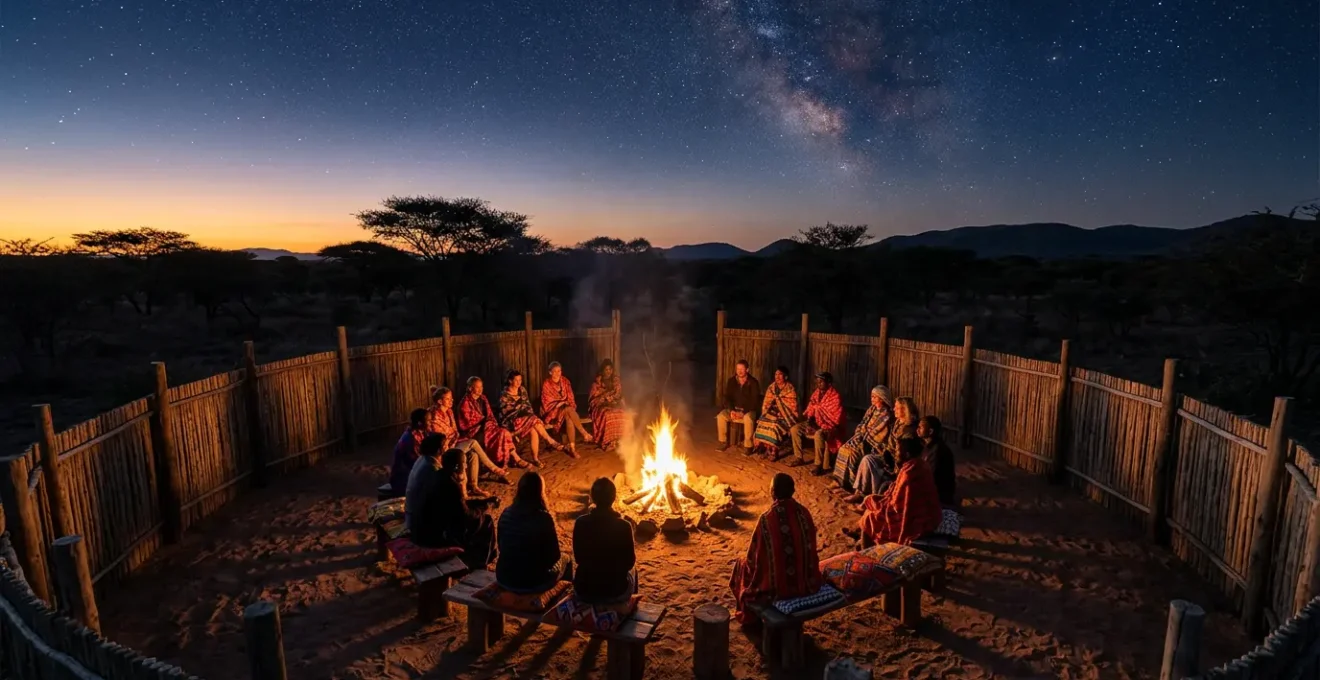
The idea of a mandatory group performance at a safari boma dinner can be daunting for shy travelers, but the reality is an invitation to connect, not a command to perform.
- The boma is a space designed for safety and community, where every element, from the circular shape to the central fire, has a symbolic meaning.
- Participation is entirely flexible; you can enjoy the food, listen to the stories, or simply soak in the atmosphere without pressure to sing or dance.
Recommendation: Approach the boma dinner as a cultural dialogue. Your attentive presence is the most valued form of participation, allowing you to experience a magical evening on your own terms.
The safari truck comes to a halt after a breathtaking evening game drive. As dusk settles over the savannah, a warm glow flickers in the distance, accompanied by the faint sound of rhythmic song. This is the call to the boma dinner, an experience touted as the social highlight of any safari. For many, this sounds like a magical evening under the stars. But for the more introverted or shy traveler, a question arises: « Will I have to sing? Do I have to dance in front of strangers? » The thought can transform anticipation into anxiety.
Many guides describe the boma simply as an « outdoor dinner with entertainment. » This description, while true, misses the heart of the experience. It reduces a rich cultural tradition to a mere meal and a show, overlooking the deep-seated symbolism and the gentle nature of the invitation. The fear of forced participation often stems from this misunderstanding. But what if the key to enjoying the boma wasn’t about stepping into the spotlight, but about understanding the story being told around you?
This guide is for you, the traveler who loves new experiences but cherishes your personal comfort zone. We’ll move beyond the surface-level descriptions to explore the ‘why’ behind the boma’s traditions. By understanding the purpose of its circular walls, the role of the fire, the meaning behind the songs, and the etiquette of the evening, you’ll discover that the boma is not a stage demanding a performance. It is a welcoming circle, an offer of cultural dialogue where your role can be as active or as observant as you wish. You’ll learn how to navigate the evening with confidence, turning potential social pressure into a genuine, memorable connection with the heart of Africa.
To help you prepare for this unique cultural event, this article breaks down every aspect of the boma dinner, from its architectural symbolism to the nature of the entertainment. The following sections will guide you through what to expect, ensuring you feel comfortable and excited for the evening ahead.
Summary: Your Guide to the Safari Boma Evening
- Why Are Boma Walls Made of Reeds and Logs in a Circular Shape?
- How Do Elders Use the Boma Fire to Pass Down Oral History?
- Do You Need to Dress Up for a Boma Dinner or Stay in Safari Gear?
- How to Navigate a Boma Buffet if You Are Vegan or Gluten-Free?
- Why Do Staff Choirs Sing Traditional Songs During Dinner?
- Why Is the Fireplace the Center of Tswana Dining Culture?
- Communal Dining vs. Private Tables: What Is the Norm in Luxury Camps?
- Canvas vs. Concrete: Why Are Tented Camps More Expensive Than Hotels?
Why Are Boma Walls Made of Reeds and Logs in a Circular Shape?
When you first step into a boma, the most striking feature is its circular design. This isn’t an arbitrary aesthetic choice; it’s a design deeply rooted in history and purpose. The word ‘boma’ itself, originating from Swahili, means « enclosure » or « fort. » This gives us the first clue to its function. As the Madikwe Safari Lodge Cultural Heritage Report explains, bomas were traditionally built by communities to protect their livestock—and themselves—from predators during the night. The high walls of reeds, branches, and logs created a vital barrier against the dangers of the wilderness.
The circular shape is equally significant. Unlike a square or rectangle with corners that create division and blind spots, a circle is inherently communal. It has no head or end, placing everyone on equal footing. This layout naturally encourages interaction and a sense of shared experience, making it the perfect setting for a community to gather. Everyone can see everyone else, fostering a feeling of unity and safety. It creates a symbolic circle of belonging, separating the warmth and light of the community from the vast, dark bush beyond.
Today, while the threat of predators in a modern safari lodge boma is managed, the structure retains its powerful symbolism. It’s a space that consciously separates you from the wildness you explored during the day, offering a sanctuary of warmth, light, and fellowship. For a shy traveler, this can be incredibly reassuring. You are not in a vast, open restaurant; you are within a defined, protected space designed to make you feel secure and part of a temporary, welcoming tribe.
How Do Elders Use the Boma Fire to Pass Down Oral History?
The fire is the heart of the boma, and its role extends far beyond providing light and warmth. For centuries, the fireside has been the classroom, the library, and the stage for African oral traditions. With no written language for many cultures, history, myths, laws, and wisdom were passed down through generations via storytelling, song, and dance. The boma fire created the perfect ambiance for this vital cultural transmission: a focused, intimate setting where the community would gather after the day’s work was done.
An elder, or a designated storyteller, would use the mesmerizing flicker of the flames to captivate their audience. The dancing shadows and glowing embers added a layer of magic and drama to their tales. This wasn’t a passive lecture; it was an interactive performance. The storyteller would use gestures, different vocal tones, and call-and-response with the audience to bring fables of clever animals, tales of heroic ancestors, and the creation myths of their people to life. This is the essence of cultural dialogue, a living, breathing exchange of heritage.
Many lodges honor this tradition by inviting a local folk storyteller to share tales during the boma dinner. As a guest, this is a beautiful opportunity for you. It’s a moment that is entirely about listening and absorbing. There is no expectation for you to do anything but be present. You can sit back, enjoy the warmth of the fire, and let yourself be transported by the narrative. It’s an authentic glimpse into the soul of the region, offered as a gift. Some experiences, like those found at the Victoria Falls Boma, even include Mbira music and other entertainers that enrich this atmosphere of shared heritage, creating a feast for all the senses.
Do You Need to Dress Up for a Boma Dinner or Stay in Safari Gear?
One of the most common questions travelers have before their first boma dinner is about the dress code. After a day spent in practical, dust-covered safari clothes, the idea of a « special » dinner might suggest a need to change into more formal attire. You can relax: the answer is overwhelmingly about comfort. The boma experience is an extension of the safari’s relaxed and natural atmosphere, not a departure from it.
Casual and practical are the keywords. There’s no need for fancy dresses or jackets. Your comfortable safari pants or shorts and a clean shirt are perfectly acceptable. In fact, as one guest noted, it can get quite warm inside the boma, especially near the fire, so light clothing is often a wise choice. However, it’s also crucial to remember that you are in a desert or bush environment. Once the sun sets, temperatures can drop significantly and quickly. The best strategy is to dress in layers—a t-shirt or light top with a fleece or warm jacket you can easily remove or put on.
Footwear is another important consideration. The ground in and around the boma can be sandy or uneven, and you’ll be walking in the dark. Practical, closed-toe shoes like sneakers or walking shoes are far more suitable than heels or flimsy sandals. The focus is on ensuring you can move around comfortably and safely. Some lodges even enhance the cultural experience by offering guests a traditional ‘chitenge’ (a sarong-like wrap) upon arrival, which is a fun, optional touch to help you get into the spirit of the evening.
Action Plan: Dressing for Your Boma Dinner
- Assess the season: Wear light, comfortable clothing for summer months (typically September to April) and warmer layers for winter (May to August).
- Prioritize practical footwear: Choose closed-toe, flat shoes suitable for walking on uneven, sandy ground in low light.
- Think in layers: Bring a fleece, sweater, or jacket as bush temperatures can drop sharply after sunset, even on a warm day.
- Embrace the experience: If offered a traditional chitenge or sarong upon arrival, accept it as a fun part of the cultural immersion.
- Focus on comfort: Remember that casual attire is the norm. The goal is to relax and enjoy the atmosphere, not to adhere to a formal dress code.
How to Navigate a Boma Buffet if You Are Vegan or Gluten-Free?
The centerpiece of the boma dinner is, of course, the food. Often served as a lavish buffet, it features a wide array of dishes, with a heavy focus on grilled meats (known as ‘braai’ in Southern Africa). For travelers with dietary restrictions, such as vegans, vegetarians, or those requiring gluten-free options, a traditional buffet can seem like a minefield. However, luxury safari lodges are exceptionally adept at catering to diverse dietary needs.
Communication is the most important first step. You should always inform the lodge of any dietary restrictions or allergies well in advance of your arrival, ideally at the time of booking. This gives the culinary team ample time to prepare. Most high-end camps have dedicated chefs who can create delicious, bespoke meals for you. At the boma itself, the head chef is often present at the buffet to guide guests through the offerings, explaining each dish. Don’t be shy about speaking with them; they can point out which dishes are suitable for you or arrange for a special plate to be made from the kitchen.
Furthermore, traditional African cuisine is naturally rich in plant-based staples. You will almost certainly find delicious options that are inherently vegan and gluten-free. For instance, a common and flavorful side dish is spinach cooked with crushed peanuts. Another cornerstone is ‘sadza’ (in Zimbabwe) or ‘pap’/’ugali’ (elsewhere), a thick porridge made from cornmeal, which is a staple food and naturally gluten-free. You’ll also find an abundance of fresh salads, roasted vegetables, and fruit. The safari industry is highly attuned to global wellness trends, with a notable expanded selection of plant-based dishes becoming standard at luxury lodges in recent years.
Why Do Staff Choirs Sing Traditional Songs During Dinner?
The moment the staff choir begins to sing is often one of the most powerful and moving parts of a boma dinner. Their harmonious voices, singing in a local language, create an atmosphere that is both vibrant and deeply soulful. For a shy traveler, this can also be the moment when anxiety peaks: « Is this the part where they pull me up to dance? » Understanding the purpose behind the performance is the key to replacing that anxiety with appreciation.
The singing and dancing are not just « entertainment. » They are a proud and joyful expression of cultural identity, an extension of the oral traditions shared around the fire. The songs often tell stories of community life, harvests, celebrations, or historical events. It is a form of cultural dialogue, a way for the staff to share a piece of their heritage with you. It’s an invitation to witness and appreciate their culture, not a demand for you to perform it. As the cultural team at Touch Nature Safaris beautifully puts it, « The performance is a two-way street. The appreciative energy from the guests validates and honors the culture being shared, creating a powerful, unifying loop of emotion. » Your attentive listening and applause are the most important forms of participation.
Some bomas, particularly at larger venues, offer an interactive drumming show after dinner. This is a highlight and is explicitly designed for guest participation. However, « participation » doesn’t mean you have to be a star performer. Each guest is typically given a djembe drum, and a lead drummer teaches a few simple rhythms. This is rhythmic participation at its most inclusive. You can tap along gently, or just hold the drum and enjoy the collective energy. No one is singled out or forced to solo. It’s about being part of a collective sound, and it’s incredibly fun and cathartic, even from the safety of your chair.
Why Is the Fireplace the Center of Tswana Dining Culture?
Across many African cultures, and particularly within Tswana culture, the fire is more than a utility; it is the sacred center of social and domestic life. Its position at the heart of the boma is a direct reflection of this deep cultural significance. The fire provides warmth against the cool night air, light that pushes back the darkness, and a means to cook food—the three essential elements for survival and comfort. It represents life, safety, and community.
The cultural team at Madikwe Safari Lodge captures this perfectly: « The crackling fire at the center represents warmth, safety, and life, while the circular seating arrangement encourages conversation and a sense of belonging. » The fireplace, or ‘leiso’ in Setswana, is the focal point around which everything happens. It’s where stories are told, where food is shared, and where the community connects. The light from the fire creates a natural and inviting atmosphere, encouraging people to draw closer and engage in conversation. This is why dining around it feels so primal and deeply satisfying.
At camps like Kings Camp, the boma is meticulously designed with a crackling fire at its heart, encircled by a wall and lit by lanterns to create an atmosphere of camaraderie. For a guest, especially one who feels a bit shy, the fire offers a wonderful, low-pressure social anchor. You don’t have to be in the middle of a conversation to feel part of the group. You can simply watch the flames, listen to the crackle of the wood, and feel the warmth on your face. It provides a natural and comfortable focal point, allowing you to feel connected to the group’s energy without needing to be the center of attention. It’s the ultimate expression of invitation, not obligation.
Communal Dining vs. Private Tables: What Is the Norm in Luxury Camps?
The concept of communal dining is central to the traditional boma experience, but the norms can vary significantly depending on the style and price point of the safari lodge. Understanding this spectrum can help you choose an experience that best fits your social comfort level. At its core, the shared table is about fostering the camaraderie and storytelling spirit that a safari naturally inspires. However, the luxury market is highly attuned to guests’ desires for both community and privacy.
A helpful way to understand the dining landscape is to look at it by safari category. The table below, based on an analysis of safari dining styles, illustrates the general trend. In budget and many mid-range camps, communal tables are often the standard for all meals. As you move into the luxury and ultra-luxury tiers—where a safari can easily cost a significant amount—the dynamic shifts. Privacy becomes a key component of the luxury offering.
| Safari Category | Price Range (per day) | Dining Style | Key Features |
|---|---|---|---|
| Budget Safari | $180-$300 | Shared communal tables | Group dining, buffet style, fixed meal times |
| Mid-Range Safari | $300-$600 | Mix of communal and private | Choice of dining locations, quality ingredients |
| Luxury Safari | $600+ | Private tables standard | À la carte options, private dining available, personalized service |
In most high-end camps, a private table is the default for regular meals. The boma dinner is often the one exception, presented as a special, optional communal event held once or twice a week. Even then, your participation is your choice. If you prefer a quiet dinner, the lodge will almost always be happy to arrange a private table for you in the main dining area or even on your private deck. The philosophy of luxury safari is personalization. You should never feel forced into a social situation you’re not comfortable with. Simply speak to the camp manager about your preferences.
Key Takeaways
- The boma dinner is a cultural invitation, not a social obligation; your comfort is the priority.
- Every element, from the circular walls to the central fire, is symbolic and designed to create a feeling of safety and community.
- Participation is flexible: listening to stories, enjoying the music, and appreciating the food are all valid ways to engage without needing to be in the spotlight.
Canvas vs. Concrete: Why Are Tented Camps More Expensive Than Hotels?
When planning a safari, travelers often notice that luxury tented camps can be significantly more expensive than traditional brick-and-mortar hotels or lodges. This might seem counterintuitive, but the price reflects a completely different philosophy of travel. The higher cost is justified by a unique combination of exclusivity, immersion in nature, and high-touch, all-inclusive experiences—of which the boma dinner is a prime example.
First, luxury tented camps are built on a principle of a light environmental footprint and high exclusivity. As premier operators like Wilderness Destinations state, their model involves having « no more than 12 suites per camp, spread over hundreds of acres. » This low-density approach means you are sharing a vast, pristine wilderness area with only a handful of other guests. The logistics of building, supplying, and staffing these remote locations to a five-star standard—with gourmet food, expert guides, and seamless service—are immense and costly. You are paying for an intimate and respectful encounter with nature, far from the crowds.
Second, the price typically includes far more than just a room. It’s an all-inclusive package covering gourmet meals, all drinks, and, most importantly, expertly guided safari activities. The unique, curated experiences are what truly define the value. A boma dinner isn’t just a meal; it’s a carefully orchestrated cultural event. A bush breakfast isn’t just food; it’s a surprise feast in a stunning, secluded location. These are the « wow » moments that a standard hotel cannot replicate. They are part of a holistic experience designed to create lasting memories, and they are woven into the fabric of the camp’s daily rhythm. This unique blend of adventure and personalized luxury is what drives the robust growth in the safari tourism market, projected to reach USD 60.91 billion by 2030.
Now that you understand the rich cultural tapestry and the reassuring, inclusive nature of the boma dinner, your final step is simply to embrace the experience. Approach the evening with an open mind, find your comfortable spot within the symbolic circle, and allow the magic of the African night to unfold around you, at your own pace.